
Description
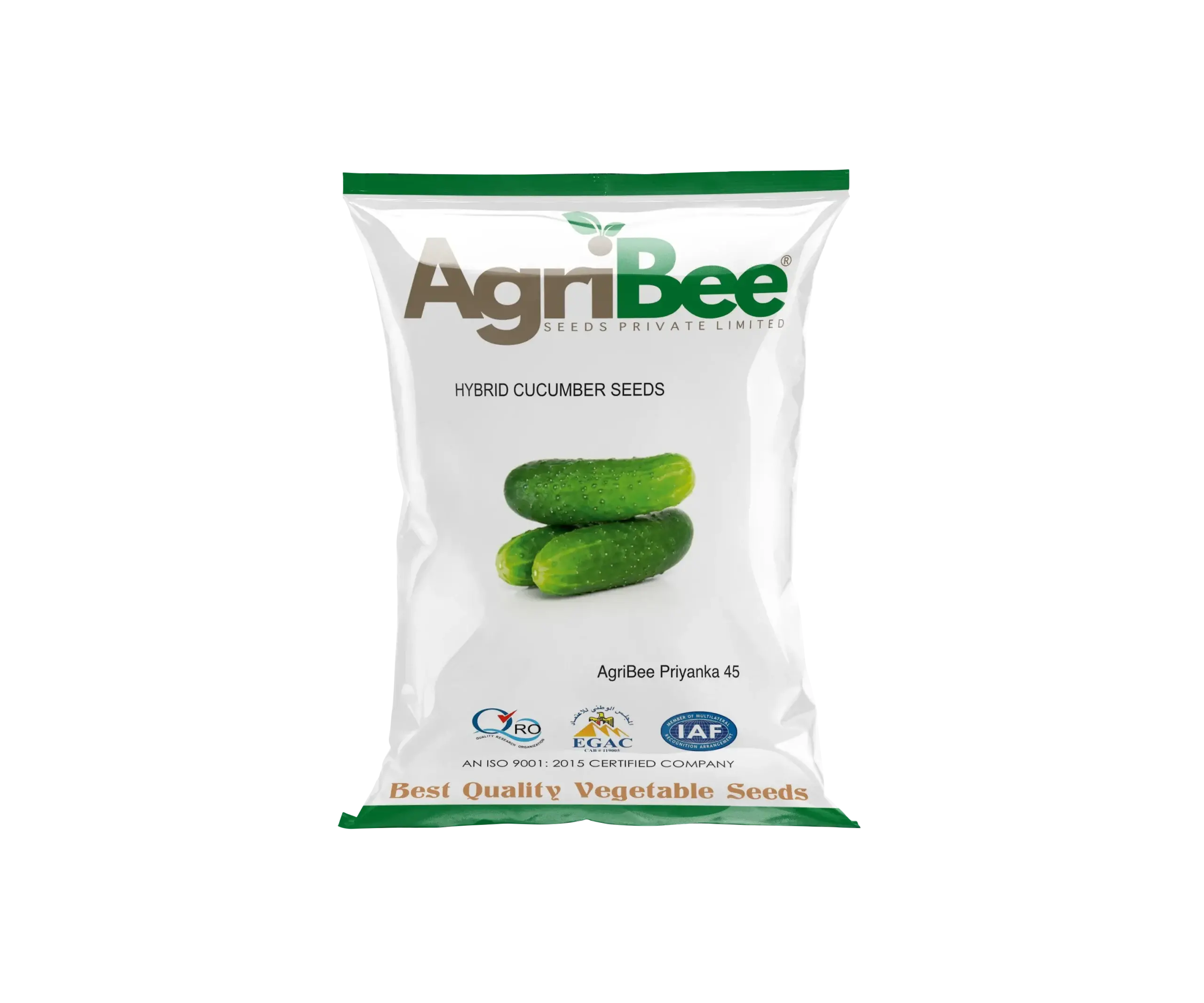
खेती एवं बुवाई निर्देशिका — Cucumber Seeds AgriBee Priyanka 45
फसल के सर्वोत्तम प्रबंधन, रोग प्रतिरोधकता और प्रीमियम उत्पादन के लिए संपूर्ण चरणबद्ध कृषि निर्देशिका।
🌾 भूमि की तैयारी एवं खेत सुधार
खेत की समुचित जुताई एवं तैयारी से एकसमान अंकुरण और मजबूत जड़ों का विकास होता है।
🌱 आदर्श मिट्टी का प्रकार एवं pH
Well-drained sandy loam to loamy soils with pH 6.0–7.5. Deep, fertile soils with good organic matter content support vigorous vine growth and uniform fruit development.
✨ प्रमुख कृषि लाभ
Loose, friable seedbed ensures rapid and uniform seed germination while providing optimal root penetration and anchorage for trailing vines.
- 1
Deep summer ploughing to 25–30 cm depth followed by 2–3 cross-harrowings for fine tilth.
- 2
Field leveling using a leveller or laser leveling equipment; prepare adequate drainage channels to prevent waterlogging.
- 3
Incorporate 8–10 tonnes per acre of well-decomposed Farm Yard Manure (FYM) or compost during the final harrowing.
- 4
Test soil pH and apply gypsum (100 kg/acre) if alkaline, or elemental sulphur (20–25 kg/acre) if acidic, two weeks before sowing.
🌱 बुवाई का समय एवं विधि
सटीक बीज दर और सही दूरी से पौधों को पर्याप्त सूर्य का प्रकाश और संतुलित विकास मिलता है।
| मानक / पैरामीटर | अनुशंसा / निर्देश | कृषि महत्व |
|---|---|---|
| बुवाई समय सीमा | Kharif: Mid-June to mid-July | Rabi: Early October to mid-November | Summer: February to early March | Cucumis sativus is a warm-season crop; sowing within these windows avoids chilling stress and ensures optimal germination temperatures of 25–30°C. |
| बीज दर (प्रति एकड़) | 800–1000 g per acre (direct seeding); 400–500 g per acre (transplanting from nursery) | Maintains optimal plant population of 10,000–12,000 plants per acre for uniform canopy and healthy fruit production. |
| कतार एवं पौधे का अंतर | 60–70 cm row-to-row × 20–25 cm plant-to-plant on raised beds | Adequate spacing promotes lateral branching, improves air circulation, reduces humidity-related disease pressure, and facilitates easy harvesting. |
| Sowing / Transplanting Depth | 2–3 cm depth for direct sowing; transplant seedlings at 2–3 true leaf stage | Optimal seeding depth ensures consistent moisture contact for imbibition and promotes uniform emergence without damping-off risk. |
💧 सिंचाई एवं जल प्रबंधन
उचित नमी प्रबंधन से पौधे की वानस्पतिक एवं फलने-फूलने की अवस्था में जोरदार विकास होता है।
☀️ जल आवश्यकता एवं सिंचाई प्रोफाइल
Cucumber is a shallow-rooted crop with moderate water demand. It performs best with consistent soil moisture at 60–70% field capacity. Drip irrigation is highly recommended, delivering 2–3 litres per plant per session every alternate day during peak summer. The crop shows moderate drought sensitivity during flowering and fruit set stages; even brief moisture stress can cause flower drop, fruit cracking, or bitter fruit formation.
🌦️ Soil नमी प्रबंधन
In rainfed or semi-arid regions, employ mulching (straw or black polythene) to conserve soil moisture and regulate soil temperature. Construct broad beds with furrow irrigation and irrigate lightly after sowing, then maintain regular light irrigation every 3–4 days during dry spells. Avoid water stagnation, which rapidly leads to root rot and Pythium blight.
- ✓
First irrigation should be applied 2–3 days after sowing to ensure seed coat softening and uniform germination. Avoid heavy flooding at this stage.
- ✓
During the vegetative phase (15–30 DAS), irrigate every 3–4 days depending on soil texture and temperature. Sandy soils require more frequent light irrigations.
- ✓
Critical irrigation window: flowering through fruit development (35–60 DAS). Maintain consistent moisture to prevent fruit deformation, bitterness, and bolting. Water stress during this stage directly affects fruit size, taste, and market quality.
- ✓
Reduce irrigation frequency 5–7 days before the first harvest to improve fruit firmness and shelf life. Do not water log the field near harvest as it increases susceptibility to fruit rot.
🧪 उर्वरक एवं पोषण प्रबंधन
संतुलित पोषण से मजबूत पौधा संरचना और उच्च गुणवत्ता वाली उपज प्राप्त होती है।
| पोषक तत्व | अनुशंसित मात्रा (प्रति एकड़) | प्रयोग विधि एवं समय |
|---|---|---|
| नाइट्रोजन (N) | 60–80 kg/acre | Basal: 40 kg N @ Urea (9 kg acre⁻¹) + remaining 20–40 kg N split into two top-dressings at 20 DAS and 35 DAS |
| फॉस्फोरस (P₂O₅) | 40 kg/acre | 100% basal application as SSP (220 kg/acre) or DAP (50 kg/acre) at last ploughing |
| पोटाश (K₂O) | 40 kg/acre | 50% basal @ Muriate of Potash (MOP, 67 kg/acre) + 50% top-dressed at first flowering for improved fruit firmness and disease resilience |
🌿 निराई-गुड़ाई एवं खरपतवार नियंत्रण
समय पर खरपतवार नियंत्रण से मुख्य फसल को पूर्ण पोषण और नमी मिलती है।
-
1
पहली निराई-गुड़ाई: Conduct light hoeing at 10–12 DAS to control early weed flush. Manual inter-row weeding at 15 DAS is recommended before vine sprawl covers the inter-row space. A weed-free period during the first 30 days is critical for competitive vine establishment.
-
2
दूसरी निराई एवं मिट्टी चढ़ाना: At 25–30 DAS, perform second weeding and lightly earthen-up around the vine base to encourage adventitious root development and provide mechanical support to growing stems, especially on loose sandy soils.
-
3
Mulching and Trellis Management: Apply organic mulch (straw or dried leaves, 3–4 cm layer) immediately after first irrigation to suppress weeds, conserve soil moisture, and maintain uniform soil temperature. For trellised crops, guide primary tendrils onto the support net weekly. Remove side shoots (suckers) below the first node to direct photosynthates toward main vine and fruit development. De-shoot laterals above the 8th node for better fruit size and canopy ventilation.
🛡️ कीट एवं रोग नियंत्रण
फसल की सक्रिय निगरानी और एकीकृत प्रबंधन से रोगमुक्त एवं स्वस्थ फसल सुनिश्चित होती है।
🐛 कीट प्रबंधन एवं रोकथाम
- Fruit Borer (Helicoverpa armigera): Larvae bore into developing fruits causing wilting and secondary rot. Identification: irregular holes on fruit surface with frass deposits. Control: Spray chlorantraniliprole 18.5% SC @ 0.3 ml/L or spinosad 45% SC @ 0.5 ml/L at 30 and 40 DAS. Release Trichogramma chilonis cards at 25,000 cards/acre at 15-day intervals as a biological measure.
- Cucumber Beetle (Aulacophora femoralis): Adult beetles create characteristic shot-hole damage on leaves; larvae attack roots and stems. Identification: shiny orange-brown beetles with black stripes on elytra. Control: Spray imidacloprid 17.8% SL @ 0.5 ml/L or thiamethoxam 25% WG @ 0.3 g/L. Install yellow sticky traps @ 10/acre for adult monitoring and mass trapping.
- ಬಿಳಿfly (Bemisia tabaci): Sucks sap causing yellowing, curling, and honeydew sooty mould. Vector for Cucumbr mosaic virus. Identification: tiny white flying insects underneath leaves. Control: Spray thiacloprid 21.7% SC @ 0.8 ml/L or acetamiprid 20% SP @ 0.5 g/L. Deploy yellow sticky traps and install silver aluminium mulch as a reflective deterrent. Ensure field sanitation and removal of alternate host weeds.
🔬 रोग नियंत्रण एवं उपचार
- Downy Mildew (Pseudoperonospora cubensis): Irregular yellow angular lesions on upper leaf surface bounded by veins; greyish-purple sporulation on lower surface under humid conditions. Preventive spray: mancozeb 75% WP @ 2 g/L or dimethomorph 50% WP @ 1 g/L at 7–10 day intervals starting at 25 DAS. Avoid overhead irrigation and ensure proper spacing for foliage drying.
- Powdery Mildew (Erysiphe cichoracearum): ಬಿಳಿ powdery fungal growth on both leaf surfaces; progresses to chlorosis and necrosis under dry, humid conditions. Preventive spray: sulfur dusting @ 15–20 kg/acre or propiconazole 25% EC @ 0.5 ml/L. Remove and destroy severely infected lower leaves. Apply potassium bicarbonate-based foliar spray for early onset management.
- Bacterial Wilt (Ralstonia solanacearum): Sudden wilting of vines despite adequate soil moisture; brown vascular disclosure observed in stem cross-section. Seed treatment with streptomyces-based biocontrol agent (Pseudomonas fluorescens) @ 10 g/kg seed. Soil drench with (cupric hydroxide) @ 2 g/L or carbendazim @ 1 g/L at planting. Ensure well-drained soil and 3–4 year crop rotation away from Solanaceae hosts.
✂️ कटाई एवं उपज गुणवत्ता निर्देशिका
सही परिपक्वता पर कटाई से अधिकतम मंडी भाव और बेहतर भंडारण क्षमता मिलती है।
⏱️ कटाई समय एवं निर्धारण
First picking commences at 45–50 days after sowing when fruits attain marketable size. Subsequent pickings are taken at intervals of 2–3 days during peak production. Frequent harvesting at young stage stimulates continued flowering and fruit set.
⭐ उपज की गुणवत्ता एवं विशेषताएं
Uniform cylindrical fruits with light to medium green peel, smooth skin texture, firm flesh, mild sweet taste, minimal bitterness, and good crunch. The variety exhibits consistent fruit caliber (18–22 cm length) with uniform thickness from shoulder to tip.
| गुणवत्ता मानक | कृषि मानक | किसान एवं मंडी लाभ |
|---|---|---|
| पहली कटाई / तुड़ाई Stage | 45–50 बुवाई के दिन बाद — initial picking at commercial maturity | Early market arrival commands premium rates and enables quick crop turnover for successive planting cycles. |
| परिपक्वता के लक्षण | Fruits reach 18–22 cm length, light-medium green uniform color, firm to touch, skin smooth without seed hardening | Ensures tender, fibrous-free produce with superior sensory qualities and consumer acceptance. |
| भंडारण क्षमता एवं टिकाऊपन | 5–7 days under ambient conditions (25–30°C); up to 10–12 days at 8–10°C with high relative humidity | Good post-harvest durability supports transport to distant mandis and retail markets with minimal quality deterioration. |
| मंडी मांग एवं उपयुक्तता | Table fresh consumption — urban wholesale markets, modern retail chains, food service sector, and processing units | Attractive uniform appearance and consistent calibre attract premium buyer preference and steady demand across all marketing channels. |
⭐ किस्म की विशेषताएं — Cucumber Seeds AgriBee Priyanka 45
विशिष्ट विशेषताएं जो इस किस्म को भारतीय किसानों की पहली पसंद बनाती हैं।
🌿 किस्म की मुख्य विशेषताएं
AgriBee Priyanka 45 is an early-maturing hybrid cucumber bred specifically for Indian growers, offering exceptional uniformity, vigorous vine growth, and reliable performance across multiple agro-climatic zones from Gujarat to South India.
🌿 उपज की गुणवत्ता एवं रूप-रंग
Produces consistently cylindrical, uniformly sized fruits (18–22 cm) with an appealing light to medium green color. The fruit possesses firm flesh, minimal seed cavity, crisp texture, and excellent table quality that meets modern market standards.
🌿 तनाव एवं रोग प्रतिरोधक क्षमता
Demonstrates strong field tolerance against major cucumber diseases including Downy Mildew, Powdery Mildew, and Bacterial Wilt. Exhibits resilience under moderate heat stress and occasional moisture fluctuation, making it suitable for diverse Indian growing conditions.
🌿 वृद्धि स्वभाव एवं ओज (विगर)
Vigorous indeterminate vine with strong lateral branching and robust primary tendril development. The plant architecture supports efficient trellising, promotes upward fruit hang, and ensures easy access for monitoring and harvesting operations.
🌿 फसल अवधि एवं पकने का समय
Remarkably early with first harvest at just 45–50 days after sowing. The abbreviated crop duration allows farmers to fit this variety into tight rotation schedules and capitalize on off-season price premiums in local markets.
🌿 मंडी एवं किसान प्राथमिकता
Preferred by progressive farmers, commission agents, and traders alike for its visual appeal, consistent fruit caliber, good shelf life, and early market readiness. The 50 g packaging format offers convenient handling and economical sizing for small and marginal growers across India.