
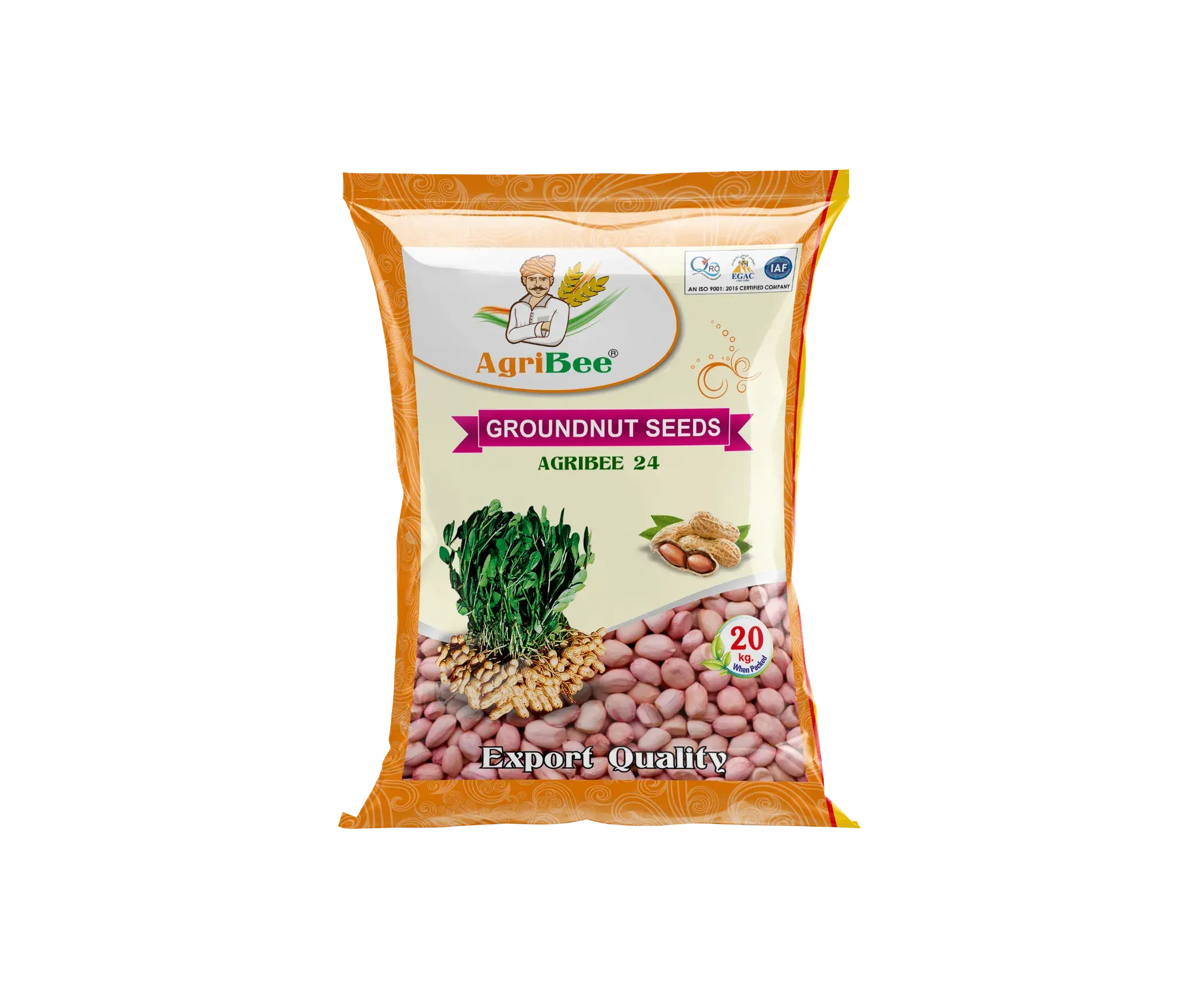
Description
खेती एवं बुवाई निर्देशिका — Groundnut AgriBee 24
फसल के सर्वोत्तम प्रबंधन, रोग प्रतिरोधकता और प्रीमियम उत्पादन के लिए संपूर्ण चरणबद्ध कृषि निर्देशिका।
🌾 भूमि की तैयारी एवं खेत सुधार
खेत की समुचित जुताई एवं तैयारी से एकसमान अंकुरण और मजबूत जड़ों का विकास होता है।
🌱 आदर्श मिट्टी का प्रकार एवं pH
Well-drained sandy loam to loam soils with good permeability; pH range 6.0 – 7.5 for optimal nodulation and peg penetration.
✨ प्रमुख कृषि लाभ
Loose, friable soil texture promotes uninterrupted pod development and easy digging at maturity, while ensuring rapid seed germination and robust taproot establishment.
- 1
Deep summer ploughing followed by 2–3 cross-harrowings to achieve fine tilth and break hardpan for peg penetration.
- 2
Field leveling and drainage preparation to prevent waterlogging, which is highly detrimental to groundnut pod development.
- 3
Incorporation of well-decomposed FYM or compost at 5–8 tonnes/ha during last harrowing for improved soil structure and moisture retention.
- 4
Soil health conditioning with gypsum application (sulphur and calcium source) especially in deficient soils to enhance pod filling and oil synthesis.
🌱 बुवाई का समय एवं विधि
सटीक बीज दर और सही दूरी से पौधों को पर्याप्त सूर्य का प्रकाश और संतुलित विकास मिलता है।
| मानक / पैरामीटर | अनुशंसा / निर्देश | कृषि महत्व |
|---|---|---|
| बुवाई समय सीमा | June – July for Kharif / October – November for Rabi (penetrating monsoon rains or post-rain irrigation) | Adequate soil moisture at sowing ensures uniform emergence; late kharif sowing risks drought stress during pod filling |
| बीज दर (प्रति एकड़) | 100 kg/ha (approximately 40–45 kg/acre) | Ensures optimal plant population for maximum canopy coverage and competitive weed suppression |
| कतार एवं पौधे का अंतर | 60 cm between rows × 15 cm between plants in row | Provides adequate inter-row aeration, sunlight penetration, and peg emergence space for healthy pod set |
| बुवाई की गहराई | 5–7 cm in lighter soils; 4–5 cm in heavier clay soils | Proper depth ensures adequate moisture contact for germination while allowing cotyledonary emergence without energy exhaustion |
💧 सिंचाई एवं जल प्रबंधन
उचित नमी प्रबंधन से पौधे की वानस्पतिक एवं फलने-फूलने की अवस्था में जोरदार विकास होता है।
☀️ जल आवश्यकता एवं सिंचाई प्रोफाइल
Groundnut AgriBee 24 exhibits moderate drought tolerance owing to its deep taproot system. The crop requires approximately 450–550 mm total water during its lifecycle. Drip irrigation with 2–3 shallow irrigations per week is highly compatible and improves water use efficiency by 30–40% over flood irrigation. The crop is sensitive to both water deficit and waterlogging; balanced soil moisture is critical.
🌦️ Soil नमी प्रबंधन
Under rainfed conditions, ensure good soil moisture conservation through mulching with paddy straw (200–250 kg/ha) immediately after sowing. Avoid moisture stress during the critical flowering and pod-filling stages (25–65 DAS). If dry spells exceed 7–10 days during flowering, provide a light protective irrigation to sustain peg insertion and pod development.
- ✓
First Irrigation: Apply 2–3 days after sowing if soil moisture is inadequate, ensuring seed swelling and radicle emergence.
- ✓
Vegetative Phase: Light irrigation at 15–20 day intervals during active branching and leaf production, avoiding water stagnation.
- ✓
Critical Growth Stage: Mandatory irrigation at 30–40 DAS coinciding with peak flowering and peg insertion, and again at 60–70 DAS during pod filling for optimal kernel development.
- ✓
Pre-Harvest Water Withholding: Stop irrigation 10–15 days before harvest to allow pod maturation, reduce moisture content, and prevent soil-borne fungal proliferation in pods.
🧪 उर्वरक एवं पोषण प्रबंधन
संतुलित पोषण से मजबूत पौधा संरचना और उच्च गुणवत्ता वाली उपज प्राप्त होती है।
| पोषक तत्व | अनुशंसित मात्रा (प्रति एकड़) | प्रयोग विधि एवं समय |
|---|---|---|
| नाइट्रोजन (N) | 20–25 kg/acre (25–30 kg N/ha) | 50% basal at sowing + 50% top-dressing at first weeding (15–20 DAS); balance supports foliage vigor and nodular nitrogen fixation |
| Phosphorus (P2O5) | 40–50 kg/acre (50–60 kg P2O5/ha) | 100% basal application as DAP or SSP incorporated during last harrowing for root development and energy transfer |
| Potash (K2O) | 20–25 kg/acre (25–30 kg K2O/ha) | 100% basal with MOP; split if soils are leaching-prone; essential for oil synthesis and overall plant metabolism |
🌿 निराई-गुड़ाई एवं खरपतवार नियंत्रण
समय पर खरपतवार नियंत्रण से मुख्य फसल को पूर्ण पोषण और नमी मिलती है।
-
1
पहली निराई-गुड़ाई: Carried out at 10–15 DAS using a conformable hoe or rotavator. Early weed control is vital as groundnut is a poor weed competitor during initial growth. Shallow cultivation avoids damaging the taproot and surface feeder roots.
-
2
दूसरी निराई एवं मिट्टी चढ़ाना: Performed at 30–35 DAS to bury emerging pegs and prevent exposure. Earthing up supports underground pod development, improves aeration around the root zone, and suppresses late-germinating weeds before they compete with the crop.
-
3
Special Interculture Operation — Mulching: Straw mulching at 20–25 DAS conserves soil moisture, moderates soil temperature, prevents crusting, and reduces weed pressure. In drip-irrigated fields, black polyethylene mulch further enhances soil warmth and early vegetative growth.
🛡️ कीट एवं रोग नियंत्रण
फसल की सक्रिय निगरानी और एकीकृत प्रबंधन से रोगमुक्त एवं स्वस्थ फसल सुनिश्चित होती है।
🐛 कीट प्रबंधन एवं रोकथाम
- Pod Borer (Helicoverpa armigera): Larvae bore into developing pods and feed on kernels. Symptoms include frass-filled entry holes and hollowed-out seeds. Control: Spray Chlorantraniliprole 18.5% SC at 0.3 ml/liter or Emamectin benzoate 5% SG at 0.4 g/liter at 45 and 60 DAS. Use pheromone traps at 10/acre for monitoring.
- Termites (Obliquetermes terminoides): Cause wilting and drying of seedlings by cutting stems underground. Infested plants pull out easily. Control: Apply Cartap hydrochloride 4% granules at 12–15 kg/acre in furrows near the seed row at sowing, or chlorpyrifos 20% EC at 12–15 liters/acre as soil drench.
- ಬಿಳಿfly (Bemisia tabaci): Sucks sap causing yellowing, curling, and stunting; also vectors Leaf Curl Virus. Honeydew promotes sooty mold. Control: Spray Imidacloprid 17.8% SL at 0.3 ml/liter or Thiamethoxam 25% WG at 0.2 g/liter. Yellow sticky traps at 10/acre help monitor and reduce populations.
🔬 रोग नियंत्रण एवं उपचार
- Early Leaf Spot (Cercospora personata): Small circular brown spots with yellow halos on lower leaves, progressing to defoliation. Causal fungus spreads via rain splash. Control: Spray Mancozeb 75% WP at 2.5 g/liter or Tebuconazole 35% WS at 0.8 ml/liter at 30 and 50 DAS preventively.
- Late Leaf Spot (Phaeoisariopsis personina): Larger dark brown to black necrotic lesions on upper and lower leaf surfaces, causing premature leaf drop. Control: Apply Propiconazole 25% EC at 0.5 ml/liter or Hexaconazole 5% WS at 1.0 g/liter at 35 and 55 DAS; ensure good canopy airflow through proper spacing.
- Foot Rot / Wilt (Macrophomina phaseolina): Wilting of whole plants with brown discoloration at the stem base; internal vascular browning. Control: Seed treatment with Trichoderma viride at 4 g/kg seed; apply Pseudomonas fluorescens at 10 kg/acre in soil; avoid waterlogging and ensure well-drained seedbeds.
✂️ कटाई एवं उपज गुणवत्ता निर्देशिका
सही परिपक्वता पर कटाई से अधिकतम मंडी भाव और बेहतर भंडारण क्षमता मिलती है।
⏱️ कटाई समय एवं निर्धारण
Whole crop is harvested by digging/pulling at 105–110 DAS. Plants are uprooted manually or mechanically, cured in shade for 2–3 days, and pods are separated.
⭐ उपज की गुणवत्ता एवं विशेषताएं
Rosy-colored kernels with high oil content (48.2%), rich aroma, and attractive shelling percentage. Pod morphology is uniform with good kernel fill, making it suitable for both table-grade and oil extraction markets.
| गुणवत्ता मानक | कृषि मानक | किसान एवं मंडी लाभ |
|---|---|---|
| कटाई की अवस्था | 105 – 110 बुवाई के दिन बाद | Ensures full kernel maturation and optimal oil accumulation for premium quality |
| परिपक्वता के लक्षण | Leaves turn yellow and begin drying; pods show netted vein pattern that turns dark; kernels fill the shell cavity completely with rosy testaa | Prevents under-maturity losses and over-maturity-related aflatoxin risk |
| भंडारण क्षमता एवं टिकाऊपन | 3–4 months under ambient storage; 6+ months under cool, dry conditions with moisture content maintained below 7% | Facilitates extended market window and reduces post-harvest losses |
| मंडी मांग एवं उपयुक्तता | Suitable for direct table consumption, oil extraction (48.2% oil), and processing sectors; preferred by mandis and exporters | Attracts premium procurement rates due to consistent quality and high oil content |
⭐ किस्म की विशेषताएं — Groundnut AgriBee 24
विशिष्ट विशेषताएं जो इस किस्म को भारतीय किसानों की पहली पसंद बनाती हैं।
🌿 किस्म की मुख्य विशेषताएं
AgriBee 24 is a high-performing groundnut variety developed for Indian agro-climatic conditions, combining earliness, balanced oil synthesis, and strong field vigor for reliable cropping systems.
🌿 उपज की गुणवत्ता एवं रूप-रंग
Rosy-colored kernels with exceptional oil content of 48.2%, uniform pod size, excellent shelling out-turn, and appealing appearance that meets both domestic and export grade standards.
🌿 तनाव एवं रोग प्रतिरोधक क्षमता
Demonstrates good field tolerance to common foliar diseases including early and late leaf spot, moderate drought resilience during pod-filling, and adaptive performance across diverse soil conditions.
🌿 वृद्धि स्वभाव एवं ओज (विगर)
Compact plant architecture with a determinate growth habit reaching 35–40 cm height; vigorous branching pattern ensures efficient canopy coverage, light interception, and effective weed suppression.
🌿 फसल अवधि एवं पकने का समय
Reaches 50% flowering within 38–40 days and matures in 105–110 days, enabling timely land preparation for succeeding crops and flexible rotation planning in intensive farming systems.
🌿 मंडी एवं किसान प्राथमिकता
Farmers favor AgriBee 24 for its uniform maturity, high oil content, attractive kernel color, strong germination rate, and consistent performance across Kharif and Rabi seasons, ensuring better returns through quality premiums.