

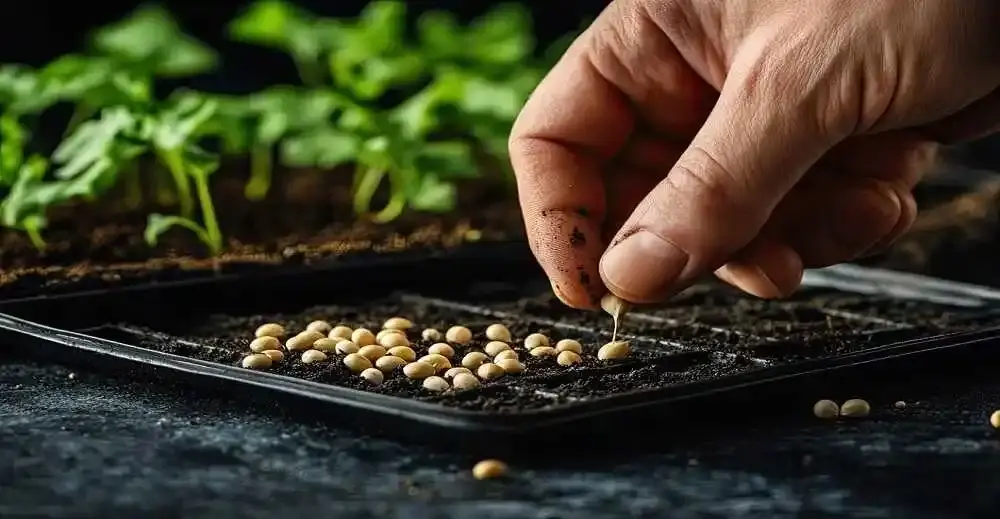
When selecting seeds for commercial farming or serious gardening, one fundamental question determines crop yield, harvest uniformity, and financial return: Should you choose F1 Hybrid seeds or Open-Pollinated Varieties (OPVs)? While both seed types serve distinct roles in agriculture, understanding their biological breeding mechanisms, yield mathematics, disease resistance, and seed-saving dynamics allows growers to make an evidence-based decision.
Summary Answer for Farmers & Gardeners:
Choose F1 Hybrid Seeds if your objective is commercial profitability, predictable uniform harvest, high yield (50%–150% higher than OPVs), and multi-gene resistance against catastrophic viral and bacterial blights.
Choose Open-Pollinated Seeds if your goal is low-cost subsistence farming, heritage seed-saving for future generations, or non-commercial backyard gardening where cosmetic uniformity and bulk transport durability are secondary.
1. What are Open-Pollinated (OPV) Seeds & Heirlooms?
Open-pollinated varieties are plants fertilized naturally by wind, rain, bees, butterflies, or other beneficial pollinators. When pollen transfers between plants of the exact same variety, the offspring remain genetically consistent, or "true-to-type."
- Heirloom Seeds: A sub-category of open-pollinated seeds that have been preserved, selected, and passed down through farming families or indigenous communities for 50 to 100+ years.
- Key Advantage: Farmers can harvest mature seed from their current crop, dry and store it, and replant it next season with predictable varietal traits, eliminating annual seed purchase expenses.
- Key Limitation: Lower overall harvest yield, susceptibility to modern evolving plant pathogens, and staggered, uneven ripening that increases manual labor costs.
2. What are F1 Hybrid (Filial 1) Seeds & How Heterosis Works?
An F1 Hybrid (First Filial Generation) is produced by intentionally cross-pollinating two distinct, highly inbred parent lines (purelines) that possess complementary desirable traits. For instance, Parent Line A may have extreme heat tolerance and deep root vigor, while Parent Line B possesses thick fruit walls and genetic resistance to Tomato Yellow Leaf Curl Virus (TYLCV).
When these two parent lines are manually crossed under controlled greenhouse conditions, the resulting F1 offspring exhibit a biological phenomenon known as Heterosis (Hybrid Vigor):
- Hybrid Vigor: The offspring perform substantially better than the mathematical average of both parents in growth rate, biomass accumulation, root absorption efficiency, and marketable fruit count.
- Uniformity: Every single plant in an F1 seed packet shares an identical genetic blueprint, resulting in simultaneous flowering, uniform fruit dimensions, and concentrated harvest flushes.
3. Comprehensive Comparison: Hybrid vs Open-Pollinated Seeds
| Agronomic Parameter | F1 Hybrid Seeds (e.g., AgriBee Research) | Open-Pollinated Seeds (OPV / Desi) |
|---|---|---|
| Marketable Yield | Very High (50% to 150% higher marketable yield) | Moderate to Low |
| Crop Uniformity | 98%+ identical fruit size, shape, color, and maturity | Variable fruit sizes and staggered ripening |
| Disease & Pest Resistance | Engineered multi-gene resistance (TYLCV, Wilt, Blight, YVMV) | Variable; vulnerable to virulent modern pathotypes |
| Seed Saving Ability | Cannot save seed (F2 segregates into wild variations) | Excellent (produces true-to-type seed indefinitely) |
| Initial Seed Cost | Higher due to specialized manual crossing labor | Inexpensive or free from previous harvest |
| Transport & Shelf Life | Thick pericarp, slow softening, excellent long-haul transit | Softer skins, prone to bruising during long transport |
4. Why You Cannot Save Seeds from F1 Hybrids (Mendelian Genetics)
A frequent question asked by farmers is: "Can I save the seeds from my hybrid tomatoes or maize and sow them next year?"
The scientific answer is No. Due to Gregor Mendel's Law of Segregation, the second generation (F2) produced from F1 plants breaks apart into random genetic recombinations. If you plant seeds saved from an F1 hybrid crop, you will observe:
- Extreme variation in plant height, fruit shape, and fruit size.
- Loss of disease resistance genes, making the crop vulnerable to catastrophic blight attacks.
- A 30% to 50% drop in overall yield compared to certified F1 seeds.
5. Are Hybrid Seeds GMO? (Debunking the Confusion)
No. Hybrid seeds are 100% Non-GMO (Genetically Modified Organism). There is widespread confusion between hybridization and genetic engineering:
- Hybridization: A natural botanical process that occurs in nature. Plant breeders perform traditional cross-pollination using tweezers and camel-hair brushes between compatible varieties of the same species. No foreign DNA, gene splicing, or laboratory transgenics are involved.
- GMOs: Involve recombinant DNA technology inserting genetic material from unrelated organisms (e.g., bacteria or viruses) into plant genomes in a specialized biotechnology laboratory.
- AgriBee Quality Standard: All AgriBee Seeds hybrid vegetable and field seeds are certified Non-GMO and bred through classic selective hybrid agronomy.
6. Economic Decision Framework: Which Should You Buy?
While hybrid seed accounts for approximately 4% to 7% of total cultivation expenditure per acre, it governs 100% of the harvest potential:
- Commercial Cash-Crop Farmers (1 to 50+ Acres): F1 hybrids are indispensable. The extra investment in hybrid seed (e.g., ₹2,000–₹5,000 per acre) yields an additional ₹40,000 to ₹1,50,000 in gross revenue through higher tonnage, Grade-1 wholesale market pricing, and reduced fungicide/pesticide sprays.
- Organic Hobbyists & Heritage Seed Savers: Open-pollinated varieties are preferred if your priority is preserving heirloom biodiversity, saving seed off-grid, and cultivating unique heritage flavors regardless of total yield.
Source High-Yield Research Seeds Directly
Order 100% genuine, sortex-cleaned hybrid seeds directly from AgriBee Seeds Pvt. Ltd. with guaranteed 90%+ germination.