
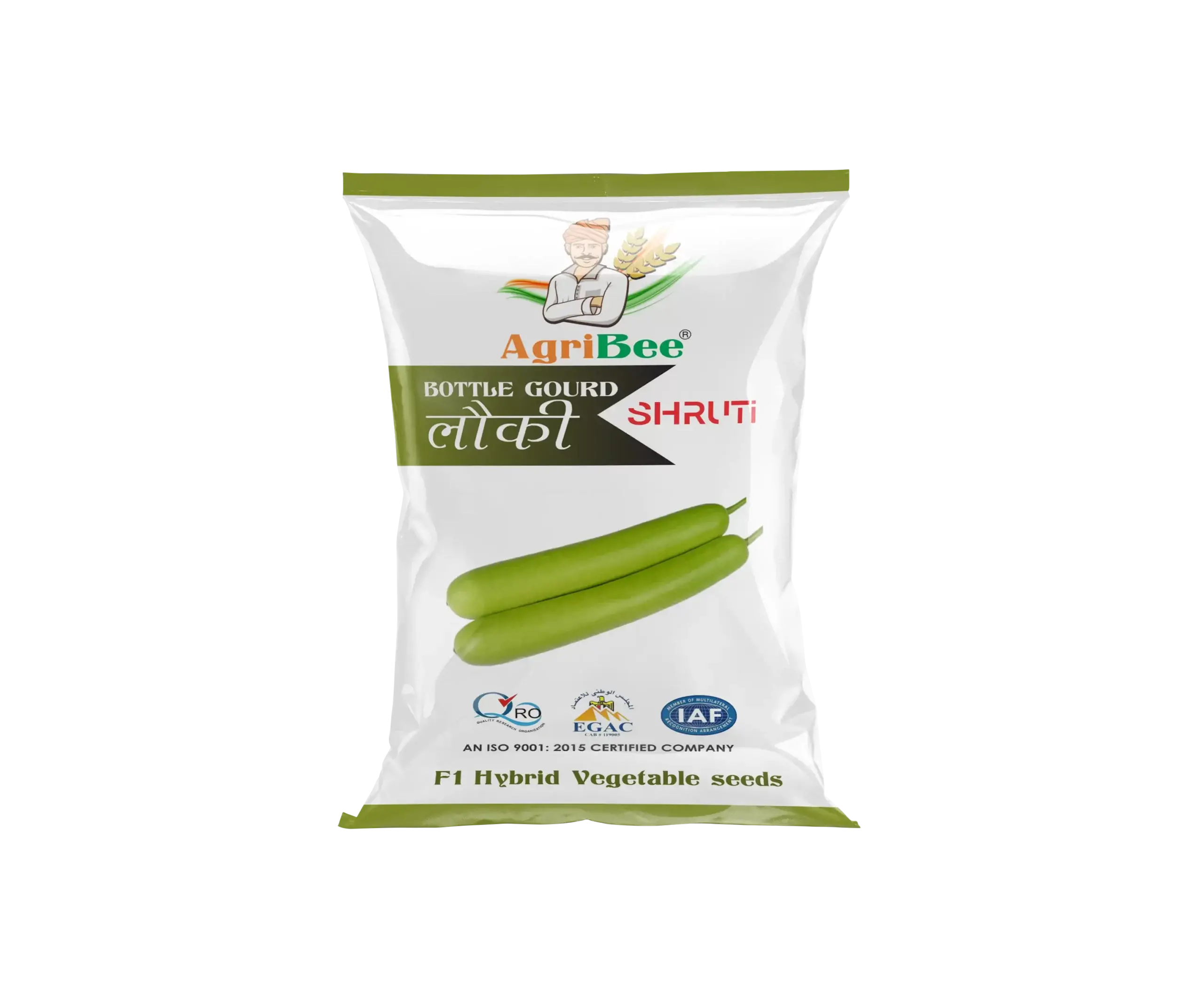
Description
खेती एवं बुवाई निर्देशिका — BottleGourd Seeds – Shruti
फसल के सर्वोत्तम प्रबंधन, रोग प्रतिरोधकता और प्रीमियम उत्पादन के लिए संपूर्ण चरणबद्ध कृषि निर्देशिका।
🌾 भूमि की तैयारी एवं खेत सुधार
खेत की समुचित जुताई एवं तैयारी से एकसमान अंकुरण और मजबूत जड़ों का विकास होता है।
🌱 आदर्श मिट्टी का प्रकार एवं pH
Well-drained sandy loam to loamy soils with good organic matter content. Ideal pH range: 6.0 – 7.5. Heavy clay or waterlogged soils should be avoided as they predispose roots to fungal infections and reduce vine vigor.
✨ प्रमुख कृषि लाभ
Loose, well-aerated seedbed ensures rapid and uniform germination while promoting deep taproot penetration for strong anchorage of vigorous climbing vines.
- 1
Deep summer ploughing followed by 2–3 cross-harrowings to achieve fine tilth and destroy weed seeds.
- 2
Field leveling and drainage channel preparation to prevent water stagnation during heavy rainfall periods.
- 3
Incorporate 15–20 tonnes/ha of well-decomposed FYM or compost during final harrowing for soil structure improvement.
- 4
Conduct a soil health test; if pH is below 6.0, apply agricultural lime at 250–300 kg/ha one month before sowing to neutralize acidity.
🌱 बुवाई का समय एवं विधि
सटीक बीज दर और सही दूरी से पौधों को पर्याप्त सूर्य का प्रकाश और संतुलित विकास मिलता है।
| मानक / पैरामीटर | अनुशंसा / निर्देश | कृषि महत्व |
|---|---|---|
| बुवाई समय सीमा | June–July (Kharif), October–November (Rabi), February–March (Summer) | Bottle gourd is a warm-season crop; sowing during these windows ensures optimal temperature (25–35°C) for germination, vine growth, and fruit development. |
| बीज दर (प्रति एकड़) | 0.8–1.0 kg per acre (2.0 kg/ha) for direct sowing; 400–500 g per acre for transplanting | Maintains optimal plant population without excessive competition for nutrients, light, and moisture. |
| कतार एवं पौधे का अंतर | Row-to-row: 2.0–2.5 m; Plant-to-plant: 0.8–1.0 m (Trellis system); Row-to-row: 1.5 m x 1.0 m (Ground system) | Adequate spacing ensures proper canopy spread, sunlight penetration, air circulation, and ease of harvesting on trellis supports. |
| Sowing / Transplanting Depth | 2.5–3.5 cm depth for direct sowing; transplant seedlings at 2–3 true leaf stage | Shallow sowing ensures quick emergence as bottle gourd seeds are large and require adequate oxygen for germination; deeper sowing delays emergence and increases damping-off risk. |
💧 सिंचाई एवं जल प्रबंधन
उचित नमी प्रबंधन से पौधे की वानस्पतिक एवं फलने-फूलने की अवस्था में जोरदार विकास होता है।
☀️ जल आवश्यकता एवं सिंचाई प्रोफाइल
Bottle gourd requires consistent soil moisture throughout its lifecycle but is moderately sensitive to drought stress, especially during flowering and fruit set. The crop performs best with 5–7 gentle irrigations depending on soil type and weather. Drip irrigation with fertigation is highly compatible and recommended for water efficiency and reduced foliar disease pressure.
🌦️ Soil नमी प्रबंधन
Under rainfed conditions, ensure thorough pre-sowing irrigation to establish the crop. Use mulching (straw or plastic) to conserve soil moisture and regulate soil temperature. Avoid waterlogging at any stage — raised beds or ridges are strongly advised in heavy rainfall zones.
- ✓
First irrigation should be applied immediately after sowing (if pre-sowing irrigation was not done) and repeated within 48 hours to ensure uniform germination.
- ✓
During the vegetative phase (20–40 DAS), irrigate at 5–7 day intervals in sandy soils and 7–10 day intervals in loamy soils to support vigorous vine growth.
- ✓
Critical irrigation is essential during flowering and fruit setting stages (40–60 DAS); moisture stress at this stage causes flower drop and poor fruit set. Maintain consistent soil moisture until fruit maturation.
- ✓
Reduce irrigation frequency 5–7 days before the final harvest to improve fruit firmness and shelf life. Do not overwater immediately before harvest as it dilutes fruit quality and promotes cracking.
🧪 उर्वरक एवं पोषण प्रबंधन
संतुलित पोषण से मजबूत पौधा संरचना और उच्च गुणवत्ता वाली उपज प्राप्त होती है।
| पोषक तत्व | अनुशंसित मात्रा (प्रति एकड़) | प्रयोग विधि एवं समय |
|---|---|---|
| नाइट्रोजन (N) | 80–100 kg/acre (as Urea 46%: ~175–220 kg/acre) | 50% basal at sowing; 25% top-dressed at 25–30 DAS; 25% at first flowering (40 DAS) |
| Phosphorus (P2O5) | 40–50 kg/acre (as DAP 18-46-0: ~90–110 kg/acre) | 100% basal application mixed thoroughly with soil at last harrowing |
| Potash (K2O) | 40–50 kg/acre (as MOP 60%: ~70–85 kg/acre) | 50% basal at sowing; 50% top-dressed at 40 DAS alongside second nitrogen split for improved fruit quality and disease tolerance |
🌿 निराई-गुड़ाई एवं खरपतवार नियंत्रण
समय पर खरपतवार नियंत्रण से मुख्य फसल को पूर्ण पोषण और नमी मिलती है।
-
1
पहली निराई-गुड़ाई: Carry out light hoeing and weeding at 15–20 DAS before vine coverage. This is critical as bottle gourd seedlings are weak competitors against weeds during the early growth phase.
-
2
दूसरी निराई एवं मिट्टी चढ़ाना: Perform second weeding at 30–35 DAS combined with light earthing-up around the base of plants to encourage adventitious root formation and improve stem stability, especially for ground-growing systems.
-
3
Vine Training & Mulching: Train vines on trellis nets or strings from 25 DAS onward. Remove lateral shoots and tendrils that interfere with main vine growth. Apply organic mulch (paddy straw, 3–4 kg/m²) between rows to conserve moisture, suppress weeds, and maintain root zone temperature.
🛡️ कीट एवं रोग नियंत्रण
फसल की सक्रिय निगरानी और एकीकृत प्रबंधन से रोगमुक्त एवं स्वस्थ फसल सुनिश्चित होती है।
🐛 कीट प्रबंधन एवं रोकथाम
- Aphids (Aphis gossypii): Cluster of small green/black insects on undersides of leaves causing curling and honeydew sooty mold. Spray Imidacloprid 17.8% SL at 0.3 ml/L or Thiamethoxam 25% WG at 0.2 g/L. Also effective: release of ladybird beetles (Cryptolaemus montrouzieri) at 50,000/acre as biological control.
- Fruit Borer (Helicoverpa armigera): Larvae bore into fruits causing holes, frass expulsion, and premature fruit rot. Spray Chlorantraniliprole 18.5% SC at 0.3 ml/L or Spinosad 45% SC at 0.4 ml/L at 7-day intervals. Install pheromone traps at 10/acre for monitoring and mass trapping.
- வெள்ளைfly (Bemisia tabaci): Yellowing, wilting, and curling of leaves with silvering on upper surface; vector for yellow mosaic virus. Spray Actara (Thiamethoxam) 25% WG at 0.2 g/L or Confidor (Imidacloprid) 17.8% SL at 0.3 ml/L. Use yellow sticky traps at 10/acre for monitoring and adult suppression.
🔬 रोग नियंत्रण एवं उपचार
- Powdery Mildew (Podosphaera xanthii): வெள்ளை powdery fungal growth on leaves and stems reducing photosynthesis. Preventive spray of Sulphur (wettable) at 2.5 g/L or Myclobutanil at 0.1 g/L at 30 and 45 DAS. Remove and burn severely infected leaves. Crop rotation with non-cucurbits reduces inoculum load.
- Downy Mildew (Pseudoperonospora cubensis): Angular yellow lesions on upper leaf surface with purple-gray sporulation beneath in humid conditions. Spray Metalaxyl + Mancozeb (64%) at 2.0 g/L or Copper oxychloride at 3.0 g/L at 25 and 40 DAS. Avoid overhead irrigation to reduce leaf wetness duration.
- Fruit Rot / Anthracnose (Colletotrichum orbiculare): Water-soaked spots on fruits turning brown and sunken with acervuli in wet weather. Spray Mancozeb at 2.0 g/L or Carbendazim at 1.0 g/L preventively. Ensure proper trellising for air circulation and avoid fruit contact with soil. Resistant varieties like Shruti offer good field tolerance.
✂️ कटाई एवं उपज गुणवत्ता निर्देशिका
सही परिपक्वता पर कटाई से अधिकतम मंडी भाव और बेहतर भंडारण क्षमता मिलती है।
⏱️ कटाई समय एवं निर्धारण
First picking begins at 50–60 days after sowing. Subsequent pickings are made at 5–7 day intervals, continuing for 4–6 weeks. Harvest fruits when they reach commercial size (30–45 cm length, 1000–1250 g weight) with smooth, firm skin.
⭐ उपज की गुणवत्ता एवं विशेषताएं
Cylindrical, uniformly light green fruits with smooth, tender skin and compact flesh. The Shruti variety delivers consistent fruit appearance, good flavor, and minimal hollowing — highly valued in fresh market channels.
| गुणवत्ता मानक | कृषि मानक | किसान एवं मंडी लाभ |
|---|---|---|
| पहली कटाई / तुड़ाई Stage | 50–60 बुवाई के दिन बाद | Enables early market entry, fetching premium prices during initial supply phases |
| परिपक्वता के लक्षण | Light green color, cylindrical shape, firm but tender skin, fruit length 30–45 cm | Prevents over-maturity which leads to hard rind, seedy interior, and market rejection |
| भंडारण क्षमता एवं टिकाऊपन | 5–7 days under ambient conditions; 10–12 days under refrigerated storage (8–10°C, 85–90% RH) | Good post-harvest longevity supports transport to distant markets and reduces post-harvest losses |
| मंडी मांग एवं उपयुक्तता | Fresh market, mandis, retail chains, and hotel/restaurant supply across India | Uniform fruit size, attractive light green color, and consistent quality make Shruti a preferred choice for traders and processors seeking grade-A produce |
⭐ किस्म की विशेषताएं — BottleGourd Seeds – Shruti
विशिष्ट विशेषताएं जो इस किस्म को भारतीय किसानों की पहली पसंद बनाती हैं।
🌿 किस्म की मुख्य विशेषताएं
Shruti is an early-maturing, high-vigor bottle gourd variety developed by AgriBee Seeds, engineered for uniform fruiting and robust field performance under diverse Indian agro-climatic conditions.
🌿 उपज की गुणवत्ता एवं रूप-रंग
Produces cylindrical, light green fruits weighing 1000–1250 g with smooth skin, compact flesh, and excellent culinary texture — ideal for domestic cooking, catering, and fresh produce retail.
🌿 तनाव एवं रोग प्रतिरोधक क्षमता
Demonstrates good tolerance to major cucurbit diseases including powdery mildew, downy mildew, and fruit rot, reducing dependency on repeated chemical interventions and ensuring healthier vines throughout the cropping cycle.
🌿 वृद्धि स्वभाव एवं ओज (विगर)
Vigorous vine growth with strong branching and excellent trellis adaptation. Plants exhibit sustained flowering and fruiting habits, minimizing bare intervals and ensuring continuous production over multiple pickings.
🌿 फसल अवधि एवं पकने का समय
First picking at 50–60 days and full maturity by 65–70 days — one of the earliest commercial varieties available, enabling faster crop turnover and flexible scheduling in rotation systems.
🌿 मंडी एवं किसान प्राथमिकता
Farmers and agri-dealers favor Shruti for its reliability, uniform fruit caliber, disease resilience, and consistent performance across Kharif, Rabi, and summer seasons — making it a dependable choice for contract farming and open market sales alike.