
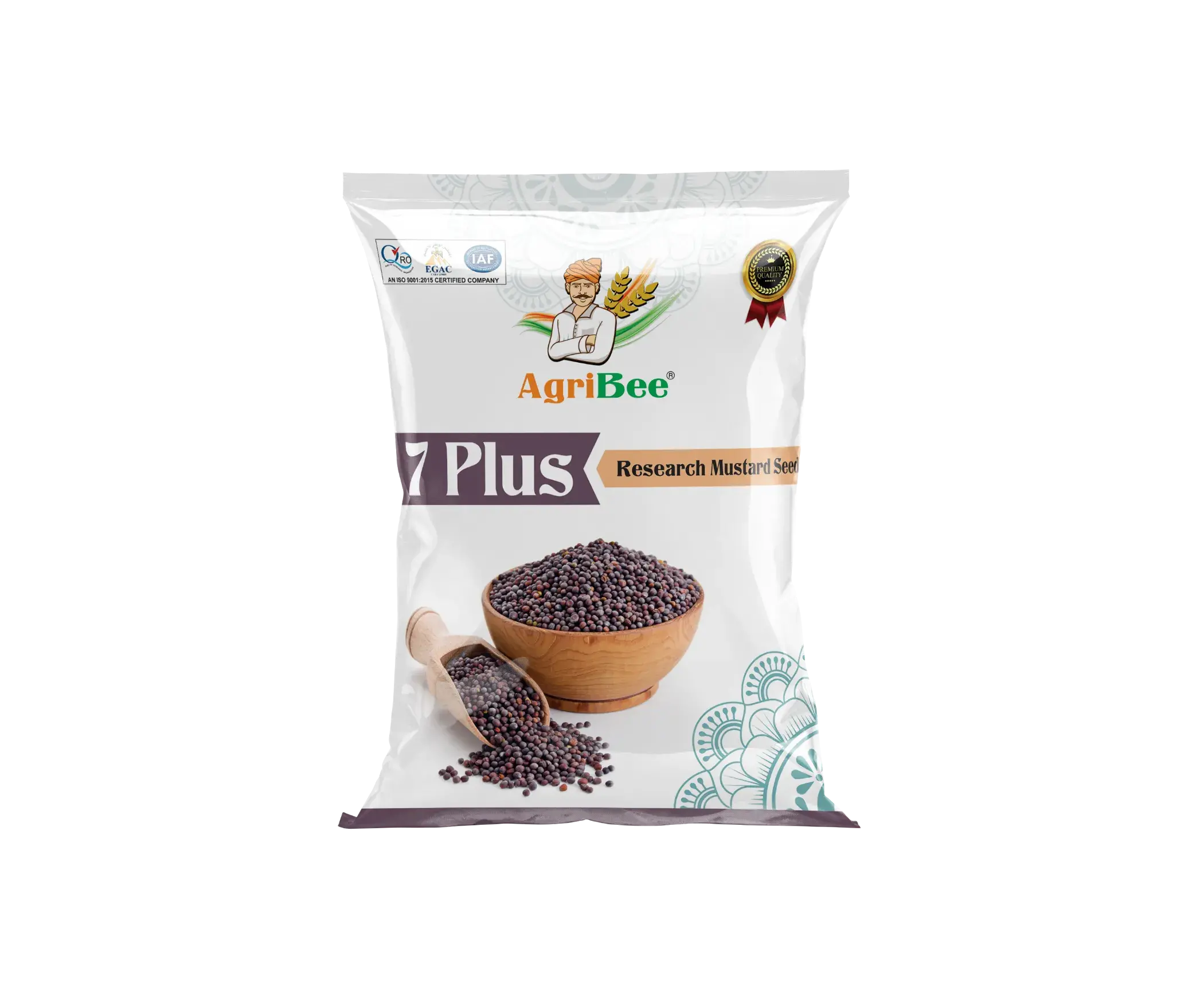
Description
खेती एवं बुवाई निर्देशिका — Mustard 7+
फसल के सर्वोत्तम प्रबंधन, रोग प्रतिरोधकता और प्रीमियम उत्पादन के लिए संपूर्ण चरणबद्ध कृषि निर्देशिका।
🌾 भूमि की तैयारी एवं खेत सुधार
खेत की समुचित जुताई एवं तैयारी से एकसमान अंकुरण और मजबूत जड़ों का विकास होता है।
🌱 आदर्श मिट्टी का प्रकार एवं pH
Well-drained loamy to clay-loam soils with good moisture retention. Optimal pH range is 6.0–8.0. The crop performs poorly in waterlogged or saline-affected fields.
✨ प्रमुख कृषि लाभ
Deep, fertile loamy soil ensures strong root anchorage, uniform germination, and healthy canopy development throughout the Rabi season.
- 1
Deep summer ploughing followed by 2–3 cross-harrowings to obtain fine tilth and break hard pans.
- 2
Field leveling using laser leveling or traditional methods to ensure uniform moisture distribution and germination.
- 3
Application of well-decomposed FYM or compost (5–8 t/acre) during last ploughing to improve soil structure and organic carbon.
- 4
Soil test-based pH correction — apply gypsum or lime where necessary; mustard tolerates slight alkalinity but thrives near neutral.
🌱 बुवाई का समय एवं विधि
सटीक बीज दर और सही दूरी से पौधों को पर्याप्त सूर्य का प्रकाश और संतुलित विकास मिलता है।
| मानक / पैरामीटर | अनुशंसा / निर्देश | कृषि महत्व |
|---|---|---|
| बुवाई समय सीमा | Early October to mid-November | Sowing within this window allows the crop to establish before winter and complete its lifecycle under favorable temperature, avoiding late heat stress during grain filling. |
| बीज दर (प्रति एकड़) | 4–5 kg per acre | Maintains optimal plant population without overcrowding, ensuring each plant receives adequate sunlight and nutrients for bold seed development. |
| कतार एवं पौधे का अंतर | 30 cm × 10 cm (row-to-row × plant-to-plant) | Provides sufficient canopy spread, improves air circulation, reduces humidity-related disease pressure, and facilitates interculture operations. |
| बुवाई की गहराई | 2–3 cm (shallow furrows) | Mustard seeds are small and require shallow sowing for rapid and uniform germination; deeper sowing delays emergence and reduces stand. |
💧 सिंचाई एवं जल प्रबंधन
उचित नमी प्रबंधन से पौधे की वानस्पतिक एवं फलने-फूलने की अवस्था में जोरदार विकास होता है।
☀️ जल आवश्यकता एवं सिंचाई प्रोफाइल
Mustard 7+ is moderately drought-tolerant once established, but consistent soil moisture significantly enhances plant vigor, pod set, and seed quality. Drip irrigation with alternate furrow watering is compatible and improves water-use efficiency by up to 30%. The crop requires approximately 350–450 mm total water over its lifecycle depending on ambient conditions.
🌦️ Soil नमी प्रबंधन
In rainfed environments, ensure the seedbed retains surface moisture at sowing. Supplemental irrigations at critical stages—especially at 25 DAS (branching), 55 DAS (flowering), and 85 DAS (pod filling)—are crucial to prevent moisture stress that leads to pod shedding and shrivelled seeds.
- ✓
First irrigation at 15–20 days after sowing to support vegetative growth and branching initiation; ensure moisture reaches the root zone without waterlogging.
- ✓
During the vegetative phase, irrigate at 15–20 day intervals depending on soil texture and rainfall. Sandy soils may need more frequent light irrigations.
- ✓
Critical irrigation at flowering (50–60 DAS) and early pod filling (75–85 DAS) is essential for maximum seed fill and oil content development. Moisture stress at these stages directly reduces seed quality.
- ✓
Withhold all irrigation 15–20 days before anticipated harvest to allow uniform pod desiccation, reduce lodging risk, and facilitate clean harvesting.
🧪 उर्वरक एवं पोषण प्रबंधन
संतुलित पोषण से मजबूत पौधा संरचना और उच्च गुणवत्ता वाली उपज प्राप्त होती है।
| पोषक तत्व | अनुशंसित मात्रा (प्रति एकड़) | प्रयोग विधि एवं समय |
|---|---|---|
| नाइट्रोजन (N) | 40–50 kg/acre | Apply 25 kg N as basal through urea at sowing; remaining 15–25 kg N as top-dressing at first weeding (20–25 DAS). |
| Phosphorus (P2O5) | 30 kg/acre | 100% applied basal through DAP or SSP at or before sowing for optimal root development and early growth. |
| Potash (K2O) | 20 kg/acre | Apply 100% basal through MOP at sowing; split second half at first top-dressing if soil test indicates deficiency. |
🌿 निराई-गुड़ाई एवं खरपतवार नियंत्रण
समय पर खरपतवार नियंत्रण से मुख्य फसल को पूर्ण पोषण और नमी मिलती है।
-
1
पहली निराई-गुड़ाई: Carry out at 15–20 days after sowing (DAS) using a hoe or cultivator. Early weed competition is the most critical factor reducing crop vigor. A clean field during this window promotes strong primary branch formation.
-
2
दूसरी निराई एवं मिट्टी चढ़ाना: Perform at 30–35 DAS to control later-emerging weeds and build up soil around the base of plants. Earthing-up provides stem support for taller varieties and improves root aeration.
-
3
Mulching and Inter-row Hoeing: Apply straw mulch between rows at 40 DAS to conserve soil moisture, suppress weeds, and maintain consistent root-zone temperature. Inter-row hoeing at this stage prevents compaction and improves soil oxygen availability.
🛡️ कीट एवं रोग नियंत्रण
फसल की सक्रिय निगरानी और एकीकृत प्रबंधन से रोगमुक्त एवं स्वस्थ फसल सुनिश्चित होती है।
🐛 कीट प्रबंधन एवं रोकथाम
- Mustard Aphid (Lipaphis erysimi): Small green/black insects cluster on tender leaves and shoots, causing curling and stunted growth; they also transmit viral diseases. Control: Spray imidacloprid 17.8% SL at 0.3 ml/litre of water or thiamethoxam 25% WG at 0.1 g/litre. Apply at first sign of infestation, repeat after 7–10 days if needed. Encourage natural predators like ladybird beetles.
- Mustard Pod Borer (Heortia vitessoides): Larvae bore into pods and consume developing seeds, leaving frass and webbing on pod surfaces. Control: Spray chlorantraniliprole 18.5% SC at 0.3 ml/litre or spinosad 45% SC at 0.4 ml/litre at early pod formation stage. Destroy infected pods manually. Pheromone traps at 10/acre help monitor adult populations.
- வெள்ளைfly (Bemisia tabaci): Sucks sap from undersides of leaves, causing yellowing, curling, and honeydew secretion leading to sooty mold. Control: Spray dimethoate 30% EC at 1.0 ml/litre or acetamiprid 20% SP at 0.5 g/litre. Use yellow sticky traps at 5 traps/acre for monitoring and reduction of adult populations.
🔬 रोग नियंत्रण एवं उपचार
- Downy Mildew (Hyaloperonospora parasitica): Characterized by white downy growth on leaf undersides, yellow patches on upper surface, and distorted leaves. Spread rapidly in cool, humid conditions. Preventive spray: Mancozeb 75% WP at 2.5 g/litre or metalaxyl + mancozeb at 2.0 g/litre at first sign of infection; repeat at 10-day intervals.
- Light Leaf Spot (Cercospora macrospora): Circular to irregular pale brown spots with dark margins on leaves; severe infection causes defoliation and reduced photosynthetic area. Control: Spraying of carbendazim 50% WP at 1.0 g/litre or tebuconazole 25% EC at 0.5 ml/litre at initial symptom appearance.
- Club Root (Plasmodiophora brassicae): Swelling and galling of roots, stunted yellow plants, wilting during daytime. Soil-borne; no chemical cure. Prevention: Maintain soil pH above 7.2 by applying agricultural lime at 200–300 kg/acre before sowing. Rotate with non-brassicaceous crops. Uproot and burn infected plants. Ensure proper drainage to avoid water stagnation.
✂️ कटाई एवं उपज गुणवत्ता निर्देशिका
सही परिपक्वता पर कटाई से अधिकतम मंडी भाव और बेहतर भंडारण क्षमता मिलती है।
⏱️ कटाई समय एवं निर्धारण
Harvest when 75–80% of pods on the main raceme turn pale yellow to straw color and seeds within harden. Usually attained at 110–120 days after sowing. Cut entire plants at base using a sickle and heap in shade for 2–3 days for uniform drying before threshing.
⭐ उपज की गुणवत्ता एवं विशेषताएं
Bold, round seeds with bright yellow to dark yellow coloration. உயர்ந்தது oil content (40–42%) delivers rich pungency and excellent pressing quality. Seeds are uniform in size with minimal shrivelling, commanding premium rates in domestic and export markets.
| गुणवत्ता मानक | कृषि मानक | किसान एवं मंडी लाभ |
|---|---|---|
| कटाई की अवस्था | 110–120 बुवाई के दिन बाद — when lower pods mature first | Ensures peak seed quality, optimal oil content, and early market entry before price depreciation. |
| परिपक्वता के लक्षण | Pods turning yellow-brown, seeds hard and rattle when shaken, plant stems begin drying | Prevents over-maturity, pod shattering losses, and seed quality deterioration. |
| भंडारण क्षमता एवं टिकाऊपन | 3–6 months under dry, cool storage conditions with moisture content below 8% | Ensures minimal insect attack and maintains oil quality during transit and storage. |
| मंडी मांग एवं उपयुक्तता | Excellent for oil extraction, mustard powder, pickle processing, and direct grain trade in mandis | Bold round seeds with high oil content attract buyers from oil mills and spice processors offering better price realization. |
⭐ किस्म की विशेषताएं — Mustard 7+
विशिष्ट विशेषताएं जो इस किस्म को भारतीय किसानों की पहली पसंद बनाती हैं।
🌿 किस्म की मुख्य विशेषताएं
Mustard 7+ is a high-performing Rabi mustard variety developed by AgriBee Seeds, combining robust plant architecture with excellent seed-filling capacity for consistent field performance across Indian agro-climatic zones.
🌿 उपज की गुणवत्ता एवं रूप-रंग
Produces bold, round, bright yellow to dark yellow seeds with 40–42% oil content. Uniform seed size and color grade make it highly suitable for oil extraction and commercial trading.
🌿 तनाव एवं रोग प्रतिरोधक क्षमता
Demonstrates good field tolerance to common mustard diseases including light leaf spot and moderate resilience to aphid damage. Adapted to tolerate slight moisture fluctuations typical of Rabi conditions.
🌿 वृद्धि स्वभाव एवं ओज (विगर)
Reaches 4–5 feet (120–150 cm) with strong erect growth habit and well-branched architecture. Dark green foliage indicates healthy photosynthetic activity throughout the growing period.
🌿 फसल अवधि एवं पकने का समय
Matures in 110–120 days, allowing timely harvest and opening the field for timely preparation of the subsequent Kharif crop, supporting efficient double-cropping systems.
🌿 मंडी एवं किसान प्राथमिकता
Trusted by commercial mustard farmers across Rajasthan, Madhya Pradesh, Maharashtra, and Uttar Pradesh for its uniform maturity, superior seed appearance, and reliable oil extraction rates that translate into better profit realization.