
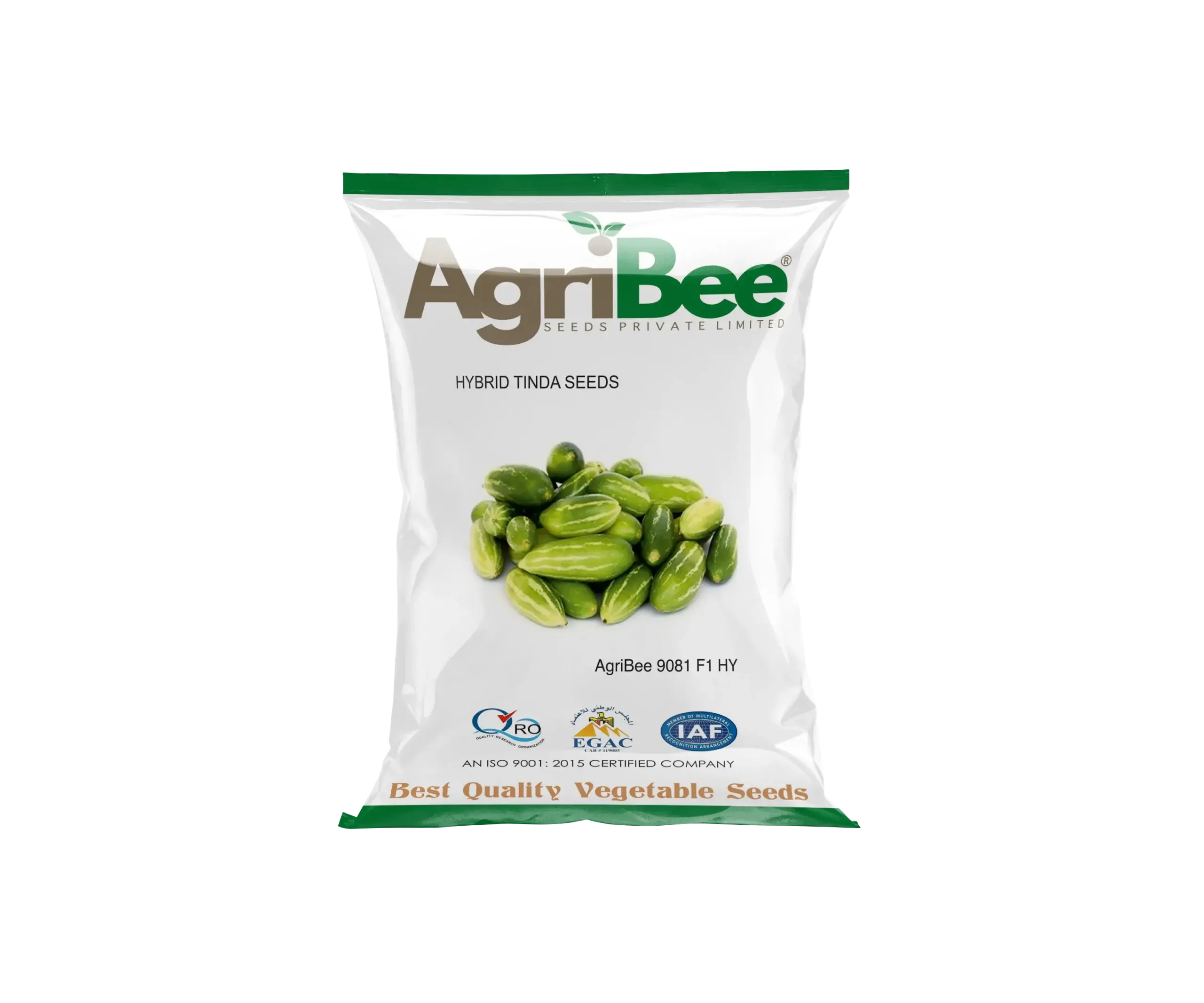
Description
खेती एवं बुवाई निर्देशिका — Tinda Seeds AgriBee 9081 F1 HY
फसल के सर्वोत्तम प्रबंधन, रोग प्रतिरोधकता और प्रीमियम उत्पादन के लिए संपूर्ण चरणबद्ध कृषि निर्देशिका।
🌾 भूमि की तैयारी एवं खेत सुधार
खेत की समुचित जुताई एवं तैयारी से एकसमान अंकुरण और मजबूत जड़ों का विकास होता है।
🌱 आदर्श मिट्टी का प्रकार एवं pH
Well-drained loamy to sandy-loam soils with good organic matter content. pH range 6.0–7.5 is optimal. Heavy clay soils must be avoided due to waterlogging sensitivity.
✨ प्रमुख कृषि लाभ
Deep, fertile, well-aerated seedbed ensures rapid germination, strong early root development, and resilient vine anchorage throughout the cropping cycle.
- 1
Deep summer ploughing followed by 2–3 cross-harrowings to obtain a fine, crumbly tilth free of clods.
- 2
Field leveling and formation of drainage channels to prevent any standing water around the root zone.
- 3
Incorporation of 15–20 tonnes/hectare of well-decomposed FYM or vermicompost during the final harrowing for soil conditioning.
- 4
Soil health assessment and lime application where pH falls below 6.0 to ensure nutrient availability.
🌱 बुवाई का समय एवं विधि
सटीक बीज दर और सही दूरी से पौधों को पर्याप्त सूर्य का प्रकाश और संतुलित विकास मिलता है।
| मानक / पैरामीटर | अनुशंसा / निर्देश | कृषि महत्व |
|---|---|---|
| बुवाई समय सीमा | June – July for Kharif; October – November for Rabi | Aligns with favorable warm-moist conditions for rapid germination and vigorous early vine growth |
| बीज दर (प्रति एकड़) | 2–2.5 kg per acre (broadcast or line sowing) | Ensures adequate plant population without excessive competition among seedlings |
| कतार एवं पौधे का अंतर | 60 cm x 30 cm (row-to-row x plant-to-plant) | Provides sufficient canopy spread, airflow, and light penetration for healthy fruit development |
| बुवाई की गहराई | 1.0–1.5 cm (do not sow deeper than 2 cm) | Shallow sowing guarantees uniform and fast emergence; deeper burial reduces germination rate significantly |
💧 सिंचाई एवं जल प्रबंधन
उचित नमी प्रबंधन से पौधे की वानस्पतिक एवं फलने-फूलने की अवस्था में जोरदार विकास होता है।
☀️ जल आवश्यकता एवं सिंचाई प्रोफाइल
Tinda is moderately sensitive to drought, particularly during flowering and fruit set. Drip irrigation is highly recommended as it conserves water, maintains uniform soil moisture, and minimizes fungal disease pressure. Flood irrigation may be used in Rabi seasons but must be carefully managed to avoid waterlogging.
🌦️ Soil नमी प्रबंधन
In rainfed situations, synchronize sowing with anticipated monsoon onset and ensure raised beds with wide drainage furrows. Mulching with straw or green leaves helps retain surface moisture and suppress weeds between irrigation events.
- ✓
First irrigation should be applied immediately after sowing to ensure seed-soil contact and trigger uniform germination.
- ✓
During the vegetative phase (20–45 DAS), maintain light irrigation every 4–5 days depending on soil texture and weather conditions.
- ✓
Critical irrigation is required from flowering through active fruit development (45–75 DAS); even short moisture deficits at this stage reduce fruit set and cause deformation.
- ✓
Reduce irrigation frequency 7–10 days before the final harvest pick to improve firmness and extend post-harvest shelf life.
🧪 उर्वरक एवं पोषण प्रबंधन
संतुलित पोषण से मजबूत पौधा संरचना और उच्च गुणवत्ता वाली उपज प्राप्त होती है।
| पोषक तत्व | अनुशंसित मात्रा (प्रति एकड़) | प्रयोग विधि एवं समय |
|---|---|---|
| नाइट्रोजन (N) | 40–50 kg/acre | 50% basal at sowing; remaining 50% as top-dressing at 30 DAS |
| Phosphorus (P2O5) | 25–30 kg/acre | 100% incorporated as DAP during final land preparation |
| Potash (K2O) | 20–25 kg/acre | 100% basal with MOP; split application supports fruit firmness and color development |
🌿 निराई-गुड़ाई एवं खरपतवार नियंत्रण
समय पर खरपतवार नियंत्रण से मुख्य फसल को पूर्ण पोषण और नमी मिलती है।
-
1
पहली निराई-गुड़ाई: Carry out at 15–20 DAS to remove early weed flush and loosen soil. Shallow hand hoeing avoids root damage to young seedlings.
-
2
दूसरी निराई एवं मिट्टी चढ़ाना: Perform at 30–35 DAS to control the second weed cycle and gently hill soil around the base of vines for improved root aeration and structural support.
-
3
Vine Training & Mulching: Train main vines onto support posts or trellis at 25–30 DAS. Apply organic mulch (straw or leaf litter) between rows to conserve moisture, suppress weeds, and keep developing fruits clean.
🛡️ कीट एवं रोग नियंत्रण
फसल की सक्रिय निगरानी और एकीकृत प्रबंधन से रोगमुक्त एवं स्वस्थ फसल सुनिश्चित होती है।
🐛 कीट प्रबंधन एवं रोकथाम
- Aphids (Macrosiphum euphorbiae): Sucking sap from tender shoots and leaves causing curling and stunting. Spray Imidacloprid 17.8% SL at 0.3 ml/liter or Neem-based formulation (Neemcin 0.3%) at 3 ml/liter. Apply at early infestation stages; repeat at 7-day intervals if needed.
- Fruit Borer (Podagrina spp./Helicoverpa armigera): Larvae bore into young fruits causing and fruit drop. Spray Chlorantraniliprole 18.4% SC at 0.5 ml/liter or Spinosad 45% SC at 0.3 ml/liter at 15 DAS and repeat at 20-day intervals. Destroy infected fruits manually.
- తెలుపుfly (Bemisia tabaci): Yellowing, wilting, and honeydew secretion leading to sooty mold. Spray Thiamethoxam 25% WG at 0.2 g/liter or Imidacloprid 70% WS at 0.3 g/liter. Install yellow sticky traps at 10 traps per acre for monitoring and mass trapping.
🔬 रोग नियंत्रण एवं उपचार
- Powdery Mildew (Erysiphe cichoracearum): తెలుపు powdery fungal growth on leaves and stems reducing photosynthetic capacity. Spray Sulphur dusting at 25 kg/acre or Micronised Sulphur 80% WP at 2 g/liter at first sign of infection. Ensure adequate spacing for air circulation.
- Downy Mildew (Pseudoperonospora cubensis): Angular yellow lesions on upper leaf surface with grey-purple sporulation underneath. Spray Metalaxyl 35% SG + Mancozeb 64% WP at 2.5 g/liter or (Copper oxychloride) at 3 g/liter as preventive measure every 10–12 days during humid weather.
- Mosaic Virus (Cucurbit mosiac virus transmitted by aphids): Mottled yellow-green leaf pattern, stunted growth, and reduced fruit quality. Control aphid vectors promptly using the recommended insecticides above. Remove and destroy severely infected plants to prevent spread.
✂️ कटाई एवं उपज गुणवत्ता निर्देशिका
सही परिपक्वता पर कटाई से अधिकतम मंडी भाव और बेहतर भंडारण क्षमता मिलती है।
⏱️ कटाई समय एवं निर्धारण
First picking begins at 50–55 days after sowing. Subsequent pickings are taken at intervals of 3–4 days during peak production, with 6–8 harvest rounds possible over the cropping cycle.
⭐ उपज की गुणवत्ता एवं विशेषताएं
Fruits exhibit a characteristic round, flat-topped shape with smooth, light green skin. Flesh is tender, crisp, and mild-flavored with low fiber content. Fruit weight ranges 50–80 gm, making it ideal for fresh table markets and home cooking.
| गुणवत्ता मानक | कृषि मानक | किसान एवं मंडी लाभ |
|---|---|---|
| पहली कटाई / तुड़ाई Stage | 50–55 बुवाई के दिन बाद | Early picking allows farmers to capitalize on pre-monsoon or early-season market prices with premium rates |
| परिपक्वता के लक्षण | Fruits reach full size with firm texture, smooth light-green surface, and shiny appearance; seeds inside are still soft and undeveloped | Prevents over-maturity which leads to hard rind, bitter taste, and poor market acceptability |
| भंडारण क्षमता एवं टिकाऊपन | 5–7 days under ambient conditions; up to 10–12 days at 8–10°C with high relative humidity | Facilitates transport to distant mandis and retail outlets with minimal quality loss |
| मंडी मांग एवं उपयुक्तता | Fresh table market, wholesale mandis, urban retail chains, and household consumption across North, West, and Central India | Uniform size, attractive color, and good shelf life command steady trader demand and reliable farm-gate prices |
⭐ किस्म की विशेषताएं — Tinda Seeds AgriBee 9081 F1 HY
विशिष्ट विशेषताएं जो इस किस्म को भारतीय किसानों की पहली पसंद बनाती हैं।
🌿 किस्म की मुख्य विशेषताएं
AgriBee 9081 ఎఫ్1 హైబ్రిడ్s deliver exceptional field vigour and uniform plant architecture, ensuring consistent vine growth and reliable canopy coverage under diverse Indian growing conditions.
🌿 उपज की गुणवत्ता एवं रूप-रंग
Fruits are distinctly round and flat-topped with a smooth, light-green rind. The flesh is tender, crisp, and free from excessive fiber, making it highly preferred by consumers and traders alike.
🌿 तनाव एवं रोग प्रतिरोधक क्षमता
The variety exhibits good resilience against common cucurbit pests and shows tolerance to powdery mildew and downy mildew pressures when grown under recommended agronomic practices.
🌿 वृद्धि स्वभाव एवं ओज (विगर)
Vigorous climbing vine with well-branched growth habit. Strong primary and lateral vine development ensures effective canopy cover and sustained fruit-bearing over multiple picking cycles.
🌿 फसल अवधि एवं पकने का समय
First harvest commences within 50–55 days after sowing, enabling farmers to enter the market earlier and rotate crops more flexibly within the season.
🌿 मंडी एवं किसान प्राथमिकता
Farmers, commission agents, and wholesale traders favor AgriBee 9081 F1 HY for its uniform fruit size, appealing light-green color, excellent handling quality, and reliable performance across Kharif and Rabi seasons in Gujarat, Maharashtra, Rajasthan, Madhya Pradesh, and South India.