Description
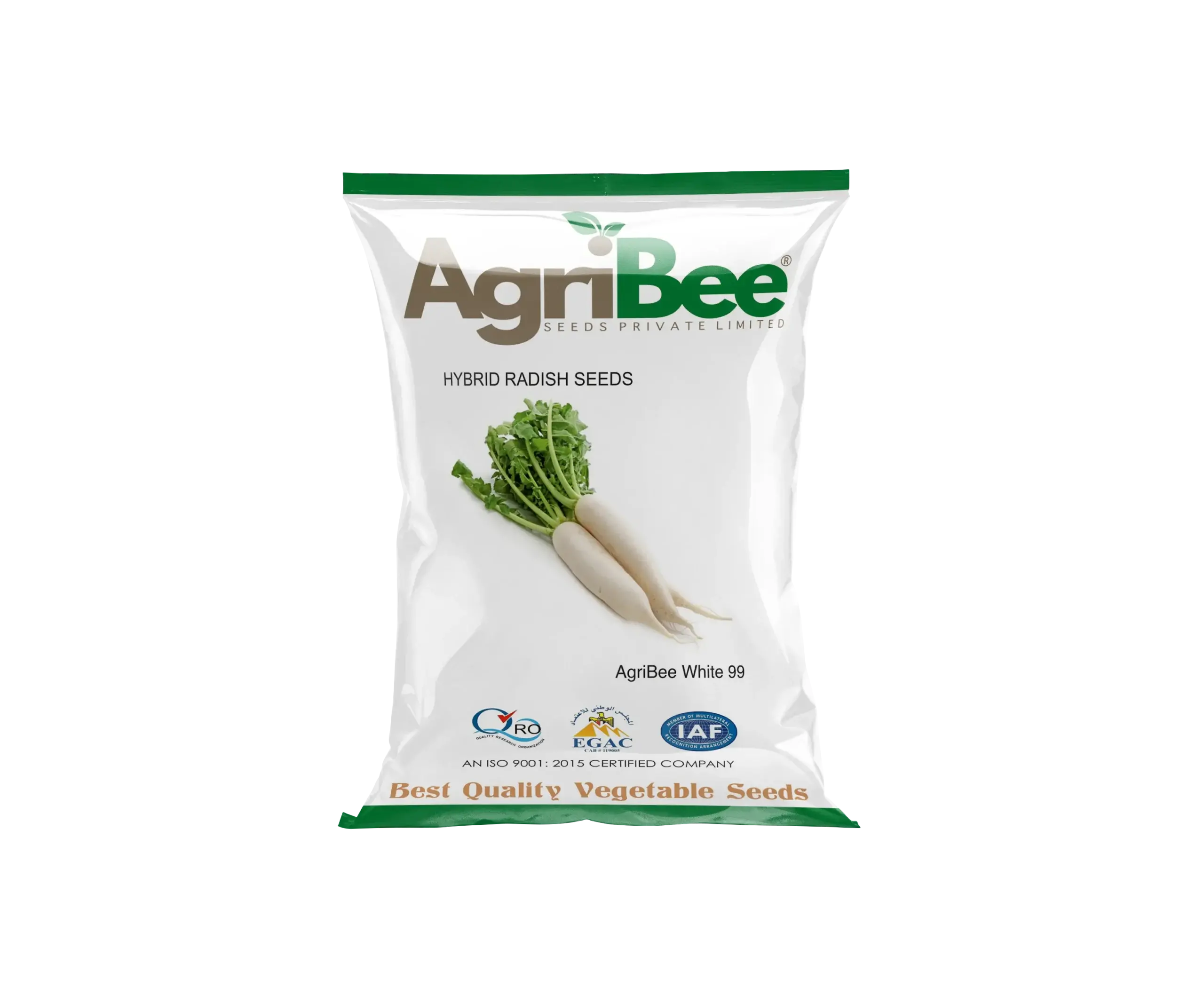
खेती एवं बुवाई निर्देशिका — Radish Seeds AgriBee తెలుపు 99
फसल के सर्वोत्तम प्रबंधन, रोग प्रतिरोधकता और प्रीमियम उत्पादन के लिए संपूर्ण चरणबद्ध कृषि निर्देशिका।
🌾 भूमि की तैयारी एवं खेत सुधार
खेत की समुचित जुताई एवं तैयारी से एकसमान अंकुरण और मजबूत जड़ों का विकास होता है।
🌱 आदर्श मिट्टी का प्रकार एवं pH
Well-drained light sandy loam to loamy soils with pH 6.0–7.5. Deep, friable soils free of stones and clods ensure straight, uniform root development.
✨ प्रमुख कृषि लाभ
Loose, well-aerated seedbed promotes rapid radish seed germination and unrestricted taproot penetration for long, cylindrical, uniform roots.
- 1
Deep summer ploughing to 25–30 cm followed by 2–3 cross-harrowings for fine tilth and debris removal.
- 2
Field leveling with laser leveling where possible; prepare raised beds of 10–12 m length in heavy soils and flat beds in light soils.
- 3
Incorporate 15–20 t/ha well-decomposed FYM or compost during last harrowing for improved soil structure and moisture retention.
- 4
Conduct soil test and apply agricultural lime at 250–300 kg/ha if pH is below 6.0 to correct acidity and prevent clubroot susceptibility.
🌱 बुवाई का समय एवं विधि
सटीक बीज दर और सही दूरी से पौधों को पर्याप्त सूर्य का प्रकाश और संतुलित विकास मिलता है।
| मानक / पैरामीटर | अनुशंसा / निर्देश | कृषि महत्व |
|---|---|---|
| बुवाई समय सीमा | October–November for Rabi season; February–March for spring crop; April–May for summer under shade net or greenhouse | Cool weather (15–22°C) ensures fast root enlargement and prevents bolting; summer sowing requires heat-tolerant protection |
| बीज दर (प्रति एकड़) | 8–10 kg/ha (3.2–4.0 kg/acre) for line sowing; thinning reduces effective population | Optimal seed rate ensures uniform stand without overcrowding, enabling full 25–30 cm root elongation |
| कतार एवं पौधे का अंतर | 30 cm row-to-row × 10–15 cm plant-to-plant | Adequate spacing allows unrestricted root expansion, improves air circulation, and facilitates weeding operations |
| बुवाई की गहराई | 1–1.5 cm deep | Shallow sowing ensures rapid and uniform germination within 4–6 days; deeper sowing delays emergence and causes misshapen roots |
💧 सिंचाई एवं जल प्रबंधन
उचित नमी प्रबंधन से पौधे की वानस्पतिक एवं फलने-फूलने की अवस्था में जोरदार विकास होता है।
☀️ जल आवश्यकता एवं सिंचाई प्रोफाइल
Radish is moderately drought-sensitive with a shallow root system requiring consistent soil moisture. Irrigate 3–4 times during the crop cycle at 7–10 day intervals depending on soil texture and weather. Drip irrigation is highly compatible and improves uniformity of root shape and purity of white colour. Maintain soil moisture at 60–70% of field capacity throughout the growing period.
🌦️ Soil नमी प्रबंधन
In rainfed zones, synchronize sowing with predictable rainfall periods and use mulching (paddy straw at 3–4 t/ha) to conserve soil moisture and regulate soil temperature. Raised beds help drain excess water during unexpected showers and prevent root rot.
- ✓
First irrigation (baby irrigation) immediately after sowing to ensure uniform seed-soil contact and trigger germination within 4–6 days.
- ✓
Vegetative phase: light and frequent irrigations every 5–7 days to support rapid foliage development without causing excessive leafiness at the expense of root fill.
- ✓
Critical stage — root bulking (20–35 DAS): maintain consistent moisture; any deficit causes root cracking, pungency exaggeration, and woody texture.
- ✓
Stop irrigation 3–4 days before harvest to firm up roots, improve shelf life, and reduce post-harvest decay during transport.
🧪 उर्वरक एवं पोषण प्रबंधन
संतुलित पोषण से मजबूत पौधा संरचना और उच्च गुणवत्ता वाली उपज प्राप्त होती है।
| पोषक तत्व | अनुशंसित मात्रा (प्रति एकड़) | प्रयोग विधि एवं समय |
|---|---|---|
| नाइट्रोजन (N) | 40–50 kg/ha (16–20 kg/acre) | 50% basal at sowing as urea; remaining 50% top-dressed at 15 DAS for sustained foliage and root growth |
| Phosphorus (P2O5) | 25–30 kg/ha (10–12 kg/acre) | 100% basal application incorporated during final land preparation as DAP or SSP |
| Potash (K2O) | 20–25 kg/ha (8–10 kg/acre) | 50% basal + 50% at 20 DAS as MOP to improve root firmness, white colour intensity, and disease resistance |
🌿 निराई-गुड़ाई एवं खरपतवार नियंत्रण
समय पर खरपतवार नियंत्रण से मुख्य फसल को पूर्ण पोषण और नमी मिलती है।
-
1
First Weeding & Thinning: Perform at 10–12 DAS. Remove weeds manually or with a hand hoe. Thin seedlings to 10–15 cm plant-to-plant spacing to prevent competition and ensure uniform root development.
-
2
Second Weeding & Hoeing: Carry out at 20–22 DAS. Light inter-row hoeing breaks crust, improves aeration to the root zone, and controls late-germinating weeds that compete during the active root-bulking phase.
-
3
Mulching: Apply paddy straw or green mulch at 3–4 t/ha after second weeding to conserve soil moisture, suppress weed resurgence, keep roots clean, and maintain uniform white colour by preventing sun exposure of shoulder tips.
🛡️ कीट एवं रोग नियंत्रण
फसल की सक्रिय निगरानी और एकीकृत प्रबंधन से रोगमुक्त एवं स्वस्थ फसल सुनिश्चित होती है।
🐛 कीट प्रबंधन एवं रोकथाम
- Radish Aphid (Lipaphis erysimi): Small green/black insects cluster on young leaves and growing points, causing curling and stunting. Spray Imidacloprid 17.8% SL at 0.3 ml/litre or Acetamiprid 20% SP at 0.5 g/litre. Alternate with Neem-based biopesticide (Neemarin Gold 3000 ppm) at 2 ml/litre for resistant management.
- Radish Flea Beetle (Phyllotreta spp.): Small metallic beetles create numerous shot-hole lesions on cotyledons and true leaves, damaging seedlings severely. Dust with carbaryl 5% DG at 10 kg/ha or spray Spinosad 45% SC at 0.3 ml/litre at 3-day intervals for 2 rounds. Use yellow sticky traps at 10/acre for monitoring.
- Radish Leafminer (Liriomyza trifolii): Miners create winding white trails inside leaves; severe infestation reduces photosynthetic capacity. Spray Emamectin benzoate 5% SG at 0.3 g/litre or Cartap hydrochloride 4% GP at 1 g/litre. Remove and destroy infested leaves manually to reduce carry-over population.
🔬 रोग नियंत्रण एवं उपचार
- Downy Mildew (Peronospora parasitica): Grey-purple fuzzy growth on leaf undersurfaces with yellow chlorotic patches above. Preventive spray of Mancozeb 75% WP at 2 g/litre or Metalaxyl + Mancozeb at 1.5 g/litre at 15 DAS and repeat at 25 DAS. Ensure proper spacing for canopy airflow and avoid overhead irrigation.
- Black Rot (Xanthomonas campestris pv. rapae): V-shaped yellow lesions on leaf margins with blackened vascular strands in roots and stems. Apply Copper oxychloride 50% WP at 3 g/litre as preventive spray at 15 DAS. Use disease-free hybrid & research seeds and practice 3-year crop rotation. Remove and burn infected plants immediately.
- Clubroot (Plasmodiophora brassicae): Swollen, spindle-shaped galls on taproots and lateral roots causing wilting and stunting. drench soil with Copper oxychloride 50% WP at 4 g/litre or Potassium permanganate at 0.1% before transplanting/sowing. Raise soil pH to 7.2–7.5 with lime; avoid continuous brassica cropping in affected fields.
✂️ कटाई एवं उपज गुणवत्ता निर्देशिका
सही परिपक्वता पर कटाई से अधिकतम मंडी भाव और बेहतर भंडारण क्षमता मिलती है।
⏱️ कटाई समय एवं निर्धारण
First harvest begins at 40–45 days after sowing. Harvest roots when they reach 25–30 cm in length with adequate girth. Remove foliage cleanly with a sharp knife, leaving a short crown stub to maintain freshness.
⭐ उपज की गुणवत्ता एवं विशेषताएं
Pure white, smooth-skinned, long cylindrical roots with uniform diameter. Crisp texture, mild pungent flavour, and low fiber content make this variety preferred for fresh market and culinary use. Roots should be firm, free of cracks, splitting, and bolting signs.
| गुणवत्ता मानक | कृषि मानक | किसान एवं मंडी लाभ |
|---|---|---|
| पहली कटाई / तुड़ाई Stage | 40–45 बुवाई के दिन बाद | Ensures peak tenderness, mild pungency, and early market arrival commanding better prices |
| परिपक्वता के लक्षण | Roots 25–30 cm long, pure white colour, firm to touch, shoulders slightly visible above soil | Prevents over-maturity that causes pithiness, hollow heart, and increased pungency |
| भंडारण क्षमता एवं टिकाऊपन | 5–7 days under ambient conditions (15–20°C); up to 10–12 days under refrigerated storage at 0–2°C with 90–95% relative humidity | Superior keeping quality enables extended sales window and wider market reach |
| मंडी मांग एवं उपयुक्तता | Fresh table market, wholesale mandis, retail chains, hotels and restaurants, processing units; suitable for domestic and export trade | Uniform appearance, attractive white colour, and mild taste attract premium rates from traders and institutional buyers |
⭐ किस्म की विशेषताएं — Radish Seeds AgriBee తెలుపు 99
विशिष्ट विशेषताएं जो इस किस्म को भारतीय किसानों की पहली पसंद बनाती हैं।
🌿 किस्म की मुख्य विशेषताएं
AgriBee తెలుపు 99 is a high-performing long-root radish variety bred for early maturity and uniform root development under diverse Indian growing conditions.
🌿 उपज की गुणवत्ता एवं रूप-रंग
Pure white, long cylindrical roots (25–30 cm) with smooth skin, crisp texture, and mild pungent taste — highly preferred by consumers for salads, garnishing, and fresh consumption.
🌿 तनाव एवं रोग प्रतिरोधक क्षमता
Demonstrates good field tolerance to downy mildew and black rot under moderate pressure; maintains root firmness and vigour under seasonal temperature fluctuations.
🌿 वृद्धि स्वभाव एवं ओज (विगर)
Compact upright plant habit with vigorous foliage that provides adequate canopy cover; uniform root set ensures consistency in grading and packing.
🌿 फसल अवधि एवं पकने का समय
Early maturity at 40–45 days enables quick crop turn-around, flexible rotation planning, and opportunities for multiple cycles within a single growing season.
🌿 मंडी एवं किसान प्राथमिकता
Uniform root length and colour, combined with mild flavour and long shelf life, make AgriBee తెలుపు 99 a trusted choice among progressive farmers, commission agents, and modern retail buyers across India.