
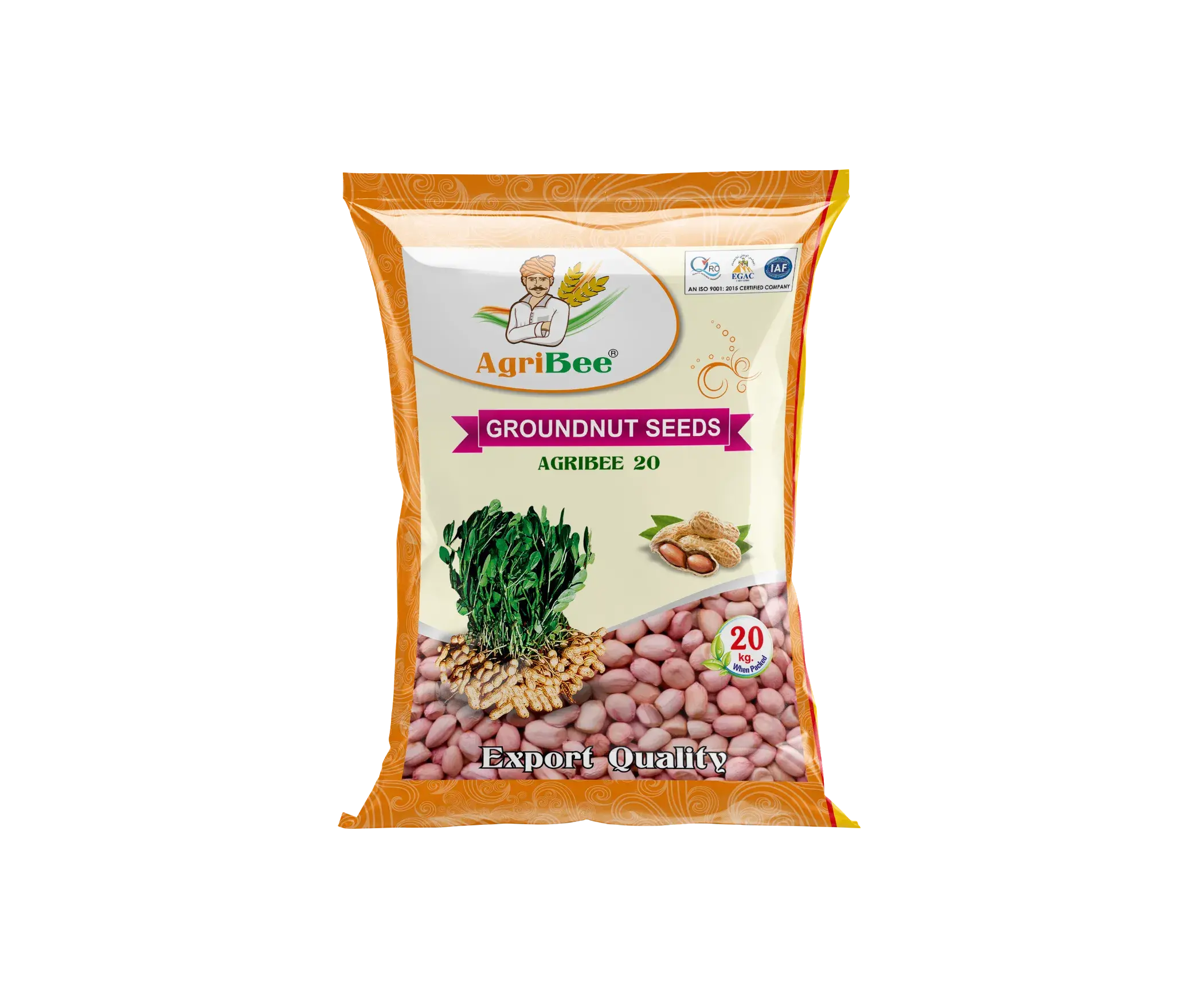
Description
खेती एवं बुवाई निर्देशिका — Groundnut AgriBee 20
फसल के सर्वोत्तम प्रबंधन, रोग प्रतिरोधकता और प्रीमियम उत्पादन के लिए संपूर्ण चरणबद्ध कृषि निर्देशिका।
🌾 भूमि की तैयारी एवं खेत सुधार
खेत की समुचित जुताई एवं तैयारी से एकसमान अंकुरण और मजबूत जड़ों का विकास होता है।
🌱 आदर्श मिट्टी का प्रकार एवं pH
Well-drained sandy loam to loamy soils with pH 6.0–7.5. Deep, friable soils with good internal drainage are ideal for peg penetration and pod development.
✨ प्रमुख कृषि लाभ
Light, well-aerated soil ensures rapid germination, healthy hypogeal growth, and unhindered peg insertion into the soil for pod setting.
- 1
Deep summer ploughing (25–30 cm) followed by 2–3 cross-harrowings to achieve fine tilth and eliminate hard pans.
- 2
Field leveling using laser leveling equipment where possible; prepare drainage channels in low-lying areas to prevent waterlogging.
- 3
Incorporate 10–15 tonnes/ha of well-decomposed FYM or farmyard compost during the last harrowing to improve soil structure and moisture retention.
- 4
Conduct soil testing prior to sowing; apply agricultural lime at 250–500 kg/ha if soil pH is below 5.5 to neutralize acidity and optimize nutrient availability.
🌱 बुवाई का समय एवं विधि
सटीक बीज दर और सही दूरी से पौधों को पर्याप्त सूर्य का प्रकाश और संतुलित विकास मिलता है।
| मानक / पैरामीटर | अनुशंसा / निर्देश | कृषि महत्व |
|---|---|---|
| बुवाई समय सीमा | June 15 – July 15 (Kharif) | October 15 – November 15 (Rabi) | Ensures adequate monsoon moisture during early growth and avoids terminal drought during pod filling |
| बीज दर (प्रति एकड़) | 80–90 kg/ha (~35–40 kg/acre) for berial seed; 90–100 kg/ha for desi types | Maintains optimal plant population of ~15–18 plants/m² for maximum canopy coverage and pod set |
| कतार एवं पौधे का अंतर | 60 cm (row-to-row) × 10–12 cm (plant-to-plant) | Provides adequate canopy spread, light interception, and air circulation for peg penetration and pod development |
| बुवाई की गहराई | 5–7 cm in normal soils; up to 8 cm in sandy soils | Optimal depth ensures consistent soil moisture contact for uniform germination while allowing adequate coleoptile emergence |
💧 सिंचाई एवं जल प्रबंधन
उचित नमी प्रबंधन से पौधे की वानस्पतिक एवं फलने-फूलने की अवस्था में जोरदार विकास होता है।
☀️ जल आवश्यकता एवं सिंचाई प्रोफाइल
Groundnut AgriBee 20 exhibits moderate drought tolerance due to its deep taproot system. Total water requirement ranges from 450–550 mm over the crop cycle. Drip irrigation is highly compatible and recommended for water-use efficiency; operate drip at 7–10 day intervals during active growth, delivering 25–35 mm per event. Under drip, apply 60–70% of ETc (crop evapotranspiration) to conserve water without compromising peg formation.
🌦️ नमी प्रबंधन
In rainfed conditions, ensure sowing coincides with reliable soil moisture. Use mulching (straw or polyethylene) immediately after sowing to conserve residual soil moisture. Apply a single rescue irrigation at initial flowering (35–40 DAS) if dry spells occur during the critical pod initiation phase.
- ✓
First Irrigation: Apply 5–7 days after sowing if soil is dry at seeding depth; this ensures uniform germination and stand establishment.
- ✓
Vegetative Phase (20–40 DAS): Light irrigation every 10–12 days to support leaf area development and branching; avoid waterlogging which causes root rot.
- ✓
Critical Stage – Flowering & Peg Initiation (40–70 DAS): Maintain adequate soil moisture; this is the most sensitive phase. Stress during flowering reduces flower longevity and peg entry, directly affecting pod set.
- ✓
Pre-Harvest: Cease irrigation 15–20 days before harvest to allow pod maturation and reduce field mold incidence; dry soil conditions facilitate clean digging.
🧪 उर्वरक एवं पोषण प्रबंधन
संतुलित पोषण से मजबूत पौधा संरचना और उच्च गुणवत्ता वाली उपज प्राप्त होती है।
| पोषक तत्व | अनुशंसित मात्रा (प्रति एकड़) | प्रयोग विधि एवं समय |
|---|---|---|
| नाइट्रोजन (N) | 20–25 kg/acre (50–60 kg/ha) | 50% basal at sowing + 50% top-dressing at 30 DAS during second weeding/earthing-up |
| Phosphorus (P2O5) | 40–50 kg/acre (100–125 kg/ha) | 100% basal application as DAP (Di-ammonium Phosphate) or SSP during final land preparation |
| Potash (K2O) | 30–40 kg/acre (75–100 kg/ha) | 100% basal; split only if soil test indicates high leaching potential in sandy soils |
🌿 निराई-गुड़ाई एवं खरपतवार नियंत्रण
समय पर खरपतवार नियंत्रण से मुख्य फसल को पूर्ण पोषण और नमी मिलती है।
-
1
पहली निराई-गुड़ाई: Carry out at 15–20 days after sowing (DAS) using a hand hoe or cultivator. Remove all emerging weeds to eliminate competition during the critical early growth phase. Shallow cultivation (5 cm depth) avoids damage to developing nodules and shallow roots.
-
2
दूसरी निराई एवं मिट्टी चढ़ाना: Perform at 30–35 DAS. Earthing-up mounds soil around the base of plants, which supports peg penetration into the soil and prevents exposed pegs from drying out. This operation also incorporates residual weed pressure and improves soil aeration around the root zone.
-
3
Mulching Application: Apply straw mulch (2–3 tonnes/ha) immediately after second weeding to conserve soil moisture, suppress late-season weeds, and maintain favorable soil temperature for pod development. In drip-irrigated crops, use black polyethylene mulch to maximize weed suppression and soil moisture efficiency.
🛡️ कीट एवं रोग नियंत्रण
फसल की सक्रिय निगरानी और एकीकृत प्रबंधन से रोगमुक्त एवं स्वस्थ फसल सुनिश्चित होती है।
🐛 कीट प्रबंधन एवं रोकथाम
- Termites (Holotrichia spp.): Symptoms include wilting patches, cut seedlings at soil level, and hollowed stems. Control: Treat soil with Chlorpyriphos 20 EC at 5 ml/liter of water drench at 10–15 DAS around plant base, or apply Carbaryl 50 WP at 2.5 kg/acre mixed with sand and broadcast in furrows before sowing.
- Pod Borer (Helicoverpa armigera): Symptoms include feeding damage on flowers, young pods, and bore holes in developing seeds. Control: Install pheromone traps at 10 traps/acre. Spray Chlorantraniliprole 18.5 SC at 0.3 ml/liter or Spinetoram 11.7 EC at 0.5 ml/liter at first sign of infestation (35–45 DAS). Repeat at 10-day intervals if needed. Use NPV virus at 250 LE/acre as a biocontrol measure.
- తెలుపుfly (Bemisia tabaci): Symptoms include yellowing of lower leaves, curling, sooty mold development, and stunted growth; also vectors. Control: Spray Imidacloprid 17.8 SL at 0.3 ml/liter or Thiamethoxam 25 WG at 0.2 g/liter at 25–30 DAS. Use yellow sticky traps at 5 traps/acre for monitoring and mass trapping.
🔬 रोग नियंत्रण एवं उपचार
- TLeaf Spot (Cercospora personata & Cercosporiopsis Personantha): Symptoms include small brown to black spots on leaves that coalesce, causing premature defoliation. Control: Spray Mancozeb 75 WP at 2.5 g/liter or Chlorothalonil 75 WP at 2 g/liter at 45 DAS and repeat at 15-day intervals. Ensure proper spacing for canopy ventilation.
- Early Leaf Spot (Cercospora arachidicola): Symptoms include circular brown spots with yellow halos on upper leaf surface; severe infection leads to defoliation and reduced pod fill. Control: Apply Tebuconazole 50 WP at 0.5 g/liter or Propiconazole 25 EC at 0.5 ml/liter at 40 DAS as preventive spray. Remove and destroy infected plant debris after harvest.
- Sclerotial Blight (Sclerotium rolfsii): Symptoms include water-soaked lesions on stems near soil level, white cottony mycelium, and small bullet-shaped sclerotia; causes plant wilting and pod rot in soil. Control: drench soil with Trichoderma viride suspension (10 g/liter) at the base of plants at 30 DAS. Avoid waterlogging and practice crop rotation with non-legume crops.
✂️ कटाई एवं उपज गुणवत्ता निर्देशिका
सही परिपक्वता पर कटाई से अधिकतम मंडी भाव और बेहतर भंडारण क्षमता मिलती है।
⏱️ कटाई समय एवं निर्धारण
Harvest when 80–90% of pods show mature kernel fill and inner shell color turns pale. Typically 110–115 days after sowing for AgriBee 20. Entire crop is uprooted, windrowed in the field for 3–5 days of sun curing, then threshed.
⭐ उपज की गुणवत्ता एवं विशेषताएं
Rosy-colored kernels with uniform size and shape, high oil content (~49.2%), rich peanut flavor, and excellent shelf stability. Pods exhibit good shell thickness protecting kernels from mechanical damage during threshing and handling.
| गुणवत्ता मानक | कृषि मानक | किसान एवं मंडी लाभ |
|---|---|---|
| कटाई की अवस्था | 110–115 days after sowing | Ensures full kernel development, maximum oil accumulation, and optimal rosy kernel appearance |
| परिपक्वता के लक्षण | Lower leaves turn yellow, pod shells show netting pattern, kernels fill cavities completely with firm texture | Prevents over-maturity that leads to aflatoxin contamination and under-maturity that reduces oil content |
| भंडारण क्षमता एवं टिकाऊपन | 12–16 months under ambient storage at <10% moisture content; 18+ months under cool, dry conditions | ఉన్నత స్థాయి oil stability and robust shell protect against rancidity and pest infestation during storage and transport |
| मंडी मांग एवं उपयुक्तता | Table grade, oil extraction, processing, and export markets | Premium rosy kernel color, consistent size grading, and 49%+ oil content attract favorable rates across all market channels |
⭐ किस्म की विशेषताएं — Groundnut AgriBee 20
विशिष्ट विशेषताएं जो इस किस्म को भारतीय किसानों की पहली पसंद बनाती हैं।
🌿 किस्म की मुख्य विशेषताएं
Groundnut AgriBee 20 delivers superior agronomic performance under Indian conditions with balanced architecture optimized for both rainfed and irrigated ecosystems, featuring early flowering initiation at 40–45 days.
🌿 उपज की गुणवत्ता एवं रूप-रंग
Rosy-colored kernels with uniform grading, high oil content of 49.2%, and excellent kernel filling ensure top commercial appeal in both domestic mandis and export markets.
🌿 तनाव एवं रोग प्रतिरोधक क्षमता
Demonstrates strong field tolerance to early and late leaf spot complexes, moderate resistance to sclerotial blight under well-drained conditions, and adequate drought resilience during pod-filling stage.
🌿 वृद्धि स्वभाव एवं ओज (विगर)
Compact plant stature of 42–45 cm with well-branched architecture promotes efficient light interception, easy field operations, and robust peg penetration into soil for prolific pod set.
🌿 फसल अवधि एवं पकने का समय
Mid-early maturity at 110–115 days enables timely harvest and flexible crop rotation sequencing, particularly valuable for Kharif-Rabi succession systems in peninsular and northwestern India.
🌿 मंडी एवं किसान प्राथमिकता
Farmers and traders favor Groundnut AgriBee 20 for its reliable germination, consistent plant population, uniform maturity, rosy kernel grade A quality, and outstanding oil recovery rate that commands premium pricing across value chains.