Description
खेती एवं बुवाई निर्देशिका — Sesame Siddhi Black
फसल के सर्वोत्तम प्रबंधन, रोग प्रतिरोधकता और प्रीमियम उत्पादन के लिए संपूर्ण चरणबद्ध कृषि निर्देशिका।
🌾 भूमि की तैयारी एवं खेत सुधार
खेत की समुचित जुताई एवं तैयारी से एकसमान अंकुरण और मजबूत जड़ों का विकास होता है।
🌱 आदर्श मिट्टी का प्रकार एवं pH
Well-drained sandy loam to medium black cotton soils; pH 6.0 – 8.0. Sesame tolerates low-moderate fertility but demands excellent drainage to prevent waterlogging and root rot.
✨ प्रमुख कृषि लाभ
Fine, loose seedbed promotes rapid radicle emergence and deep taproot development — critical for drought resilience and nutrient uptake in sesame.
- 1
Deep summer ploughing (25–30 cm) followed by 2–3 cross-harrowings to achieve a fine, clod-free tilth.
- 2
Field leveling using laser or board leveling to ensure uniform moisture distribution and prevent water stagnation.
- 3
Incorporate 5–8 t/ha of well-decomposed FYM or compost during the last harrowing to improve soil structure and organic carbon.
- 4
Conduct a soil test before sowing; if pH is below 6.0, apply 200–300 kg/acre of agricultural lime; above 8.0, incorporate gypsum at 250 kg/acre for improved soil conditioning.
🌱 बुवाई का समय एवं विधि
सटीक बीज दर और सही दूरी से पौधों को पर्याप्त सूर्य का प्रकाश और संतुलित विकास मिलता है।
| मानक / पैरामीटर | अनुशंसा / निर्देश | कृषि महत्व |
|---|---|---|
| बुवाई समय सीमा | Kharif: mid-June to mid-July (onset of monsoon); Rabi: October–November with assured irrigation | Monsoon sowing aligns with warm, humid conditions ideal for germination (25–30°C) and early vegetative growth. |
| बीज दर (प्रति एकड़) | 0.8 – 1.2 kg / Acre (2 – 3 kg / ha) | Ensures optimal plant population without overcrowding, which can increase humidity-related disease pressure. |
| कतार एवं पौधे का अंतर | 45 cm row-to-row × 10–15 cm plant-to-plant within row | Balanced spacing promotes lateral branching, adequate canopy aeration, and reduces pod shattering losses at harvest. |
| बुवाई की गहराई | 1.5 – 2.0 cm (do not exceed 2.5 cm) | Small seeds require shallow sowing; deeper placement significantly reduces germination rate and seedling emergence. |
💧 सिंचाई एवं जल प्रबंधन
उचित नमी प्रबंधन से पौधे की वानस्पतिक एवं फलने-फूलने की अवस्था में जोरदार विकास होता है।
☀️ जल आवश्यकता एवं सिंचाई प्रोफाइल
Sesame is inherently drought-tolerant with a deep taproot system. Under rainfed conditions, 2–3 effective rains are sufficient. Under irrigated conditions, provide light irrigation at 10–12 day intervals during active growth. Drip irrigation is highly compatible and can reduce water use by 40–50% while maintaining uniform soil moisture.
🌦️ Soil नमी प्रबंधन
In rainfed zones, sow immediately after the first substantial monsoon shower to ensure timely germination. Use mulching (straw or polythene) to conserve soil moisture during dry spells. Avoid moisture stress during capsule formation stage as it leads to high pod abortion and shattering.
- ✓
First irrigation at 7–10 DAS — critical for uniform germination and seedling establishment in dry seedbeds.
- ✓
Vegetative phase: light irrigation every 10–12 days to support vigorous branching and foliage development.
- ✓
Critical stage — flowering through capsule filling (35–65 DAS): maintain consistent soil moisture; water stress here reduces pod set and seed quality significantly.
- ✓
Withhold irrigation 15–20 days before harvest to promote capsule drying, reduce shattering, and improve seed moisture content for safe storage.
🧪 उर्वरक एवं पोषण प्रबंधन
संतुलित पोषण से मजबूत पौधा संरचना और उच्च गुणवत्ता वाली उपज प्राप्त होती है।
| पोषक तत्व | अनुशंसित मात्रा (प्रति एकड़) | प्रयोग विधि एवं समय |
|---|---|---|
| नाइट्रोजन (N) | 30–40 kg/acre (as Urea) | 50% basal at sowing + 50% top-dressing at 30 DAS |
| फॉस्फोरस (P₂O₅) | 40 kg/acre (as DAP or SSP) | 100% basal at sowing incorporated into seedbed |
| पोटाश (K₂O) | 20 kg/acre (as MOP) | 100% basal at sowing; split only if soil is excessively leached |
🌿 निराई-गुड़ाई एवं खरपतवार नियंत्रण
समय पर खरपतवार नियंत्रण से मुख्य फसल को पूर्ण पोषण और नमी मिलती है।
-
1
पहली निराई-गुड़ाई: Carry out at 15–20 DAS using a hand hoe or conical weeder. Sesame has a shallow root system; shallow weeding (3–5 cm depth) is essential to avoid root damage. An early weed-free period (0–30 DAS) is critical for competition avoidance.
-
2
दूसरी निराई एवं मिट्टी चढ़ाना: Perform at 30–35 DAS with slightly deeper hoeing (5–7 cm). Light earthing-up around the base of plants helps support branching stems and improves root zone aeration, reducing risk of stem rot in heavy soils.
-
3
Mulching and Interspace Management: Apply straw mulch (2–3 t/acre) immediately after first weeding to conserve soil moisture, suppress weeds, and moderate soil temperature. Remove any late-emerging suckers or side branches at the base that may harbor pests or reduce air circulation.
🛡️ कीट एवं रोग नियंत्रण
फसल की सक्रिय निगरानी और एकीकृत प्रबंधन से रोगमुक्त एवं स्वस्थ फसल सुनिश्चित होती है।
🐛 कीट प्रबंधन एवं रोकथाम
- Shoot and Fruit Borer (Helicoverpa armigera): Larvae bore into terminals, buds, and capsules causing wilting and pod damage. Control: Apply neonictinoid insecticide — Imidacloprid 17.8% SL at 0.3 ml/L or Chlorantraniliprole 18.4% SC at 0.4 ml/L — as a foliar spray at first sign of infestation (5–7% plant incidence). Alternate with Bt cyantraniliprole for resistance management.
- Jassids / Leafhoppers (Amritodus atropunctatus): Sucking insects cause hopping damage — yellowing and curling of leaf margins with bronze discoloration. Control: Spray Thiometon 30% G at 10–12 kg/acre as soil application near base, or Imidacloprid 17.8% SL at 0.3 ml/L as foliar spray. Introduce Trichogramma releases (1 lakh/acre) at 7-needle stage for biological control.
- Aphids (Aphis gossypii): Colonies on younger shoots and pods extract sap, causing leaf curling and sooty mold development. Control: Spray Dimethoate 30% EC at 1.0 ml/L or Thiogerm 50% WP at 0.5 g/L. Encourage natural predators — ladybird beetles and hoverflies — by minimizing broad-spectrum insecticide use.
🔬 रोग नियंत्रण एवं उपचार
- Root Rot and Wilt (Fusarium oxysporum f.sp. sesami): Wilting of one side of the plant, vascular browning, and eventual plant death. Prevention: Seed treatment with Thiram or Carbendazim (2 g/kg seed). Soil drench with Pseudomonas fluorescens (10 g/L) or Trichoderma viride (5 g/L) at 15 and 30 DAS. Ensure proper field drainage to avoid water stagnation.
- Phytophthora Blight (Phytophthora parasitica): Water-soaked lesions on stems at soil level, wilting, and plant collapse during high rainfall. Control: Apply metalaxyl-based fungicide — Metalaxyl 35% WS at 2.5 g/L as soil drench at early symptoms. Crop rotation with non-host cereals for 2 seasons and raised bed sowing are essential preventive measures.
- Alternaria Leaf Spot (Alternaria alternata): Circular to irregular dark brown spots with concentric rings on lower leaves, leading to premature defoliation. Control: Spray Mancozeb 75% WP at 2.0 g/L or Chlorothalonil 50% WP at 2.0 g/L at 45 DAS and repeat at 60 DAS. Remove and destroy infected plant debris post-harvest to reduce inoculum load.
✂️ कटाई एवं उपज गुणवत्ता निर्देशिका
सही परिपक्वता पर कटाई से अधिकतम मंडी भाव और बेहतर भंडारण क्षमता मिलती है।
⏱️ कटाई समय एवं निर्धारण
Begin harvest when 60–70% of capsules on the main stem turn brown and begin to dehisce. Harvest in 2–3 staggered pickings at 10–12 day intervals to capture sequentially matured capsules and minimize shattering losses.
⭐ उपज की गुणवत्ता एवं विशेषताएं
Premium black sesame seeds with high oil content (45–55%), rich aroma, and excellent commercial grade. Seeds exhibit uniform black color, smooth texture, and high purity with minimal admixture. Nutritional profile includes high protein (17–20%), calcium, and lignans.
| गुणवत्ता मानक | कृषि मानक | किसान एवं मंडी लाभ |
|---|---|---|
| कटाई की अवस्था | 90 – 100 बुवाई के दिन बाद (DAS) — when lower capsules brown and split open | Captures peak seed oil content and flavor compounds; early harvesting maximizes market timing. |
| परिपक्वता के लक्षण | Capsules turn light brown, plant canopy becomes yellowish; seeds harden and exhibit glossy black color | Prevents over-maturity, excessive pod shattering, and seed deterioration in field. |
| भंडारण क्षमता एवं टिकाऊपन | 6–8 months under cool, dry, low-humidity storage conditions with seed moisture content below 6% | Black sesame seeds with low moisture resist rancidity and fungal growth, ensuring extended market window. |
| मंडी मांग एवं उपयुक्तता | Ideal for oil extraction (high oleic acid content), confectionery-grade export, halal certification markets, and direct consumer retail | Premium appearance and consistent quality attract higher prices from oil millers and exporters. |
⭐ किस्म की विशेषताएं — Sesame Siddhi Black
विशिष्ट विशेषताएं जो इस किस्म को भारतीय किसानों की पहली पसंद बनाती हैं।
🌿 किस्म की मुख्य विशेषताएं
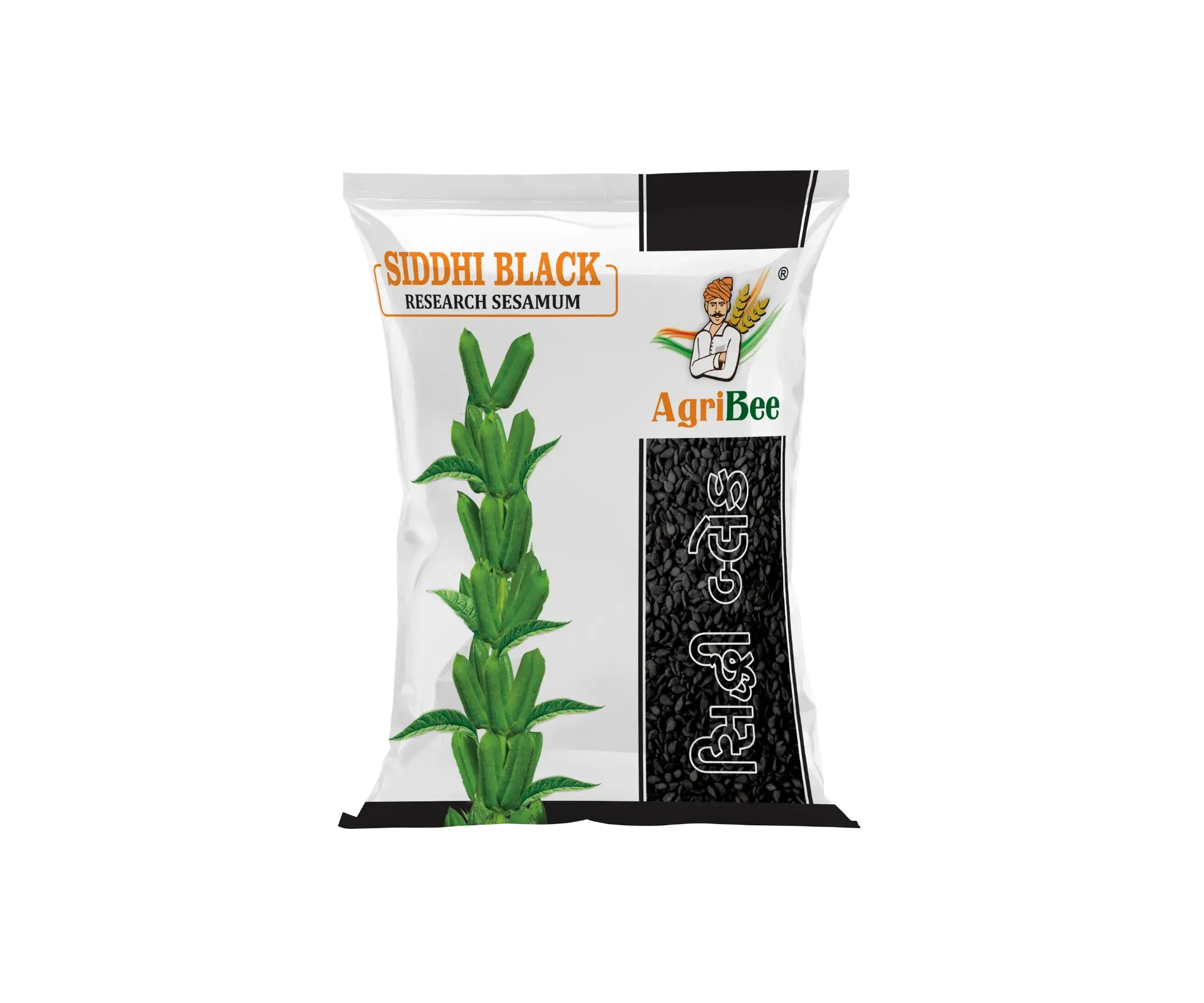
Sesamum Siddhi Black is a high-vigor, semi-determinate variety developed by AgriBee Seeds with exceptional capsule retention and reduced shattering — a critical trait for harvesting efficiency.
🌿 उपज की गुणवत्ता एवं रूप-रंग
Produces uniformly black, medium-sized seeds with a glossy sheen and high oil percentage (45–55%). Seeds show excellent color consistency and minimal broken or shriveled kernels, meeting top export-grade standards.
🌿 तनाव एवं रोग प्रतिरोधक क्षमता
Demonstrates strong field tolerance to Fusarium wilt and moderate resistance to phytophthora blight. The compact yet well-branched architecture reduces canopy humidity, lowering susceptibility to foliar diseases under humid Kharif conditions.
🌿 वृद्धि स्वभाव एवं ओज (विगर)
మొక్కల ఎత్తు of 105–110 cm with strong upright stem architecture and prolific lateral branching (8–12 branches per plant). The bushy habit ensures maximum capsule-bearing nodes per plant and efficient land use.
🌿 फसल अवधि एवं पकने का समय
Reaches 50% flowering within 45–50 days and attains physiological maturity in 90–100 days. This medium-early duration allows flexible rotation with Kharif pulses or Rabi crops, maximizing annual farm productivity.
🌿 मंडी एवं किसान प्राथमिकता
Farmers favor Siddhi Black for its reliable germination, uniform stand, and low shattering loss. Traders and oil millers prefer the variety due to superior seed color, high oil performance, and clean black seeds that command premium mandi rates.