Description
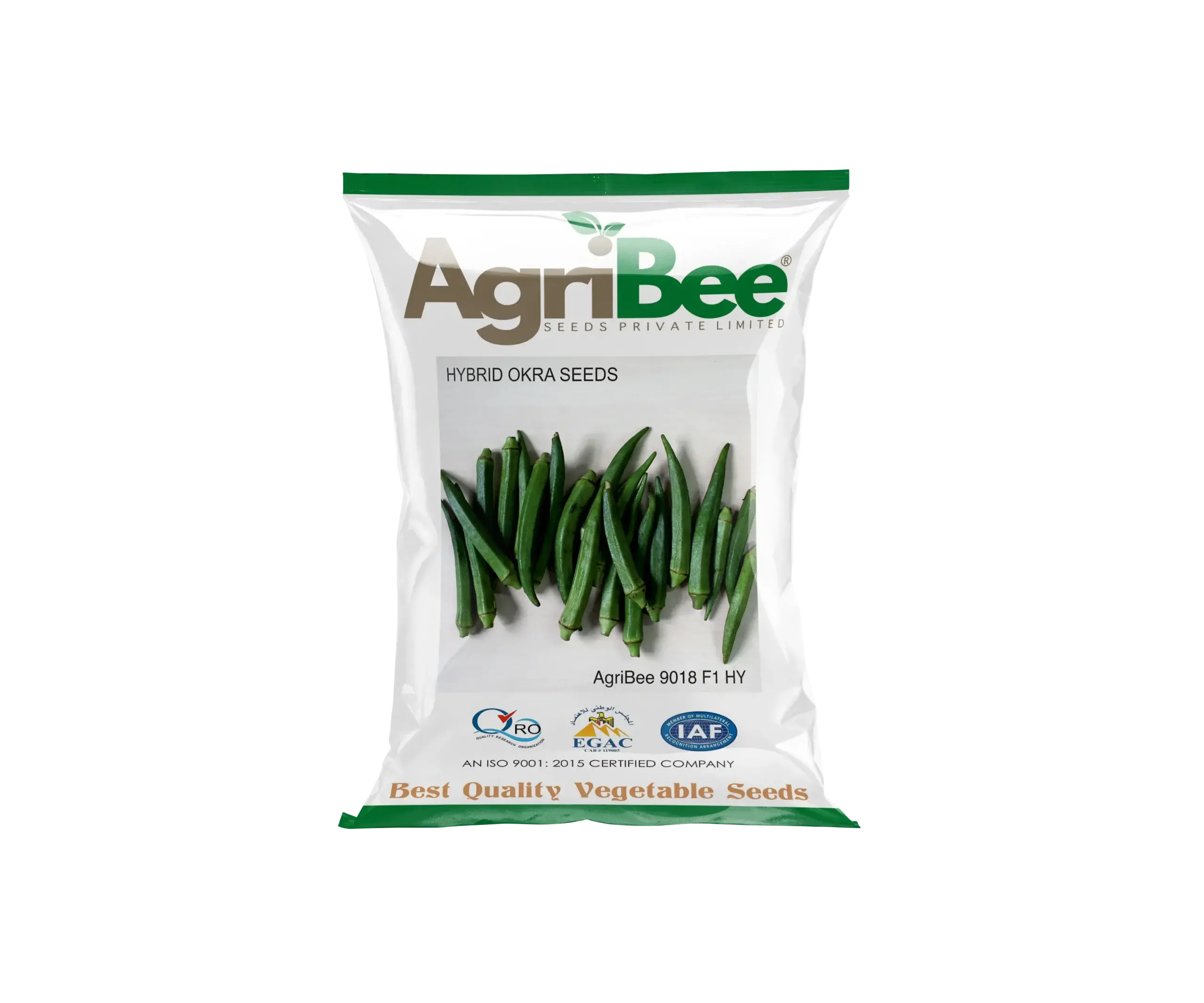
Farming & Cultivation Guide — Okra Seeds AgriBee 9018 F1 HY
Complete step-by-step agronomic guide for optimal crop management, disease resistance, and premium produce quality.
🌾 Soil Preparation & Field Prep
Proper land preparation ensures uniform seedling emergence and robust root anchorage.
🌱 Ideal Soil Type & pH
Well-drained loamy or sandy-loam soils with pH 6.0–7.5. Deep, fertile soils with good organic matter content support vigorous growth. Waterlogging must be avoided as okra is highly sensitive to stagnation.
✨ Core Advantage
Loose, well-aerated seedbed ensures rapid and uniform germination while allowing deep root penetration for improved nutrient uptake and drought resilience during critical growth phases.
- 1
Deep summer ploughing to 25–30 cm followed by 2–3 cross-harrowings to obtain fine tilth and destroy weed seeds.
- 2
Field leveling using laser levelling or board levelling with proper drainage channels to prevent water stagnation.
- 3
Incorporate 8–10 tonnes per hectare of well-decomposed FYM or compost during last ploughing for soil structure and moisture retention.
- 4
Conduct soil health test; if pH is below 6.0, apply agricultural lime at 250–300 kg/ha. If alkaline (pH >7.5), incorporate gypsum at 500 kg/ha.
🌱 Sowing Time & Method
Precise seed rate and spacing maximize light interception and canopy development.
| Parameter | Recommendation | Agronomic Importance |
|---|---|---|
| Sowing Window | Kharif: June–July | Rabi: October–November | Summer: March–April under protective cultivation | Okra is a warm-season crop; sowing after the risk of chilling has passed ensures rapid germination and healthy early growth. |
| Seed Rate | 3–4 kg/ha for broadcast; 2.5–3 kg/ha for line sowing | Optimal seed rate maintains ideal plant population without overcrowding, reducing competition for light and nutrients. |
| Spacing | 60 cm (row-to-row) x 30–45 cm (plant-to-plant) | Adequate spacing promotes canopy spread, improves air circulation, reduces humidity-related disease pressure, and facilitates interculture operations. |
| Sowing Depth | 2–3 cm for normal soils; 3–4 cm for light sandy soils | Correct depth ensures adequate soil contact for moisture absorption while allowing the seedling to emerge without excessive energy expenditure. |
💧 Irrigation & Water Management
Adequate moisture regulation supports strong vegetative and reproductive growth.
☀️ Water Requirement Profile
Okra requires moderate irrigation but is moderately drought-tolerant once established. Average water requirement is approximately 400–500 mm over the crop cycle. Drip irrigation with fertigation is highly compatible and improves water use efficiency by 30–40%. Well-drained sandy loams may require frequent light irrigations, while clay loams need less frequent but deeper applications.
🌦️ Soil Moisture Management
In rainfed zones, ensure timely sowing to capture residual soil moisture. Mulching with straw or polythene sheet helps conserve soil moisture and suppress weeds. Avoid moisture stress during flowering and fruit set stages, as even brief dry spells can cause flower drop and poor pod development.
- ✓
First irrigation (thin irrigation) within 3–5 days after sowing to ensure uniform germination and seedling establishment.
- ✓
During vegetative phase (20–45 DAS), irrigate at 8–10 day intervals depending on soil texture and weather conditions; maintain moderate moisture without waterlogging.
- ✓
Critical stage: Flowering and fruit set (45–75 DAS) — irrigate at 6–8 day intervals. Moisture stress at this stage significantly reduces fruit set and quality.
- ✓
Reduce irrigation frequency 7–10 days before the final harvest to improve firmness and extend post-harvest shelf life.
🧪 Fertilizer & Nutrition Management
Balanced crop nutrition supports robust plant structure and premium produce quality.
| Nutrient | Recommended Dose (per Acre) | Application Method & Timing |
|---|---|---|
| Nitrogen (N) | 80–100 kg/acre (60–75 kg N/ha as basal + 40–50 kg N/ha split at 30 DAS and 50 DAS) | Basal application of 40 kg/acre at sowing; rest split equally at first and second interculture weeding. |
| Phosphorus (P2O5) | 40–50 kg/acre (30–40 kg P2O5/ha) | 100% basal application as DAP (18:46:00) or SSP alongside seedbed preparation. |
| Potash (K2O) | 30–40 kg/acre (25–30 kg K2O/ha) | Apply 50% basal with P fertilizer and remaining 50% at first top-dressing to support fruit development and stalk strength. |
🌿 Interculture & Weed Management
Timely weed control ensures optimal nutrient and moisture availability for crop seedlings.
-
1
First Weeding & Hoeing: Perform shallow hoeing at 15–20 days after sowing (DAS) to control early weed flush. Avoid deep cultivation to prevent root damage. Manual weeding is preferred to protect the shallow root system of okra seedlings.
-
2
Second Weeding & Earthing-Up: Conduct second weeding at 30–35 DAS along with earthing-up around the plant base. This improves root aeration, prevents lodging, and conserves soil moisture during the active vegetative phase.
-
3
Mulching and Inter-row Operations: Apply black polythene mulch or organic straw mulch at 20 DAS to suppress weeds, conserve moisture, and maintain lower soil temperature. Remove spent leaves and lateral branches (desuckering) after first harvest to improve airflow and reduce pest habitats.
🛡️ Pest & Disease Management
Proactive crop monitoring and integrated management ensure healthy crop development.
🐛 Insect Pest Management
- Shoot and Fruit Borer (Helicoverpa armigera): Larvae bore into shoots, flowers, and young fruits causing wilting, hole exit signs, and frass accumulation. Control: Apply Bacillus thuringiensis (Bt) @ 250 ml/acre at 25 DAS and repeat at 40 DAS. For severe infestation, use Emamectin benzoate 5 SG @ 150 g/acre or Chlorantraniliprole 18.5 SC @ 100 ml/acre. Rotate modes of action to prevent resistance.
- Pink Fruit Bug / Stink Bug (Eocanthecona furcellata & Nezara viridula): Nymphs and adults suck sap from pods, causing discoloration, corky patches, and pod deformation. Control: Spray Neemastron @ 3 ml/litre or Azadirachtin 1% @ 2 ml/litre at early infestation. For heavy attacks, use Malathion 50 EC @ 1.5 ml/litre. Monitor with pheromone traps (10 traps/acre) for early warning.
- Jassids / Leafhoppers (Amrasca biguttula): Sucking damage causes yellowing and browning of leaf margins ('hopper burn'), stunted growth, and reduced photosynthetic area. Control: Spray Imidacloprid 17.8 SL @ 0.3 ml/litre or Thiamethoxam 25 WG @ 0.2 g/litre. Install yellow sticky traps @ 10 per acre for monitoring and mass trapping. Maintain field hygiene to remove alternate hosts.
🔬 Disease Control
- Yellow Vein Mosaic Virus (YVMV): Symptoms include bright yellow chlorotic webbing on leaves, severe stunting, and reduced branching. Transmitted by whiteflies (Bemisia tabaci). Tolerance: AgriBee 9018 F1 HY carries documented tolerance to YVMV. Prevention: Deploy whitefly traps (yellow sticky) @ 20/acre, spray Confidor 70 WS @ 0.3 ml/litre during early vector buildup, and remove infected plants immediately. Avoid close proximity to previous okra crops.
- Powdery Mildew (Erysiphe cichoracearum): White powdery growth on leaves and stems, progressing to chlorosis and premature defoliation. Favored by dry weather with high humidity. Control: Spray Sulphur dust @ 15–20 kg/acre or Micronised sulphur 80 WP @ 2 g/litre. For resistant varieties, preventive spray at 30 DAS is recommended under high disease pressure.
- Fusarium Wilt (Fusarium oxysporum f. sp. abelmoschi): Progressive yellowing and wilting of lower leaves, vascular browning, and plant collapse. Soil-borne pathogen thriving in warm, moist conditions. Control: Soil drench with Trichoderma viride @ 10 g/litre or Pseudomonas fluorescens @ 5 g/litre at transplanting/sowing. Crop rotation with non-host cereals for 2–3 seasons and use of raised beds for drainage are essential preventive measures.
✂️ Harvesting & Produce Quality Guide
Harvesting at peak maturity ensures maximum commercial grade and long keeping quality.
⏱️ Harvesting Schedule & Timing
First picking begins at 45–50 days after sowing. Subsequent pickings are taken at 2–3 day intervals. Total harvest span extends over 30–45 days with 7–10 pickings per plant cycle.
⭐ Produce Quality Characteristics
Pods are slender, tender, and free from fibrous strands. Dark green coloration, smooth ridged surface, and crisp texture define premium quality. Tenderness is retained up to 12 cm length. The variety exhibits consistent pod set and uniformity across multiple pickings.
| Quality Parameter | Agronomic Standard | Farmer & Market Benefit |
|---|---|---|
| First Harvest Stage | 45–50 Days after Sowing | Enables early market entry when supply is limited, fetching better price realization. |
| Harvest Maturity Signs | Pods 10–12 cm long, dark green, tender when bent; seeds not yet developed hard | Ensures optimal tenderness and avoids fiber formation that occurs with over-maturity. |
| Shelf Life & Keeping Quality | 3–5 days under ambient conditions; 7–10 days at 10–12°C with 85–90% RH | Sturdy, dark green pods with thick walls retain marketable quality during transport and show sale. |
| Market Suitability | Fresh market (mandi), retail chains, export-grade under controlled packaging, and processing units | Slender, attractive dark green pods with 5 prominent ridges meet premium buyer specifications for domestic and export markets. |
⭐ Varietal Features — Okra Seeds AgriBee 9018 F1 HY
Distinguishing characteristics that make this variety a top choice for Indian growers.
🌿 Core Variety Highlight
AgriBee 9018 F1 HY is a hybrid okra specifically bred for Yellow Vein Mosaic Virus (YVMV) tolerance, making it reliable in YVMV-prone zones across central and western India.
🌿 Produce Quality & Appearance
Produces slender, dark green, 5-ridged pods of 10–12 cm with exceptional tenderness, minimal fiber, and attractive sheen that commands premium rates in mandi and retail channels.
🌿 Stress & Disease Tolerance
Documented field tolerance to YVMV; moderate resistance to powdery mildew under typical Indian growing conditions; good adaptation to variable moisture regimes.
🌿 Growth Habit & Vigor
Compact to semi-compact plant architecture with strong primary growth, well-branched secondary shoots, and upright foliage that maximizes light interception and simplifies spray operations.
🌿 Crop Duration & Earliness
First harvest at 45–50 days after sowing enables earlier crop turnover, flexible rotation planning, and access to pre-monsoon or early winter premium price windows.
🌿 Market & Farmer Preference
Farmers favor this variety for its uniform pod set, attractive dark green color, YVMV resilience, and consistent delivery of trade-standard slender pods across multiple harvests—making it a dependable choice for contract farming and organized procurement.