
Description
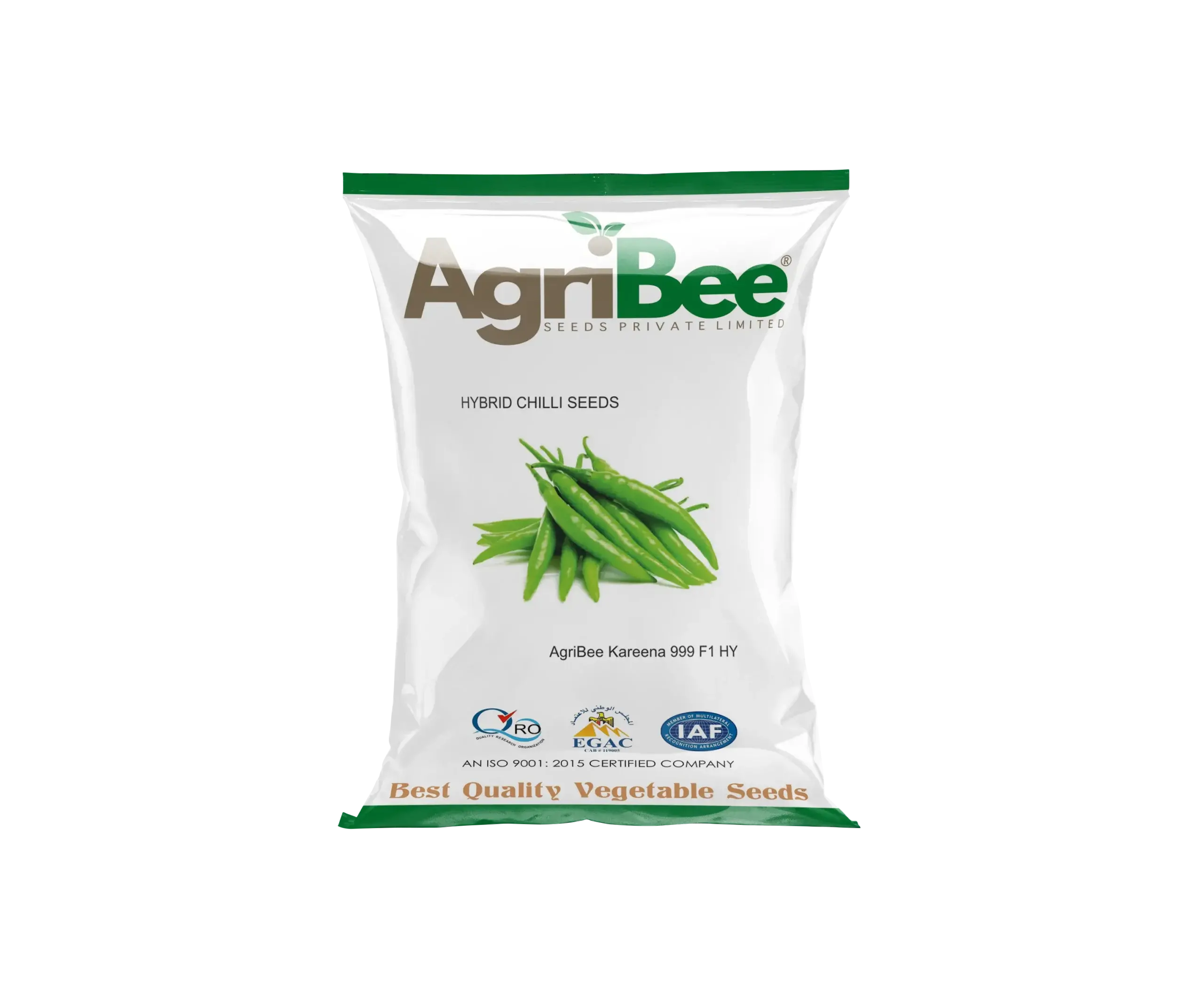
खेती एवं बुवाई निर्देशिका — मिर्च Seeds AgriBee Kareena 999 F1 HY
फसल के सर्वोत्तम प्रबंधन, रोग प्रतिरोधकता और प्रीमियम उत्पादन के लिए संपूर्ण चरणबद्ध कृषि निर्देशिका।
🌾 भूमि की तैयारी एवं खेत सुधार
खेत की समुचित जुताई एवं तैयारी से एकसमान अंकुरण और मजबूत जड़ों का विकास होता है।
🌱 आदर्श मिट्टी का प्रकार एवं pH
Well-drained loamy or sandy-loam soils with pH 6.0–7.5. मिर्च thrives in fertile, organic-rich soils with good moisture retention but absolutely no waterlogging.
✨ प्रमुख कृषि लाभ
Loamy soil with good structure ensures rapid seedling establishment, deep root penetration, and sustained nutrient uptake throughout the crop cycle.
- 1
Deep summer ploughing followed by 2–3 cross-harrowings to achieve a fine, well-tilled seedbed.
- 2
Field leveling and formation of drainage channels to prevent water stagnation around root zones.
- 3
Incorporation of 8–10 tonnes per acre of well-decomposed FYM or compost during final harrowing.
- 4
Soil health conditioning with gypsum (if sodic) or sulfur (if alkaline) to maintain optimal pH for nutrient availability.
🌱 बुवाई का समय एवं विधि
सटीक बीज दर और सही दूरी से पौधों को पर्याप्त सूर्य का प्रकाश और संतुलित विकास मिलता है।
| मानक / पैरामीटर | अनुशंसा / निर्देश | कृषि महत्व |
|---|---|---|
| बुवाई समय सीमा | June–July for Kharif; October–November for Rabi; February–March for Summer | Aligns sowing with favorable temperature and humidity for optimal germination and vegetative growth |
| बीज दर (प्रति एकड़) | 250–300 g per acre (transplanted method) | Ensures adequate nursery seed for thinning and uniform stand establishment in the main field |
| कतार एवं पौधे का अंतर | 60 cm (row-to-row) × 45 cm (plant-to-plant) | Optimizes canopy spread, sunlight interception, and air circulation to reduce disease pressure |
| Sowing / Transplanting Depth | 0.5–1.0 cm depth for direct sowing; 2–3 true-leaf stage for transplanting | Shallow covering ensures uniform emergence while proper nursery age prevents transplant shock |
💧 सिंचाई एवं जल प्रबंधन
उचित नमी प्रबंधन से पौधे की वानस्पतिक एवं फलने-फूलने की अवस्था में जोरदार विकास होता है।
☀️ जल आवश्यकता एवं सिंचाई प्रोफाइल
मिर्च is moderately drought-tolerant once established but demands consistent soil moisture for sustained flowering and fruit set. Drip irrigation is highly recommended with 3–4 cm of water per week during active growth. Over-irrigation must be strictly avoided as it promotes root rot and blossom-end drop.
🌦️ Soil नमी प्रबंधन
Under rainfed conditions, mulching with straw or polythene sheeting conserves soil moisture and suppresses weeds. Critical moisture stress periods—flower initiation and young fruit development—must be managed with supplementary irrigation wherever possible.
- ✓
First irrigation 5–7 days after transplanting to promote root establishment; apply as a gentle soak rather than a heavy flood.
- ✓
During vegetative phase (20–45 DAT), irrigate at 7–10 day intervals depending on soil type and weather conditions.
- ✓
Critical stage irrigation during flowering and fruit set (45–60 DAT): maintain consistent moisture to prevent flower drop and ensure uniform fruit development.
- ✓
Reduce irrigation frequency 10–15 days before the last harvest to improve fruit firmness and extend shelf life.
🧪 उर्वरक एवं पोषण प्रबंधन
संतुलित पोषण से मजबूत पौधा संरचना और उच्च गुणवत्ता वाली उपज प्राप्त होती है।
| पोषक तत्व | अनुशंसित मात्रा (प्रति एकड़) | प्रयोग विधि एवं समय |
|---|---|---|
| नाइट्रोजन (N) | 60–80 kg/acre | 50% basal at transplanting; remaining 50% split equally at 30 DAT and 60 DAT |
| फॉस्फोरस (P2O5) | 40–50 kg/acre | 100% basal application mixed with FYM and applied at transplanting |
| पोटाश (K2O) | 40–50 kg/acre | 100% basal except for 25% reserved for top-dressing at flowering to enhance fruit quality and pungency |
🌿 निराई-गुड़ाई एवं खरपतवार नियंत्रण
समय पर खरपतवार नियंत्रण से मुख्य फसल को पूर्ण पोषण और नमी मिलती है।
-
1
पहली निराई-गुड़ाई: Carry out first weeding and shallow hoeing at 15 days after transplanting (DAT) to control early weed flush and improve soil aeration without damaging shallow roots.
-
2
दूसरी निराई एवं मिट्टी चढ़ाना: Perform second weeding at 30 DAT along with earthing-up around plant bases to support the increasingly bushy canopy and improve root zone drainage.
-
3
Mulching and Staking: Apply black polythene mulch or organic straw mulch immediately after transplanting to conserve moisture, suppress weeds, and maintain soil temperature. Stake plants in high-density or windy areas to prevent lodging under heavy fruit load.
🛡️ कीट एवं रोग नियंत्रण
फसल की सक्रिय निगरानी और एकीकृत प्रबंधन से रोगमुक्त एवं स्वस्थ फसल सुनिश्चित होती है।
🐛 कीट प्रबंधन एवं रोकथाम
- aphid (Myzus persicae): Sucks sap from leaves and tender shoots causing curling and yellowing; vector for viral diseases. Control: Spray Imidacloprid 17.8% SL at 0.3 ml/liter or Neem-based pesticide (Azadirachtin 1% EC) at 2.5 ml/liter. Repeat at 10-day intervals if infestation persists.
- fruit borer (Helicoverpa armigera): Larvae bore into fruits causing direct damage and secondary infections. Control: Spray Chlorantraniliprole 18.5% SC at 0.4 ml/liter or Spinosad 45% SC at 0.3 ml/liter. Use pheromone traps at 10 traps/acre for monitoring and mass trapping.
- red spider mite (Tetranychus spp.): Causes stippling and bronzing of leaves, especially under dry and hot conditions. Control: Spray Hexythiazox 5% WP at 0.5 g/liter or Abamectin 1.9% EC at 0.3 ml/liter. Maintain adequate soil moisture to discourage mite outbreaks.
🔬 रोग नियंत्रण एवं उपचार
- bacterial leaf spot (Xanthomonas campestris pv. vesicatoria): Small water-soaked lesions on leaves turning brown with yellow halos; fruit lesions are raised and scabby. Preventive: Spray Copper oxychloride 50% WP at 2.5 g/liter at 10-day intervals starting from 30 DAT. Remove and destroy infected plant debris.
- anthracnose (Colletotrichum capsici): Dark sunken spots on mature fruits with pinkish sporulation in humid conditions. Control: Spray Mancozeb 75% WP at 2.0 g/liter or Carbendazim 50% WP at 1.0 g/liter. Avoid overhead irrigation and ensure proper spacing for canopy drying.
- wilt (Fusarium oxysporum f. sp. capsici): Sudden wilting of one side of the plant with yellowing and vascular browning. Prevention: Use disease-free hybrid & research seeds, practice 3-year crop rotation, drench soil with Trichoderma viride at 10 g/liter around seedlings, and remove symptomatic plants with surrounding soil.
✂️ कटाई एवं उपज गुणवत्ता निर्देशिका
सही परिपक्वता पर कटाई से अधिकतम मंडी भाव और बेहतर भंडारण क्षमता मिलती है।
⏱️ कटाई समय एवं निर्धारण
First picking begins 65–70 days after transplanting. Subsequent pickings are made at 5–7 day intervals, totaling 7–9 harvest rounds over an extended picking window.
⭐ उपज की गुणवत्ता एवं विशेषताएं
Long, slender dark green fruits with a sleek glossy appearance, firm texture, and high pungency. The variety delivers uniform fruit size and shape, thick walls, and excellent market gradeability suitable for both fresh consumption and processing.
| गुणवत्ता मानक | कृषि मानक | किसान एवं मंडी लाभ |
|---|---|---|
| पहली कटाई / तुड़ाई Stage | 65–70 days after transplanting | Ensures early market entry when prices are typically favorable |
| परिपक्वता के लक्षण | Dark green color, glossy skin, firm texture, and fruits reaching 8–10 cm length | Prevents over-maturity that leads to softening and reduces shelf life |
| भंडारण क्षमता एवं टिकाऊपन | 7–10 days under ambient conditions; up to 15 days under cool storage (10–12°C) | Facilitates long-distance transportation and extends the marketing window for farmers |
| मंडी मांग एवं उपयुक्तता | Fresh market, mandis, export-grade trading, and dry chilli processing | उच्च (High) pungency and attractive dark green color command premium rates from traders and processors |
⭐ किस्म की विशेषताएं — मिर्च Seeds AgriBee Kareena 999 F1 HY
विशिष्ट विशेषताएं जो इस किस्म को भारतीय किसानों की पहली पसंद बनाती हैं।
🌿 किस्म की मुख्य विशेषताएं
AgriBee Kareena 999 F1 HY is a hybrid chilli developed for exceptional field vigor, uniform plant architecture, and reliable performance across multiple growing seasons in India.
🌿 उपज की गुणवत्ता एवं रूप-रंग
Produces long, slender fruits (8–10 cm) with dark green coloration, thick walls, and high pungency—highly preferred by traders and consumers for fresh markets and value-added processing.
🌿 तनाव एवं रोग प्रतिरोधक क्षमता
Demonstrates strong field tolerance to Fusarium wilt and moderate resistance to bacterial leaf spot and anthracnose, ensuring consistent crop health under varying environmental conditions.
🌿 वृद्धि स्वभाव एवं ओज (विगर)
Medium-tall, bushy plant with strong branching habit and upright fruit orientation, enabling efficient light capture and easy harvesting operations.
🌿 फसल अवधि एवं पकने का समय
Early maturing with first harvest at 65–70 days after transplanting, allowing flexible crop rotation planning and multiple cropping systems across Indian agro-climatic zones.
🌿 मंडी एवं किसान प्राथमिकता
Uniform fruit size, high pungency, attractive dark green color, and excellent shelf life make this variety a trusted choice among progressive farmers, commission agents, and export-oriented buyers.