
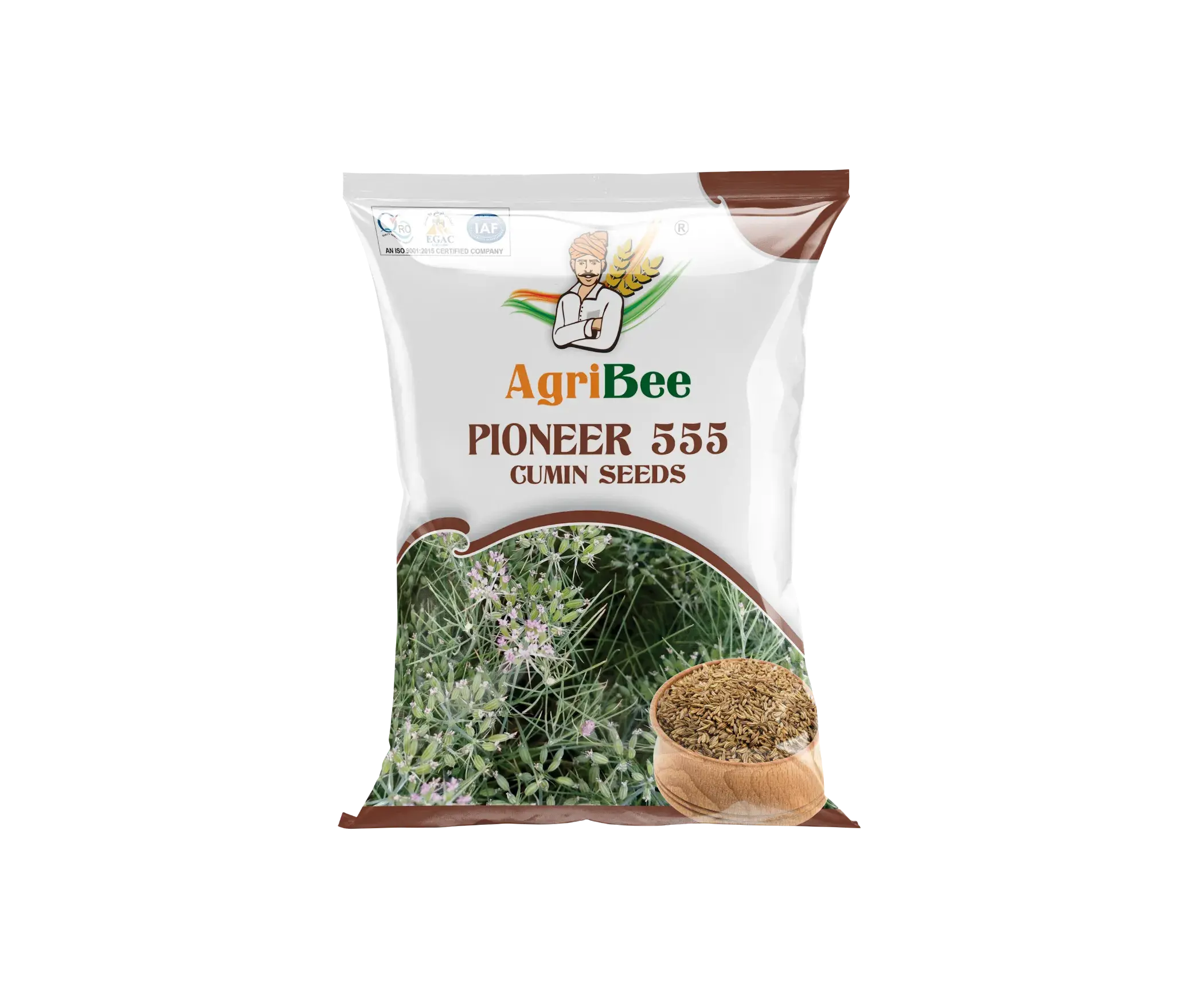
Description
खेती एवं बुवाई निर्देशिका — जीरा Pioneer 555
फसल के सर्वोत्तम प्रबंधन, रोग प्रतिरोधकता और प्रीमियम उत्पादन के लिए संपूर्ण चरणबद्ध कृषि निर्देशिका।
🌾 भूमि की तैयारी एवं खेत सुधार
खेत की समुचित जुताई एवं तैयारी से एकसमान अंकुरण और मजबूत जड़ों का विकास होता है।
🌱 आदर्श मिट्टी का प्रकार एवं pH
Well-drained loamy to sandy-loam soils with good aeration; pH range 6.5 – 8.0. जीरा thrives in light soils free from waterlogging. Heavy clay or saline soils should be avoided.
✨ प्रमुख कृषि लाभ
Fine, loose tilth ensures rapid germination of tiny cumin seeds, uniform seedling emergence, and strong root anchorage in shallow-rooted plants reaching 25–28 cm.
- 1
Deep summer ploughing followed by 2–3 cross-harrowings to obtain fine, clod-free tilth essential for small-seeded cumin germination.
- 2
Field leveling with a leveller and preparation of shallow drainage channels to prevent any moisture stagnation around the root zone.
- 3
Incorporation of 15–20 quintals per acre of well-decomposed FYM or vermicompost during the last harrowing to improve soil structure and organic content.
- 4
Soil health conditioning through lime application where pH is below 6.5, and thorough cleaning of previous crop residues to reduce carry-over inoculum of fungal pathogens.
🌱 बुवाई का समय एवं विधि
सटीक बीज दर और सही दूरी से पौधों को पर्याप्त सूर्य का प्रकाश और संतुलित विकास मिलता है।
| मानक / पैरामीटर | अनुशंसा / निर्देश | कृषि महत्व |
|---|---|---|
| बुवाई समय सीमा | Mid-October to mid-November under Rabi conditions | Sowing within this window ensures cool early growth, avoids pre-monsoon humidity stress, and aligns flowering and fruit set with dry autumn conditions ideal for cumin. |
| बीज दर (प्रति एकड़) | 10 – 15 kg / ha (4 – 6 kg / acre) | उच्च (High)er seed rate compensates for small seed size and variable field germination, ensuring uniform plant population across the field. |
| कतार एवं पौधे का अंतर | Broadcast (broad carting) or 22.5 cm x 7.5 cm (line sowing) | ब्रॉड कार्टिंग maximizes land use for low-stature plants; narrow row line sowing improves canopy aeration and facilitates interculture operations. |
| बुवाई की गहराई | 1 – 2 cm (never deeper than 2.5 cm) | जीरा seeds are photoblastic and tiny; shallow sowing ensures adequate light exposure and rapid, uniform emergence without energy depletion in the cotyledon. |
💧 सिंचाई एवं जल प्रबंधन
उचित नमी प्रबंधन से पौधे की वानस्पतिक एवं फलने-फूलने की अवस्था में जोरदार विकास होता है।
☀️ जल आवश्यकता एवं सिंचाई प्रोफाइल
जीरा is moderately drought-sensitive despite being grown in semi-arid regions. It requires consistent soil moisture during germination, vegetative growth, and fruit development. Drip irrigation is highly compatible with line-sown cumin and delivers 30–40% water savings while maintaining uniform soil moisture. Avoid both waterlogging and prolonged dry spells, especially after flowering.
🌦️ Soil नमी प्रबंधन
In rainfed zones, ensure the seedbed is moist at sowing. Use mulching (straw or bio-degradable sheets) to conserve surface moisture. If a pre-sowing irrigation (ghanḍ) is feasible, apply 25–30 mm to establish the crop before winter rains begin. Monitor soil moisture during January–February when rainfall may be sparse.
- ✓
First irrigation 5–7 days after sowing if soil moisture at seedbed is insufficient; critical for uniform germination of tiny seeds.
- ✓
Vegetative phase (15–45 DAS): Irrigate every 12–15 days depending on soil type — sandy soils require more frequent light irrigations; loamy soils can stretch to 15–18 day intervals.
- ✓
Critical stage — Flowering and fruit set (50–80 DAS): Maintain steady soil moisture with 10–12 day irrigation intervals. Water stress during this phase causes flower drop, poor fruit set, and shrivelled caryopses.
- ✓
Pre-harvest withholding: Cease all irrigation 15–20 days before planned harvest to allow fruits to dry on the plant, enhance essential oil concentration, and facilitate uniform maturation and easier threshing.
🧪 उर्वरक एवं पोषण प्रबंधन
संतुलित पोषण से मजबूत पौधा संरचना और उच्च गुणवत्ता वाली उपज प्राप्त होती है।
| पोषक तत्व | अनुशंसित मात्रा (प्रति एकड़) | प्रयोग विधि एवं समय |
|---|---|---|
| नाइट्रोजन (N) | 30 – 40 kg/acre (40 – 50 kg N/ha) | 50% basal at sowing + 50% top-dressed at 30 DAS with first irrigation |
| फॉस्फोरस (P2O5) | 20 – 25 kg/acre (25 – 30 kg P2O5/ha) | 100% basal applied as DAP or SSP at sowing, incorporated into the seedbed |
| पोटाश (K2O) | 15 – 20 kg/acre (20 – 25 kg K2O/ha) | 50% basal at sowing + 50% split at 30 DAS alongside nitrogen top-dressing for improved fruit filling and essential oil content |
🌿 निराई-गुड़ाई एवं खरपतवार नियंत्रण
समय पर खरपतवार नियंत्रण से मुख्य फसल को पूर्ण पोषण और नमी मिलती है।
-
1
पहली निराई-गुड़ाई: Carry out at 15–20 days after sowing (DAS) using a conformable hoe or hand weeder. जीरा has a shallow root system and slow early growth, making it highly vulnerable to weed competition during the first three weeks. A clean seedbed at this stage is critical for uniform stand establishment.
-
2
Second Weeding & Shallow Hoeing: Conduct at 30–35 DAS concurrently with nitrogen top-dressing. Perform shallow inter-row hoeing (2–3 cm depth only) to avoid damaging the fibrous root system. This operation improves soil aeration around the developing crown and controls late-emerging weeds before canopy closure.
-
3
Mulching and Interculture Maintenance: Apply straw mulch at 8–10 quintals per acre after the second weeding to conserve soil moisture, suppress residual weeds, and moderate soil temperature. In line-sown crops, perform occasional inter-row cultural tiller cultivation to maintain soil friability. Remove any volunteer or alternate host plants outside the field boundary to minimise pest reservoirs.
🛡️ कीट एवं रोग नियंत्रण
फसल की सक्रिय निगरानी और एकीकृत प्रबंधन से रोगमुक्त एवं स्वस्थ फसल सुनिश्चित होती है।
🐛 कीट प्रबंधन एवं रोकथाम
- Aphids (Macrosiphum euphorbiae): Sucking pests that colonize young leaves and tender stems, causing curling, yellowing, and stunted growth; also vectors viral diseases. Spray Imidacloprid 17.8% SL at 0.3 ml/litre water or Thiometon 25% WG at 0.8 g/litre water. For biological control, introduce Aphidius colemani or spray Neem-based formulation (Neem oil 3 ml/litre) at first sign of infestation.
- Jassids / Leafhoppers (Amrasca biguttula): Cause reddish-yellow leaf discoloration, leaf curling, and premature drying of foliage. The pests prefer hot, dry conditions common during late crop stages. Spray Dimethoate 30% EC at 1.0 ml/litre or Acephate 75% SP at 1.0 g/litre water. Install yellow sticky traps at 15 per acre for monitoring and reduction of adult populations.
- Pod Borer / Fruit Borer (Helicoverpa armigera): Larvae bore into developing fruits and seeds, causing direct performance loss and secondary fungal infection. Monitor with pheromone traps (20 per acre). Apply Bacillus thuringiensis (Bt) Kurstaki at 2.5 g/litre water at early larval stage, or spray Chlorantraniliprole 18.4% SC at 0.3 ml/litre during peak egg-laying periods. Practice deep winter ploughing to destroy overwintering pupae in soil.
🔬 रोग नियंत्रण एवं उपचार
- Downy Mildew (Peronospora farinosa f. sp. carvi): Identified by yellow chlorotic patches on upper leaf surface and grey-purple sporulation on the undersides under humid conditions. Preventive spray of Mancozeb 75% WP at 2.0 g/litre or Metalaxyl 35% WS at 0.8 g/litre at 30 DAS and repeated at 15-day intervals during humid weather. Ensure adequate plant spacing for air circulation and avoid late irrigation in evening hours.
- Leaf Spot / Cercospora Leaf Spot (Cercospora communis): Appears as small circular to irregular brown spots with dark margins on older leaves, progressing to defoliation under severe infestation. Apply Copper oxychloride 50% WP at 2.5 g/litre or Bordeaux mixture (1%) as preventive spray at 35 DAS and repeat at 20-day intervals. Remove and destroy heavily infected plant debris after harvest to reduce primary inoculum.
- Wilt / Root Rot (Fusarium oxysporum f. sp. cumini): Plants show sudden wilting, yellowing, and root rot with brown discoloration of vascular tissue. Prevention is critical — drench seedbed with Thiram or Carbendazim 50% WP at 2.5 g/litre before sowing. For in-field management, apply Trichoderma viride@d 5 g per litre water at base of affected plants along with soil drench. Rotate with non-host crops and avoid continuous cumin cultivation on the same field.
✂️ कटाई एवं उपज गुणवत्ता निर्देशिका
सही परिपक्वता पर कटाई से अधिकतम मंडी भाव और बेहतर भंडारण क्षमता मिलती है।
⏱️ कटाई समय एवं निर्धारण
Full crop harvest at 110–115 days after sowing when the majority of umbrellalets turn brown and seeds firm up. Cut entire plants close to the ground using a sickle or reaper, gather into small bundles (windrows), and stack for 2–3 days for further field curing before threshing.
⭐ उपज की गुणवत्ता एवं विशेषताएं
Light brown, elongated caryopses with prominent ridges and a characteristic strong aromatic odour. Essential oil content is high, imparting intense flavour and therapeutic properties. Seeds are uniform in size with good test weight, free from shrivelled or discoloured grains when harvested and cured properly.
| गुणवत्ता मानक | कृषि मानक | किसान एवं मंडी लाभ |
|---|---|---|
| कटाई की अवस्था | 110 – 115 बुवाई के दिन बाद | Ensures complete seed maturation with maximum essential oil accumulation and optimum sensory quality for market acceptance. |
| परिपक्वता के लक्षण | 70–80% umbrellalets turn yellow-brown; seeds feel hard between fingernails; plant stem becomes dry and brittle | Prevents over-maturity that leads to shattering and seed shedding, while ensuring under-maturity defects such as green or empty seeds are avoided. |
| भंडारण क्षमता एवं टिकाऊपन | 8 – 12 months under ambient storage; up to 18 months under cool, dry, moisture-proof conditions with essential oil retention above 90% | Facilitates long-distance transport, extended marketing windows, and sustained trader demand throughout the off-season. |
| मंडी मांग एवं उपयुक्तता | Dry spice mandis, export-grade whole seed market, processing units for essential oil extraction, and food manufacturing sectors | Uniform seed size, attractive light brown colour, and high essential oil content command premium rates from traders and exporters alike. |
⭐ किस्म की विशेषताएं — जीरा Pioneer 555
विशिष्ट विशेषताएं जो इस किस्म को भारतीय किसानों की पहली पसंद बनाती हैं।
🌿 Compact उच्च (High)-Vigor Plant Architecture
Stature of 25–28 cm makes जीरा Pioneer 555 a compact, sturdy variety with excellent lodging resistance and strong branch architecture supporting heavy fruit loads without plant collapse.
🌿 Premium Seed Appearance & Aroma
Produces uniform light brown, elongated caryopses with a consistently high essential oil profile, delivering strong aroma and flavour that meets stringent domestic and export market specifications.
🌿 Adapted Disease & Stress Resilience
Demonstrates good field tolerance to Downy Mildew, Leaf Spot, and Fusarium Wilt under Indian Rabi conditions, along with moderate drought resilience during the grain-filling phase when managed with sound irrigation practices.
🌿 Robust Vegetative Vigor & Canopy Development
Rapid early seedling establishment and healthy foliage development ensure effective weed suppression during the critical early growth phase, reducing dependency on intensive interculture operations.
🌿 Predictable Medium-Late Maturity Profile
Flowering initiates at 50–55 DAS with full maturity at 110–115 DAS, providing a reliable cropping timeline that fits neatly within the Indian Rabi calendar and allows for subsequent crop sequencing in rotation systems.
🌿 Trusted AgriBee Quality Standard
Developed and validated under diverse Indian growing conditions, जीरा Pioneer 555 is preferred by progressive farmers and seed dealers for its uniformity, reliable germination, strong market appeal, and consistent field performance season after season.