
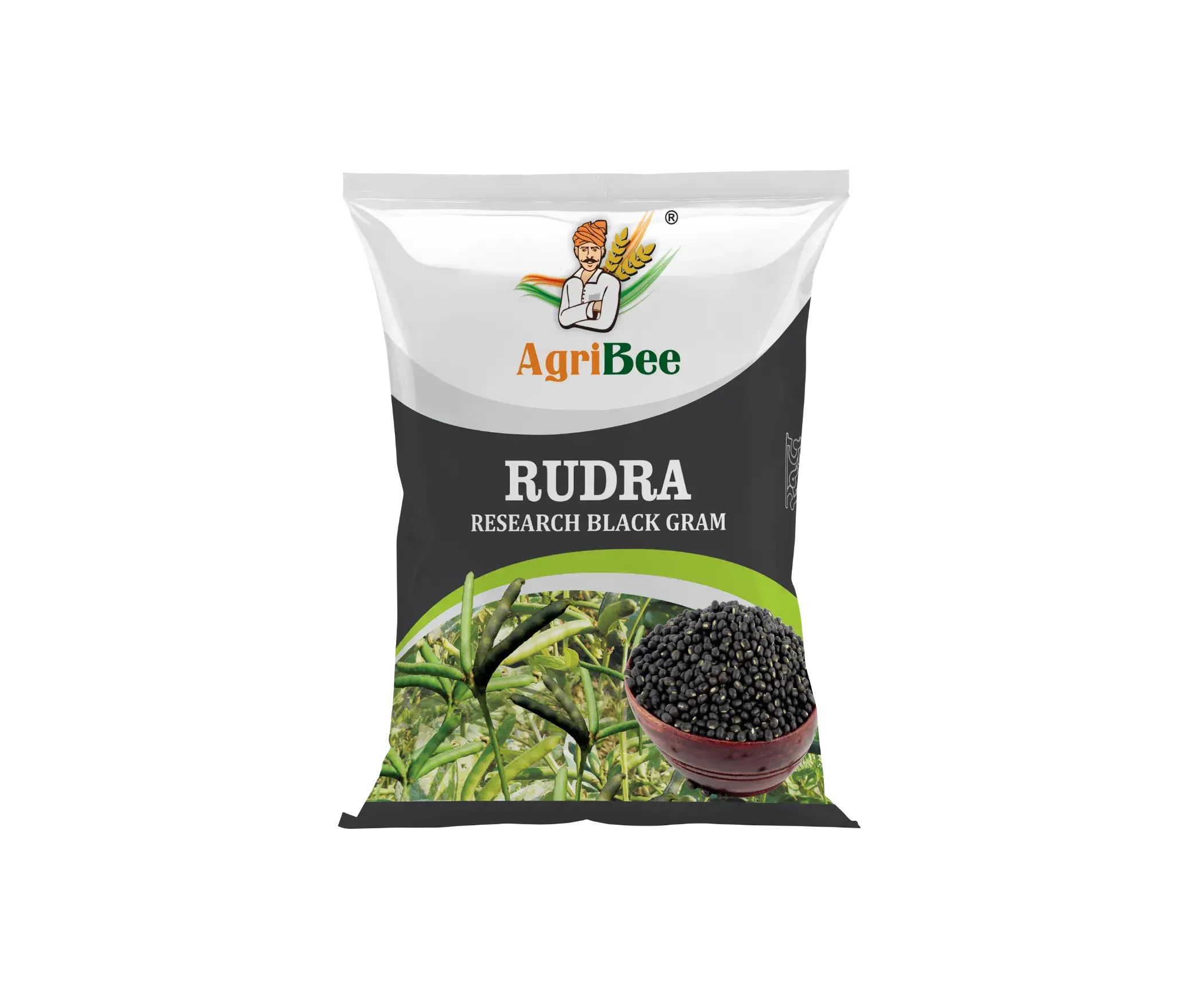
Description
खेती एवं बुवाई निर्देशिका — BlackGram Rudra
फसल के सर्वोत्तम प्रबंधन, रोग प्रतिरोधकता और प्रीमियम उत्पादन के लिए संपूर्ण चरणबद्ध कृषि निर्देशिका।
🌾 भूमि की तैयारी एवं खेत सुधार
खेत की समुचित जुताई एवं तैयारी से एकसमान अंकुरण और मजबूत जड़ों का विकास होता है।
🌱 आदर्श मिट्टी का प्रकार एवं pH
Well-drained sandy loam to clay loam soils; pH 6.0–7.8; medium fertility preferred.
✨ प्रमुख कृषि लाभ
Adapted to diverse Indian agro-climates with deep taproot ensuring strong anchorage and efficient moisture/nutrient uptake.
- 1
Two to three deep ploughings in summer followed by harrowing and leveling for fine tilth.
- 2
Creation of raised beds or flats depending on rainfall intensity to ensure good drainage.
- 3
Incorporation of 5–8 tonnes/ha well-decomposed FYM or compost during last ploughing.
- 4
Soil testing and liming if pH <5.5; gypsum application in saline-affected patches.
🌱 बुवाई का समय एवं विधि
सटीक बीज दर और सही दूरी से पौधों को पर्याप्त सूर्य का प्रकाश और संतुलित विकास मिलता है।
| मानक / पैरामीटर | अनुशंसा / निर्देश | कृषि महत्व |
|---|---|---|
| बुवाई समय सीमा | Early June to mid-July (Kharif); early October to mid-November (Rabi) | Aligns with monsoon onset for guaranteed germination; avoids late-season waterlogging or frost stress. |
| बीज दर (प्रति एकड़) | 40–50 kg/ha (rainfed); 25–30 kg/ha (irrigated) | Ensures optimal plant population (150,000–200,000 plants/ha) for canopy closure and weed suppression. |
| कतार एवं पौधे का अंतर | 45 cm (row-to-row) × 10 cm (plant-to-plant) | Balances light interception, air circulation, and branch expansion for uniform grain fill. |
| बुवाई की गहराई | 3–5 cm in light soils; 4–6 cm in heavy soils | Promotes uniform emergence without burying cotyledons too deep, enhancing germination rate. |
💧 सिंचाई एवं जल प्रबंधन
उचित नमी प्रबंधन से पौधे की वानस्पतिक एवं फलने-फूलने की अवस्था में जोरदार विकास होता है।
☀️ जल आवश्यकता एवं सिंचाई प्रोफाइल
BlackGram Rudra exhibits moderate drought tolerance due to its taproot system. Under rainfed conditions, rely on residual soil moisture; under irrigated systems, apply light irrigation at 25, 45, and 65 days after sowing to sustain vegetative growth and pod development.
🌦️ Soil नमी प्रबंधन
Apply mulch (straw/paddy husk) immediately after sowing to conserve topsoil moisture. Avoid water stagnation; install drainage channels in heavy soils to prevent root rot during intense rainfall.
- ✓
First irrigation at 20–25 DAS if soil moisture is critically low; otherwise wait for natural rainfall.
- ✓
Light irrigation every 10–12 days during vegetative phase (30–50 DAS) to maintain foliage vigor.
- ✓
Critical: irrigation at flower initiation (42–45 DAS) and early pod-filling stage (60–70 DAS) to prevent floral abortion.
- ✓
Withhold irrigation 10–12 days before harvest to facilitate even pod desiccation and reduce shattering.
🧪 उर्वरक एवं पोषण प्रबंधन
संतुलित पोषण से मजबूत पौधा संरचना और उच्च गुणवत्ता वाली उपज प्राप्त होती है।
| पोषक तत्व | अनुशंसित मात्रा (प्रति एकड़) | प्रयोग विधि एवं समय |
|---|---|---|
| नाइट्रोजन (N) | 20–25 kg N/ha | 50% basal at sowing as DAP; rest split and applied as urea at 30 DAS. |
| फॉस्फोरस (P₂O₅) | 40–50 kg P₂O₅/ha | 100% basal at sowing through Di-ammonium Phosphate (DAP) or Single Super Phosphate (SSP). |
| पोटाश (K₂O) | 20–30 kg K₂O/ha | 100% basal at sowing as MOP; supports stalk strength and grain filling. |
🌿 निराई-गुड़ाई एवं खरपतवार नियंत्रण
समय पर खरपतवार नियंत्रण से मुख्य फसल को पूर्ण पोषण और नमी मिलती है।
-
1
पहली निराई-गुड़ाई: Carry out at 15 DAS using hand hoe or rotary weeder. Maintains weed-free period crucial for seedling establishment and root aeration.
-
2
दूसरी निराई एवं मिट्टी चढ़ाना: Perform at 30 DAS; lightly heap soil around bases to support branching and improve moisture retention near roots.
-
3
विशेष अंतर-कृषि क्रियाएं: Apply organic mulch (2–3 t/ha straw) after first weeding to suppress weeds and conserve soil moisture. Remove weak lateral suckers manually to direct nutrients toward main branches.
🛡️ कीट एवं रोग नियंत्रण
फसल की सक्रिय निगरानी और एकीकृत प्रबंधन से रोगमुक्त एवं स्वस्थ फसल सुनिश्चित होती है।
🐛 कीट प्रबंधन एवं रोकथाम
- pod borer (Helicoverpa armigera): Larvae bore into pods, causing defoliation and pod damage. Control: Spray neem-based biopesticide (Neem oil 3 ml/L water) or carbendazim 50 WP (0.1%) at 30 and 45 DAS. Use pheromone traps at 10/acre.
- green aphid (Aphis craccivora): Sucks sap from young shoots and pods, leading to curling and sooty mold. Control: Spray imidacloprid 17.8 SL (0.3 ml/L) or release ladybird beetles. Maintain field sanitation.
- jassid (Amrasca biguttula): Causes leaf yellowing and edge browning; vector of yellow mosaic virus. Control: Spray thiamethoxam 25 WG (0.2 g/L) or sticky yellow traps at 20 DAS. Remove infected plants promptly.
🔬 रोग नियंत्रण एवं उपचार
- powdery mildew (Erysiphe cichoracearum): ਚਿੱਟਾ powdery growth on leaves and pods; reduces photosynthetic area. Control: Spray wettable sulfur (2 g/L) or myclobutanil 70 WP (0.5 g/L) at first appearance. Ensure proper spacing for air circulation.
- yellow mosaic virus (YVMV): Vein clearing, leaf curling, stunting; transmitted by jassids. Control: Use hybrid & research resistant seed; remove and destroy affected plants. Spray insecticides to control vector; apply foliar nutrients to boost recovery.
- anthracnose (Colletotrichum truncatum): Dark sunken lesions on stems and pods; causes cracking. Control: Seed treatment with trichoderma viride (4 g/kg seed). Field spray with copper oxychloride (3 g/L) at 30 DAS prophylactically.
✂️ कटाई एवं उपज गुणवत्ता निर्देशिका
सही परिपक्वता पर कटाई से अधिकतम मंडी भाव और बेहतर भंडारण क्षमता मिलती है।
⏱️ कटाई समय एवं निर्धारण
Harvest when 70–80% pods turn black/dark brown and plant stems dry (75–85 DAS). Cut entire plant at base, bundle, and sun-dry for 2–3 days before threshing.
⭐ उपज की गुणवत्ता एवं विशेषताएं
Seeds are uniformly black, small-sized (100-seed weight ~3.2 g), with smooth texture, high protein content, and excellent cooking quality. Foliage remains dense and green until maturity, indicating robust photosynthetic activity.
| गुणवत्ता मानक | कृषि मानक | किसान एवं मंडी लाभ |
|---|---|---|
| कटाई की अवस्था | 75–85 days after sowing | Ensures full seed maturation and maximum grain quality with minimal shattering losses. |
| परिपक्वता के लक्षण | Pods dark brown/black, seeds hard and shiny, leaves yellowish-brown | Prevents over-maturity that leads to pod shattering and seed discoloration. |
| भंडारण क्षमता एवं टिकाऊपन | Seeds maintain viability and cooking quality for 8–10 months at ambient storage (moisture <10%) | Enables extended market availability and reduced post-harvest losses. |
| मंडी मांग एवं उपयुक्तता | Preferred for direct human consumption, retail packaging, and export markets due to uniform black color and small seed size | Fetches premium rates in domestic mandis and meets international grading standards. |
⭐ किस्म की विशेषताएं — BlackGram Rudra
विशिष्ट विशेषताएं जो इस किस्म को भारतीय किसानों की पहली पसंद बनाती हैं।
🌿 Compact Growth Habit
ਪੌਦੇ ਦੀ ਉਚਾਈ 30–40 cm with 4–5 well-branched stems, promoting efficient land use and ease of mechanized harvest.
🌿 Premium Seed Quality
Uniform black seed coat, small size (3.2 g/100 seeds), high protein content, and consistent cooking texture appreciated by consumers.
🌿 Disease & Stress Resilience
Inherent tolerance to yellow mosaic virus, powdery mildew, and Jassid attacks; moderate drought resilience ensures stable performance under variable rainfall.
🌿 Fast Maturity
Reaches 50% flowering in 42–45 days and full maturity in 75–85 days, enabling flexible cropping sequences and multiple crop cycles per year.
🌿 Vigorous Canopy Development
Lush foliage cover reduces weed pressure, conserves soil moisture, and sustains photosynthetic activity throughout pod-filling stage.
🌿 Farmer & Trader Preference
Reliable germination rate (>85%), uniform maturity, and excellent grain appearance make BlackGram Rudra a trusted choice among growers and procurement agents across India.