
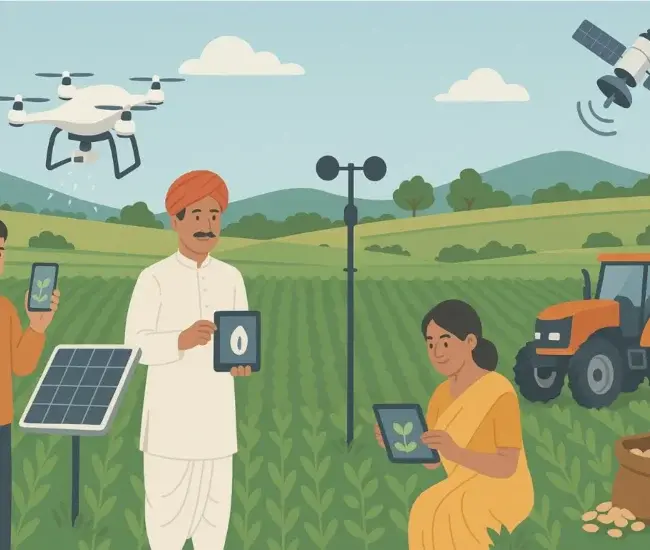
6 Low-Cost Technologies That Are Changing Indian Agriculture
The agricultural sector in India is undergoing a quiet revolution, propelled not by massive industrial operations but rather by accessible and reasonably priced technology that are changing the way smallholder farmers operate. These tools enhance yields, boost efficiency, and aid in climate uncertainty adaptation in addition to lowering operating costs. Small and marginal landholdings are used by more than 85% of Indian farmers. Productivity has been hampered by traditional issues, including unpredictable rains, an excessive reliance on manual labour, and restricted access to market knowledge. However, inexpensive technology designed for Indian circumstances are closing the gap. Farmers are receiving affordable gadgets that solve actual field issues thanks to government programmes and innovative startups. The future of Indian agriculture is being redefined by these advances, which range from post-harvest cold storage to soil health management.Soil Testing Kits Improve Nutrient Management
Yield potential is determined by the health of the soil. However, typical lab-based testing takes a lot of time and is frequently unavailable to rural farmers. This is resolved by portable soil testing kits that provide immediate, on-site nutrient readings. Farmers can use colorimetric kits to evaluate micronutrients, pH, and NPK levels through straightforward chemical reactions. These kits save weeks of waiting for lab results and can be purchased for as little as ₹300 to ₹1000. This technology helps farmers:- Reduce fertilizer waste by knowing exactly what nutrients are needed
- Lower input costs by 15 to 30%
- Improve yield through targeted nutrient management
Mobile Agriculture Apps Support Real-Time Decision Making
Smartphones have transformed rural communication. Now, mobile apps are bringing agronomic advice, mandi prices, and pest alerts directly to farmers’ hands.- Weather APIs for hyperlocal forecasts
- Push notifications to alert farmers about pest outbreaks or market changes
- AI chatbots to offer crop advisory in local languages
Micro-Irrigation Brings Water Precision to Small Farms
In Indian agriculture, water stress is a constant threat. More than 52% of arable land depends on erratic rainfall. Drip and micro-irrigation systems provide solutions that improve yields while conserving water. Low-cost kits that use emitters, flow regulators, and polyethylene pipes to distribute water straight to plant roots start at ₹2,500 for 1-acre setups. These systems:- Cut water usage by 30–50% compared to flood irrigation
- Enable fertigation (nutrients via water), boosting nutrient uptake
- Increase yields by 20–40% in vegetables and fruits
Solar-Powered Cold Storage Reduces Post-Harvest Loss
Post-harvest spoiling costs India ₹92,000 crore a year. Farmers lack access to cold storage, particularly those who cultivate perishables like spinach and tomatoes. This is being changed by solar-powered cold storage devices. To keep vegetables fresh off-grid, these machines use solar panels, battery backups, and insulated chambers. With capacities ranging from 500 kg to 2 tonnes, startups like Ecozen and Tan90 provide cold storage for between ₹30,000 and ₹1.5 lakh. They help:- Extend shelf-life of produce by 4–7 days
- Enable better price realization at distant markets
- Reduce spoilage losses by over 40%
Affordable Farm Mechanization Fills the Labor Gap
Farm inefficiencies and increased labour costs are the results of rural labour migration. Large tractors and harvesters are neither suitable nor cheap for smallholders. This is being resolved by low-cost mechanisation, such as weed. Products such as:- Power tillers (₹40,000 to ₹70,000)
- Hand-operated seed drills (₹2,000 to ₹6,000)
- Battery-powered weeders (₹15,000 to ₹30,000)
IoT Sensors Enable Precision with Simple Devices
Precision farming is no longer just for large farms. Affordable IoT sensors and data dashboards are now being deployed in Indian villages. These devices monitor:- Soil moisture
- Ambient temperature
- Light intensity and humidity
Government and NGO Support Fuel Tech Access
Tech adoption isn't possible without financing and support. The Indian government, along with NGOs, is facilitating tech reach through schemes, subsidies, and training. Major initiatives include:- PMFBY (crop insurance) and PMKSY (irrigation subsidies)
- Soil Health Card Scheme for nutrient tracking
- ISAP and Digital Green for training and extension services
Farmer Success Stories Showcase Real Impact
In Maharashtra’s Yavatmal district, farmer Ramesh Pawar installed a ₹3,000 drip irrigation kit on his cotton field. His water usage dropped by 48%, and yield rose by 38%. He reinvested savings into seed drills. In Bihar, Meena Devi, a member of a local SHG, used a ₹350 soil test kit. She identified a potassium deficiency and adjusted her fertilizer use, increasing rice yield by 20% while cutting input costs by ₹2,000. In Andhra Pradesh, a farmer group rented a solar cold storage unit for ₹500/day during the tomato harvest season. Their spoilage dropped from 22% to under 5%, allowing them to supply to larger urban retailers. These stories show how small, actionable tech steps result in measurable benefits.Challenges Slow Down Adoption in Some Areas
Despite the advantages, there is still opposition to digital use. Financial disparities, inadequate infrastructure, and low digital literacy remain obstacles. App usage is restricted by mobile internet reliability and rural broadband. Due to inadequate training or subpar after-sales support, many farmers mistrust untested equipment. Another obstacle is cost perception; even inexpensive tools appear costly in the absence of finance or subsidies. Additionally, Tier 3 regions lack qualified experts for diagnosis and repairs.What Does the Future Hold?
Emerging innovations will drive the next phase of agri transformation in India:- AI-based crop prediction tools using historical and satellite data
- Blockchain-led supply chain traceability to assure buyers of the product origin
- Edge computing sensors that work without internet, ideal for remote farms
- Swarms of autonomous UAVs for crop monitoring and pest spraying
FAQs
- What is the most affordable technology for Indian farmers today? Soil testing kits are among the most affordable, costing ₹300–₹1000 and offering quick results to improve crop nutrition decisions.
- Are mobile apps really helping rural farmers? Yes. Agri apps offer weather alerts, pest warnings, and market prices. Many farmers report better yields and reduced input costs after using them.
- How much water can drip irrigation save? Drip systems reduce water use by 30–50% and improve yields. They also lower weed growth and allow nutrient delivery via fertigation.
- Can farmers get government help to buy tech tools? Yes. Schemes like PMKSY and KCC offer subsidies, loans, and training support for purchasing tools like drip kits, soil testers, and more.
- Do IoT devices work in areas with no internet? Many IoT tools now use LoRaWAN and store data locally, enabling offline operation with periodic syncs.