Description
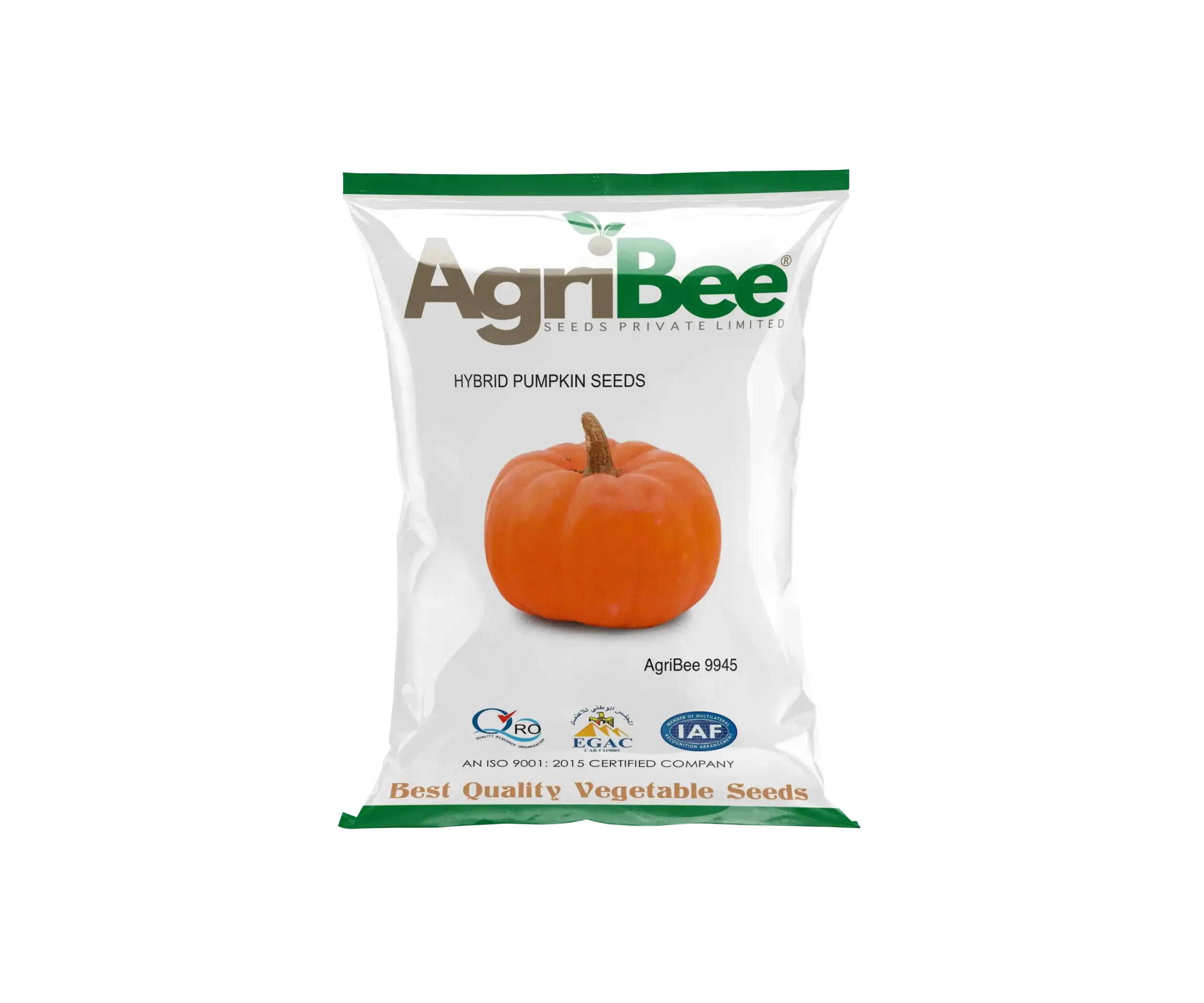
Farming & Cultivation Guide — Pumpkin Seeds AgriBee 9945
Complete step-by-step agronomic guide for optimal crop management, disease resistance, and premium produce quality.
🌾 Soil Preparation & Field Prep
Proper land preparation ensures uniform seedling emergence and robust root anchorage.
🌱 Ideal Soil Type & pH
Well-drained loamy to sandy-loam soils with pH 6.0 – 7.5. Cucurbita moschata performs best in soils with high organic matter content and good water-holding capacity without waterlogging.
✨ Core Advantage
Deep, friable soil ensures rapid seed germination, strong root penetration, and vigorous vine spread essential for flat-round ribbed fruit development.
- 1
Deep summer ploughing (25–30 cm) followed by 2–3 cross-harrowings to produce a fine, clod-free tilth.
- 2
Field leveling with laser leveling if available, and preparation of drainage channels to prevent water stagnation.
- 3
Incorporation of 8–10 tonnes per acre of well-decomposed FYM or compost during the last harrowing for improved soil structure and nutrient supply.
- 4
Soil testing for pH and nutrient status; if pH is below 6.0, apply agricultural lime at 200–250 kg/acre one month before sowing.
🌱 Sowing Time & Method
Precise seed rate and spacing maximize light interception and canopy development.
| Parameter | Recommendation | Agronomic Importance |
|---|---|---|
| Sowing Window | June – mid-July (Kharif) / October – early November (Rabi) | Aligns sowing with favorable temperatures (25–30°C) for rapid germination and avoids extreme heat stress during fruit development. |
| Seed Rate | 1.5 – 2.0 kg per acre (direct sowing) | Ensures adequate plant population while accounting for seed viability and field emergence variability. |
| Spacing | 3.0 – 3.5 m × 1.5 – 2.0 m (row-to-row × plant-to-plant) | Provides sufficient canopy spread area for flat-round ribbed fruit development and improves air circulation to reduce fungal incidence. |
| Sowing / Transplanting Depth | 2.5 – 3.5 cm deep (2 seeds per hill, later thinning to 1 robust seedling) | Optimal depth ensures adequate soil moisture contact for uniform germination while preventing deep-sown seed damping-off. |
💧 Irrigation & Water Management
Adequate moisture regulation supports strong vegetative and reproductive growth.
☀️ Water Requirement Profile
Pumpkin (Cucurbita moschata) requires moderate and consistent moisture throughout its growth cycle. While established vines show reasonable drought tolerance, prolonged moisture stress during flowering and fruit set significantly reduces fruit quality and firmness. Drip irrigation is highly recommended for uniform moisture delivery, reducing foliar disease pressure, and conserving water. Weekly deep irrigation of 40–50 mm is adequate during active growth phases.
🌦️ Soil Moisture Management
Under rainfed conditions, sow at the onset of monsoon rains to capture residual soil moisture. Mulching with straw or green foliage helps conserve soil moisture and suppress weeds. Ensure proper field drainage to avoid waterlogging during heavy rainfall, which can cause root rot and vine collapse. Supplemental irrigation during dry spells in the reproductive phase is critical for maintaining fruit flesh firmness and deep orange color development.
- ✓
First irrigation should be applied immediately after sowing (land preparation irrigation) followed by light irrigation 2–3 days post-sowing to ensure uniform seed germination.
- ✓
During the vegetative phase (20–50 DAS), irrigate at 7–10 day intervals depending on soil texture and weather conditions to support vigorous vine growth and leaf development.
- ✓
Critical irrigation window: 50–80 DAS (flowering through fruit development and flesh coloration). Maintain consistent soil moisture at this stage to prevent fruit cracking, hollow heart, and poor flesh quality. Avoid overhead irrigation during flowering to prevent pollination disruption.
- ✓
Reduce irrigation frequency from 80 DAS onward and completely withhold water 7–10 days before anticipated harvest to improve shelf life, firmness, and sugar concentration in the flesh.
🧪 Fertilizer & Nutrition Management
Balanced crop nutrition supports robust plant structure and premium produce quality.
| Nutrient | Recommended Dose (per Acre) | Application Method & Timing |
|---|---|---|
| Nitrogen (N) | 60 – 80 kg/acre | 40% basal at sowing along with P and K; remaining 60% as two split top-dressings at 30 DAS and 55 DAS to support sustained vine growth and fruit development. |
| Phosphorus (P2O5) | 40 – 50 kg/acre | 100% basal application incorporated into the soil during final harrowing or placed near seeds at sowing (band placement 5 cm below and beside the seed) to promote root development and early vigor. |
| Potash (K2O) | 40 – 50 kg/acre | 100% basal application at sowing; split application supports fruit firmness, deep orange flesh coloration, and overall produce quality. |
🌿 Interculture & Weed Management
Timely weed control ensures optimal nutrient and moisture availability for crop seedlings.
-
1
First Weeding & Hoeing: Carry out the first weeding and shallow hoeing at 15–20 DAS to eliminate early weed competition during the critical weed-sensitive stage. Use a rotavator or hand hoe carefully, keeping tools 5–7 cm away from the plant base to avoid root damage.
-
2
Second Weeding & Vine Training: Perform the second weeding and hoeing at 30–35 DAS. Guide spreading vines outward from the hill to maximize canopy utilization and improve air circulation. Light earthing-up around the hill base can help encourage adventitious root formation for improved nutrient uptake.
-
3
Mulching and Inter-row Maintenance: Apply organic mulch (straw, dried leaves, or intercrop residue) at 25–30 DAS to conserve soil moisture, suppress weed regeneration, and maintain lower soil temperature. Manual inter-row weeding should be done as needed. Remove any senescent or diseased leaves periodically to reduce disease inoculum and improve fruit exposure.
🛡️ Pest & Disease Management
Proactive crop monitoring and integrated management ensure healthy crop development.
🐛 Insect Pest Management
- Fruit and Shoot Borer (Diaphania perspectalis): Larvae bore into shoots, flowers, and young fruits causing wilting, hole damage, and frass exudation. Control: Apply Neem-based biopesticide (Neem oil 3 ml/liter or NPV spray 250 LE/acre) at 7-day intervals from flowering. For severe infestations, spray Chlorantraniliprole 18.5% SC at 60 ml/acre or Emamectin benzoate 5% SG at 200 g/acre. Remove and destroyInfested shoot tips manually.
- Cucurbit Beetle / Fruit Fly (Bactrocera cucurbitae): Adult beetles chew holes in leaves and fruits; fruit fly larvae cause larval galleries inside fruits, leading to rotting. Control: Apply yellow sticky traps at 10–12 traps per acre from 30 DAS. Spray Spinosad 45% SC at 100 ml/acre or Imidacloprid 17.8% SL at 50 ml/acre. Use protein bait spray (hydrolyzed protein + insecticide) at 5 ml/liter as a spot treatment on foliage every 10–12 days.
- Leaf Miner (Liriomyza trifolii): Serrated white trails and mines appear on leaves reducing photosynthetic area. Control: Apply Cartap hydrochloride 4% GR at 10–12 kg/acre as soil drench or spray Cartap 50% WP at 750 g/acre. Alternative: Spray Thiamethoxam 25% WG at 100 g/acre. Remove and burn heavily infested leaves to reduce pest buildup.
🔬 Disease Control
- Powdery Mildew (Erysiphe cichoracearum / Podosphaera xanthii): White powdery fungal growth on both leaf surfaces, leading to premature leaf drying and reduced fruit quality. Control: Spray Sulphur dust (80% WP) at 2 kg/acre or wettable sulphur at 2 g/liter at 7-day intervals from 30 DAS. For severe outbreaks, apply Propineb 50% WP at 2 g/liter or Myclobutanil 10.7% EC at 0.5 ml/liter. Rotate fungicide classes to prevent resistance.
- Downy Mildew (Pseudoperonospora cubensis): Angular yellow lesions bounded by leaf veins on upper surface with fuzzy grey-purple sporulation on the underside. Control: Spray Mancozeb 75% WP at 2.5 g/liter or Metalaxyl + Mancozeb (6.9% + 64%) at 2 g/liter at 7–10 day intervals during humid conditions. Ensure proper spacing and pruning for canopy airflow to minimize leaf wetness.
- Bacterial Wilt (Erwinia tracheiphila): Sudden wilting of individual branches or entire vine with brownish bacterial ooze from cut stems. Vector-controlled via cucumber beetles. Control: Remove and destroy infected plants immediately. Apply copper-based bactericides (Copper oxychloride 50% WP at 2.5 g/liter) as a prophylactic spray at 10-day intervals. Control root-infesting pests like stem borer larvae through soil applications of Carbofuran 3G at 10 kg/acre at sowing.
✂️ Harvesting & Produce Quality Guide
Harvesting at peak maturity ensures maximum commercial grade and long keeping quality.
⏱️ Harvesting Schedule & Timing
First harvest begins at 90–100 days after sowing. Harvest mature fruits when they reach full size (4–6 kg), the rind hardens, and the color becomes uniform. Cut the fruit leaving a 2–3 cm stem attachment to extend shelf life. Fruits can be harvested individually as they mature over a 7–10 day window.
⭐ Produce Quality Characteristics
Premium quality fruits exhibit a uniformly flat-round ribbed shape, firm and dense flesh with a rich deep orange color throughout. The rind is hard and resistant to minor handling bruising. Flesh texture is fine, non-fibrous, and sweet with low moisture content, making it ideal for cooking, pureeing, and processing. Fruit weight ranges between 4–6 kg, meeting commercial market standards.
| Quality Parameter | Agronomic Standard | Farmer & Market Benefit |
|---|---|---|
| First Harvest Stage | 90–100 Days after Sowing | Ensures full fruit development, maximum flesh firmness, and optimal deep orange pigmentation for premium market acceptance. |
| Harvest Maturity Signs | Hard rind (cannot be punctured with thumbnail), deep uniform orange skin color, dried and brown stem, and characteristic sound when tapped (hollow sound indicates maturity) | Prevents harvesting immaterial fruits with watery flesh and poor keeping quality. |
| Shelf Life & Keeping Quality | 3–4 weeks under ambient conditions (15–25°C) with 70–75% relative humidity; stems intact for maximum storage longevity | Facilitates long-distance transport, multiple market iterations, and extended selling window for farmers. |
| Market Suitability | Suitable for fresh mandis, retail chains, processing units (puree, soup, canned products), and value-added markets due to firm deep-orange flesh and attractive flat-round ribbed appearance | Commanding premium prices in both domestic and processing markets due to consistent visual appeal and superior culinary qualities. |
⭐ Varietal Features — Pumpkin Seeds AgriBee 9945
Distinguishing characteristics that make this variety a top choice for Indian growers.
🌿 Core Variety Highlight
AgriBee 9945 is a selectively bred Cucurbita moschata variety delivering uniform fruit set, strong vine vigor, and reliable field performance under diverse Indian growing conditions across Kharif and Rabi seasons.
🌿 Produce Quality & Appearance
Flat-round ribbed fruits with dense, firm deep orange flesh. Each fruit weighs 4–6 kg with an attractive uniform shape and rich coloration that commands premium rates in fresh and processing markets.
🌿 Stress & Disease Tolerance
Demonstrates good field tolerance to major cucurbit diseases including powdery mildew and downy mildew under moderate pressure, along with reasonable adaptation to moisture stress when managed with proper irrigation scheduling.
🌿 Growth Habit & Vigor
Vigorous vining habit with extensive lateral branching suited for sprawling cultivation. Strong canopy development supports uniform fruit sizing and provides natural ground cover for moisture conservation.
🌿 Crop Duration & Earliness
Reaches first harvest in 90–100 days after sowing, enabling timely crop completion and flexibility for subsequent crop rotation in intensive farming systems.
🌿 Market & Farmer Preference
Farmers and traders favor AgriBee 9945 for its consistent fruit shape, excellent deep orange flesh color, firm texture ideal for both fresh consumption and processing, and reliable germination and field establishment with AgriBee seed quality assurance.