Description
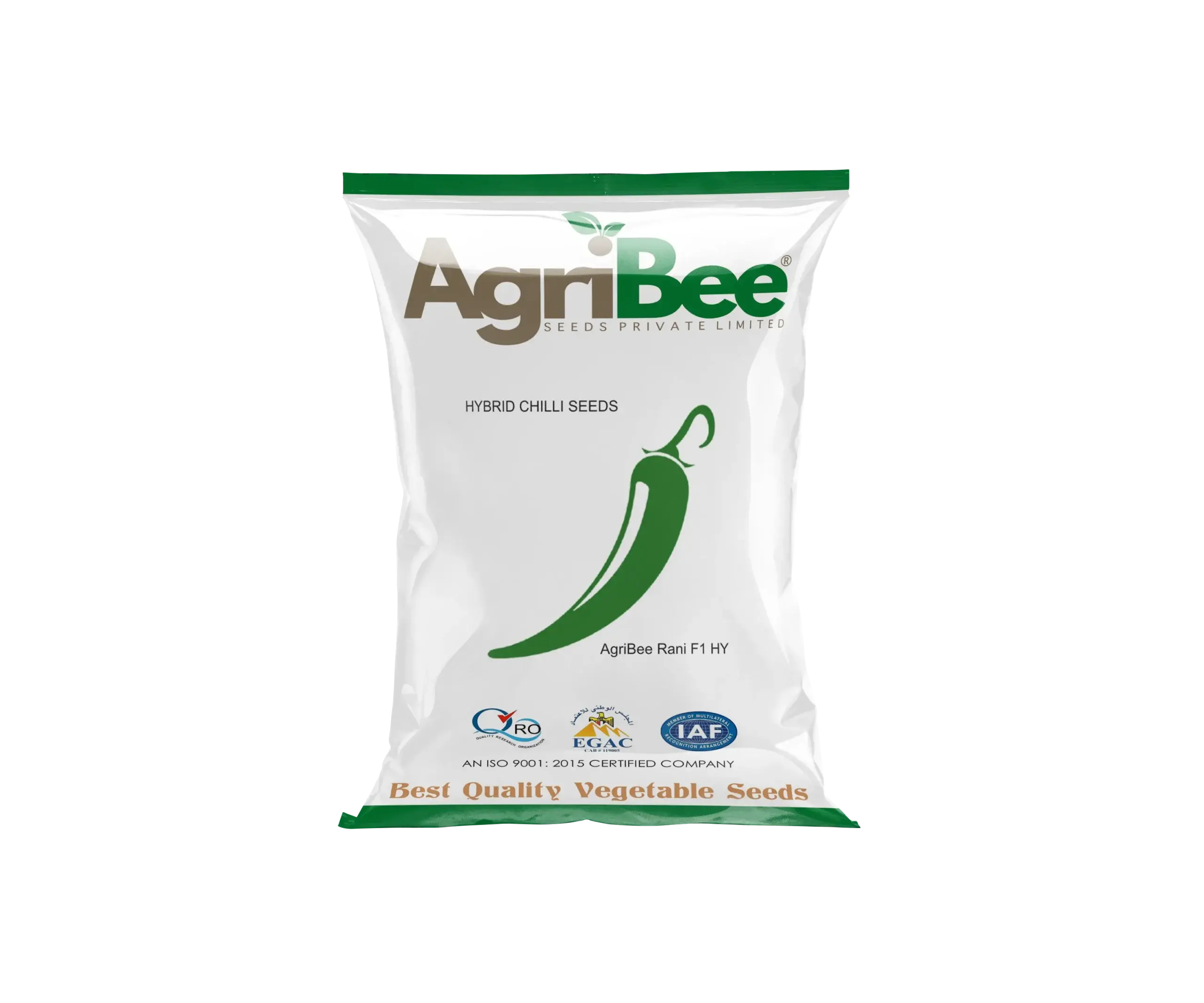
Farming & Cultivation Guide — Chilli Seeds AgriBee Rani F1 HY
Complete step-by-step agronomic guide for optimal crop management, disease resistance, and premium produce quality.
🌾 Soil Preparation & Field Prep
Proper land preparation ensures uniform seedling emergence and robust root anchorage.
🌱 Ideal Soil Type & pH
Well-drained loamy or sandy-loam soils with pH 6.0–7.5. Deep, fertile soils with good organic matter content are preferred. Avoid waterlogged or heavy clay soils prone to root rot.
✨ Core Advantage
Loamy soil with excellent drainage promotes rapid seedling establishment, strong root development, and sustained vegetative vigor throughout the crop cycle.
- 1Deep summer ploughing followed by 2–3 cross-harrowings for fine tilth and weed seed destruction.
- 2Field leveling and drainage preparation to prevent water stagnation during monsoon.
- 3Incorporate 8–10 tonnes per acre of well-decomposed FYM or compost during final land preparation.
- 4Conduct soil test and adjust pH using agricultural lime (if acidic) or gypsum (if alkaline) before sowing.
🌱 Sowing Time & Method
Precise seed rate and spacing maximize light interception and canopy development.
| Parameter | Recommendation | Agronomic Importance |
|---|---|---|
| Sowing Window | June–July for Kharif; October–November for Rabi season | Aligns crop growth with favorable temperature (25–30°C) and avoids extreme heat or heavy rain damage during flowering |
| Seed Rate | 250–300 g per Acre (Transplanted) | Ensures adequate plant population of approximately 35,000–40,000 plants per acre |
| Spacing | 45 cm (row-to-row) x 30 cm (plant-to-plant) | Promotes adequate canopy spread, sunlight penetration, and air circulation reducing disease pressure |
| Sowing / Transplanting Depth | Sow seeds at 0.5–1.0 cm depth in nursery; transplant at 3–4 true leaf stage (25–30 DAS) | Shallow sowing ensures rapid and uniform germination; proper transplanting depth prevents damping-off and stem rot |
💧 Irrigation & Water Management
Adequate moisture regulation supports strong vegetative and reproductive growth.
☀️ Water Requirement Profile
Chilli is moderately drought-tolerant but requires consistent soil moisture for optimal fruit set and quality. Drip irrigation is highly recommended with 2–3 mm water per application during active growth. The crop requires approximately 600–700 mm total water during the growing period. Under drip, apply water every 2–3 days during peak summer and every 4–5 days during Rabi season.
🌦️ Soil Moisture Management
In rainfed conditions, ensure proper field drainage to avoid waterlogging. Apply mulch (straw or black polyethylene film) to conserve soil moisture and reduce evaporation. Critical moisture stress periods include flowering and fruit development stages; supplemental irrigation during dry spells significantly improves fruit set and reduces flower dropping.
- ✓First irrigation immediately after transplanting (within 24 hours) to reduce transplanting shock and promote root establishment.
- ✓During vegetative phase (15–45 DAT), irrigate at 5–7 day intervals depending on soil type and weather conditions; maintain moderate soil moisture.
- ✓Critical stages — flowering and fruit setting (45–75 DAT) — require consistent moisture; avoid both water deficit and waterlogging as both cause flower and fruit drop.
- ✓Withhold irrigation 7–10 days before final harvest to improve fruit firmness, pungency, and shelf life.
🧪 Fertilizer & Nutrition Management
Balanced crop nutrition supports robust plant structure and premium produce quality.
| Nutrient | Recommended Dose (per Acre) | Application Method & Timing |
|---|---|---|
| Nitrogen (N) | 80–100 kg/acre | 50% basal at transplanting; 25% at 30 DAT; 25% at 60 DAT |
| Phosphorus (P2O5) | 50–60 kg/acre | 100% basal application at final land preparation mixed with FYM |
| Potash (K2O) | 40–50 kg/acre | 50% basal at transplanting; 50% split at 45 DAT for improved fruit quality and pungency |
🌿 Interculture & Weed Management
Timely weed control ensures optimal nutrient and moisture availability for crop seedlings.
🛡️ Pest & Disease Management
Proactive crop monitoring and integrated management ensure healthy crop development.
🐛 Insect Pest Management
- Thrips (Thrips tabaci): Sucking punctures on leaves cause silvery streaks and curling; flowers and young fruits show scarring. Spray Imidacloprid 17.8% SL at 0.3 mL/L or Spinosad 45% SC at 0.5 mL/L. Apply every 10–12 days during peak infestation. Install blue sticky traps at 15 traps per acre for monitoring.
- Whitefly (Bemisia tabaci): Yellowing, curling, and drying of leaves; honeydew leads to sooty mold. Spray Thiamethoxam 25% WG at 0.3 g/L or Acetamiprid 20% SP at 0.5 g/L. Deploy yellow sticky traps at 10 traps per acre. Remove and destroy infected plant parts promptly.
- Fruit Borer (Helicoverpa armigera): Larvae bore into fruits causing exit holes and frass accumulation; severely damaged fruits become unmarketable. Spray Chlorantraniliprole 18.5% SC at 0.3 mL/L or Bacillus thuringiensis var. kurstaki (Btk) at 2.5 g/L during early larval stage. Pheromone traps at 10 per acre for monitoring and mass trapping.
🔬 Disease Control
- Anthracnose (Colletotrichum capsici): Water-soaked lesions on fruits turning dark brown to black with concentric spore masses in humid conditions. Spray Mancozeb 75% WP at 2.5 g/L or Copper oxychloride 50% WP at 3.0 g/L at 10-day intervals starting at flowering. Ensure proper field drainage and avoid overhead irrigation.
- Bacterial Wilt (Ralstonia solanacearum): Sudden wilting of entire plant while remaining green; brown discoloration of vascular tissue visible on stem cross-section. No chemical cure; remove and burn infected plants. drench soil with Streptocycline 0.2 g/L or CopperBased bactericides at 10-day intervals around suspect areas. Practice 3-year crop rotation with non-Solanaceous crops.
- Powdery Mildew (Leveillula taurica): White powdery growth on upper and lower leaf surfaces; leaves turn yellow and dry prematurely reducing photosynthetic capacity. Spray Sulphur-based fungicide (Wettable Sulphur 80% WP at 2.5 g/L) or Myclobutanil 10% WP at 0.5 mL/L at 12–15 day intervals during cool dry weather.
✂️ Harvesting & Produce Quality Guide
Harvesting at peak maturity ensures maximum commercial grade and long keeping quality.
⏱️ Harvesting Schedule & Timing
First harvest begins 65–70 days after transplanting. Subsequent pickings are made at 7–10 day intervals. Typically 5–7 pickings are taken over a harvesting period extending 90–100 days after the first harvest.
⭐ Produce Quality Characteristics
Long slender dark green chilies with high pungency, smooth shiny skin, firm flesh, and attractive glossy appearance. Uniform fruit length of 8–10 cm with thick walls suitable for both fresh market and dry processing.
| Quality Parameter | Agronomic Standard | Farmer & Market Benefit |
|---|---|---|
| First Harvest Stage | 65–70 Days after Transplanting (DAT) | Ensures peak quality and early market arrival with premium pricing |
| Harvest Maturity Signs | Fruits attaining full length (8–10 cm), dark glossy green color, firm texture, and skin tautness | Prevents over-maturity and deterioration; maintains uniformity across picking |
| Shelf Life & Keeping Quality | 7–10 days under ambient conditions; up to 14 days under controlled cool storage at 8–10°C with high humidity | Facilitates long-distance transport, extended sales window, and reduced post-harvest losses |
| Market Suitability | Fresh table market, drying and spice powder processing, export-grade commodity | High pungency and attractive dark green color attract premium rates from traders and processors |
⭐ Varietal Features — Chilli Seeds AgriBee Rani F1 HY
Distinguishing characteristics that make this variety a top choice for Indian growers.
🌿 Core Variety Highlight
AgriBee Rani F1 is a high-performing hybrid with early maturity (65–70 days to first harvest), combining vigorous growth with high pungency and attractive dark green fruit.
🌿 Produce Quality & Appearance
Produces long slender fruits of 8–10 cm with dark green glossy skin, thick fleshy walls, and intense pungency making it ideal for fresh consumption and value-added processing.
🌿 Stress & Disease Tolerance
Demonstrates strong field tolerance to common chilli diseases including anthracnose and bacterial wilt, along with moderate adaptability to both Kharif and Rabi growing conditions across India.
🌿 Growth Habit & Vigor
Compact yet bushy plant architecture with strong branching, excellent foliage cover, and uniform fruiting habit enabling efficient canopy management and easier harvesting operations.