Description
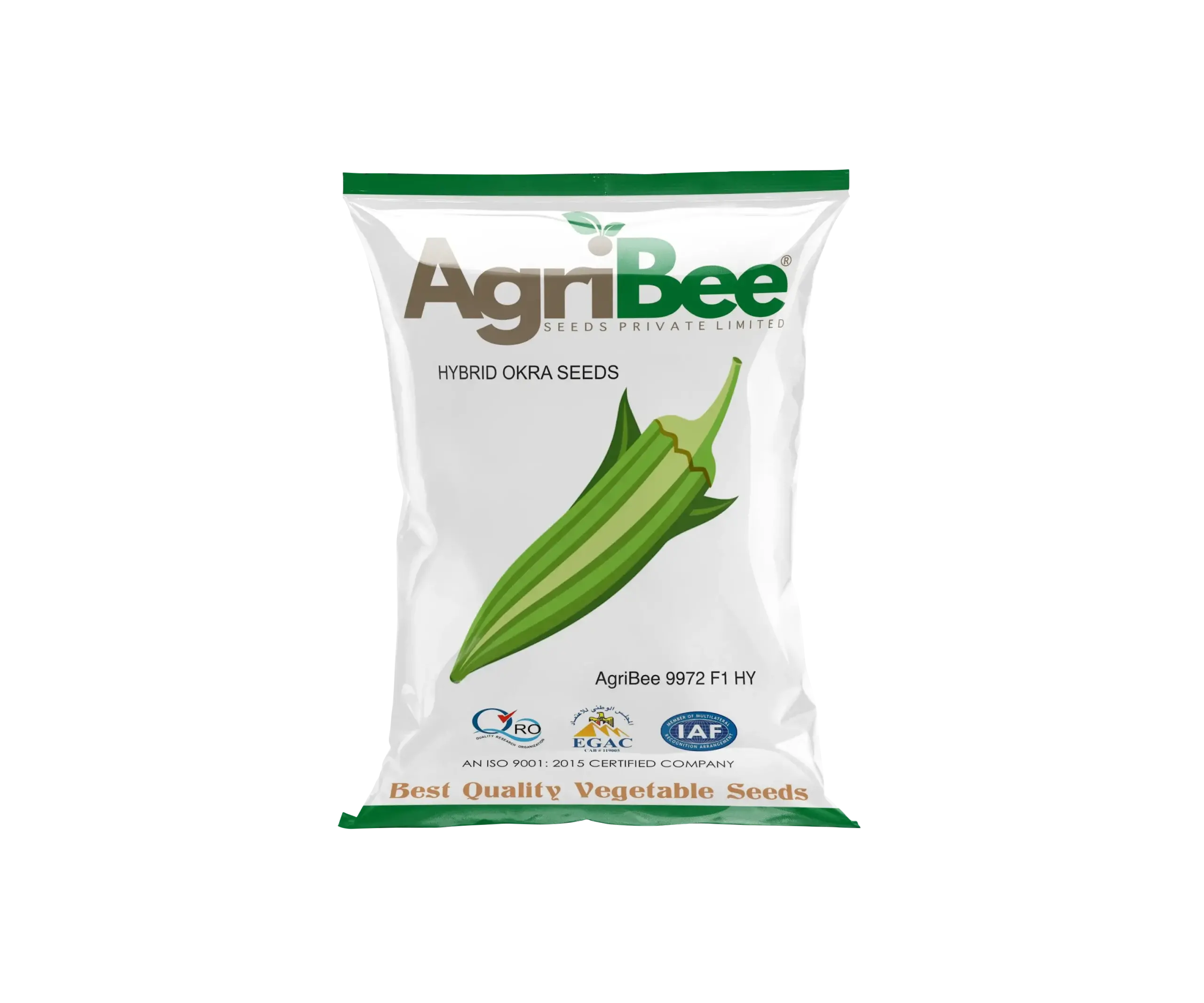
Farming & Cultivation Guide — Okra Seeds AgriBee 9972 F1 HY
Complete step-by-step agronomic guide for optimal crop management, disease resistance, and premium produce quality.
🌾 Soil Preparation & Field Prep
Proper land preparation ensures uniform seedling emergence and robust root anchorage.
🌱 Ideal Soil Type & pH
Well-drained loamy or sandy-loam soils with pH 6.0–7.5. Deep, fertile soils with good organic matter content support vigorous plant growth and sustained fruit production.
✨ Core Advantage
Loamy soils with good drainage ensure rapid seed germination, strong taproot development, and efficient nutrient uptake throughout the crop cycle.
- 1
Deep summer ploughing to a depth of 25–30 cm followed by 2–3 cross-harrowings for fine tilth and weed elimination.
- 2
Field leveling using a leveller and creation of effective drainage channels to prevent waterlogging during heavy rains.
- 3
Incorporation of 8–10 tonnes per hectare of well-decomposed FYM or compost during final harrowing for soil structure improvement.
- 4
Soil health conditioning: if pH is below 6.0, apply agricultural lime at 250–300 kg/ha; if above 8.0, incorporate gypsum at 200 kg/ha before sowing.
🌱 Sowing Time & Method
Precise seed rate and spacing maximize light interception and canopy development.
| Parameter | Recommendation | Agronomic Importance |
|---|---|---|
| Sowing Window | Kharif: June–July | Rabi: Oct–Nov | Summer: Feb–March | Ensures favorable temperature and moisture conditions for germination and protects young seedlings from early cold stress |
| Seed Rate | 25–30 g per acre (direct sowing) / 8–10 kg per hectare | Optimal seed rate maintains ideal plant population without overcrowding, ensuring each plant receives adequate sunlight and nutrition |
| Spacing | 60 cm (row-to-row) × 30–45 cm (plant-to-plant) | Balanced spacing promotes healthy canopy spread, improves air circulation, reduces disease pressure, and facilitates easy interculture operations |
| Sowing / Transplanting Depth | 2–3 cm for direct sowing; transplants raised in polybags for 15–20 days | Correct sowing depth ensures uniform emergence; seeds buried too deeply face reduced germination due to oxygen limitation |
💧 Irrigation & Water Management
Adequate moisture regulation supports strong vegetative and reproductive growth.
☀️ Water Requirement Profile
Okra is moderately drought-tolerant but responds well to regular irrigation. The crop requires approximately 400–500 mm of water over the growing period. Drip irrigation is highly compatible and improves water use efficiency by 30–40% while maintaining consistent fruit quality. Avoid both water stagnation and severe moisture stress, especially during flowering and fruiting phases.
🌦️ Soil Moisture Management
In rainfed situations, conservation tillage and mulching help retain soil moisture. Timely monsoon rainfall during sowing and early growth stages is critical. Supplemental irrigation of 2–3 critical events (flowering, fruit set, and pod filling) can significantly improve canopy health and fruit development even under marginal rainfall conditions.
- ✓
First irrigation (white irrigation) within 3–4 days after sowing to ensure uniform germination and seedling establishment.
- ✓
Vegetative phase: irrigate at 7–10 day intervals depending on soil type and weather; sandy soils require more frequent light irrigation.
- ✓
Critical stages — flowering, fruit set, and active pod development (30–60 DAS): maintain consistent soil moisture with irrigation every 5–7 days to prevent flower drop and ensure tender fruit development.
- ✓
Pre-harvest: reduce irrigation frequency 5–7 days before last picking to improve fruit firmness and extend post-harvest shelf life.
🧪 Fertilizer & Nutrition Management
Balanced crop nutrition supports robust plant structure and premium produce quality.
| Nutrient | Recommended Dose (per Acre) | Application Method & Timing |
|---|---|---|
| Nitrogen (N) | 60–80 kg/acre (40 kg basal + 20–40 kg top-dressed at 30 DAS) | 60% as basal with P and K; remaining 40% split at 30 DAS for sustained vegetative growth |
| Phosphorus (P2O5) | 40 kg/acre | 100% basal application through DAP (21:54:0) or SSP at sowing for root development and energy transfer |
| Potash (K2O) | 30–40 kg/acre | 100% basal through MOP for improved fruit quality, firmness, and disease resistance |
🌿 Interculture & Weed Management
Timely weed control ensures optimal nutrient and moisture availability for crop seedlings.
-
1
First Weeding & Hoeing: Carry out at 10–15 days after sowing (DAS) using a hoe or weedicide (pre-emergence oxyfluorfen at 240 ml/ha). Early weeding is critical as okra is a slow-establishing crop vulnerable to weed competition during the first three weeks.
-
2
Second Weeding & Earthing-Up: Perform at 25–30 DAS to remove weeds and lightly heap soil around plant bases. This improves root aeration, supports upright plant habit, and prevents lodging during heavy rains or fruit load.
-
3
Mulching and Inter-row Maintenance: Apply straw or black polyethylene mulch at 15–20 DAS to conserve soil moisture, suppress weed growth, and maintain fruit cleanliness by preventing soil splash. Remove any suckers or lateral branches below the first node to direct energy toward main stem and fruit production.
🛡️ Pest & Disease Management
Proactive crop monitoring and integrated management ensure healthy crop development.
🐛 Insect Pest Management
- Shoot and Fruit Borer (Helicoverpa armigera): Larvae bore into shoots and fruits causing wilting and FRuat damage. Control: Spray Neem-based formulations (Neem oil 3 ml/liter) or Bacillus thuringiensis (Bt) at 250 g/ha at 25, 40, and 55 DAS. For severe infestation, apply Chlorantraniliprole at 3 ml/ha or Indoxacarb at 150 g/ha following IPM guidelines.
- Okra Jassid / Leafhopper (Amrasca biguttula biguttula): Sucks sap causing yellowing, curling, and drying of leaves (hopper burn). Control: Spray Imidacloprid at 0.3 ml/liter or Thiamethoxam at 25 g/ha. Install yellow sticky traps at 15 per acre for monitoring and mass trapping. Maintain field hygiene by removing infected plants.
- Whitefly (Bemisia tabaci): Sucks sap and excretes honeydew leading to sooty mold; also transmits YVMV. Control: Apply Imidacloprid 17.8% SL at 0.3 ml/liter or Acetamiprid at 0.1 g/liter. Use blue sticky traps at 10 per acre. Rogue out infected plants immediately to break the virus transmission cycle.
🔬 Disease Control
- Yellow Vein Mosaic Virus (YVMV): Caused by Okra yellow vein mosaic virus (OkYVMV) transmitted by whitefly. Symptoms include bright yellow veinal mosaic, leaf reduction, and stunted growth. Control: This variety carries tolerance to YVMV. Practice whitefly vector management rigorously. Remove and destroy heavily infected plants. Apply systemic insecticides (Imidacloprid) preventively at 15 and 30 DAS.
- Powdery Mildew (Oidium abelmoschi): White powdery fungal growth on leaves and young FRuats. Control: Spray wettable sulfur at 2 g/liter or Myclobutanil at 0.1 g/liter at first sign of infection. Ensure proper plant spacing for canopy airflow. Avoid overhead irrigation to keep foliage dry.
- Damping Off and Root Rot (Pythium spp.): Seedlings collapse at soil level with water-soaked lesions. Control: Treat seeds with Carbendazim at 2 g/kg or T. viride at 4 g/kg before sowing. Avoid waterlogging and ensure well-drained seedbeds. Apply Copper oxychloride drench at 2.5 g/liter around sensitive seedlings if outbreak occurs.
✂️ Harvesting & Produce Quality Guide
Harvesting at peak maturity ensures maximum commercial grade and long keeping quality.
⏱️ Harvesting Schedule & Timing
First harvest begins at 45–50 days after sowing. Subsequent pickings are made at 2–3 day intervals, continuing for 6–10 harvesting cycles until plant vigor declines.
⭐ Produce Quality Characteristics
Premium dark green, slender, 5-ridged FRuats of 10–12 cm length with tender texture, minimal fiber, and excellent flavor. The produce commands premium prices in mandis due to superior appearance and market-ready grade consistency.
| Quality Parameter | Agronomic Standard | Farmer & Market Benefit |
|---|---|---|
| First Harvest Stage | 45–50 Days after Sowing | Early market arrival fetches better price realization and enables timely crop rotation |
| Harvest Maturity Signs | FRuits 10–12 cm long, dark green, firm, tender when bent; seams not yet prominent | Timely harvesting prevents over-maturity, fibrous texture, and seed hardening |
| Shelf Life & Keeping Quality | 3–4 days under ambient conditions; up to 7–10 days under controlled cool storage (8–10°C) | Firm dark green FRuits maintain commercial appeal over longer transport distances |
| Market Suitability | Fresh table market, wholesale mandis, retail chains, and food processing units | Uniform slender dark green FRuits meet trader and consumer preference for export-grade appearance |
⭐ Varietal Features — Okra Seeds AgriBee 9972 F1 HY
Distinguishing characteristics that make this variety a top choice for Indian growers.
🌿 Core Variety Highlight
AgriBee 9972 F1 HY is a professionally developed hybrid exhibiting strong field vigor, early establishment, and reliable performance across diverse Indian agro-climatic zones.
🌿 Produce Quality & Appearance
Produces slender, 5-ridged dark green FRuats of 10–12 cm length with appealing glossy skin, minimal ridging prominence, and tender flesh free from excessive fiber development.
🌿 Stress & Disease Tolerance
Demonstrates notable tolerance to Yellow Vein Mosaic Virus (YVMV), one of the most devastating okra diseases in India, along with good resilience to moderate heat and moisture stress.
🌿 Growth Habit & Vigor
Compact to semi-compact plant architecture with strong central stem, well-branched canopy, and robust foliage that ensures efficient photosynthesis and sustained FRuit setting.
🌿 Crop Duration & Earliness
First harvest at 45–50 days after sowing enables early market entry, faster crop turn-around, and greater flexibility in subsequent cropping sequences.
🌿 Market & Farmer Preference
Farmers and traders prefer this variety for its uniform dark green FRuit colour, slender shape, tender texture, and dependable field performance under Indian growing conditions.