Description
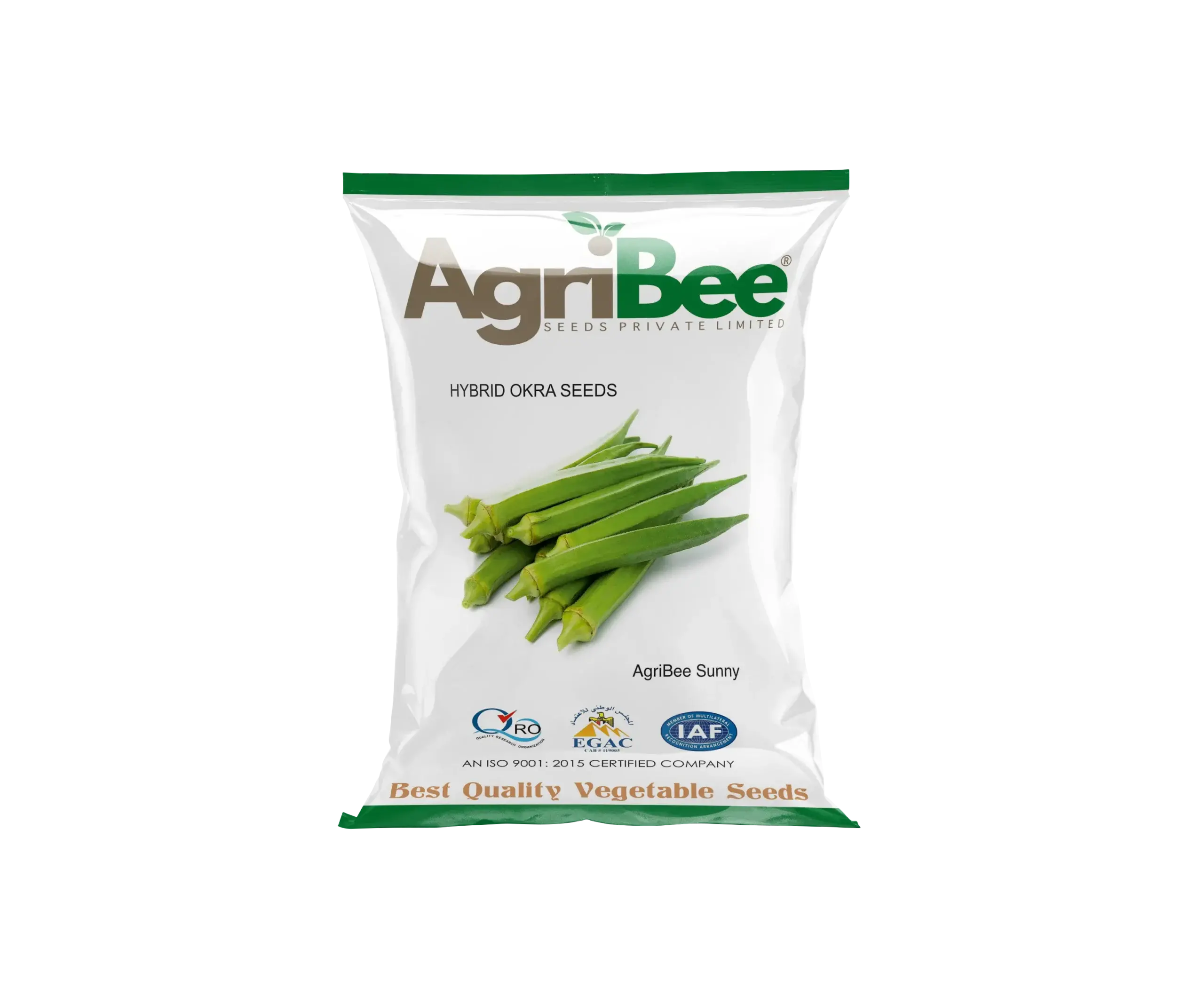
Farming & Cultivation Guide — Okra Seeds AgriBee Sunny
Complete step-by-step agronomic guide for optimal crop management, disease resistance, and premium produce quality.
🌾 Soil Preparation & Field Prep
Proper land preparation ensures uniform seedling emergence and robust root anchorage.
🌱 Ideal Soil Type & pH
Well-drained loamy to sandy-loam soils with pH 6.0–7.5. Heavy clay soils should be avoided due to poor drainage and waterlogging susceptibility. Soil should have good organic matter content and a deep rooting profile.
✨ Core Advantage
Light, well-aerated seedbeds ensure rapid imbibition and uniform germination, while deep soil structure provides excellent anchorage for the upright canopy and promotes healthy taproot development throughout the crop lifecycle.
- 1
Deep summer ploughing followed by 2–3 cross-harrowings to achieve fine tilth and destroy weed seed banks.
- 2
Field leveling with ridges and furrows or flat bed preparation depending on irrigation method; ensure adequate surface drainage.
- 3
Incorporation of 8–10 tonnes per hectare of well-decomposed farmyard manure or compost during the final harrowing for improved soil structure and microbial activity.
- 4
Soil health conditioning — test pH and amend with gypsum or lime if required; consider biofertilizer inoculation (Rhizobium / Azotobacter) for enhanced nutrient availability.
🌱 Sowing Time & Method
Precise seed rate and spacing maximize light interception and canopy development.
| Parameter | Recommendation | Agronomic Importance |
|---|---|---|
| Sowing Window | Kharif: mid-June to mid-July | Rabi: mid-October to mid-November | Summer: February to early March | Okra is a warm-season crop; temperatures above 20°C are essential for germination and vegetative growth. Early Kharif sowing aligns with monsoon onset, while Rabi sowing avoids peak pest pressure. |
| Seed Rate | 3–4 kg per acre (direct sowing) | 1.5–2 kg per acre (transplanted) | Optimal seed rate ensures correct plant population without excessive thinning, balancing canopy cover and resource competition. |
| Spacing | 60 cm (row-to-row) × 45 cm (plant-to-plant) | This spacing allows adequate canopy spread, sunlight penetration, and air circulation, reducing humidity-related disease incidence. |
| Sowing / Transplanting Depth | 2–3 cm depth for direct sowing; seedlings transplanted at 2–3 leaf stage | Correct sowing depth ensures reliable emergence. OKra seeds have moderate dormancy; shallow sowing in warm, moist soil gives the best germination rates. |
💧 Irrigation & Water Management
Adequate moisture regulation supports strong vegetative and reproductive growth.
☀️ Water Requirement Profile
Okra is moderately drought-tolerant but demands consistent soil moisture for optimal pod development and fruit quality. Under drip irrigation, apply 25–35 mm of water per week. Drip systems also enable fertigation, improving nutrient use efficiency by 30–40% compared to conventional methods. In rainfed areas, conservation techniques such as mulching help retain soil moisture.
🌦️ Moisture Management
In rainfed conditions, ensure timely sowing to capture pre-monsoon soils. Avoid water stress during flowering and pod-setting stages (25–40 DAS), as moisture deficit during this phase causes flower drop and malformation of pods. Mulching with straw or polythene sheets conserves soil moisture and suppresses weeds.
- ✓
First irrigation within 3–4 days after sowing (dribble or light sprinkler) to ensure seed imbibition and uniform germination.
- ✓
During the active vegetative phase (15–30 DAS), irrigate at 8–10 day intervals depending on soil texture and weather conditions.
- ✓
Critical stage: flowering and pod development (30–60 DAS) — maintain regular irrigation every 5–7 days; even slight moisture stress leads to pod curling and fiber formation.
- ✓
Withhold irrigation 2–3 days before each harvest to reduce fruit moisture content, improve firmness, and extend post-harvest shelf life.
🧪 Fertilizer & Nutrition Management
Balanced crop nutrition supports robust plant structure and premium produce quality.
| Nutrient | Recommended Dose (per Acre) | Application Method & Timing |
|---|---|---|
| Nitrogen (N) | 60–80 kg/acre (split application) | Basal: 40% at sowing | Top-dress: 60% in two equal splits at 25 DAS and 40 DAS |
| Phosphorus (P2O5) | 40–50 kg/acre | 100% basal application as Di-ammonium Phosphate (DAP) or Single Super Phosphate (SSP) at sowing |
| Potash (K2O) | 30–40 kg/acre | 50% basal at sowing + 50% top-dress at first picking to support fruit set and cell wall strength |
🌿 Interculture & Weed Management
Timely weed control ensures optimal nutrient and moisture availability for crop seedlings.
-
1
First Weeding & Hoeing: Carry out at 10–12 days after sowing (DAS) using a hand hoe or cultipacker. Early weed control is critical as okra is a slow-establishing crop and competes heavily with weeds during the first three weeks.
-
2
Second Weeding & Earthing-Up: Perform at 25–30 DAS. Light earthing-up around the base of the plant supports stem stability, especially in areas prone to strong winds or heavy rain. This also covers shallow roots and improves water uptake.
-
3
Mulching and Stake Management: Apply organic mulch (paddy straw, 3–4 cm layer) immediately after first weeding to conserve moisture, suppress weeds, and moderate soil temperature. In tall-growing environments, install bamboo stakes at 45–50 cm from the main stem to prevent lodging during fruit load.
🛡️ Pest & Disease Management
Proactive crop monitoring and integrated management ensure healthy crop development.
🐛 Insect Pest Management
- Shoot and Fruit Borer (Helicoverpa armigera): Larvae bore into shoots and young fruits causing wilting and frass-filled galleries. Control: Spray Chlorantraniliprole 18.5% SC @ 60 ml/acre or Emamectin Benzoate 5% SG @ 200 g/acre. Alternate with Bacillus thuringiensis (Bt) @ 1–1.5 kg/acre for organic compliance. Apply sprays in the evening when borer activity is highest.
- Okra Jassid / Leafhopper (Amritodus atropunctatus): Sucking damage causes yellowing, curling, and drying of leaf margins ('hopperburn'). Vector of YVMV. Control: Spray Imidacloprid 17.8% SL @ 150 ml/acre or Confidor 70% WS @ 50 g/acre. Install yellow sticky traps @ 10/acre for monitoring and mass trapping. Remove and destroy infected plant residues.
- Fruit Bug / Pod Bug (Riptortus linearis): Adults and nymphs suck sap from pods causing shriveling and drying. Control: Spray Methomyl 4% SP @ 1 kg/acre or Thiacloprid 21.7% SC @ 150 ml/acre. Practice intercrop with sorghum or maize as trap crop. Hand-pick and destroy adults during low populations.
🔬 Disease Control
- Yellow Vein Mosaic Virus (YVMV): Caused by Okra Yellow Vein Mosaic Virus transmitted by whitefly (Bemisia tabaci). Symptoms include bright yellow veins, stunting, and leaf mottling. Tolerance varies by variety — AgriBee Sunny carries demonstrated YVMV tolerance. Control: Whitefly management is critical — use silver polythene mulch (@ 40 m width/acre) during sowing to repel whiteflies. Spray Neem-based formulations (NeemOil 3% EC @ 2.5 ml/litre) prophylactically every 10 days. Remove and burn severely infected plants immediately.
- Powdery Mildew (Erysiphe cichoracearum): White powdery fungal growth on leaves and petioles, leading to premature senescence. Control: Spray Sulphur dust @ 15–20 kg/acre or Propineb 50% WP @ 250 g/acre. Improve air circulation through proper spacing. Apply sulfur-based fungicides at the first sign of infection — preventive sprays are more effective than curative ones.
- Bacterial Blight (Xanthomonas axonopodis pv. mallothi): Water-soaked lesions on leaves turning brown with yellow halos; stems show dark cankers and pod rot. Control: Spray Copper Oxychloride 50% WP @ 2.5 g/litre or Streptocycline 50 ppm @ 0.5 g/acre. Maintain field sanitation by destroying crop debris post-harvest. Avoid overhead irrigation to reduce bacterial splash dispersal.
✂️ Harvesting & Produce Quality Guide
Harvesting at peak maturity ensures maximum commercial grade and long keeping quality.
⏱️ Harvesting Schedule & Timing
First harvest begins 45–50 days after sowing. Subsequent pickings are made at 2–3 day intervals over a period of 30–40 days. Each pod should be harvested before the seeds harden to ensure tender, succulent quality.
⭐ Produce Quality Characteristics
Premium dark green, slender fruits with 5 prominent ridges and a length of 10–12 cm. Firm texture with minimal fiber even at later pickings. Glossy skin and vibrant color indicate optimal maturity. Pods are free from blemishes, insect marks, and disease symptoms. Excellent taste — sweet, tender with characteristic okra mucilage when cooked.
| Quality Parameter | Agronomic Standard | Farmer & Market Benefit |
|---|---|---|
| First Harvest Stage | 45–50 Days after Sowing | Ensures peak tenderness and early market arrival, capturing premium prices during initial supply windows. |
| Harvest Maturity Signs | Pods reach 10–12 cm length, dark green glossy color, firm texture, and seeds not yet hardened | Prevents over-maturity which causes fibrous pods, seed hardening, and off-grade market rejection. |
| Shelf Life & Keeping Quality | 3–5 days under ambient temperature; 7–10 days at 10–12°C with 90–95% relative humidity | Good post-harvest retention supports longer transport distances and extended market sales windows without visible quality loss. |
| Market Suitability | Fresh table marketing (local mandis, retail), contract farming supply, urban wholesale markets, and processing units | Attractive dark green color, uniform shape, and YVMV tolerance make this variety preferred by traders and progressive farmers seeking reliable market returns. |
⭐ Varietal Features — Okra Seeds AgriBee Sunny
Distinguishing characteristics that make this variety a top choice for Indian growers.
🌿 Core Variety Highlight
AgriBee Sunny is bred for field tolerance to Yellow Vein Mosaic Virus (YVMV), one of the most devastating viral diseases of okra in India, giving growers confidence in stable crop performance even under moderate disease pressure.
🌿 Produce Quality & Appearance
Produces slender, 5-ridged dark green fruits of 10–12 cm length with glossy skin, firm flesh, and consistent size uniformity — traits highly valued in fresh vegetable markets across India.
🌿 Stress & Disease Tolerance
Demonstrated tolerance to YVMV; moderate resilience against heat and moisture stress during the Kharif season. Good overall field vigor helps the plant withstand sub-optimal conditions.
🌿 Growth Habit & Vigor
Compact to semi-erect plant architecture with strong primary stem and well-spaced branching pattern, allowing adequate light penetration and ease of hand harvesting without damaging adjacent foliage.
🌿 Crop Duration & Earliness
First picking at just 45–50 days enables early market entry — a significant competitive advantage for farmers targeting high-price windows before seasonal surplus floods local mandis.
🌿 Market & Farmer Preference
Farmers across Gujarat, Maharashtra, Rajasthan, and South India prefer AgriBee Sunny for its reliable pod set, attractive dark green color, YVMV resilience, and repeatable multi-picking cycle that ensures steady income over the harvest period.