
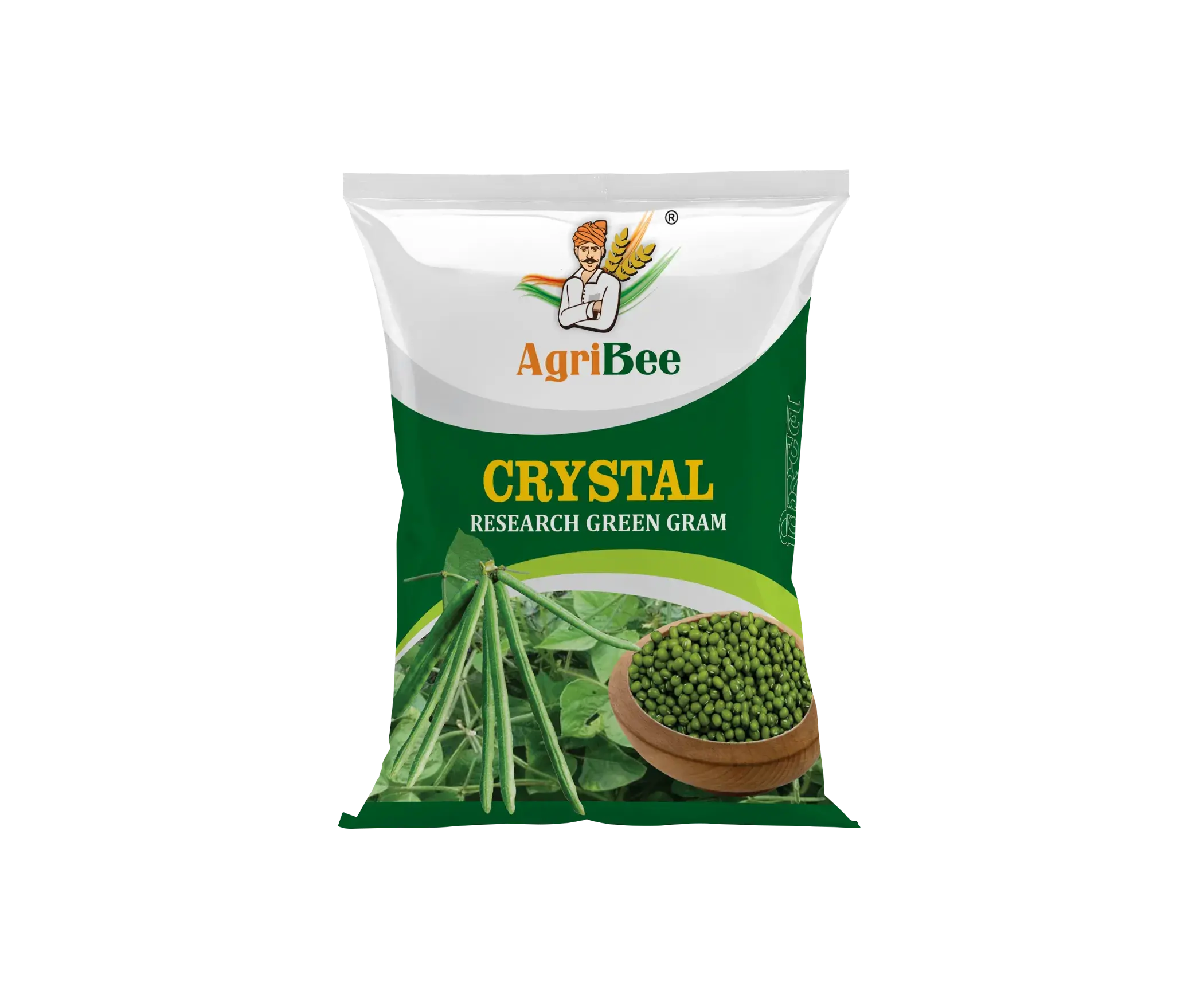
Description
ખેતી અને વાવણી માર્ગદર્શિકા — મગ Crystal
પાકના શ્રેષ્ઠ સંચાલન, રોગ પ્રતિકારક શક્તિ અને પ્રીમિયમ ગુણવત્તાવાળા ઉત્પાદન માટે સંપૂર્ણ વિગતવાર માર્ગદર્શિકા.
🌾 જમીનની તૈયારી અને ખેડ
જમીનની યોગ્ય તૈયારીથી એકસરખો ઉગાવો અને મૂળનો ઊંડો વિકાસ સુનિશ્ચિત થાય છે.
🌱 યોગ્ય જમીનનો પ્રકાર અને pH
Well-drained loamy, sandy loam to clay loam soils; pH range 6.0 – 7.8. Avoid heavy waterlogged or alkaline sodic soils.
✨ મુખ્ય કૃષિ ફાયદા
Loose, friable seedbed ensures rapid imbibition, uniform germination, and deep root anchorage critical for vigorous branching.
- 1
Deep summer ploughing followed by 2–3 cross-harrowings to produce fine tilth and break crust-forming surface layers.
- 2
Field leveling with ridge-and-furrow or flat bed preparation ensuring proper surface drainage to prevent water stagnation.
- 3
Incorporate 5–8 tonnes per acre of well-decomposed FYM or compost during last ploughing to enhance soil structure and microbial activity.
- 4
In high-pH (>7.8) or saline-affected fields, apply gypsum at 250–300 kg/acre and incorporate thoroughly before sowing.
🌱 વાવણીનો સમય અને પદ્ધતિ
Precise seed rate and spacing maximize light interception and canopy development.
| માપદંડ / પેરામીટર | ભલામણ / સૂચના | કૃષિ મહત્વ |
|---|---|---|
| વાવણી સમયમર્યાદા | Kharif: June–July (onset of monsoon); Rabi: Oct–Nov; Summer: March–April under irrigation | Aligns sowing with favorable temperature (25–35°C) and moisture for rapid germination and minimal stress |
| બિયારણનો દર (એકર દીઠ) | 25–30 kg/acre (line sowing) | 35–40 kg/acre (broadcast) | Ensures optimal plant population of ~200,000 plants/acre for balanced canopy and branching |
| હાર અને છોડ વચ્ચેનું અંતર | 30 cm (row-to-row) × 10 cm (plant-to-plant) | Promotes adequate inter-row aeration, light penetration, and unrestricted branch spread for healthy pod development |
| વાવણીની ઊંડાઈ | 3–5 cm in light sandy soils; 4–5 cm in heavier soils | Correct depth ensures consistent soil contact, adequate moisture uptake, and uniform seedling emergence |
💧 પિયત અને પાણી વ્યવસ્થાપન
Adequate moisture regulation supports strong vegetative and reproductive growth.
☀️ પાણીની જરૂરિયાત અને પિયત પ્રોફાઇલ
મગ Crystal exhibits moderate drought tolerance once established, making it suitable for rainfed and marginal irrigated environments. Under drip irrigation, apply 20–25 mm per event at 5–7 day intervals. Over-irrigation must be avoided as waterlogging severely impacts nodulation and root health.
🌦️ Soil ભેજ વ્યવસ્થાપન
In rainfed conditions, sow early with residual soil moisture. Use mulching (straw or agro-film) to conserve soil moisture and reduce evapotranspiration. One protective irrigation at flowering and another at pod-filling stage significantly enhances pod set and grain filling in dry spells.
- ✓
First irrigation at 4–5 DAS (days after sowing) if soil is dry — critical for uniform germination and stand establishment.
- ✓
Vegetative phase: light irrigation every 10–12 days to support branching and foliage development without causing excessive vegetative growth.
- ✓
Critical stage – flowering and initial pod set (25–40 DAS): maintain adequate soil moisture; moisture stress at this stage causes flower drop and poor pod formation.
- ✓
Pre-harvest: withhold irrigation 7–10 days before final picking to facilitate even drying of pods and improve field harvestability.
🧪 ખાતર અને પોષણ વ્યવસ્થાપન
Balanced crop nutrition supports robust plant structure and premium produce quality.
| પોષક તત્વ | ભલામણ કરેલ માત્રા (એકર દીઠ) | ઉપયોગ પદ્ધતિ અને સમય |
|---|---|---|
| નાઇટ્રોજન (N) | 20–25 kg/acre (as Urea 46%) | 50% basal at sowing + 50% top-dress at 25 DAS; Rhizobial symbiosis supplies additional N – avoid excess N to prevent excessive vegetative growth |
| ફોસ્ફરસ (P₂O₅) | 40–50 kg/acre (as DAP 18:46:0 or SSP) | 100% basal application at sowing – critical for nodulation, root development, and early growth vigor |
| પોટાશ (K₂O) | 20–25 kg/acre (as MOP 60%) | 100% basal; supports stalk strength, disease resistance, and grain quality |
🌿 નિંદામણ નિયંત્રણ અને આંતરખેડ
Timely weed control ensures optimal nutrient and moisture availability for crop seedlings.
-
1
પ્રથમ નિંદામણ અને ગોડ: Carry out at 10–12 DAS using a hand hoe or conical weeder. Early weed competition is most damaging; a clean seedbed during first 20 days ensures strong root establishment and canopy development.
-
2
બીજી વાવણી અને પાળા ચઢાવવા: Perform at 25–30 DAS. Light earthing-up around plant bases improves root aeration, supports early branch development, and suppresses late-germinating weeds before canopy closure.
-
3
Mulching & Inter-row Cultivation: Apply straw mulch (2–3 tonnes/acre) immediately after second weeding to conserve moisture, suppress weeds, and maintain soil temperature. For later-sown crops in heavy rains, construct shallow inter-row channels for quick drainage.
🛡️ જીવાત અને રોગ નિયંત્રણ
Proactive crop monitoring and integrated management ensure healthy crop development.
🐛 જીવાત નિયંત્રણ અને સંરક્ષણ
- Pod Borer (Helicoverpa armigera): Larvae bore into pods and consume developing seeds. Control: Spray Carbendazim + Mancozeb (0.2%) or recommend pheromone traps at 10/acre. At early infestation, apply Spinosad 45% SC at 0.5 ml/L or Emamectin Benzoate 5% SG at 0.3 g/L. Scout fields weekly from 25 DAS.
- Leaf Minor (Orophia coronata): Miners create serpentine tunnels in leaves reducing photosynthetic area. Control: Apply Quinalphos 25% EC at 1.5 ml/L or Chlorantraniliprole 18.5% SC at 0.3 ml/L at 30 DAS. Remove and destroy heavily infested leaves during first weeding.
- Aphids (Aphis craccivora): Colonies on tender shoots and pods cause curling and honeydew sooty mould. Control: Spray Imidacloprid 17.8% SL at 0.3 ml/L or Thiometon 25% WG at 0.4 g/L. Encourage natural enemies — ladybird beetles and lacewings – by avoiding broad-spectrum insecticides.
🔬 રોગ નિયંત્રણ અને ઉપચાર
- Yellow Mosaic Virus (YMV): transmitted by whitefly (Bemisia tabaci); symptoms include bright yellow mosaic, leaf curling, and stunted growth. Preventive control: install silver plastic mulch or aluminium reflecting sheets at 20 DAS to repel whiteflies; spray insecticide (Imidacloprid 0.3 ml/L) at first sign of vector; rogue out and remove severely affected plants immediately.
- Powdery Mildew (Erysiphe polygoni): white powdery growth on leaves and pods, reducing photosynthesis. Control: spray Sulphur dust (80% WP) at 2 kg/acre or wettable sulphur at 2 g/L at 30 DAS and repeat at 45 DAS. Ensure proper spacing for air circulation.
- Root Rot & Wilt (Fusarium oxysporum / Macrophomina phaseolina): wilting, yellowing, and root necrosis. Control: seed treatment with Trichoderma viride at 4 g/kg seed; avoid waterlogged conditions; rotate with non-legume crops; apply Carbendazim 50% WP at 1 g/L as soil drench at 20 DAS in susceptible fields.
✂️ કાપણી અને ગુણવત્તા માર્ગદર્શિકા
Harvesting at peak maturity ensures maximum commercial grade and long keeping quality.
⏱️ કાપણીનો સમય અને આયોજન
Begin first picking at 55–60 DAS when 40–50% pods turn brown and begin to dry on the plant. Subsequent pickings at 5–7 day intervals for 5–7 rounds until all pods mature.
⭐ ઉત્પાદનની ગુણવત્તા અને લક્ષણો
Seeds exhibit bright green colour, smooth testa, uniform seed size (3.6 g/100 seeds), and good cooking quality with soft texture and pleasant flavour. Pods are long, slender, and free fromrousness.
| ગુણવત્તા માપદંડ | કૃષિ ધોરણ | ખેડૂત અને બજાર ફાયદો |
|---|---|---|
| કાપણીનો તબક્કો | 55 – 60 Days After Sowing (DAS) — picking initiated | Early market arrival commands premium prices; staggered maturity enables continuous income flow |
| પરિપક્વતાના લક્ષણો | Pods turn pale brown, seeds rattle inside, testa becomes hard and glossy green | Optimal maturity signs prevent harvesting immature pods (poor quality) or over-mature pods (splitting and shattering losses) |
| સંગ્રહ ક્ષમતા અને ગુણવત્તા | Dry grains retain viability and quality for 8 – 10 months under cool, dry storage (moisture content <10%) | Excellent storability reduces post-harvest losses and enables off-season marketing for better price realization |
| બજાર માંગ અને યોગ્યતા | Fresh green pods for mandis and retail; dry seeds for whole-market, dal processing, and institutional buyers | Dual-purpose utility (fresh pod + dry seed) provides flexible marketing channels and broader buyer reach for farmers |
⭐ જાતની વિશેષતાઓ — મગ Crystal
Distinguishing characteristics that make this variety a top choice for Indian growers.
🌿 જાતની મુખ્ય વિશેષતાઓ
AgriBee મગ Crystal delivers superior uniformity in plant stature and pod distribution, ensuring consistent field performance across diverse Indian agro-climatic zones.
🌿 ઉત્પાદનની ગુણવત્તા અને દેખાવ
Bright green, plump seeds with smooth, glossy testa and excellent cooking quality — soft, aromatic, and preferred by consumers for dal and whole-seed preparations.
🌿 વાતાવરણ અને રોગ પ્રતિકારક ક્ષમતા
Demonstrates field tolerance to Yellow Mosaic Virus pressure, moderate heat resilience during grain filling, and adaptive root architecture for moisture-limited environments.
🌿 વિકાસ અને છોડની જોમ
Compact plant height of 50–60 cm with 5–8 well-distributed branches providing balanced canopy, strong pod-bearing capacity, and reduced lodging risk.
🌿 પાક સમયગાળો અને પાકવાનો સમય
Reaches 50% flowering in 30–38 days and maturity in 60–65 days — one of the earliest varieties enabling tight crop rotation cycles and multiple cropping systems.
🌿 બજાર અને ખેડૂત પસંદગી
Trusted by progressive farmers and agri-dealers for reliable germination rates, disease resilience, uniform maturity facilitating mechanized or manual harvesting, and consistent market demand for its premium green seed appearance.