
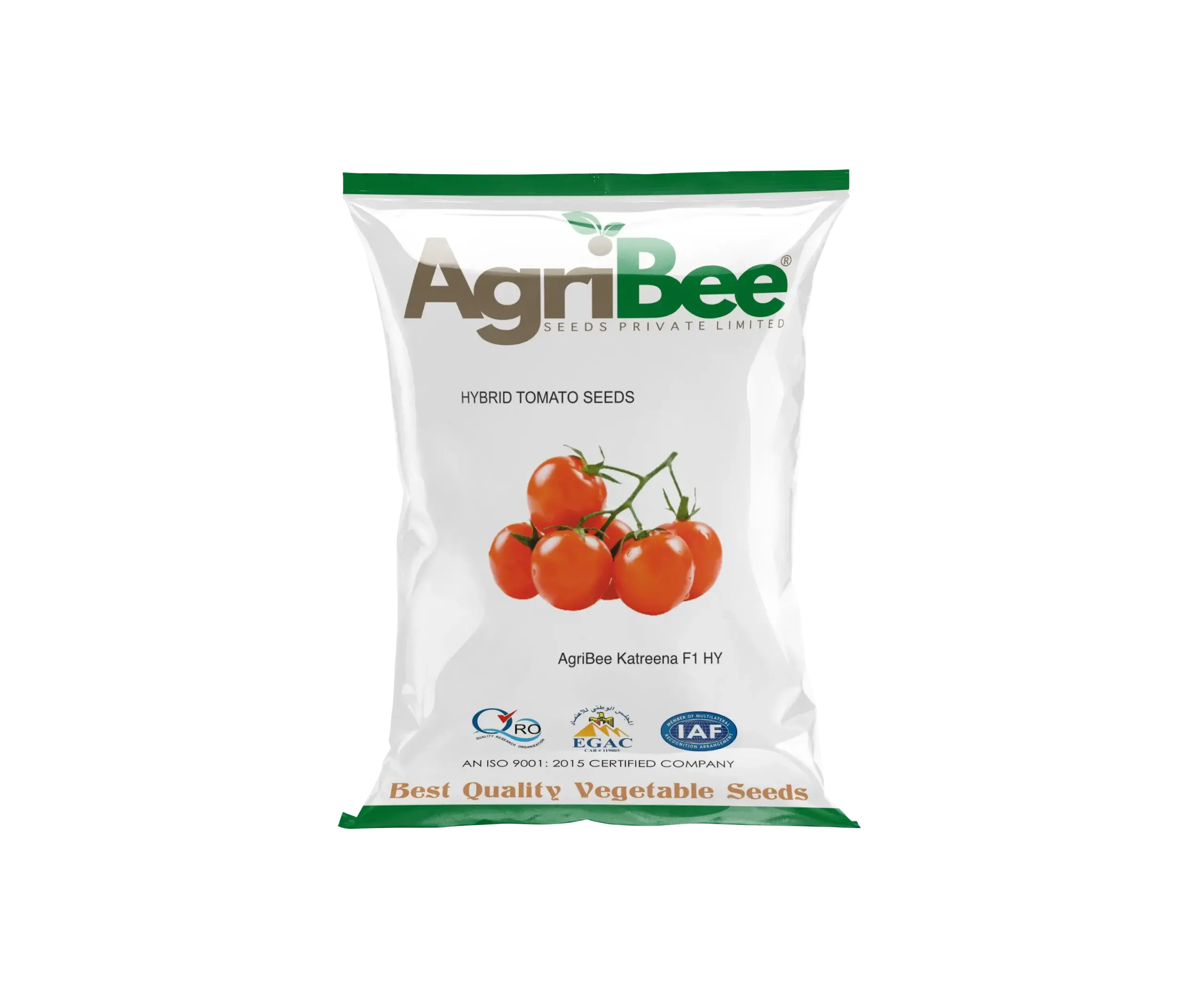
Description
शेती व लागवड संपूर्ण मार्गदर्शक — Tomato Seeds AgriBee Katreena F1 HY
Complete step-by-step agronomic guide for optimal crop management, disease resistance, and premium produce quality.
🌾 जमिनीची पूर्वमशागत
Proper land preparation ensures uniform seedling emergence and robust root anchorage.
🌱 योग्य जमिनीचा प्रकार व सामू (pH)
Well-drained loamy or sandy-loam soils with good organic matter. Soil pH range 6.0–6.8 ensures optimal nutrient uptake.
✨ प्रमुख कृषी फायदे
Loose, fertile seedbed promotes rapid root establishment and supports vigorous vegetative growth essential for ToLCV-tolerant performance.
- 1
Deep summer ploughing followed by 2–3 cross-harrowings to break hardpan and create fine tilth.
- 2
Formation of raised beds (1–1.2 m width) with well-defined drainage channels to prevent waterlogging.
- 3
Incorporation of 8–10 t/ha well-decomposed FYM or compost during last ploughing for soil conditioning.
- 4
Soil test-based lime application if pH is below 6.0 to correct acidity and improve phosphorus availability.
🌱 पेरणीची वेळ व पद्धत
Precise seed rate and spacing maximize light interception and canopy development.
| निकष / मापदंड | शिफारस / पद्धत | कृषी महत्त्व |
|---|---|---|
| पेरणीची वेळ | June–July for Kharif, Oct–Nov for Rabi, Jan–Feb for Summer | Aligns crop cycle with favorable temperature and minimizes peak pest pressure. |
| बियाणे प्रमाण (प्रति एकर) | 250–300 g per acre for transplanting | Ensures adequate nursery stock for uniform plant population. |
| लागवडीतील अंतर | 60 cm (row-to-row) x 45 cm (plant-to-plant) | Balances canopy closure for light interception and improves air circulation to reduce humidity-related diseases. |
| Sowing / Transplanting Depth | 0.5–1.0 cm for direct sowing; transplant at 25–30 DAS with 2–3 true leaves | Shallow covering ensures quick emergence; proper transplant age prevents nursery stress and ensures uniform stand. |
💧 पाणी व्यवस्थापन
Adequate moisture regulation supports strong vegetative and reproductive growth.
☀️ Water Requirement Profile
Tomato requires consistent soil moisture but is moderately drought-sensitive during flowering and fruit set. Drip irrigation is highly recommended for water efficiency and reduced foliar disease pressure.
🌦️ Soil Moisture Management
Mulching with black polyethylene film or paddy straw conserves soil moisture, suppresses weeds, and maintains even fruit development under rainfed conditions.
- ✓
First irrigation immediately after transplanting to reduce wilting stress.
- ✓
Light irrigations every 5–7 days during vegetative phase to promote root and foliage development.
- ✓
Critical irrigation at flowering, fruit setting, and fruit bulking stages; avoid water stress to prevent blossom end rot and fruit cracking.
- ✓
Withhold irrigation 5–7 days before final harvest to improve firmness and shelf life.
🧪 खत व्यवस्थापन
Balanced crop nutrition supports robust plant structure and premium produce quality.
| पोषक घटक | शिफारस केलेले प्रमाण (प्रति एकर) | वापरण्याची वेळ व पद्धत |
|---|---|---|
| नायट्रोजन (N) | 80–100 kg/acre | 50% basal at last ploughing; remaining 50% split at 30 and 60 DAT. |
| फॉस्फरस (P2O5) | 50 kg/acre | 100% basal application through DAP or superphosphate at planting. |
| पोटॅश (K2O) | 40 kg/acre | Split equally at basal and first top-dressing; second split at fruiting stage for fruit quality. |
🌿 तण नियंत्रण व आंतरमशागत
Timely weed control ensures optimal nutrient and moisture availability for crop seedlings.
-
1
First Weeding & Hoeing: Perform at 15 DAT to remove early weed competition; shallow hoeing avoids root damage.
-
2
Second Weeding & Earthing-Up: At 30 DAT, deepen furrows and mound soil around stems to support branching and improve aeration.
-
3
विशेष आंतरमशागत: Adopt single-stem pruning by removing suckers weekly; apply mulch immediately after weeding to conserve moisture and suppress weeds.
🛡️ कीड व रोग व्यवस्थापन
Proactive crop monitoring and integrated management ensure healthy crop development.
🐛 Insect Pest Management
- पांढराfly (Bemisia tabaci): Transmits ToLCV. Yellow sticky traps at 10/acre; spray imidacloprid 17.8% SL 0.3 ml/L or thiamethoxam 25% WG 0.2 g/L every 10–12 days.
- Fruit borer (Helicoverpa armigera): Boreholes in fruits with frass. Apply pheromone traps at 10/acre; spray carbendazim 50% WP 1 g/L or Bacillus thuringiensis 1 g/L at first incidence.
- Mites (Tetranychus spp.): Stippling and bronzing of leaves. Spray hexythiazox 11.3% SC 0.5 ml/L or abamectin 1.9% EC 0.3 ml/L.
🔬 Disease Control
- Early blight (Alternaria solani): Target-shaped leaf spots. Preventive spray of mancozeb 75% WP 2.5 g/L or chlorothalonil 50% WP 2 g/L at 10-day intervals.
- Lates blight (Phytophthora infestans): Water-soaked lesions on leaves and fruit. Spraying metalaxyl 35% WS 0.5 g/L or copper oxychloride 50% WP 3 g/L.
- Bacterial canker (Clavibacter michiganensis): Bird-excrement leaf spots and stem cankers. Remove infected plants; drench soil with streptocycline 0.3 g/L or copper hydroxide 3 g/L at transplanting.
✂️ काढणी व प्रत नियंत्रण
Harvesting at peak maturity ensures maximum commercial grade and long keeping quality.
⏱️ Harvesting Schedule & Timing
First picking begins 65–70 days after transplanting; subsequent picks every 3–4 days for 5–7 harvests.
⭐ Produce Quality Characteristics
Flat-round to oval deep red fruits with thick flesh, glossy skin, excellent taste, and high soluble solids. Fruits are firm with minimal hollow locules, suitable for long-distance transport.
| Quality निकष / मापदंड | Agronomic Standard | Farmer & Market Benefit |
|---|---|---|
| First काढणीची अवस्था | 65–70 days after transplanting | Ensures peak fruit set and allows earlier market arrival for better price realization. |
| परिपक्वतेची लक्षणे | Uniform deep red coloration, firm texture, and full size (80–100 g) | Prevents over-maturity softening and reduces field loss. |
| Shelf Life & Keeping Quality | 7–10 days under ambient conditions; up to 14 days under controlled atmosphere | Facilitates transportation to distant markets and extended sales window. |
| बाजार उपयुक्तता | Excellent for fresh market, local mandis, and retail chains | Attracts premium rates due to attractive appearance, consistent size, and disease tolerance. |
⭐ विविध वैशिष्ट्ये — Tomato Seeds AgriBee Katreena F1 HY
Distinguishing characteristics that make this variety a top choice for Indian growers.
🌿 Core Variety उच्चlight
AgriBee Katreena F1 is bred for high field tolerance to Tomato Leaf Curl Virus (ToLCV), ensuring stable performance under viral pressure zones across India.
🌿 Produce Quality & Appearance
Flat-round to oval deep red fruits with firm texture, appealing gloss, and balanced sugar-acid ratio, meeting modern consumer preferences.
🌿 Stress & Disease Tolerance
Strong resistance to ToLCV and good field tolerance to early blight and bacterial canker, reducing dependency on frequent pesticide interventions.
🌿 Growth Habit & Vigor
Compact to medium-vigor determinate plant architecture with strong branching, promoting efficient light interception and easier staking.
🌿 Crop Duration & Earliness
65–70 days to first harvest enables flexible cropping sequences and faster turnover compared to conventional hybrids.
🌿 Market & Farmer Preference
Trusted by progressive farmers for reliable uniformity, disease resilience, and high-quality fruits that command better prices in competitive mandis.