
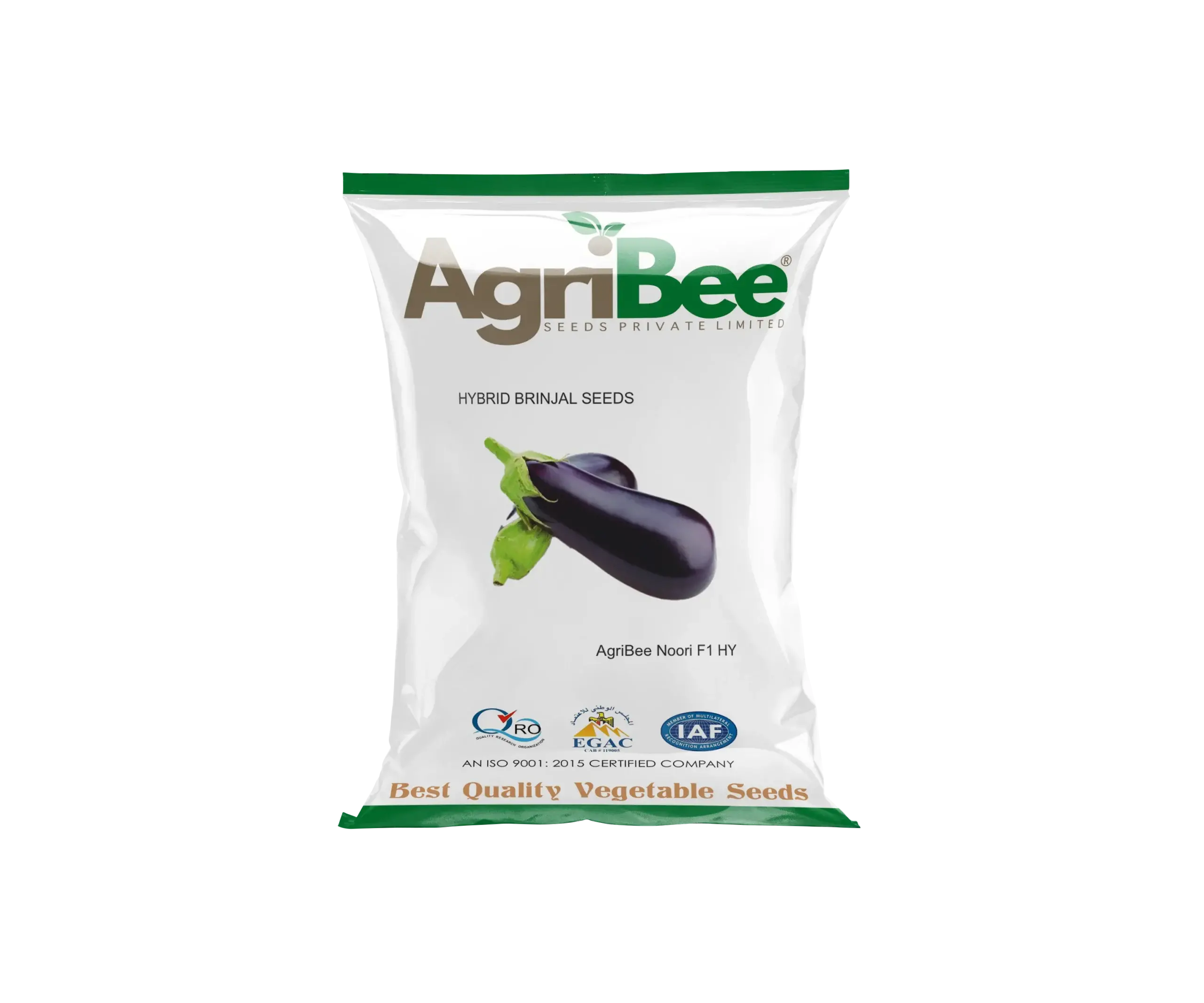
Description
शेती व लागवड संपूर्ण मार्गदर्शक — Brinjal Seeds AgriBee Noor
Complete step-by-step agronomic guide for optimal crop management, disease resistance, and premium produce quality.
🌾 जमिनीची पूर्वमशागत
Proper land preparation ensures uniform seedling emergence and robust root anchorage.
🌱 योग्य जमिनीचा प्रकार व सामू (pH)
Well-drained loamy to clay-loam soils with pH 6.0–7.5. Rich in organic matter with good water-holding capacity yet free from waterlogging.
✨ प्रमुख कृषी फायदे
Deep, fertile soil ensures vigorous root development, strong stalk anchorage, and sustained nutrient availability throughout the prolonged picking cycle of brinjal.
- 1
Deep summer ploughing followed by 2–3 cross-harrowings for fine tilth and thorough pest/debris burial.
- 2
Field leveling and drainage channel preparation to prevent standing water around the root zone.
- 3
Incorporation of 15–20 tonnes per acre of well-decomposed FYM or compost during final harrowing for improved soil structure.
- 4
Soil health conditioning — apply gypsum at 250 kg/acre in alkaline soils or sulfur at 50 kg/acre in calcareous soils to maintain optimal pH.
🌱 पेरणीची वेळ व पद्धत
Precise seed rate and spacing maximize light interception and canopy development.
| निकष / मापदंड | शिफारस / पद्धत | कृषी महत्त्व |
|---|---|---|
| पेरणीची वेळ | June–July for Kharif; October–November for Rabi; February–March for Summer under protected cultivation | Aligns with favorable temperature (25–32°C) and humidity for rapid seed germination and healthy nursery establishment |
| बियाणे प्रमाण (प्रति एकर) | 300–400 g per Acre (Transplanted) | Ensures adequate plant population with minimal gaps and reduces dependency on extra seedling raising |
| लागवडीतील अंतर | 60 cm (Row-to-Row) x 45 cm (Plant-to-Plant) | Optimizes canopy spread, sunlight penetration, and air circulation for reduced disease pressure and better fruit development |
| Sowing / Transplanting Depth | Sow seeds at 0.5–1.0 cm depth; transplant seedlings at 8–10 DAT with 2–3 true leaves | Shallow sowing ensures uniform emergence; proper transplanting depth avoids stem rot and promotes strong adventitious root formation |
💧 पाणी व्यवस्थापन
Adequate moisture regulation supports strong vegetative and reproductive growth.
☀️ Water Requirement Profile
Brinjal is moderately sensitive to water stress, especially during flowering and fruit development. Consistent soil moisture is essential for continuous bearing. Drip irrigation with 3–4 liters per plant per session is recommended for efficient water use and reduced foliar disease pressure.
🌦️ Soil Moisture Management
Under rainfed conditions, ensure raised beds with wide furrows for rapid drainage. Mulching with straw or polythene preserves soil moisture during dry spells. Avoid waterlogging at any stage, as it rapidly causes root rot and flower drop.
- ✓
First irrigation within 24–48 hours after transplanting to reduce wilt stress and promote early root establishment.
- ✓
During vegetative phase (20–45 DAT), irrigate at 7–10 day intervals depending on soil texture and weather conditions.
- ✓
Critical stages — flowering, fruit set, and active picking phase (45–100 DAT) — require consistent moisture every 5–7 days; even brief moisture deficit causes small, misshapen fruits.
- ✓
Reduce irrigation frequency 5–7 days before each picking cycle to improve fruit firmness and post-harvest keeping quality.
🧪 खत व्यवस्थापन
Balanced crop nutrition supports robust plant structure and premium produce quality.
| पोषक घटक | शिफारस केलेले प्रमाण (प्रति एकर) | वापरण्याची वेळ व पद्धत |
|---|---|---|
| नायट्रोजन (N) | 80–100 kg/acre | 60% basal at transplanting; remaining 40% split into two top-dressings at 30 DAT and 60 DAT |
| फॉस्फरस (P2O5) | 50–60 kg/acre | 100% basal application incorporated during final land preparation alongside FYM |
| पोटॅश (K2O) | 40–50 kg/acre | 50% basal at transplanting; remaining 50% applied at first top-dressing to support fruit quality and firmness |
🌿 तण नियंत्रण व आंतरमशागत
Timely weed control ensures optimal nutrient and moisture availability for crop seedlings.
-
1
First Weeding & Hoeing: Perform shallow inter-row hoeing at 15–20 DAT to control early weeds without damaging the shallow root system. Maintain a weed-free zone around the plant base to reduce competition during critical establishment phase.
-
2
Second Weeding & Earthing-Up: Carry out second weeding at 30–35 DAT along with light earthing-up around the stem base. This supports the increasingly heavy branching habit of brinjal and improves root zone aeration.
-
3
Mulching and Plant Support: Apply black polythene mulch or organic straw mulch at transplanting to conserve moisture, suppress weeds, and raise soil temperature. Stake taller varieties where heavy fruit load may cause lodging during monsoon rains.
🛡️ कीड व रोग व्यवस्थापन
Proactive crop monitoring and integrated management ensure healthy crop development.
🐛 Insect Pest Management
- Fruit and Shoot Borer (FBP) — Leucinodes orbonalis: Larvae bore into fruits and tender shoots causing wilting and fruit rot. Control: Apply pheromone traps at 10 traps/acre for monitoring; spray Cartap hydrochloride 50 WP at 1.0 g/liter or Emamectin benzoate 5 SG at 0.3 g/liter at 7-day intervals starting at first flowering. Rotate chemical classes to prevent resistance.
- Brinjal Shot Hole Borer (ASHB) — Anthonomus erythromelas: Small round holes on fruits and shoots with larval galleries inside. Control: Spray Chlorantraniliprole 18.5 SC at 0.3 ml/liter or Spinosad 45 SC at 0.3 ml/liter at early symptom appearance. Remove and destroy infected plant parts immediately. Use yellow sticky traps at 5 per acre for adult monitoring.
- पांढराfly — Bemisia tabaci: Sucks sap causing leaf yellowing, curling, and sooty mold; also vectors Yellow Vein Mosaic Virus. Control: Apply Imidacloprid 17.8 SL at 0.3 ml/liter or Thiamethoxam 25 WG at 0.2 g/liter. Deploy yellow sticky traps at 10 per acre. Practice crop rotation and remove alternate host weeds. Use net house cultivation for summer protection.
🔬 Disease Control
- Southern Blight (Sclerotium rolfsii): पांढरा mycelial growth at soil line, spherical sclerotia, and sudden wilting of entire plant. Control: Apply carbendazim 50 WP at 1.0 g/liter or Trichoderma viride paste at 10 g/kg soil around stem base. Ensure proper drainage and avoid deep planting. Crop rotation with non-Solanaceous crops for 2 seasons.
- Verticillium Wilt (Verticillium dahliae): Lower leaves show marginal yellowing and V-shaped necrosis; internal vascular browning; gradual wilt. Control: Drench with Thiram or Carbendazim at 2 g/liter at first symptom appearance. Use hybrid & research disease-free seedlings. Uproot and burn severely infected plants. Raise beds for better drainage.
- Bacterial Wilt (Ralstonia solanacearum): Sudden wilting of one side of the plant with green leaves initially; brown vascular discoloration on stem cut; bacterial ooze when stem is squeezed. Control: Seed treatment with Streptomyces griseobreviatus or copper oxychloride 3 g/liter. Soil drench with Streptomycin sulfate 0.2 g/liter + Tetracycline 0.2 g/liter at transplanting. Maintain strict field hygiene and rotate with legumes.
✂️ काढणी व प्रत नियंत्रण
Harvesting at peak maturity ensures maximum commercial grade and long keeping quality.
⏱️ Harvesting Schedule & Timing
First picking begins 60–65 days after transplanting. Subsequent pickings are taken at 3–4 day intervals over a prolonged harvesting window spanning 40–50 days. Harvest only during morning hours for best fruit firmness.
⭐ Produce Quality Characteristics
Fruits exhibit glossy purple/black skin with uniform coloration, firm flesh, and minimal seed development at harvest maturity. The calyx is green and non-spiny, enhancing handling quality and market appeal. Internal tissue is creamy-white with dense, tender mesocarp.
| Quality निकष / मापदंड | Agronomic Standard | Farmer & Market Benefit |
|---|---|---|
| First काढणीची अवस्था | 60–65 Days after Transplanting | Enables early market entry and commands premium prices in pre-monsoon or early-season demand windows |
| परिपक्वतेची लक्षणे | Skin glossy and fully colored; fruit firm to gentle pressure; calyx enlarged and rounded; seeds developing but not hardened | Prevents over-maturity which causes bitterness, seed hardness, and reduced shelf life |
| Shelf Life & Keeping Quality | 5–7 days under ambient conditions; up to 12–14 days at 8–10°C with high relative humidity | Superior post-harvest longevity facilitates transport to distant markets and reduces post-harvest losses |
| बाजार उपयुक्तता | Fresh table market, mandis, retail chains, and export-grade packaging due to attractive glossy fruit appearance and non-spiny calyx | Strong trader and consumer preference for uniform oval/oblong shape with consistent dark purple coloration |
⭐ विविध वैशिष्ट्ये — Brinjal Seeds AgriBee Noor
Distinguishing characteristics that make this variety a top choice for Indian growers.
🌿 Core Variety उच्चlight
Brinjal Seeds AgriBee Noor is bred for early productivity with uniform fruit set and consistent bearing under diverse Indian growing conditions, making it suitable for both Kharif and Rabi seasons.
🌿 Produce Quality & Appearance
Fruits are oval to oblong in shape with a rich glossy purple to black skin. The non-spiny green calyx and compact fruit size (100–250 gm) ensure excellent visual appeal and easy handling throughout the supply chain.
🌿 Stress & Disease Tolerance
Demonstrates field tolerance to common brinjal pathogens including bacterial wilt and verticillium wilt under moderate pressure. Improved resilience to whitefly-mediated virus transmission supports healthier foliage and sustained fruiting.
🌿 Growth Habit & Vigor
Moderately compact plant architecture with strong primary and secondary branching. Vigorous foliage coverage provides natural shade to developing fruits while maintaining adequate air circulation to minimize fungal Incidence.
🌿 Crop Duration & Earliness
Early maturing with first harvest at 60–65 days after transplanting. The short duration enables flexible crop sequencing and multiple cropping systems across Indian agricultural zones.
🌿 Market & Farmer Preference
उच्चly favored by farmers and traders for its uniform fruit appearance, reliable early bearing, non-spiny calyx, and strong shelf stability. The 10-gram packing size offers convenience for smallholder trial and precision sowing.