
Description
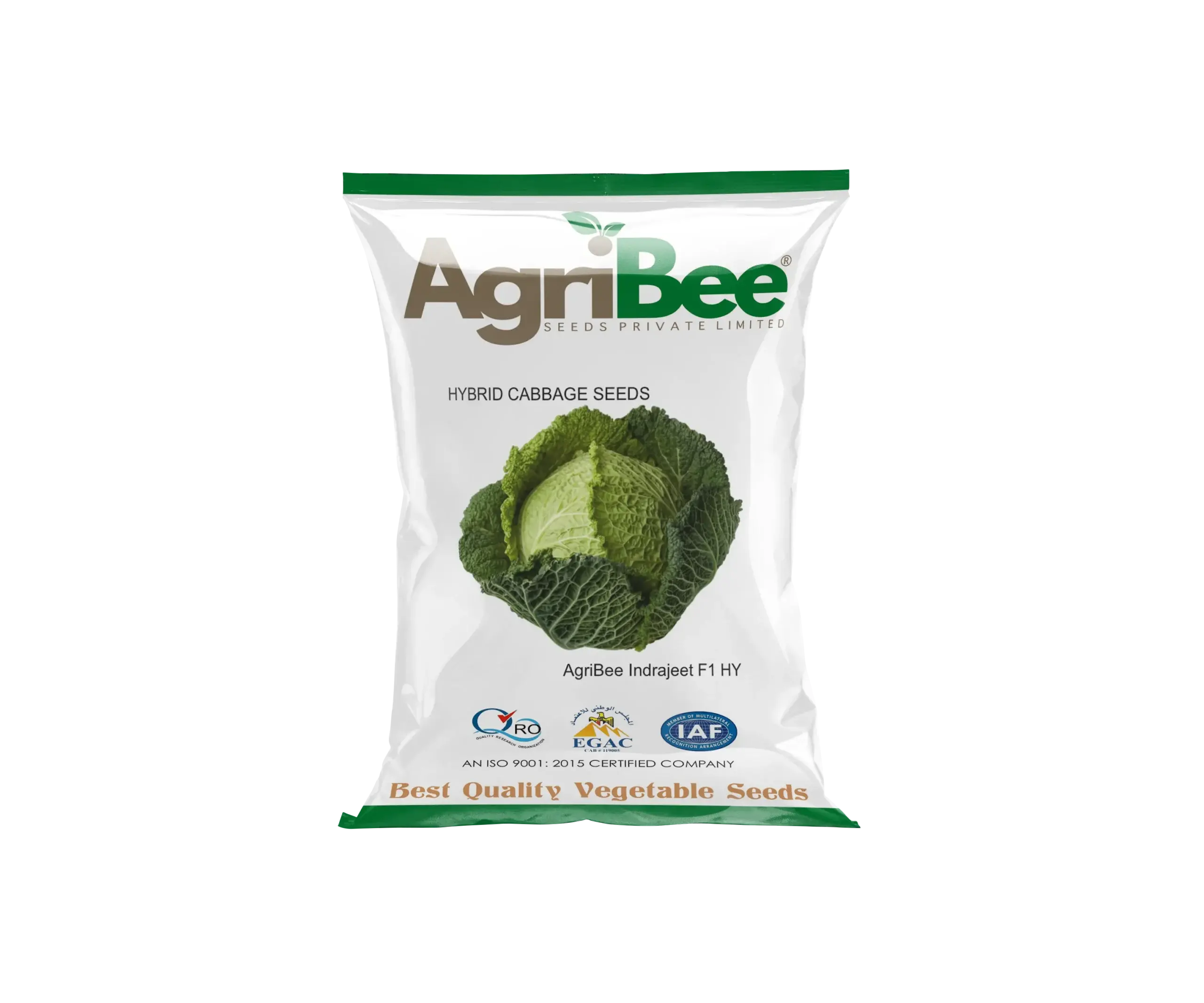
शेती व लागवड संपूर्ण मार्गदर्शक — Cabbage Seeds AgriBee Indrajeet F1 HY
Complete step-by-step agronomic guide for optimal crop management, disease resistance, and premium produce quality.
🌾 जमिनीची पूर्वमशागत
Proper land preparation ensures uniform seedling emergence and robust root anchorage.
🌱 योग्य जमिनीचा प्रकार व सामू (pH)
Well-drained loamy or sandy-loam soils with pH 6.0–7.5 and good organic matter content.
✨ प्रमुख कृषी फायदे
Fine, loose tilth ensures rapid seed germination, strong root anchorage, and uniform nutrient uptake.
- 1
Deep summer ploughing followed by 2–3 cross-harrowings for fine tilth.
- 2
Field leveling and drainage preparation to prevent waterlogging.
- 3
Incorporation of 15–20 t/ha well-decomposed FYM or compost during final harrowing.
- 4
Soil health conditioning: apply agricultural lime if pH is below 6.0 to optimise nutrient availability.
🌱 पेरणीची वेळ व पद्धत
Precise seed rate and spacing maximize light interception and canopy development.
| निकष / मापदंड | शिफारस / पद्धत | कृषी महत्त्व |
|---|---|---|
| पेरणीची वेळ | June–July for Kharif; October–November for Rabi | Aligns with moderate temperatures that favour vigorous seedling growth and tight head formation. |
| बियाणे प्रमाण (प्रति एकर) | 250–300 g / Acre (Transplanted) | Ensures an optimal plant population of approximately 7,000–7,500 plants per acre for balanced canopy development. |
| लागवडीतील अंतर | 60 cm (row-to-row) × 45 cm (plant-to-plant) | Provides adequate room for full leaf expansion, improves air circulation, and reduces disease pressure. |
| Sowing / Transplanting Depth | Seeds sown at 0.5–1.0 cm depth; transplants planted at same depth as in nursery | Promotes uniform germination and prevents damping-off while ensuring stable root establishment. |
💧 पाणी व्यवस्थापन
Adequate moisture regulation supports strong vegetative and reproductive growth.
☀️ Water Requirement Profile
Cabbage is moderately sensitive to moisture stress. Drip irrigation with frequent, light applications is highly compatible and promotes uniform head tightening. Avoid both waterlogging and prolonged dry spells.
🌦️ Soil Moisture Management
Maintain consistent soil moisture, especially from vegetative growth through head initiation. Mulching with straw or polythene helps retain soil moisture and suppress weeds.
- ✓
First irrigation immediately after transplanting to reduce wilting and promote root set.
- ✓
During the vegetative phase, irrigate every 7–10 days depending on soil texture and weather.
- ✓
Critical irrigation at head formation stage (approx. 30–45 DAT) to support rapid leaf expansion and compact head development.
- ✓
Withhold irrigation 7–10 days before harvest to improve head firmness and field-shelf life.
🧪 खत व्यवस्थापन
Balanced crop nutrition supports robust plant structure and premium produce quality.
| पोषक घटक | शिफारस केलेले प्रमाण (प्रति एकर) | वापरण्याची वेळ व पद्धत |
|---|---|---|
| नायट्रोजन (N) | 80–100 kg/acre | Basal: 1/3 dose; two side-dressings at 20 and 40 DAT |
| फॉस्फरस (P2O5) | 40–50 kg/acre | 100% incorporated as basal with FYM during final land preparation |
| पोटॅश (K2O) | 40–50 kg/acre | Split: half basal and half at 30 DAT to enhance head density and colour |
🌿 तण नियंत्रण व आंतरमशागत
Timely weed control ensures optimal nutrient and moisture availability for crop seedlings.
-
1
First Weeding & Hoeing: Carry out at 15 DAT to remove early weed flush and loosen soil, improving aeration and nutrient availability.
-
2
Second Weeding & Earthing-Up: At 30 DAT, remove weeds and gently earth-up around stems to support developing heads and reduce lodging.
-
3
विशेष आंतरमशागत: Apply organic mulch (straw/paddy husk) between rows after second weeding to conserve moisture, suppress weeds, and keep heads clean.
🛡️ कीड व रोग व्यवस्थापन
Proactive crop monitoring and integrated management ensure healthy crop development.
🐛 Insect Pest Management
- Aphids (Myzus persicae): Sucking sap from undersides of leaves, causing curling and yellowing. Spray Imidacloprid 17.8% SL at 0.3 ml/L or use neem-based biopesticide. Repeat at 7-day intervals if infestation persists.
- Cabbage caterpillars (Plutella xylostella): Leaf miners and bore into heads. Apply Bacillus thuringiensis at 250 g/acre or Chlorantraniliprole 18.5% SC at 0.2 ml/L during early larval stage.
- पांढराflies (Bemisia tabaci): Vector viral diseases and excrete honeydew leading to sooty mould. Spray Thiamethoxam 25% WG at 0.1 g/L or use yellow sticky traps at 10 traps/acre.
🔬 Disease Control
- Black Rot (Xanthomonas campestris pv. campestris): V-shaped yellow lesions on leaf margins with blackened veins. Prevent via seed treatment with Streptocycline 0.1 g/L and avoid overhead irrigation. Spray Copper oxychloride 50 WP at 2.5 g/L.
- Downy Mildew (Peronospora parasitica): Yellow patches on upper leaf surface with fuzzy grey sporulation underneath. Apply Metalaxyl 35% WS at 1.5 g/L or Mancozeb 75 WP at 2 g/L as preventive spray at 20 and 40 DAT.
- Clubroot (Plasmodiophora brassicae): Swelling and galling of roots leading to wilting. Raise seedlings in treated nursery beds, maintain soil pH above 7.2 with lime, and rotate with non-brassica crops for 3–4 years.
✂️ काढणी व प्रत नियंत्रण
Harvesting at peak maturity ensures maximum commercial grade and long keeping quality.
⏱️ Harvesting Schedule & Timing
First harvest at 65–75 days after transplanting when heads reach full size and firmness. Only one commercial harvest per plant.
⭐ Produce Quality Characteristics
Round, very compact heads with bluish-green outer leaves and crisp, sweet inner tissue. उच्च moisture content, dense core, and excellent cutting appearance ensure premium market appeal.
| Quality निकष / मापदंड | Agronomic Standard | Farmer & Market Benefit |
|---|---|---|
| First काढणीची अवस्था | 65–75 Days after Transplanting | Ensures peak physiological maturity, optimal head density, and early market arrival. |
| परिपक्वतेची लक्षणे | Heads feel firm when squeezed, outer leaves show Bluish-green colour, and head diameter reaches 18–22 cm | Prevents over-maturity, splitting, and quality deterioration. |
| Shelf Life & Keeping Quality | 7–10 days under ambient conditions; up to 21 days under refrigerated storage (0–2°C, 90–95% RH) | Facilitates long-distance transport and extends sales window for farmers and traders. |
| बाजार उपयुक्तता | उच्चly suitable for fresh table sales, wholesale mandis, retail chains, and export-grade packing due to uniform shape and robust post-harvest life. | Attracts premium market rates because of consistent Blusih-green colour and compact head structure. |
⭐ विविध वैशिष्ट्ये — Cabbage Seeds AgriBee Indrajeet F1 HY
Distinguishing characteristics that make this variety a top choice for Indian growers.
🌿 Core Variety उच्चlight
F1 hybrid bred for exceptional field vigour, uniform plant type, and strong root system that supports dense head development under diverse Indian agro-climatic conditions.
🌿 Produce Quality & Appearance
Round, very compact heads with a striking bluish-green exterior and tender, crisp inner leaves; minimal core length and high firmness ensure excellent visual and culinary quality.
🌿 Stress & Disease Tolerance
Demonstrates strong tolerance to common brassica pests and diseases such as black rot, downy mildew, and aphid damage, reducing dependence on repeated chemical interventions.
🌿 Growth Habit & Vigor
Upright plant architecture with moderately broad, upright leaves that efficiently capture sunlight while allowing good canopy aeration and ease of field operations.
🌿 Crop Duration & Earliness
Relatively short maturity period (65–75 days after transplanting) enables flexible crop rotation, multiple cropping cycles, and timely market supply.
🌿 Market & Farmer Preference
Preferred by progressive farmers, aggregators, and exporters for its consistent head weight (1.5–2.0 kg), vibrant colour, tight wrapping, and high post-harvest shelf life.