
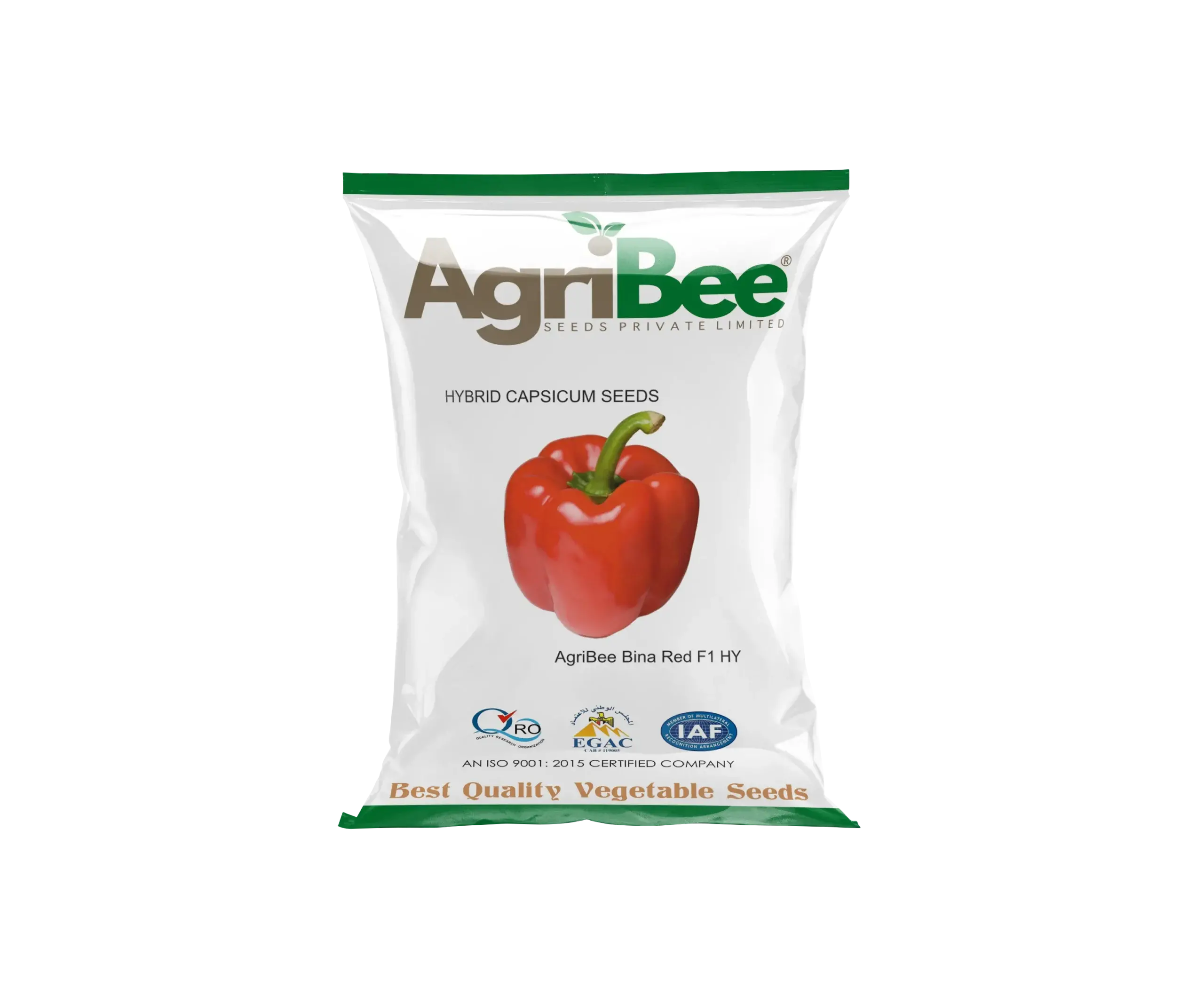
Description
शेती व लागवड संपूर्ण मार्गदर्शक — Capsicum Seeds AgriBee Bina Red F1 HY
Complete step-by-step agronomic guide for optimal crop management, disease resistance, and premium produce quality.
🌾 जमिनीची पूर्वमशागत
Proper land preparation ensures uniform seedling emergence and robust root anchorage.
🌱 योग्य जमिनीचा प्रकार व सामू (pH)
Well-drained loamy or sandy-loam soils with pH 6.0–7.0 and good organic matter content.
✨ प्रमुख कृषी फायदे
Fine, well-aerated seedbed promotes rapid root establishment and uniform seedling vigor.
- 1
Deep summer ploughing followed by 2–3 cross-harrowings for fine tilth.
- 2
Field leveling and drainage preparation to prevent waterlogging.
- 3
Incorporate 15–20 t/ha of well-decomposed FYM or compost before transplanting.
- 4
Maintain soil pH near neutral; apply gypsum or lime where required for optimal nutrient availability.
🌱 पेरणीची वेळ व पद्धत
Precise seed rate and spacing maximize light interception and canopy development.
| निकष / मापदंड | शिफारस / पद्धत | कृषी महत्त्व |
|---|---|---|
| पेरणीची वेळ | June–July for Kharif; October–November for Rabi | Aligns crop with favorable temperature and reduced pest pressure |
| बियाणे प्रमाण (प्रति एकर) | 50–60 g per acre (transplanted method) | Ensures adequate plant population with strong field stand |
| लागवडीतील अंतर | 60 cm x 45 cm (row-to-row x plant-to-plant) | Balances canopy spread, airflow, and light interception |
| Sowing / Transplanting Depth | 0.5–1.0 cm depth in nursery; transplant at 4–5 true leaf stage | Promotes uniform emergence and strong root anchorage |
💧 पाणी व्यवस्थापन
Adequate moisture regulation supports strong vegetative and reproductive growth.
☀️ Water Requirement Profile
Capsicum is moderately sensitive to drought during flowering and fruit set. Drip irrigation is highly recommended for efficient water use and consistent fruit development under Indian conditions.
🌦️ Soil Moisture Management
Ensure continuous soil moisture from flowering onward. Avoid both water stress and waterlogging. Use mulching to conserve moisture and regulate soil temperature.
- ✓
First irrigation immediately after transplanting to reduce shock.
- ✓
Light irrigation every 3–4 days during active vegetative growth.
- ✓
Maintain consistent moisture during flowering, fruit set, and fruit development stages.
- ✓
Reduce irrigation 7–10 days before final harvest to improve firmness and shelf life.
🧪 खत व्यवस्थापन
Balanced crop nutrition supports robust plant structure and premium produce quality.
| पोषक घटक | शिफारस केलेले प्रमाण (प्रति एकर) | वापरण्याची वेळ व पद्धत |
|---|---|---|
| नायट्रोजन (N) | 80–100 kg/acre | 50% basal + 2 split top-dressings at 20 and 40 DAT |
| फॉस्फरस (P2O5) | 50 kg/acre | 100% basal application as DAP or single super phosphate |
| पोटॅश (K2O) | 40–50 kg/acre | Split into two equal applications after first and second fruit set |
🌿 तण नियंत्रण व आंतरमशागत
Timely weed control ensures optimal nutrient and moisture availability for crop seedlings.
-
1
First Weeding & Hoeing: Carry out at 15 DAS to maintain weed-free status and improve soil aeration.
-
2
Second Weeding & Earthing-Up: Perform at 30 DAS to control weeds, support stems, and encourage adventitious root growth.
-
3
विशेष आंतरमशागत: Use polythene mulch for moisture conservation and weed suppression. Stake plants if needed to prevent lodging under heavy fruit load.
🛡️ कीड व रोग व्यवस्थापन
Proactive crop monitoring and integrated management ensure healthy crop development.
🐛 Insect Pest Management
- Thrips (Thrips tabaci): Suck sap causing silvering and distortion. Spray Spinosad 45 SC @ 0.3 ml/L or Imidacloprid 17.8 SL @ 0.2 ml/L. Repeat at 7-day intervals.
- Spider Mites (Tetranychus urticae): Webbing and yellow spotting on leaves. Apply Abamectin 1.9 EC @ 0.5 ml/L or sulfur powder @ 2 kg/acre.
- Fruit and Shoot Borer (Helicoverpa armigera): Larvae bore into fruits and shoots. Use pheromone traps @ 10/acre and spray Carbendazim-based or Bacillus thuringiensis @ 1–2 g/L.
🔬 Disease Control
- Anthracnose (Colletotrichum gloeosporioides): Water-soaked lesions on fruit ripening stage. Prevent with mancozeb @ 2.5 g/L or copper oxychloride @ 3 g/L at 10-day intervals.
- Bacterial Spot (Xanthomonas campestris): Small dark spots on leaves and fruits. Apply streptocycline @ 0.5 g/10 L water or copper hydroxide @ 2 g/L prophylactically.
- Phytophthora Blight (Phytophthora capsici): Wilting and crown rot in high moisture. Ensure good drainage; drench soil with metalaxyl @ 2 g/L at transplantation.
✂️ काढणी व प्रत नियंत्रण
Harvesting at peak maturity ensures maximum commercial grade and long keeping quality.
⏱️ Harvesting Schedule & Timing
Begin first harvest 70–75 days after transplanting. Subsequent pickings can be done at 5–7 day intervals for 6–8 cycles.
⭐ Produce Quality Characteristics
Blocky, shiny, thick-walled fruits with excellent texture, balanced sweetness, and attractive green-to-red color transition. Fruits are uniform in size and shape with minimal defects.
| Quality निकष / मापदंड | Agronomic Standard | Farmer & Market Benefit |
|---|---|---|
| First काढणीची अवस्था | 70–75 days after transplanting | Ensures peak fruit firmness and early market arrival |
| परिपक्वतेची लक्षणे | Full size, glossy skin, and firm texture | Maximizes quality and consumer appeal |
| Shelf Life & Keeping Quality | 10–14 days under cool storage conditions | Supports longer transport and extended market reach |
| बाजार उपयुक्तता | Fresh market, supermarkets, and export-grade packaging | Commands premium prices due to uniformity and visual appeal |
⭐ विविध वैशिष्ट्ये — Capsicum Seeds AgriBee Bina Red F1 HY
Distinguishing characteristics that make this variety a top choice for Indian growers.
🌿 Disease Resilience
Strong field resistance to major capsicum pathogens ensuring healthier foliage and longer productive lifespan.
🌿 Premium Fruit Quality
Blocky, thick-walled fruits with attractive red coloration and high commercial appeal.
🌿 Adaptability
Performs consistently across Indian climatic zones under both protected and open-field conditions.
🌿 Vigorous Growth Habit
Robust plant architecture with strong branching supporting heavy fruit loads without lodging.