
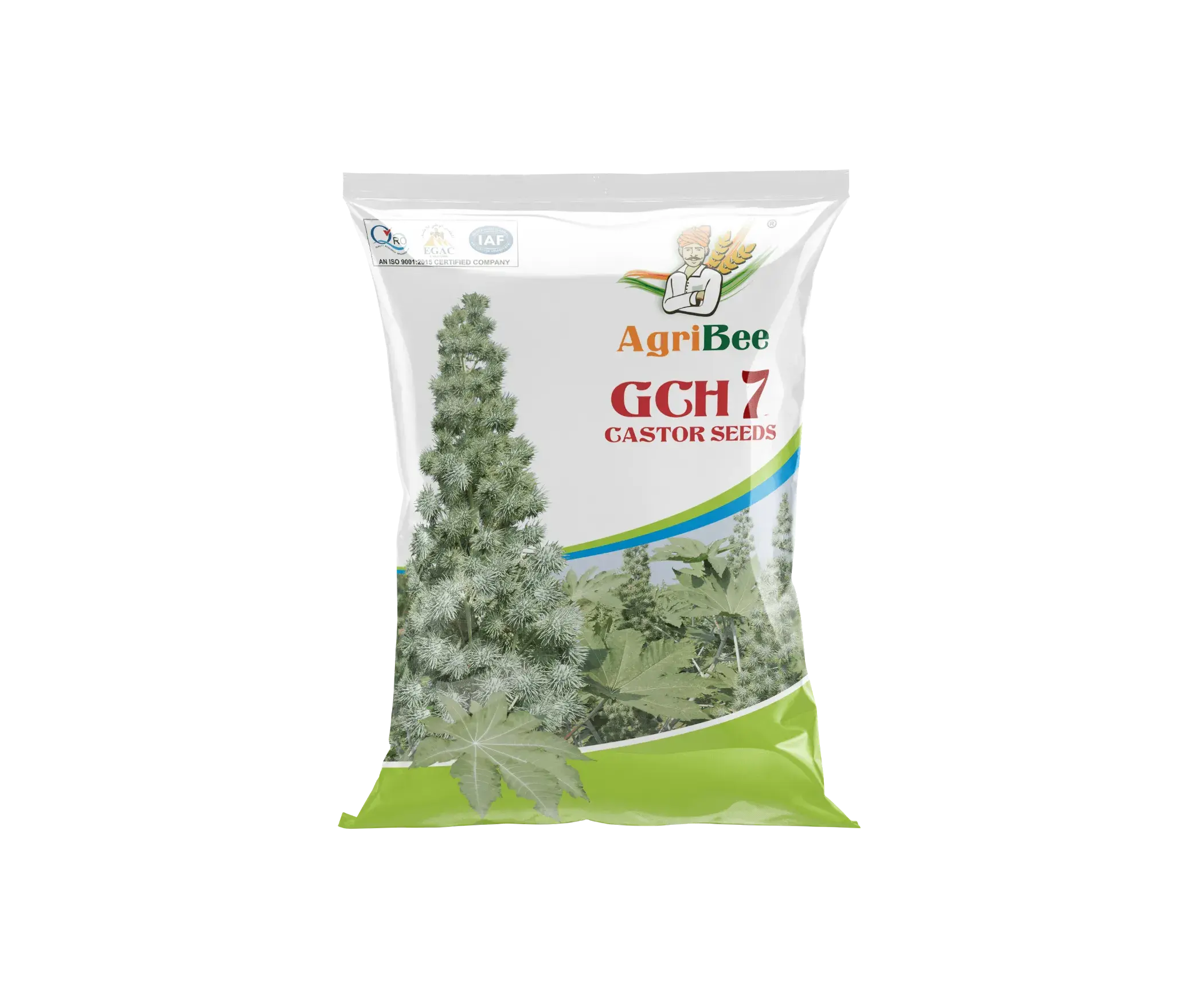
Description
शेती व लागवड संपूर्ण मार्गदर्शक — Castor Seeds GCH-7
Complete step-by-step agronomic guide for optimal crop management, disease resistance, and premium produce quality.
🌾 जमिनीची पूर्वमशागत
Proper land preparation ensures uniform seedling emergence and robust root anchorage.
🌱 योग्य जमिनीचा प्रकार व सामू (pH)
Well-drained loamy to sandy-loam soils with good organic matter content. pH range: 6.0–8.0. Castor thrives in deep soils that do not waterlog even temporarily.
✨ प्रमुख कृषी फायदे
GCH-7 exhibits strong root architecture suited for medium-textured soils, ensuring rapid early growth and enhanced nutrient uptake under Indian tropical conditions.
- 1
Deep summer ploughing to 25–30 cm followed by 2–3 cross-harrowings for fine tilth and weed seed burial.
- 2
Field leveling with laser leveling where possible; prepare drainage channels to prevent water stagnation.
- 3
Incorporate optimal produce volume of well-decomposed FYM or compost per acre during last ploughing for soil structure improvement.
- 4
Conduct soil health card test prior to sowing; apply gypsum at 250 kg/acre in saline-alkali soils and sulfur at 50 kg/acre in alkaline soils to balance pH.
🌱 पेरणीची वेळ व पद्धत
Precise seed rate and spacing maximize light interception and canopy development.
| निकष / मापदंड | शिफारस / पद्धत | कृषी महत्त्व |
|---|---|---|
| पेरणीची वेळ | June 15 – July 15 (Kharif) | October 15 – November 15 (Rabi) | Ensures favourable monsoon moisture for germination; avoids pre-monsoon drought and late-season moisture stress |
| बियाणे प्रमाण (प्रति एकर) | 6–8 kg/acre (bunch sowing) | 4–5 kg/acre (line sowing) | Maintains optimum plant population while allowing thinning; avoids overcrowding that reduces capsule size |
| लागवडीतील अंतर | 90 cm x 60 cm (Row-to-row x Plant-to-plant) | Optimizes canopy spread, inter-row aeration, and sunlight penetration for triple-bloom expression |
| पेरणीची खोली | 3–5 cm for light soils; 5–7 cm for heavy soils | Correct depth ensures adequate soil contact, uniform germination, and strong radicle emergence |
💧 पाणी व्यवस्थापन
Adequate moisture regulation supports strong vegetative and reproductive growth.
☀️ Water Requirement Profile
Castor is inherently drought-tolerant but responds well to 3–4 irrigations during critical stages. GCH-7, being medium tall with robust root system, tolerates moderate moisture stress. For irrigated crops, apply irrigation at 20, 40, 60, and 80 DAS. Drip irrigation is highly compatible and conserves 40% water while maintaining uniform soil moisture.
🌦️ Soil Moisture Management
In rainfed conditions, ensure in-situ moisture conservation through summer fallow prep, mulching with crop residue, and contour bunding on sloping lands. Avoid moisture deficit during flowering and capsule development to prevent premature drying, which GCH-7 is specifically resistant against.
- ✓
First irrigation at 15–20 DAS to promote uniform stand establishment and early vegetative growth.
- ✓
Irrigate every 15–20 days during vegetative phase (20–50 DAS); avoid waterlogging as castor is highly sensitive to saturated soils.
- ✓
Critical: irrigate at peak flowering (55–70 DAS) and early capsule development (70–85 DAS) to maximize bloom longevity and triple-bloom expression.
- ✓
Withhold irrigation 10–15 days before first picking to allow capsule maturation and reduce field spoilage during harvest.
🧪 खत व्यवस्थापन
Balanced crop nutrition supports robust plant structure and premium produce quality.
| पोषक घटक | शिफारस केलेले प्रमाण (प्रति एकर) | वापरण्याची वेळ व पद्धत |
|---|---|---|
| नायट्रोजन (N) | 80–100 kg N/acre | 50% basal at sowing + 25% at 40 DAS + 25% at 60 DAS |
| Phosphorus (P₂O₅) | 50–60 kg P₂O₅/acre | 100% basal as DAP or SSP incorporated during final ploughing |
| Potash (K₂O) | 40–50 kg K₂O/acre | 50% basal + 50% at 60 DAS for improved capsule filling and stalk strength |
🌿 तण नियंत्रण व आंतरमशागत
Timely weed control ensures optimal nutrient and moisture availability for crop seedlings.
-
1
First Weeding & Hoeing: Perform at 15–20 DAS using hand hoe or cultivator. Early weeding prevents competition during critical establishment phase when GCH-7 seedlings are most vulnerable to weed pressure.
-
2
Second Weeding & Earthing-Up: Carry out at 35–40 DAS. Earthing-up around the base supports the medium-tall stature of GCH-7 and improves root aeration, reducing root rot incidence.
-
3
विशेष आंतरमशागत: Remove lateral suckers (side shoots) from leaf axils starting at 45 DAS to direct nutrients toward main spike and secondary bloom clusters. Apply black polyethylene mulch at wide spacing to conserve moisture and suppress weeds in drip-irrigated plots.
🛡️ कीड व रोग व्यवस्थापन
Proactive crop monitoring and integrated management ensure healthy crop development.
🐛 Insect Pest Management
- Shoot and Fruit Borer (Helicoverpa armigera): Larvae bore into main shoot and young capsules causing wilting and capsule damage. Control: Spray Endosulfan 4G at 15 kg/acre OR Chlorantraniliprole 18.5% SC at 60 ml/acre + Spinetoram 11.7% WS at 40 ml/acre in 500 L water/acre. Start sprays at first flower appearance and repeat at 15-day intervals. Use pheromone traps at 10/acre for monitoring.
- Castor Phyllera (Phyllera robusta): Defoliating caterpillars cause skeletonization of leaves, severely reducing photosynthetic area. Control: Spray Bt formulation (Curahil) at 250–500 g/acre in 500 L water OR NSKE 5% at 2.5 L/acre. For severe infestation, use Emamectin benzoate 5% SG at 250 g/acre. Target younger larvae before they cause extensive defoliation.
- Mealybug (Ferrisia virgata): Sucks sap from leaves and stems, secreting honeydew that promotes sooty mold. Control: Spray Imidacloprid 17.8% SL at 100 ml/acre in 500 L water OR Thiamethoxam 25% WG at 100 g/acre. Apply at tillering stage and repeat if pest rebound occurs. Encourage natural enemies like Cryptolaemus montrouzieri.
🔬 Disease Control
- Root Rot (Macrophomina phaseolina / Rhizoctonia solani): Wilting, yellowing, and sudden drying of lower leaves; black sclerotia visible on stem base near soil line. Prevention: Seed treatment with Trichoderma viride at 10 g/kg seed + carbendazim. Soil drench with Pseudomonas fluorescens at 10 g/L water at 30 DAS. Avoid waterlogging; GCH-7 is tolerant but preventive management is essential.
- Wilt Disease (Fusarium oxysporum f.sp. castoris): Vascular browning, yellowing, and permanent wilting of entire plant. Prevention: Raise nursery in non-infested soil; use raised beds with good drainage. Apply biocontrol agent Trichoderma at 5 g per plant at transplanting. Remove and burn infected plants immediately. Crop rotation with non-host crops for 2–3 seasons.
- Leaf Spot (Cercospora ricinella): Small circular brown spots with purple halo on leaves, leading to premature defoliation. Prevention: Spraying Mancozeb 75% WP at 250 g/acre in 500 L water at 45 DAS and again at 65 DAS. Ensure proper plant spacing for canopy ventilation. Remove and destroy infected plant debris after harvest.
✂️ काढणी व प्रत नियंत्रण
Harvesting at peak maturity ensures maximum commercial grade and long keeping quality.
⏱️ Harvesting Schedule & Timing
harvesting begins at 90–100 DAS when main spike capsules turn brown and begin to dehisce. Subsequent pickings are taken at 12–15 day intervals for secondary and tertiary blooms. Total 3–4 pickings over 30–35 days.
⭐ Produce Quality Characteristics
GCH-7 produces medium spiny capsules with deep red stems, indicating robust pigment development and strong stalk integrity. Seeds exhibit uniform size, high oil content potential, and dark mottled appearance characteristic of premium castor hybrids.
| Quality निकष / मापदंड | Agronomic Standard | Farmer & Market Benefit |
|---|---|---|
| काढणीची अवस्था | 90–100 Days after Sowing | Main spike maturity allows early market entry; triple-bloom habit ensures continued picking capacity |
| परिपक्वतेची लक्षणे | Capsules turn pale green to yellow-brown; spines become less prominent; slight cracking at capsule tips indicates seed maturity | Prevents over-maturity and shattering losses; ensures optimal seed fill and oil concentration |
| Shelf Life & Keeping Quality | Dried capsules and seeds maintain viability and oil quality for 8–10 months under dry, cool storage conditions at <10% moisture content | Enables flexible marketing timing and reduces post-harvest losses in transit |
| बाजार उपयुक्तता | Suitable for direct seed sale, oil extraction, and pharma-grade castor meal utilization | Uniform capsule size and strong red-stem phenotype attract buyers in major mandis across Gujarat, Maharashtra, and Rajasthan |
⭐ विविध वैशिष्ट्ये — Castor Seeds GCH-7
Distinguishing characteristics that make this variety a top choice for Indian growers.
🌿 Core Variety उच्चlight
GCH-7 is a medium tall hybrid with distinctive red stem and medium spiny capsules, offering a triple-bloom architecture that maximizes productive canopy and reduces premature drying under field stress.
🌿 Produce Quality & Appearance
Uniform capsule size with well-developed spines, consistent red stem pigmentation, and high seed setting percentage per capsule cluster indicate superior genetic quality and commercial appeal.
🌿 Stress & Disease Tolerance
Engineered resistance to premature drying and tolerance to root rot (Macrophomina/Rhizoctonia) make GCH-7 resilient under variable rainfall and moderately waterlogged conditions common in castor-growing regions.
🌿 Growth Habit & Vigor
Medium-tall stature with strong central and three well-distributed bloom clusters per plant. Branching pattern supports efficient light interception and balanced assimilate partitioning.
🌿 Crop Duration & Earliness
Main spike maturity in 90–110 days provides an optimal window for crop rotation in Kharif-Rabi systems, particularly suitable for Gujarat and Maharashtra where early-maturing varieties command better prices.
🌿 Market & Farmer Preference
AgriBee Seeds' GCH-7 combines early vigor, disease resilience, and distinctive morphology, making it a preferred choice among farmers in semi-arid and transitional zones of India seeking reliable field performance with manageable input requirements.