
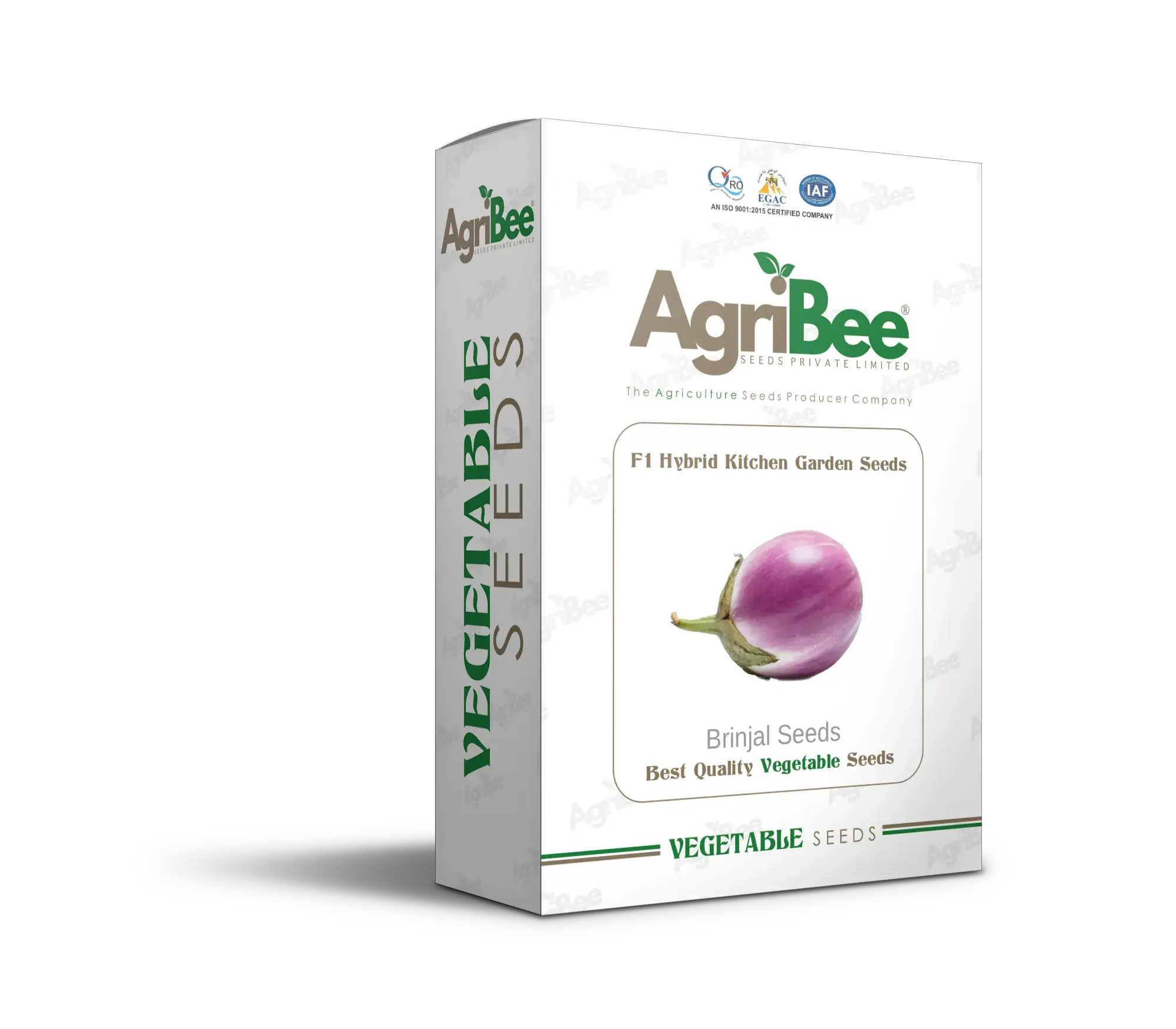
Description
शेती व लागवड संपूर्ण मार्गदर्शक — एफ1 संकरीत Brinjal
Complete step-by-step agronomic guide for optimal crop management, disease resistance, and premium produce quality.
🌾 जमिनीची पूर्वमशागत
Proper land preparation ensures uniform seedling emergence and robust root anchorage.
🌱 योग्य जमिनीचा प्रकार व सामू (pH)
Well-drained loamy or sandy loam soil with good organic matter content. pH range: 5.5 – 7.5. Soil should have excellent drainage to prevent waterlogging, which brinjal cannot tolerate.
✨ प्रमुख कृषी फायदे
Fine, well-aerated seedbed promotes rapid and uniform germination while ensuring strong root anchorage for vigorous vegetative growth.
- 1
Deep summer ploughing to a depth of 25–30 cm followed by 2–3 cross-harrowings to achieve a fine tilth and break hardpan.
- 2
Field leveling using laser levelling or traditional methods; prepare effective drainage channels to prevent water stagnation during heavy rains.
- 3
Incorporate 8–10 tonnes per acre of well-decomposed FYM or compost into the topsoil before final harrowing to improve soil structure and nutrient retention.
- 4
Test soil pH and apply agricultural lime (300–400 kg/acre) if pH is below 5.5; ensure balanced nutrition for robust plant development.
🌱 पेरणीची वेळ व पद्धत
Precise seed rate and spacing maximize light interception and canopy development.
| निकष / मापदंड | शिफारस / पद्धत | कृषी महत्त्व |
|---|---|---|
| पेरणीची वेळ | June – mid July (Kharif); October – November (Rabi); March – April for summer crop under protected cultivation | Aligns crop with optimal temperature (25–30°C) and avoids extreme weather stress during critical flowering and fruiting phases |
| बियाणे प्रमाण (प्रति एकर) | 100 – 120 g / Acre for transplanted crop | Ensures adequate seedling population in the nursery and compensates for low-cost F1 hybrid seeds requiring fewer plants per acre |
| लागवडीतील अंतर | 60 cm × 45 cm (Row-to-Row × Plant-to-Plant) | Optimises canopy spread, improves air circulation, reduces disease pressure, and facilitates field operations |
| Sowing / Transplanting Depth | Sow seeds at 0.5 – 1.0 cm depth in nursery; transplant at 2–3 true leaf stage (25–30 DAS) | Shallow sowing ensures timely germination; early transplanting prevents root damage and promotes rapid establishment in the field |
💧 पाणी व्यवस्थापन
Adequate moisture regulation supports strong vegetative and reproductive growth.
☀️ Water Requirement Profile
Brinjal requires moderate but consistent moisture throughout its growth cycle. The crop is moderately sensitive to both water deficit and waterlogging. Drip irrigation is highly recommended for efficient water use, especially in light soils and Rabi/summer seasons. Maintain soil moisture at field capacity without saturation.
🌦️ Soil Moisture Management
In rainfed Kharif conditions, ensure proper field drainage to avoid standing water. Mulching with straw or polythene sheet helps conserve soil moisture during dry spells. Apply light irrigations immediately after transplanting and during critical flowering and fruit development stages to prevent flower dropping.
- ✓
First Irrigation: Apply immediately after transplanting (within 24 hours) to reduce transplanting shock and promote quick root establishment.
- ✓
Vegetative Phase: Light irrigation every 5–7 days during active leaf and stem growth; maintain consistent soil moisture for vigorous foliage development.
- ✓
Critical Growth Stage: Increase frequency during flowering, fruit set, and young fruit development (25–55 DAT); moisture stress at this stage causes flower drop and deformed fruits.
- ✓
Pre-Harvest: Reduce irrigation frequency 5–7 days before harvest to improve fruit firmness, glossiness, and shelf life.
🧪 खत व्यवस्थापन
Balanced crop nutrition supports robust plant structure and premium produce quality.
| पोषक घटक | शिफारस केलेले प्रमाण (प्रति एकर) | वापरण्याची वेळ व पद्धत |
|---|---|---|
| नायट्रोजन (N) | 60 – 75 kg/acre | 50% basal at transplanting; remaining 50% split into two top-dressings at 30 and 60 days after transplanting |
| फॉस्फरस (P2O5) | 35 – 40 kg/acre | 100% basal application at final land preparation mixed with FYM and incorporated into the soil |
| पोटॅश (K2O) | 30 – 40 kg/acre | 100% basal application at transplanting; supports fruit development, firmness, and disease resistance |
🌿 तण नियंत्रण व आंतरमशागत
Timely weed control ensures optimal nutrient and moisture availability for crop seedlings.
-
1
First Weeding & Hoeing: Carry out shallow hoeing at 15 days after transplanting (DAT) to control early weed flush and loosen soil for better aeration. Avoid deep hoeing near plant base to prevent root damage.
-
2
Second Weeding & Earthing-Up: Perform second weeding at 30 DAT along with light earthing-up around plant bases to support branching stems and improve root zone aeration, especially in heavier soils.
-
3
Mulching Application: Apply black polythene mulch or organic straw mulch at transplanting to suppress weeds, conserve moisture, maintain soil temperature, and reduce soil-borne disease splash. In Rabi conditions, mulching significantly improves early crop growth.
🛡️ कीड व रोग व्यवस्थापन
Proactive crop monitoring and integrated management ensure healthy crop development.
🐛 Insect Pest Management
- Fruit and Shoot Borer (FBW – Leucinodes orbonalis): Larvae bore into fruits and tender shoots causing wilting and fruit rot. Control: Install pheromone traps at 10 traps/acre. Spray Chlorantraniliprole 18.5% SC at 0.3 ml/L or Emamectin benzoate 5% SG at 0.3 g/L at 10-day intervals starting at first flower appearance. DestroyInfested fruits manually.
- Eggplant Fruit and Shoot Borer (ESFB): Small white moths lay eggs on flowers and shoots; larvae feed on blossoms and developing fruits causing direct damage. Control: Spray Spinetoram 11.7% WS at 0.3 ml/L or Lufenuron 3.8% EC at 1.5 ml/L during early flowering. Practice crop sanitation by removing and destroying infested plant parts.
- Jassids / Leafhoppers (Amrasca biguttula): Sucking pests cause yellowing and browning of leaf edges (hopper burn), reducing photosynthetic capacity. Control: Spray Imidacloprid 17.8% SL at 0.3 ml/L or Thiamethoxam 25% WG at 0.2 g/L at 10-day intervals. Use yellow sticky traps at 5 traps/acre for monitoring.
🔬 Disease Control
- Bacterial Wilt (Ralstonia solanacearum): Sudden wilting of one side of the plant with vascular browning; no recovery even under high moisture. Prevention: Use hybrid & research disease-free seeds and transplants. Rotate with non-Solanaceous crops for 2–3 years. Treat seeds with Streptocycline 0.1 g/L or Copper oxychloride 0.3%. Apply soil drench with Copper oxychloride 0.3% at transplanting.
- Phytophthora Blight (Phytophthora capsici): Water-soaked lesions on stems and branches leading to wilt; fruit rot with white fungal growth under humid conditions. Control: Apply Metalaxyl 35% WP at 250 g/acre as soil drench at 15 and 30 DAT. Ensure proper field drainage. Remove and destroy infected plants immediately.
- Anthracnose (Colletotrichum dematium): Circular sunken spots with pinkish-black spore masses on mature fruits; leads to fruit decay and reduced marketability. Control: Spray Mancozeb 75% WP at 2.5 g/L or Carbendazim 50% WP at 1.0 g/L at 15-day intervals starting from fruit initiation. Avoid overhead irrigation to reduce disease spread.
✂️ काढणी व प्रत नियंत्रण
Harvesting at peak maturity ensures maximum commercial grade and long keeping quality.
⏱️ Harvesting Schedule & Timing
First harvest begins 60–65 days after transplanting. Subsequent pickings are done at 7–10 day intervals. Typically, 5–7 pickings are made over a harvesting period of 30–45 days.
⭐ Produce Quality Characteristics
Harvested fruits exhibit glossy, attractive purple/black or green skin depending on variety, with firm, spongy-free flesh. Fruits are sweet with characteristic brinjal flavour, low seed coarseness, and uniform oval to round shape. Nutritional quality is high with dietary fibre, antioxidants, and essential minerals.
| Quality निकष / मापदंड | Agronomic Standard | Farmer & Market Benefit |
|---|---|---|
| First काढणीची अवस्था | 60 – 65 Days after Transplanting | Early and uniform harvest enables farmers to capture premium early-market prices and ensures consistent fruit size |
| परिपक्वतेची लक्षणे | Skin glossy and firm; seeds developing but not hardened; fruit has reached varietal size and colour | Prevents over-maturity which causes bitterness, seed hardness, and reduced market value |
| Shelf Life & Keeping Quality | 7 – 10 days under ambient conditions; up to 14 days under refrigerated storage (8–10°C) | Excellent post-harvest quality allows transportation to distant markets with minimal deterioration |
| बाजार उपयुक्तता | Fresh table market, local mandis, retail chains, and processing units; attractive appearance commands premium rates | Uniform fruit size, vibrant colour, and good gloss make this F1 hybrid highly sought after by traders and processors |
⭐ विविध वैशिष्ट्ये — एफ1 संकरीत Brinjal
Distinguishing characteristics that make this variety a top choice for Indian growers.
🌿 Core Variety उच्चlight
एफ1 संकरीत vigor ensures uniform plant growth, synchronized flowering, and consistent fruit development across the crop stand.
🌿 Produce Quality & Appearance
Attractive oval/round fruits with glossy purple/black/green skin, firm flesh, minimal seed development, and excellent table appeal.
🌿 Stress & Disease Tolerance
Strong field tolerance to common brinjal diseases including bacterial wilt, phytophthora blight, and anthracnose; good adaptability to Indian climatic conditions.
🌿 Growth Habit & Vigor
Compact to semi-compact plant architecture with strong central stem and balanced branching; non-spiny calyx facilitates easy handling and harvesting.