
Description
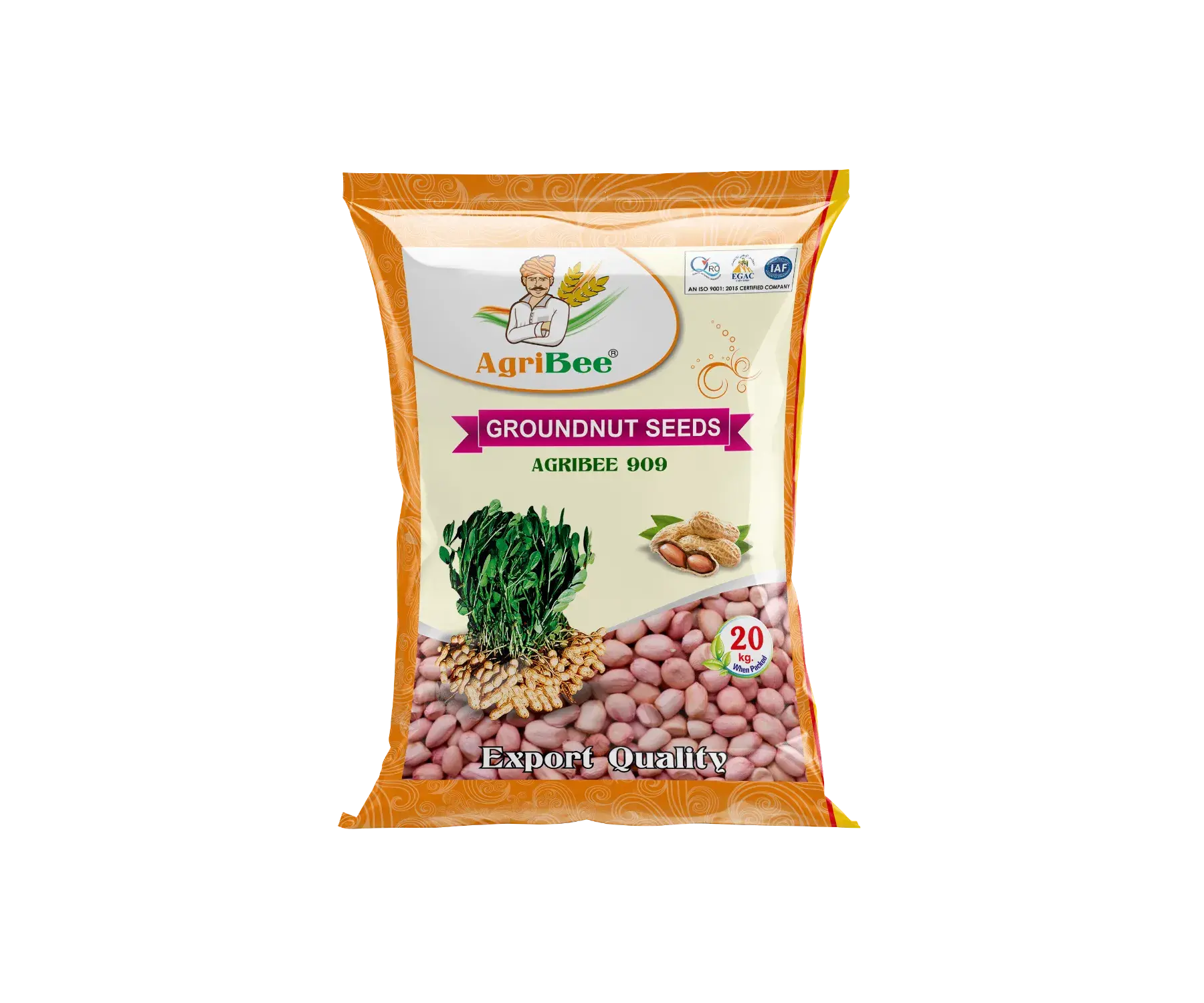
शेती व लागवड संपूर्ण मार्गदर्शक — Groundnut AgriBee 909
Complete step-by-step agronomic guide for optimal crop management, disease resistance, and premium produce quality.
🌾 जमिनीची पूर्वमशागत
Proper land preparation ensures uniform seedling emergence and robust root anchorage.
🌱 योग्य जमिनीचा प्रकार व सामू (pH)
Well-drained sandy loam to loamy sand; pH 6.0 – 7.5; depth > 30 cm for unrestricted peg penetration.
✨ प्रमुख कृषी फायदे
Loose, friable soil texture ensures rapid germination, unhindered geocarpic peg insertion, and uniform pod set throughout the root zone.
- 1
Deep summer ploughing (25–30 cm) followed by 2–3 cross-harrowings to obtain fine tilth.
- 2
Field leveling with laser or board leveling and formation of drainage channels to prevent water stagnation.
- 3
Incorporation of 10–15 t/ha well-decomposed FYM or compost during last harrowing for soil conditioning.
- 4
Soil testing for pH correction using gypsum (for alkaline soils) or elemental sulfur (for acidic soils) before sowing.
🌱 पेरणीची वेळ व पद्धत
Precise seed rate and spacing maximize light interception and canopy development.
| निकष / मापदंड | शिफारस / पद्धत | कृषी महत्त्व |
|---|---|---|
| पेरणीची वेळ | Early June to mid-July (Kharif); early October to mid-November (Rabi in rain-fed areas of MP, Maharashtra) | Sowing coincides with monsoon onset ensuring adequate soil moisture for germination and early vegetative growth. |
| बियाणे प्रमाण (प्रति एकर) | 100 kg/ha (≈ 40–45 kg/acre), using uniform, healthy rosy seeds | Optimal plant population ensures complete canopy closure by 45 DAS and maximizes light interception. |
| लागवडीतील अंतर | 30 cm (row-to-row) × 10–12 cm (plant-to-plant) | Balanced spacing promotes lateral branching, improves air circulation, and facilitates interculture operations. |
| पेरणीची खोली | 5–7 cm in light soils; 3–5 cm in heavy soils | Shallow sowing in heavy soils prevents damping-off, while deeper placement in light soils ensures adequate moisture contact. |
💧 पाणी व्यवस्थापन
Adequate moisture regulation supports strong vegetative and reproductive growth.
☀️ Water Requirement Profile
Groundnut AgriBee 909 exhibits moderate drought tolerance due to its deep taproot system. Under drip irrigation, apply 25–30 mm per event at 5–7 day intervals during active growth. Total water requirement is approximately 450–550 mm over the crop cycle.
🌦️ Soil Moisture Management
In rainfed ecosystems, ensure 2–3 protective irrigations at critical stages: pre-sowing soak, flowering (35–45 DAS), and pod development (60–75 DAS). Mulching with dry straw conserves soil moisture and suppresses weeds.
- ✓
First irrigation at sowing itself (if soil is dry) to ensure uniform germination within 7–10 days.
- ✓
Light irrigation every 10–12 days during vegetative phase (20–40 DAS) to support canopy establishment.
- ✓
Critical irrigation at peak flowering and peg insertion (35–50 DAS) and during pod filling (60–80 DAS); moisture stress at these stages severely affects fruit set.
- ✓
Stop irrigation 10–12 days before harvest to allow pod maturation and prevent post-harvest aflatoxin risk.
🧪 खत व्यवस्थापन
Balanced crop nutrition supports robust plant structure and premium produce quality.
| पोषक घटक | शिफारस केलेले प्रमाण (प्रति एकर) | वापरण्याची वेळ व पद्धत |
|---|---|---|
| नायट्रोजन (N) | 20–25 kg/acre (50–60 kg/ha) | 50% basal with P and K; remaining 50% as top-dressing at first weeding (25–30 DAS). |
| फॉस्फरस (P2O5) | 40–50 kg/acre (100–125 kg/ha) | 100% basal application as DAP (18:46:0) or Super Phosphate incorporated during final harrowing. |
| पोटॅश (K2O) | 30–40 kg/acre (75–100 kg/ha) | 100% basal as MOP (60% K2O); split only if soil leaching is severe in high-rainfall zones. |
🌿 तण नियंत्रण व आंतरमशागत
Timely weed control ensures optimal nutrient and moisture availability for crop seedlings.
-
1
First Weeding & Hoeing: Carry out at 15–20 DAS using a hand hoe or rotavator. Early weed control is critical as groundnut is a poor competitive grower during the first 30 days.
-
2
Second Weeding & Earthing-Up: Perform at 30–35 DAS. Earthing-up (mounding soil around stems) supports developing pegs, prevents exposed pods from greening, and improves aeration around the root zone.
-
3
Mulching & Inter-row Cultivation: Apply dry straw mulch (2–3 t/ha) immediately after second weeding to conserve moisture, moderate soil temperature, and suppress regrowth of weeds. Mechanical inter-row hoeing can be done at 45 DAS if needed.
🛡️ कीड व रोग व्यवस्थापन
Proactive crop monitoring and integrated management ensure healthy crop development.
🐛 Insect Pest Management
- Pod Borer (Helicoverpa armigera): Larvae bore into developing pods causing direct performance loss. Apply Profenophos 50 EC at 1.5 ml/L or Spinosad 45 SC at 0.5 ml/L at 30, 45, and 60 DAS. Release Trichogramma japonicum at 50,000/acre at 25 and 40 DAS as biological control.
- Termites (Odontotermes spp.): Attack germinating seeds and young roots causing patchy stands. Treat soil with Chlorpyriphos 20 EC at 5 ml/kg soil or Carbofuran 3G at 10 kg/acre before sowing. Use neem cake (@ optimal produce volume) as an eco-friendly deterrent.
- Leafhopper (Amrasca biguttula biguttula): Sucks sap from underside of leaves causing silvery stippling and premature drying. Spray Dimethoate 30 EC at 1.0 ml/L or Imidacloprid 17.8 SL at 0.3 ml/L. Encourage natural predators such as green lacewings and ladybird beetles.
🔬 Disease Control
- Late Leaf Spot (Puccinia arachidis): Caused by fungal pathogen; characterized by dark brown circular lesions on lower leaves leading to defoliation. Preventive spray of Propiconazole 25 EC at 0.1 ml/L or Mancozeb 75 WP at 2.5 g/L at 45 and 60 DAS effectively controls epidemics.
- पांढरा Rot / Sclerotial Blight (Sclerotium rolfsii): Soil-borne fungus causes wilting and white mycelial growth at stem base near soil level. Treat seed with Trichoderma viride at 4 g/kg seed + 25 kg/acre soil application. Avoid water stagnation and practice 3-year rotation with cereals.
- Tobacco Streak Virus (TSV): Transmitted by thrips; symptoms include necrotic streaks on leaves, petioles, and pegs reducing pod quality. Control thrips vector promptly with Imidacloprid. Rogue out infected plants and use virus-free hybrid & research seed stock.
✂️ काढणी व प्रत नियंत्रण
Harvesting at peak maturity ensures maximum commercial grade and long keeping quality.
⏱️ Harvesting Schedule & Timing
Harvest at 100–105 DAS when approximately 75% of pods show mature internal seed development. Uproot the entire crop and spread on clean ground for sun curing for 3–4 days.
⭐ Produce Quality Characteristics
Rosy seed coat with attractive luster; kernel size is uniform and well-filled. Oil content averages 48.9%, yielding a rich, sweet flavor profile. Seeds exhibit excellent fill percentage with minimal shrivelled kernels, making it highly desirable for both confectionery and oil extraction markets.
| Quality निकष / मापदंड | Agronomic Standard | Farmer & Market Benefit |
|---|---|---|
| काढणीची अवस्था | 100–105 Days after Sowing | Ensures full pod maturation, maximum oil synthesis, and optimal seed weight for premium market grades. |
| परिपक्वतेची लक्षणे | Upper foliage turns yellowish-green; pods have firm, well-ribbed shells; seeds fill the cavity completely with rosy testa. | Prevents over-maturity which leads to pod shattering, aflatoxin contamination, and quality deterioration. |
| Shelf Life & Keeping Quality | 7–10 days under ambient conditions; up to 30+ days at 10–15°C and 70% RH with low moisture content (< 8%). | Robust seed coat and balanced oil composition ensure extended market window and reduced post-harvest losses during transportation. |
| बाजार उपयुक्तता | Fresh market (boiled/roasted), oil extraction, kernel grading, and export-grade raw pods. | Versatile end-use appeal attracts premium rates from both processor networks and commodity traders across mandis. |
⭐ विविध वैशिष्ट्ये — Groundnut AgriBee 909
Distinguishing characteristics that make this variety a top choice for Indian growers.
🌿 Core Variety उच्चlight
AgriBee 909 combines early vigour with a compact growth habit (40–45 cm), enabling dense planting and efficient land use while delivering consistent field performance under diverse Indian agro-climatic conditions.
🌿 Produce Quality & Appearance
Rosy-coloured seed coat with high visual appeal; uniform kernel size, excellent fill percentage, and oil content of 48.9% deliver superior nutritional value and processing performance.
🌿 Stress & Disease Tolerance
Demonstrates strong field tolerance to Late Leaf Spot and पांढरा Rot, moderate resistance to drought stress, and adequate resilience against termite pressure when standard seed treatments are applied.
🌿 Growth Habit & Vigor
Bushy, semi-erect plant architecture with prolific lateral branching ensures rapid canopy closure by 40 DAS, suppressing weeds naturally while supporting heavy peg and pod load.
🌿 Crop Duration & Earliness
Reaches 50% flowering within 35–40 DAS and attains physiological maturity in 100–105 DAS, allowing flexible crop rotation with rabi vegetables or pulse crops in multiple growing zones.
🌿 Market & Farmer Preference
Farmers favour AgriBee 909 for its reliable germination, uniform maturity, attractive seed colour, and high oil content — traits that translate into better trader acceptance and stable pricing across both local mandis and processing units.