Description
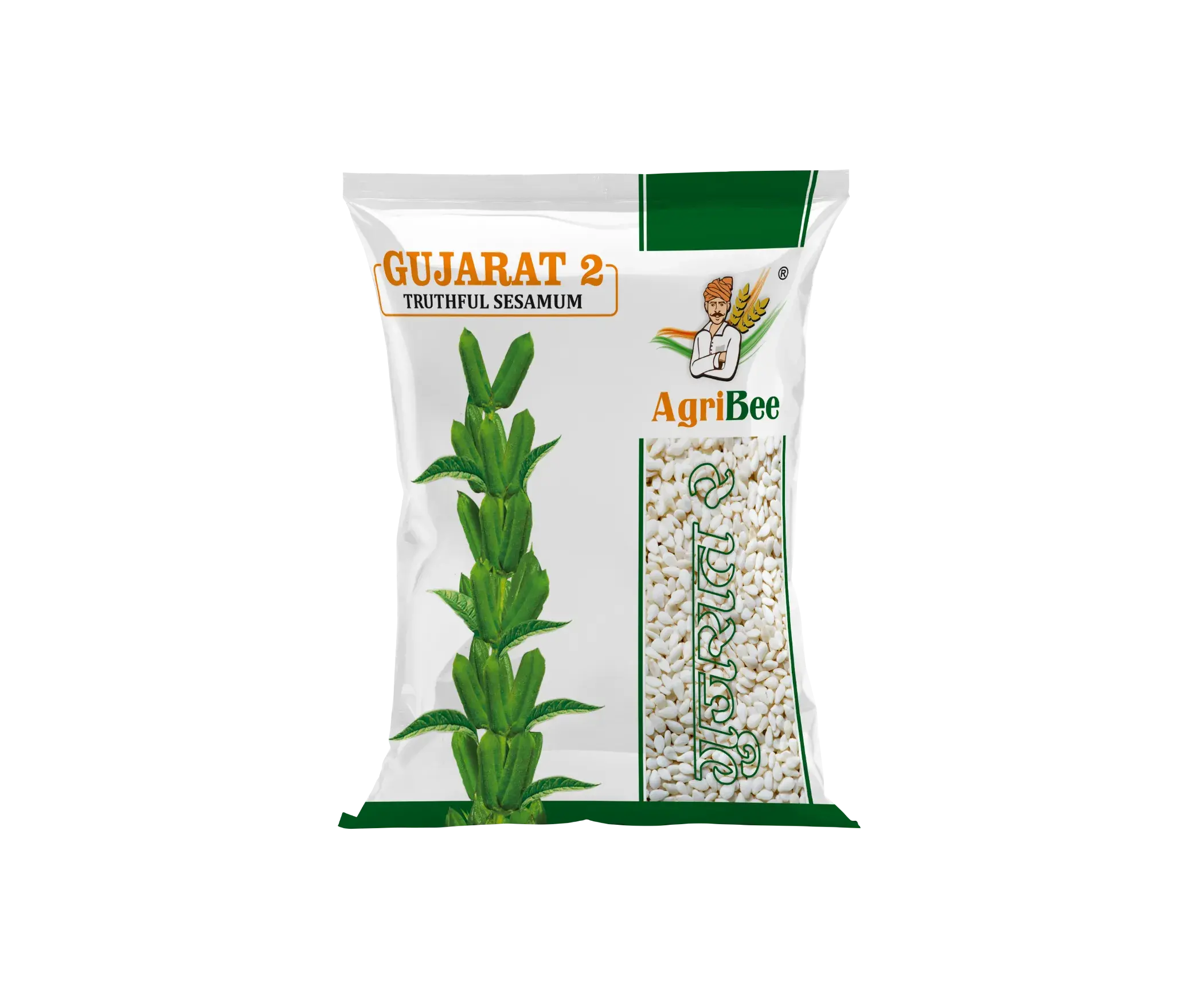
शेती व लागवड संपूर्ण मार्गदर्शक — Sesame Guj 2
Complete step-by-step agronomic guide for optimal crop management, disease resistance, and premium produce quality.
🌾 जमिनीची पूर्वमशागत
Proper land preparation ensures uniform seedling emergence and robust root anchorage.
🌱 योग्य जमिनीचा प्रकार व सामू (pH)
Well-drained sandy loam to medium black cotton soil; pH 6.0–8.0. Sesame is highly sensitive to waterlogging, so free-draining soil is essential.
✨ प्रमुख कृषी फायदे
Fine tilth and loose soil structure ensure rapid emergence of tiny sesame seeds and strong taproot penetration for drought resilience.
- 1
Deep summer ploughing followed by 2–3 cross-harrowings to achieve a fine, clod-free tilth.
- 2
Field leveling with ridges and furrows or flat sowing depending on irrigation availability; ensure proper drainage channels.
- 3
Incorporate 5–8 tonnes/ha of well-decomposed FYM or compost during the last harrowing for soil structure and organic carbon.
- 4
If soil pH is above 8.0, apply gypsum at 250 kg/ha; for acidic patches below 6.0, use agricultural lime at 200 kg/ha.
🌱 पेरणीची वेळ व पद्धत
Precise seed rate and spacing maximize light interception and canopy development.
| निकष / मापदंड | शिफारस / पद्धत | कृषी महत्त्व |
|---|---|---|
| पेरणीची वेळ | Early June to mid-July (Kharif); early October to mid-November (Rabi in southern zones) | Aligns with monsoon onset for adequate soil moisture; avoids late-season dry stress during capsule maturation |
| बियाणे प्रमाण (प्रति एकर) | 3–4 kg / Ha (1.2–1.6 kg / Acre) for line sowing; 4–5 kg / Ha for broadcast | Ensures optimum plant population of ~2.5–3.0 lakhs/ha without overcrowding |
| लागवडीतील अंतर | 45 cm row-to-row × 10–15 cm plant-to-plant | Promotes good canopy aeration, reduces humidity-related diseases, and supports uniform capsule development along the stem |
| पेरणीची खोली | 1–2 cm only | Sesame seeds are minute (100-seed weight 3.7 g); deep sowing severely limits germination and seedling emergence |
💧 पाणी व्यवस्थापन
Adequate moisture regulation supports strong vegetative and reproductive growth.
☀️ Water Requirement Profile
Sesame is inherently drought-tolerant due to its taproot system but is sensitive to both moisture stress and waterlogging. Under drip irrigation, apply 2–3 cm water per session at 5–7 day intervals during active growth. Drip systems significantly improve uniformity and help manage weeds.
🌦️ Soil Moisture Management
In rainfed conditions, sow with the first effective monsoon spell. Use mulching ( straw or polyethylene) to conserve soil moisture. Avoid standing water at any stage — raised beds or ridges are recommended in heavy soils.
- ✓
First irrigation at 3–5 DAS (Days After Sowing) if pre-sow moisture is insufficient; promotes uniform germination.
- ✓
During vegetative phase (15–40 DAS), maintain light soil moisture at 5–7 day intervals; avoid excess water that encourages root rot.
- ✓
Critical stage — flowering and pod initiation (45–65 DAS): Ensure adequate moisture; severe stress here reduces capsule set and seed quality.
- ✓
Withhold irrigation completely 10–12 days before harvest to facilitate capsule drying on the plant and prevent shattering losses.
🧪 खत व्यवस्थापन
Balanced crop nutrition supports robust plant structure and premium produce quality.
| पोषक घटक | शिफारस केलेले प्रमाण (प्रति एकर) | वापरण्याची वेळ व पद्धत |
|---|---|---|
| नायट्रोजन (N) | 40 kg N / Ha (16–20 kg/acre) | 50% basal at sowing + 50% top-dress at 30 DAS |
| फॉस्फरस (P2O5) | 30 kg P2O5 / Ha (12–15 kg/acre) | 100% basal as DAP (68 kg/ha) or SSP (400 kg/ha) at sowing |
| पोटॅश (K2O) | 20 kg K2O / Ha (8–10 kg/acre) | 100% basal as MOP at sowing for improved capsule filling and stress tolerance |
🌿 तण नियंत्रण व आंतरमशागत
Timely weed control ensures optimal nutrient and moisture availability for crop seedlings.
-
1
First Weeding & Hoeing: Carry out at 15 DAS using a manual hoe or cultipacker. Sesame has slow early growth and is highly competitive against weeds; keeping the field weed-free during the first 30 days is critical for crop vigor.
-
2
Second Weeding & Light Earthing-Up: Conducted at 30 DAS. Light earthing-up around the base improves root aeration and provides stability to the 95–105 cm tall plants, reducing lodging risk.
-
3
Mulching and Inter-row Cultivation: Apply straw mulch @ 3–4 tonnes/ha after second weeding to conserve moisture and suppress weeds. Conduct inter-row hoeing at 45 DAS. Remove weaker seedlings at 20 DAS to maintain 10–15 cm plant-to-plant spacing for optimal photosynthesis and capsule development.
🛡️ कीड व रोग व्यवस्थापन
Proactive crop monitoring and integrated management ensure healthy crop development.
🐛 Insect Pest Management
- Aphids (Aphis gossypii): Sucking sap from tender shoots causing curling and honeydew sooty mold. Spray Imidacloprid 17.8% SL @ 0.3 ml/L or Thiamethoxam 25% WG @ 0.2 g/L. Repeat at 10-day interval if infestation persists.
- Semilooper (Achaea janata): Larvae chew irregular holes in leaves, defoliating plants severely. Spray Spinosad 45% SC @ 0.3 ml/L or Bt formulation (Curlew) @ 1 g/L. Target early larval stage for maximum control.
- Jassids (Amritodus atropunctatus): Honeydew secretion and leaf yellowing with curling. Spray Acetamiprid 20% SP @ 0.5 g/L or Dimethoate 30% EC @ 1 ml/L. Monitor regularly during dry, warm conditions.
🔬 Disease Control
- Phytophthora Blight (Phytophthora nicotianae): Wilting, blackening of stem base, and plant death. Preventive spray of Metalaxyl 35% WP @ 2.5 g/L or Mancozeb @ 2 g/L at 15-day intervals starting from 30 DAS. Ensure field drainage is adequate.
- .root Rot / Collar Rot (Rhizoctonia solani): Water-soaked lesions at soil line, wilting, and rotting. Seed treatment with Trichoderma viride @ 4 g/kg + Carbendazim @ 2 g/kg before sowing. Avoid waterlogged fields.
- Sclerotial Rot (Sclerotium rolfsii): पांढरा fungal growth on stem base, spherical sclerotia formation, and plant collapse. Apply Trichoderma @ 5 kg/ha in soil drench at 30 DAS. Remove and destroy infected plants immediately; avoid continuous sesame monoculture.
✂️ काढणी व प्रत नियंत्रण
Harvesting at peak maturity ensures maximum commercial grade and long keeping quality.
⏱️ Harvesting Schedule & Timing
Primary harvest at 80–85 DAS when 70–80% capsules turn brown and begin to split. Selective picking may be done every 3–4 days from lower canopy upward, as capsules mature progressively from bottom to top.
⭐ Produce Quality Characteristics
पांढरा-seeded variety with high oil content, delicate nutty flavor, and excellent shell-out percentage. Capsules are non-shattering to moderately shattering, ensuring good seed retention at maturity. Seeds exhibit uniform size, bright white color, and minimal broken kernels.
| Quality निकष / मापदंड | Agronomic Standard | Farmer & Market Benefit |
|---|---|---|
| काढणीची अवस्था | 80–85 पेरणीनंतरचे दिवस; when lower capsules turn straw-colored | Captures peak seed fill and ensures premium seed appearance and oil quality |
| परिपक्वतेची लक्षणे | Brown/dry capsules, seeds rattle when shaken, lower leaves turn yellow | Prevents over-maturity, minimizes shattering losses, and preserves seed color integrity |
| Shelf Life & Keeping Quality | 6–8 months under cool, dry conditions in gunny bags or sealed containers | पांढरा sesame seeds resist rancidity well due to balanced oil composition, supporting extended marketability |
| बाजार उपयुक्तता | Premium export-quality white sesame; preferred for confectionery, bakery, oil extraction, and ethnic food processing | उच्च demand in domestic and international markets (Middle East, Southeast Asia) fetches better realized prices for growers |
⭐ विविध वैशिष्ट्ये — Sesame Guj 2
Distinguishing characteristics that make this variety a top choice for Indian growers.
🌿 Core Variety उच्चlight
Sesamum Guj 2 is a high-performing white-seeded sesame variety developed for Indian agro-climatic conditions, offering reliable field performance across Kharif and Rabi seasons.
🌿 Produce Quality & Appearance
Produces brilliant white seeds with 100-seed weight of 3.7 g, exhibiting excellent uniformity, high shell-out, and superior commercial grade accepted by processors and exporters.
🌿 Stress & Disease Tolerance
Demonstrates good tolerance to Phytophthora blight and root rots under field conditions, with moderate resistance to jassid infestation. Adapts well to moisture stress once established.
🌿 Growth Habit & Vigor
Compact to semi-erect plant architecture with height of 95–105 cm. Strong main stem with well-branched lateral growth supports abundant capsule distribution along the stem.
🌿 Crop Duration & Earliness
Reaches 50% flowering in 45–50 days and attains physiological maturity in 80–85 days, enabling flexible rotation with subsequent Kharif or Rabi crops such as mustard, groundnut, or pulses.
🌿 Market & Farmer Preference
Farmers favor Sesamum Guj 2 for its consistent stand establishment, ease of harvest, uniform maturation, and strong market demand for its white seed grade. Recommended by agronomists across Gujarat, Rajasthan, MP, and Maharashtra for both rainfed and irrigated cultivation.