
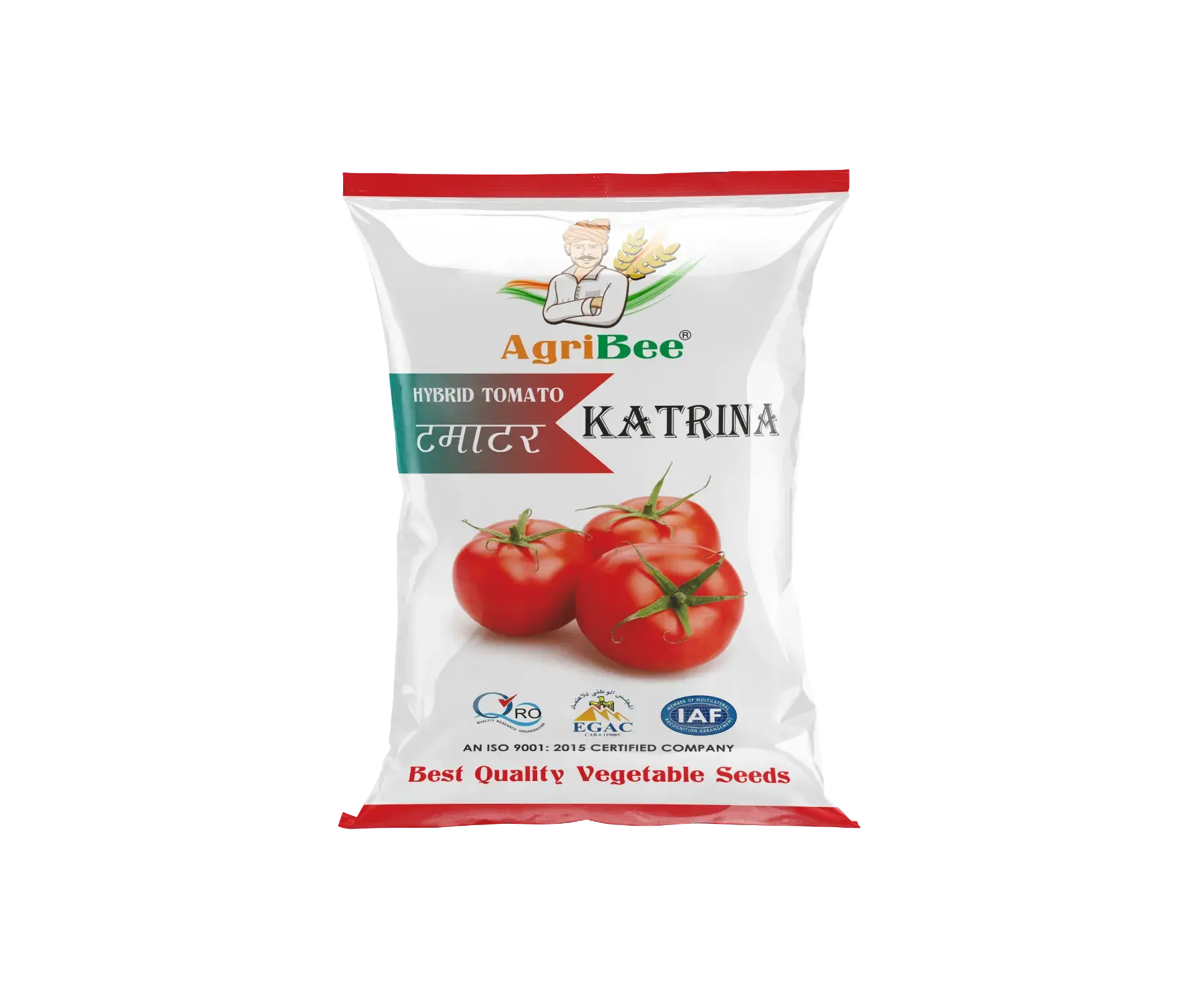
Description
शेती व लागवड संपूर्ण मार्गदर्शक — Tomato Seeds – Katrina
Complete step-by-step agronomic guide for optimal crop management, disease resistance, and premium produce quality.
🌾 जमिनीची पूर्वमशागत
Proper land preparation ensures uniform seedling emergence and robust root anchorage.
🌱 योग्य जमिनीचा प्रकार व सामू (pH)
Well-drained loamy to sandy-loam soils with pH 6.0–7.0 and good organic matter content. Heavy clay soils should be avoided due to poor drainage and waterlogging susceptibility.
✨ प्रमुख कृषी फायदे
Deep, fertile, well-aerated soil ensures strong root development, uniform nutrient uptake, and healthy vegetative growth essential for continuous fruit production.
- 1
Deep summer ploughing to 25–30 cm followed by 2–3 cross-harrowings for fine tilth and weed elimination.
- 2
Field leveling and formation of drainage channels to prevent water stagnation, especially in Kharif season.
- 3
Incorporate 8–10 tonnes per acre of well-decomposed FYM or compost during final harrowing for improved soil structure and moisture retention.
- 4
Conduct soil test and amend with gypsum (50 kg/acre) in alkaline soils or sulfur (25 kg/acre) in acidic soils to maintain pH within 6.0–7.0 range.
🌱 पेरणीची वेळ व पद्धत
Precise seed rate and spacing maximize light interception and canopy development.
| निकष / मापदंड | शिफारस / पद्धत | कृषी महत्त्व |
|---|---|---|
| पेरणीची वेळ | Kharif: June–July | Rabi: October–November | Summer: February–March (under shade net/protection) | Aligns crop cycle with favorable temperature and avoids peak ToLCV pressure during extreme summer monsoon periods |
| बियाणे प्रमाण (प्रति एकर) | 250–300 g per Acre (Transplanted nursery method) | Ensures adequate plant population of 25,000–30,000 plants per acre with strong healthy seedlings |
| लागवडीतील अंतर | 60 cm (row-to-row) x 45 cm (plant-to-plant) | Promotes optimal canopy development, air circulation, and sunlight penetration for disease management and fruit quality |
| Sowing / Transplanting Depth | Sow seeds at 0.5–1.0 cm depth in nursery; transplant seedlings at same depth as in nursery plug trays | Optimal depth ensures uniform germination, prevents damping-off, and promotes adventitious root development at base |
💧 पाणी व्यवस्थापन
Adequate moisture regulation supports strong vegetative and reproductive growth.
☀️ Water Requirement Profile
Tomato is moderately sensitive to water stress, particularly during flowering and fruit set stages. Drip irrigation is highly recommended with 3–4 mm water applied per event. Maintaining soil moisture at 70–80% field capacity ensures uniform fruit development and prevents physiological disorders like blossom-end rot and sunscald.
🌦️ Soil Moisture Management
In rainfed situations, employ mulching with straw or black polyethylene film to conserve soil moisture and regulate soil temperature. Construct wide drainage channels between beds to safely evacuate excess monsoon rainfall and prevent root rot conditions.
- ✓
First irrigation immediately after transplanting (within 6 hours) to reduce seedling stress and promote rapid root establishment.
- ✓
Vegetative phase: Light irrigation at 3–4 day intervals during summer and 5–7 day intervals during Rabi/Kharif to encourage deep root growth.
- ✓
Critical stage — Flowering and Fruit Setting: Maintain consistent moisture without waterlogging; intermittent stress at this stage causes flower drop and misshapen fruits.
- ✓
Pre-harvest: Reduce irrigation frequency 7–10 days before last picking to improve fruit firmness, color development, and post-harvest shelf life.
🧪 खत व्यवस्थापन
Balanced crop nutrition supports robust plant structure and premium produce quality.
| पोषक घटक | शिफारस केलेले प्रमाण (प्रति एकर) | वापरण्याची वेळ व पद्धत |
|---|---|---|
| नायट्रोजन (N) | 80–100 kg/acre (as Urea 46-0-0 @ 174–217 kg/acre) | 50% basal at transplanting; remaining 50% split into two equal top-dressings at 20 DAT and 40 DAT |
| फॉस्फरस (P2O5) | 50–60 kg/acre (as DAP 18-46-0 @ 109–130 kg/acre) | 100% basal application mixed thoroughly with soil during final land preparation |
| पोटॅश (K2O) | 40–50 kg/acre (as MOP 0-0-60 @ 67–83 kg/acre) | 50% basal at transplanting; remaining 50% applied at 40 DAT to support fruit development and disease resistance |
🌿 तण नियंत्रण व आंतरमशागत
Timely weed control ensures optimal nutrient and moisture availability for crop seedlings.
-
1
First Weeding & Hoeing: Perform shallow hoeing at 10–12 DAT to control early weed flush and improve soil aeration. Avoid deep hoeing near plant base to prevent root injury. Maintain weed-free condition during first 30 days for optimal plant establishment.
-
2
Second Weeding & Earthing-Up: Carry out second weeding at 25–30 DAT along with light earthing-up around plant bases to support stems, cover adventitious roots, and improve moisture conservation during hot weather.
-
3
Staking and Suckering: Begin staking/support at 20–25 DAT using bamboo stakes or string trellis system. Remove lateral suckers below first flower cluster up to 4th cluster (single-stem training) to direct nutrition toward fruit development and improve airflow within canopy. Apply straw or black mulch between rows to suppress weeds and retain moisture.
🛡️ कीड व रोग व्यवस्थापन
Proactive crop monitoring and integrated management ensure healthy crop development.
🐛 Insect Pest Management
- पांढराfly (Bemisia tabaci): Symptoms include yellowing, curling of upper leaves and sooty mold deposition. Control: Yellow sticky traps @ 10/acre; spray Imidacloprid 17.8% SL @ 100 ml/acre or Thiamethoxam 25% WG @ 50 g/acre. Rotate with Afidopyropen 50% WG @ 100 g/acre for resistance management.
- Fruit Borer (Helicoverpa armigera): Symptoms include bore holes on fruits with frass exudation and internal feeding damage. Control: Install pheromone traps @ 10/acre for monitoring; spray Chlorantraniliprole 18.5% SC @ 70 ml/acre or Spinetoram 11.7% WS @ 60 ml/acre. Apply Bt cysts @ 250 g/acre as preventive measure.
- Leaf Miner (Liriomyza trifolii): Symptoms appear as winding whitish tunnels or mines within leaf tissue reducing photosynthetic area. Control: Spray Indoxacarb 14.5% SC @ 70 ml/acre or Cartap hydrochloride 50% WP @ 600 g/acre. Remove and destroy heavily infested leaves promptly.
🔬 Disease Control
- Tomato Leaf Curl Virus (ToLCV): Symptoms include upward curling of leaves, yellowing, stunting, and reduced flowering. Vector-borne by whiteflies. Control: Use virus-free hybrid & research seeds and resistant hybrids like Katrina. Install silver polyethylene mulch @ 40 m/acre to repel whiteflies. Spray Neem oil 3% @ 3 ml/liter at 10-day intervals. Rogue and destroy infected plants immediately.
- Bacterial Wilt (Ralstonia solanacearum): Symptoms include sudden wilting of one side of plant, brown vascular discoloration, and bacterial ooze from cut stem. Control: Practice 3-year crop rotation with non-Solanaceous crops. drench soil with Streptocycline 50 ppm @ 4 liters/plant at 15 DAT. Apply Trichoderma viride @ 5 kg/acre mixed with FYM as soil application for biocontrol.
- Early Blight (Alternaria solani): Symptoms present as concentric ring spots on lower leaves progressing upward, leading to defoliation and fruit sunscald. Control: Spray Mancozeb 75% WP @ 250 g/acre or Chlorothalonil 50% WP @ 150 g/acre at 10-day intervals starting from fruit setting stage. Ensure proper spacing and pruning for canopy airflow.
✂️ काढणी व प्रत नियंत्रण
Harvesting at peak maturity ensures maximum commercial grade and long keeping quality.
⏱️ Harvesting Schedule & Timing
First harvesting begins 65–70 days after transplanting. Subsequent pickings are carried out at 3–4 day intervals over a extended period of 45–60 days, totaling 7–10 harvest cycles.
⭐ Produce Quality Characteristics
Premium flat round to oval shaped fruits with deep red coloration, smooth skin, firm flesh texture, balanced sweetness-acidity profile, and excellent internal locule development. Average fruit weight of 80–100 grams ensures uniform grading and high consumer appeal in fresh market segments.
| Quality निकष / मापदंड | Agronomic Standard | Farmer & Market Benefit |
|---|---|---|
| First काढणीची अवस्था | 65–70 Days after Transplanting (DAT) | Ensures peak quality and early market arrival when prices are favorable |
| परिपक्वतेची लक्षणे | Uniform deep red coloration, firm but yielding to gentle pressure, glossy skin surface | Prevents over-maturity, fruit cracking, and deterioration during handling |
| Shelf Life & Keeping Quality | 7–10 days under ambient conditions (25–30°C); 14–18 days under cool storage (12–15°C) | Facilitates long-distance transport and extends sales window for farmers |
| बाजार उपयुक्तता | Fresh table market, organized retail, mandis, and regional wholesale markets | Attracts premium market rates for farmers due to attractive appearance, uniform size, and disease tolerance |
⭐ विविध वैशिष्ट्ये — Tomato Seeds – Katrina
Distinguishing characteristics that make this variety a top choice for Indian growers.
🌿 Core Variety उच्चlight
Katrina is bred specifically for tolerance to Tomato Leaf Curl Virus (ToLCV), one of the most destructive viral diseases affecting tomato cultivation across India, ensuring reliable crop stands and consistent productivity even under high vector pressure.
🌿 Produce Quality & Appearance
Produces uniformly flat round to oval shaped fruits weighing 80–100 grams with attractive deep red color, firm texture, thick fruit walls, and appealing glossy finish that commands premium prices in regulated markets.
🌿 Stress & Disease Tolerance
Demonstrates strong field tolerance to ToLCV under endemic conditions. Exhibits good resilience against moderate drought stress and reasonable adaptability to varying temperature ranges encountered during Kharif and Rabi seasons.
🌿 Growth Habit & Vigor
Indeterminate growth habit with strong main stem architecture and well-branched laterals. Vigorous foliage with dark green leaves provides effective canopy cover while maintaining adequate light penetration for fruit ripening.
🌿 Crop Duration & Earliness
Earliest harvesting at 65–70 days after transplanting enables timely field recovery for succeeding crops and supports multiple cropping systems in high-value vegetable production belts across India.
🌿 Market & Farmer Preference
Trusted by progressive farmers across Gujarat, Maharashtra, Rajasthan, MP, and South India for its reliable performance, disease resilience, uniform fruit caliber, deep red coloration, and excellent field transit durability under Indian supply chain conditions.