
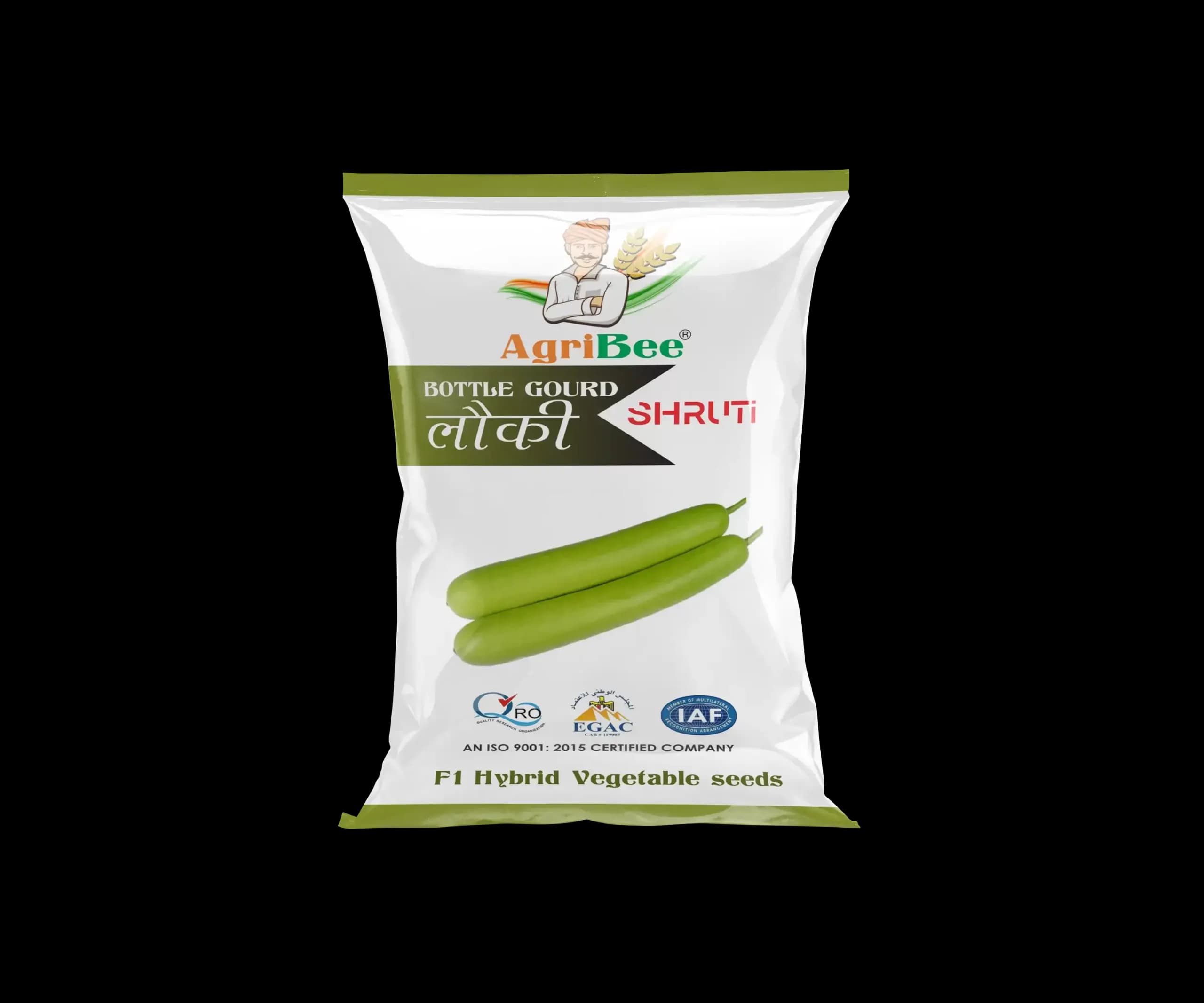
Description
Farming & Cultivation Guide — BottleGourd Seeds – Shruti
Complete step-by-step agronomic guide for optimal crop management, disease resistance, and premium produce quality.
🌾 Soil Preparation & Field Prep
Proper land preparation ensures uniform seedling emergence and robust root anchorage.
🌱 Ideal Soil Type & pH
Well-drained sandy loam to loamy soils with good organic matter content. Ideal pH range: 6.0 – 7.5. Heavy clay or waterlogged soils should be avoided as they predispose roots to fungal infections and reduce vine vigor.
✨ Core Advantage
Loose, well-aerated seedbed ensures rapid and uniform germination while promoting deep taproot penetration for strong anchorage of vigorous climbing vines.
- 1
Deep summer ploughing followed by 2–3 cross-harrowings to achieve fine tilth and destroy weed seeds.
- 2
Field leveling and drainage channel preparation to prevent water stagnation during heavy rainfall periods.
- 3
Incorporate 15–20 tonnes/ha of well-decomposed FYM or compost during final harrowing for soil structure improvement.
- 4
Conduct a soil health test; if pH is below 6.0, apply agricultural lime at 250–300 kg/ha one month before sowing to neutralize acidity.
🌱 Sowing Time & Method
Precise seed rate and spacing maximize light interception and canopy development.
| Parameter | Recommendation | Agronomic Importance |
|---|---|---|
| Sowing Window | June–July (Kharif), October–November (Rabi), February–March (Summer) | Bottle gourd is a warm-season crop; sowing during these windows ensures optimal temperature (25–35°C) for germination, vine growth, and fruit development. |
| Seed Rate | 0.8–1.0 kg per acre (2.0 kg/ha) for direct sowing; 400–500 g per acre for transplanting | Maintains optimal plant population without excessive competition for nutrients, light, and moisture. |
| Spacing | Row-to-row: 2.0–2.5 m; Plant-to-plant: 0.8–1.0 m (Trellis system); Row-to-row: 1.5 m x 1.0 m (Ground system) | Adequate spacing ensures proper canopy spread, sunlight penetration, air circulation, and ease of harvesting on trellis supports. |
| Sowing / Transplanting Depth | 2.5–3.5 cm depth for direct sowing; transplant seedlings at 2–3 true leaf stage | Shallow sowing ensures quick emergence as bottle gourd seeds are large and require adequate oxygen for germination; deeper sowing delays emergence and increases damping-off risk. |
💧 Irrigation & Water Management
Adequate moisture regulation supports strong vegetative and reproductive growth.
☀️ Water Requirement Profile
Bottle gourd requires consistent soil moisture throughout its lifecycle but is moderately sensitive to drought stress, especially during flowering and fruit set. The crop performs best with 5–7 gentle irrigations depending on soil type and weather. Drip irrigation with fertigation is highly compatible and recommended for water efficiency and reduced foliar disease pressure.
🌦️ Soil Moisture Management
Under rainfed conditions, ensure thorough pre-sowing irrigation to establish the crop. Use mulching (straw or plastic) to conserve soil moisture and regulate soil temperature. Avoid waterlogging at any stage — raised beds or ridges are strongly advised in heavy rainfall zones.
- ✓
First irrigation should be applied immediately after sowing (if pre-sowing irrigation was not done) and repeated within 48 hours to ensure uniform germination.
- ✓
During the vegetative phase (20–40 DAS), irrigate at 5–7 day intervals in sandy soils and 7–10 day intervals in loamy soils to support vigorous vine growth.
- ✓
Critical irrigation is essential during flowering and fruit setting stages (40–60 DAS); moisture stress at this stage causes flower drop and poor fruit set. Maintain consistent soil moisture until fruit maturation.
- ✓
Reduce irrigation frequency 5–7 days before the final harvest to improve fruit firmness and shelf life. Do not overwater immediately before harvest as it dilutes fruit quality and promotes cracking.
🧪 Fertilizer & Nutrition Management
Balanced crop nutrition supports robust plant structure and premium produce quality.
| Nutrient | Recommended Dose (per Acre) | Application Method & Timing |
|---|---|---|
| Nitrogen (N) | 80–100 kg/acre (as Urea 46%: ~175–220 kg/acre) | 50% basal at sowing; 25% top-dressed at 25–30 DAS; 25% at first flowering (40 DAS) |
| Phosphorus (P2O5) | 40–50 kg/acre (as DAP 18-46-0: ~90–110 kg/acre) | 100% basal application mixed thoroughly with soil at last harrowing |
| Potash (K2O) | 40–50 kg/acre (as MOP 60%: ~70–85 kg/acre) | 50% basal at sowing; 50% top-dressed at 40 DAS alongside second nitrogen split for improved fruit quality and disease tolerance |
🌿 Interculture & Weed Management
Timely weed control ensures optimal nutrient and moisture availability for crop seedlings.
-
1
First Weeding & Hoeing: Carry out light hoeing and weeding at 15–20 DAS before vine coverage. This is critical as bottle gourd seedlings are weak competitors against weeds during the early growth phase.
-
2
Second Weeding & Earthing-Up: Perform second weeding at 30–35 DAS combined with light earthing-up around the base of plants to encourage adventitious root formation and improve stem stability, especially for ground-growing systems.
-
3
Vine Training & Mulching: Train vines on trellis nets or strings from 25 DAS onward. Remove lateral shoots and tendrils that interfere with main vine growth. Apply organic mulch (paddy straw, 3–4 kg/m²) between rows to conserve moisture, suppress weeds, and maintain root zone temperature.
🛡️ Pest & Disease Management
Proactive crop monitoring and integrated management ensure healthy crop development.
🐛 Insect Pest Management
- Aphids (Aphis gossypii): Cluster of small green/black insects on undersides of leaves causing curling and honeydew sooty mold. Spray Imidacloprid 17.8% SL at 0.3 ml/L or Thiamethoxam 25% WG at 0.2 g/L. Also effective: release of ladybird beetles (Cryptolaemus montrouzieri) at 50,000/acre as biological control.
- Fruit Borer (Helicoverpa armigera): Larvae bore into fruits causing holes, frass expulsion, and premature fruit rot. Spray Chlorantraniliprole 18.5% SC at 0.3 ml/L or Spinosad 45% SC at 0.4 ml/L at 7-day intervals. Install pheromone traps at 10/acre for monitoring and mass trapping.
- Whitefly (Bemisia tabaci): Yellowing, wilting, and curling of leaves with silvering on upper surface; vector for yellow mosaic virus. Spray Actara (Thiamethoxam) 25% WG at 0.2 g/L or Confidor (Imidacloprid) 17.8% SL at 0.3 ml/L. Use yellow sticky traps at 10/acre for monitoring and adult suppression.
🔬 Disease Control
- Powdery Mildew (Podosphaera xanthii): White powdery fungal growth on leaves and stems reducing photosynthesis. Preventive spray of Sulphur (wettable) at 2.5 g/L or Myclobutanil at 0.1 g/L at 30 and 45 DAS. Remove and burn severely infected leaves. Crop rotation with non-cucurbits reduces inoculum load.
- Downy Mildew (Pseudoperonospora cubensis): Angular yellow lesions on upper leaf surface with purple-gray sporulation beneath in humid conditions. Spray Metalaxyl + Mancozeb (64%) at 2.0 g/L or Copper oxychloride at 3.0 g/L at 25 and 40 DAS. Avoid overhead irrigation to reduce leaf wetness duration.
- Fruit Rot / Anthracnose (Colletotrichum orbiculare): Water-soaked spots on fruits turning brown and sunken with acervuli in wet weather. Spray Mancozeb at 2.0 g/L or Carbendazim at 1.0 g/L preventively. Ensure proper trellising for air circulation and avoid fruit contact with soil. Resistant varieties like Shruti offer good field tolerance.
✂️ Harvesting & Produce Quality Guide
Harvesting at peak maturity ensures maximum commercial grade and long keeping quality.
⏱️ Harvesting Schedule & Timing
First picking begins at 50–60 days after sowing. Subsequent pickings are made at 5–7 day intervals, continuing for 4–6 weeks. Harvest fruits when they reach commercial size (30–45 cm length, 1000–1250 g weight) with smooth, firm skin.
⭐ Produce Quality Characteristics
Cylindrical, uniformly light green fruits with smooth, tender skin and compact flesh. The Shruti variety delivers consistent fruit appearance, good flavor, and minimal hollowing — highly valued in fresh market channels.
| Quality Parameter | Agronomic Standard | Farmer & Market Benefit |
|---|---|---|
| First Harvest Stage | 50–60 Days after Sowing | Enables early market entry, fetching premium prices during initial supply phases |
| Harvest Maturity Signs | Light green color, cylindrical shape, firm but tender skin, fruit length 30–45 cm | Prevents over-maturity which leads to hard rind, seedy interior, and market rejection |
| Shelf Life & Keeping Quality | 5–7 days under ambient conditions; 10–12 days under refrigerated storage (8–10°C, 85–90% RH) | Good post-harvest longevity supports transport to distant markets and reduces post-harvest losses |
| Market Suitability | Fresh market, mandis, retail chains, and hotel/restaurant supply across India | Uniform fruit size, attractive light green color, and consistent quality make Shruti a preferred choice for traders and processors seeking grade-A produce |
⭐ Varietal Features — BottleGourd Seeds – Shruti
Distinguishing characteristics that make this variety a top choice for Indian growers.
🌿 Core Variety Highlight
Shruti is an early-maturing, high-vigor bottle gourd variety developed by AgriBee Seeds, engineered for uniform fruiting and robust field performance under diverse Indian agro-climatic conditions.
🌿 Produce Quality & Appearance
Produces cylindrical, light green fruits weighing 1000–1250 g with smooth skin, compact flesh, and excellent culinary texture — ideal for domestic cooking, catering, and fresh produce retail.
🌿 Stress & Disease Tolerance
Demonstrates good tolerance to major cucurbit diseases including powdery mildew, downy mildew, and fruit rot, reducing dependency on repeated chemical interventions and ensuring healthier vines throughout the cropping cycle.
🌿 Growth Habit & Vigor
Vigorous vine growth with strong branching and excellent trellis adaptation. Plants exhibit sustained flowering and fruiting habits, minimizing bare intervals and ensuring continuous production over multiple pickings.
🌿 Crop Duration & Earliness
First picking at 50–60 days and full maturity by 65–70 days — one of the earliest commercial varieties available, enabling faster crop turnover and flexible scheduling in rotation systems.
🌿 Market & Farmer Preference
Farmers and agri-dealers favor Shruti for its reliability, uniform fruit caliber, disease resilience, and consistent performance across Kharif, Rabi, and summer seasons — making it a dependable choice for contract farming and open market sales alike.