Description
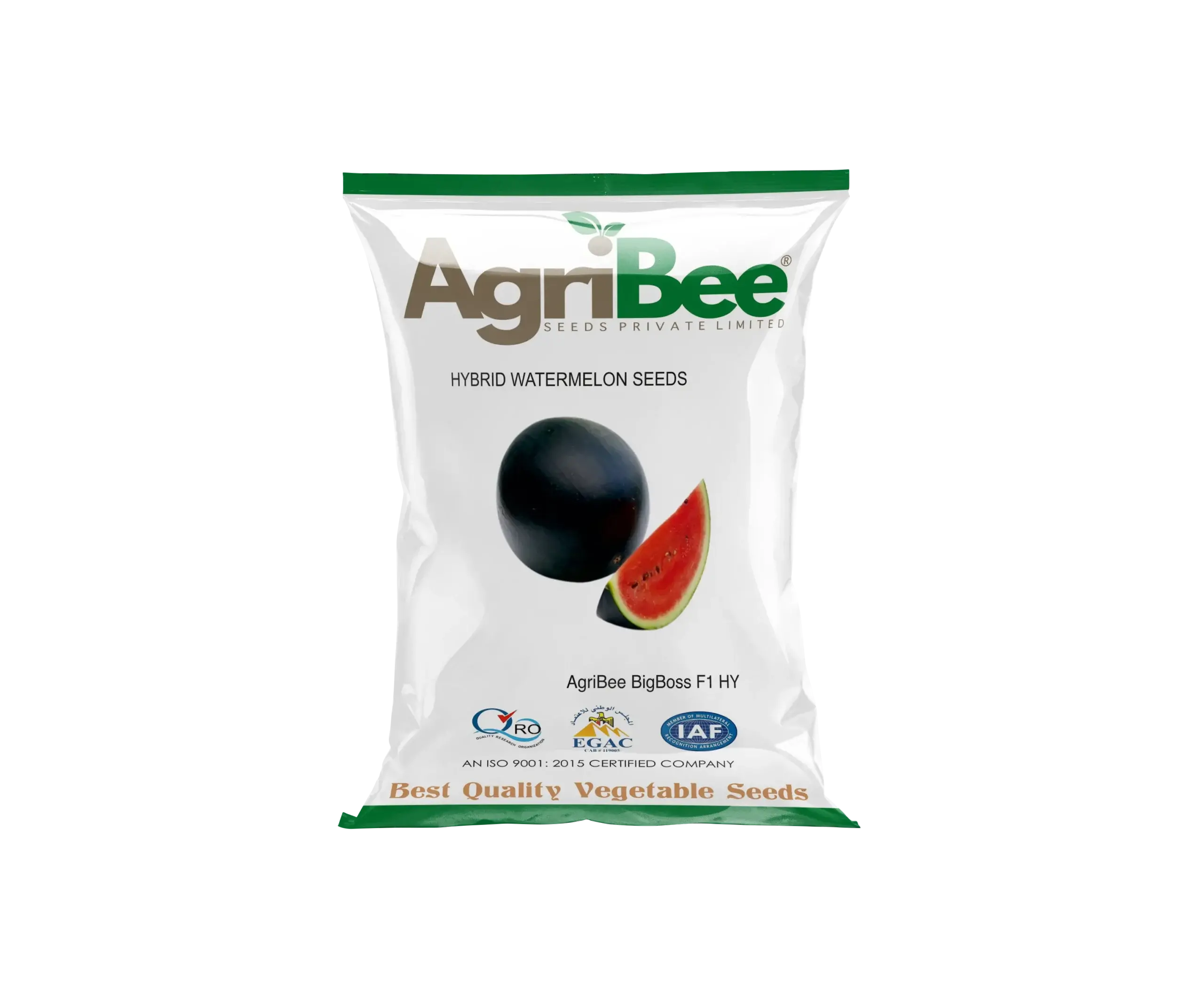
Farming & Cultivation Guide — Watermelon Seeds AgriBee BigBoss F1 HY
Complete step-by-step agronomic guide for optimal crop management, disease resistance, and premium produce quality.
🌾 Soil Preparation & Field Prep
Proper land preparation ensures uniform seedling emergence and robust root anchorage.
🌱 Ideal Soil Type & pH
Well-drained sandy loam to loamy soils with pH 6.0–7.5. Watermelon thrives in deep, fertile soils with good organic matter content and avoids heavy clay or waterlogged conditions.
✨ Core Advantage
Loose, well-aerated soil enables rapid seed germination, strong taproot development, and prevents fruit rot caused by soil moisture contact.
- 1
Deep summer ploughing to 25–30 cm followed by 2–3 cross-harrowings to achieve fine tilth and break capillary action.
- 2
Field leveling using laser leveling for uniform water distribution and proper drainage channel preparation.
- 3
Incorporate 8–10 t/ha of well-decomposed FYM or vermicompost during last harrowing to improve soil structure and water retention.
- 4
Conduct soil health testing; if pH is below 6.0, apply agricultural lime at 250–300 kg/ha and if above 7.5, apply gypsum at 200–250 kg/ha before sowing.
🌱 Sowing Time & Method
Precise seed rate and spacing maximize light interception and canopy development.
| Parameter | Recommendation | Agronomic Importance |
|---|---|---|
| Sowing Window | Jan – Mar for summer crop; Jul – Aug for Kharif; Oct – Nov for Rabi in warm zones | Watermelon is a warm-season crop; temperatures between 25–35°C promote vigorous growth and optimal fruit set |
| Seed Rate | 700–900 g per acre (direct sowing); 250–300 g per acre (transplanting) | Ensures adequate plant population while maintaining cost efficiency; F1 hybrid seeds have high germination thus lower rates suffice |
| Spacing | Row-to-row: 1.5–2.0 m; Plant-to-plant: 60–75 cm | Provides sufficient canopy spread, improves air circulation, reduces disease pressure, and facilitates easy field operations |
| Sowing / Transplanting Depth | 2.5–3.5 cm for direct sowing; 1–2 cm for transplanting | Proper depth ensures consistent moisture contact for germination while preventing seed rot and promoting strong seedling emergence |
💧 Irrigation & Water Management
Adequate moisture regulation supports strong vegetative and reproductive growth.
☀️ Water Requirement Profile
Watermelon requires moderate but consistent moisture throughout its lifecycle. The crop is moderately drought-tolerant once established but is highly sensitive to both water deficit and waterlogging. Drip irrigation is highly recommended with 2–4 liters per hour emitters spaced at 30–40 cm apart. Total water requirement ranges from 400–600 mm over the crop cycle depending on climate and soil type.
🌦️ Soil Moisture Management
In rainfed or semi-arid regions, ensure adequate soil moisture at sowing through pre-sowing irrigation. Use black plastic mulch to conserve soil moisture and suppress weeds. Avoid moisture stress during flowering and fruit development stages as it leads to poor fruit set, flower drop, and small-sized fruits.
- ✓
First irrigation should be given 2–3 days after sowing to ensure uniform germination; subsequent irrigations at 4–5 day intervals during the vegetative phase.
- ✓
During active vine growth (20–40 DAS), maintain light and frequent irrigation every 3–4 days to support rapid canopy development without waterlogging.
- ✓
Critical stage at fruit set and fruit development (45–70 DAS): increase irrigation frequency to every 2–3 days; consistent moisture during this period is essential for optimal fruit size, crispness, and sweetness.
- ✓
Reduce irrigation frequency 7–10 days before harvest to concentrate sugars in the flesh and improve shelf life; avoid overhead watering to prevent fruit splitting and disease incidence.
🧪 Fertilizer & Nutrition Management
Balanced crop nutrition supports robust plant structure and premium produce quality.
| Nutrient | Recommended Dose (per Acre) | Application Method & Timing |
|---|---|---|
| Nitrogen (N) | 80–100 kg/ha (18–24 kg N/acre) | 50% basal at sowing along with phosphorus and potash; remaining 50% as split top-dressing at 25–30 DAS and 45 DAS |
| Phosphorus (P2O5) | 50–60 kg/ha (12–14 kg P2O5/acre) | 100% basal application at sowing mixed with soil or applied in furrows below seed level to promote root development |
| Potash (K2O) | 60–80 kg/ha (14–19 kg K2O/acre) | 50% basal at sowing; remaining 50% applied at fruit initiation stage (45–50 DAS) to enhance fruit sizing, sugar accumulation, and firmness |
🌿 Interculture & Weed Management
Timely weed control ensures optimal nutrient and moisture availability for crop seedlings.
-
1
First Weeding & Hoeing: Carry out first weeding and shallow hoeing at 15–20 DAS to remove early weed flush without damaging shallow roots. Keep the area around the plant stem clean to reduce pest harboring sites.
-
2
Second Weeding & Earthing-Up: Perform second weeding and light earthing-up around the base of plants at 30–35 DAS to improve root zone aeration and support spreading vines. Remove excess runners at this stage to direct plant energy toward fruit development.
-
3
Mulching and Vine Training: Apply black polythene mulch at planting or lay straw mulch between rows to conserve moisture, suppress weeds, and keep fruits clean off the soil. Place fruits on clean straw pads once set to prevent soil-borne diseases and maintain uniform coloring.
🛡️ Pest & Disease Management
Proactive crop monitoring and integrated management ensure healthy crop development.
🐛 Insect Pest Management
- Aphids (Aphis gossypii): Sucking sap from leaves causing yellowing, curling, and honeydew accumulation leading to sooty mold. Control: Spray IMIDACLOPRID 17.8% SL at 0.3 ml/liter of water or THIAMETHOXAM 25% WG at 0.2 g/liter. Release ladybird predators (Cheilomenes spp.) at 5,000/acre as biological control.
- Fruit Fly (Bactrocera cucurbitae): Adult flies lay eggs inside developing fruits causing larval infestation, fruit dropping, and rotting. Control: Apply MONOCROTOPHOS 36% WSC at 1 ml/liter as spray OR use protein bait spray (Neem-based protein hydrolysate + MONOCROTOPHOS 50% EC at 1 ml/liter). Set up yellow sticky traps at 10 traps/acre for monitoring and mass trapping.
- Cucurbit Beetle / Fruit & Leaf Bug (Actenocoris trivittatus): Nymphs and adults feed on fruits and tender shoots causing scarring and distorted fruit development. Control: Spray CYPERMETHRIN 10% EC at 0.5 ml/liter or CHLORPYRIFOS 20% EC at 1.0 ml/liter. Practice crop rotation and remove crop residues after harvest to reduce overwintering populations.
🔬 Disease Control
- Powdery Mildew (Podosphaera xanthii): White powdery fungal growth on upper and lower leaf surfaces, leading to leaf necrosis and reduced photosynthetic capacity. Preventive spray: MYCLOBUTANIL 8% WP at 0.1 g/liter or SULPHUR 80% WP at 2.5 g/liter. Apply at 7-day intervals starting from 30 DAS under humid conditions.
- Fusarium Wilt (Fusarium oxysporum f. sp. nivele): Yellowing and wilting of vines starting from older leaves, vascular browning observed on stem cross-section, eventual plant collapse. Management: Use resistant F1 hybrids like AgriBee BigBoss F1 HY; drench with THIOVIT (wettable sulphur) at 2.5 g/liter at first appearance; practice 3–4 year crop rotation with non-cucurbit crops; ensure well-drained soil.
- Downy Mildew (Pseudoperonospora cubensis): Irregular yellow angular lesions on upper leaf surface bounded by veins, greyish-purple sporulation on lower surface in humid weather. Preventive spray: MANCOZEB 75% WP at 2.0 g/liter or METALAXYL 35% WS at 0.8 g/liter. Start prophylactic sprays at 25–30 DAS in Kharif conditions and repeat at 10–12 day intervals.
✂️ Harvesting & Produce Quality Guide
Harvesting at peak maturity ensures maximum commercial grade and long keeping quality.
⏱️ Harvesting Schedule & Timing
First harvest begins at 75–80 days after sowing. Fruits are typically ready for a single full harvest. Individual fruit maturity is determined by assessing field signs rather than fixed calendar dates across all plants.
⭐ Produce Quality Characteristics
Deep red, crisp, and very sweet flesh with high TSS (Brix) content. Dark green striped exterior with oblong to round fruit shape weighing 4–8 kg. Firm texture ensures excellent handling quality and consumer appeal.
| Quality Parameter | Agronomic Standard | Farmer & Market Benefit |
|---|---|---|
| First Harvest Stage | 75–80 days after sowing depending on season and growing conditions | Ensures peak sugar accumulation, optimal fruit size, and early market arrival for better price realization |
| Harvest Maturity Signs | Drying and browning of the tendril nearest to the fruit peduncle, creamy-yellow ground spot, firm fruit feel, and distinct sound when tapped | Prevents premature or over-mature harvesting which affects sweetness, texture, and storability |
| Shelf Life & Keeping Quality | 7–12 days under ambient conditions (25–30°C); up to 14–18 days under cool storage at 10–12°C with 85–90% relative humidity | Facilitates long-distance transportation, extends marketing window, and maintains commercial quality for wholesale and retail channels |
| Market Suitability | Suitable for fresh table market, mandis, modern retail chains, and export markets due to uniform size, attractive dark green striped rind, deep red crisp flesh, and high sweetness | Attracts premium market rates from traders and processors owing to consistent quality, good firmness, and high consumer acceptance |
⭐ Varietal Features — Watermelon Seeds AgriBee BigBoss F1 HY
Distinguishing characteristics that make this variety a top choice for Indian growers.
🌿 Core Variety Highlight
AgriBee BigBoss F1 HY is a high-performing watermelon hybrid engineered for superior field vigor, uniform fruit development, and consistent quality across diverse Indian growing conditions.
🌿 Produce Quality & Appearance
Produces oblong to round fruits with an attractive dark green striped rind. The flesh is deep red, exceptionally crisp, and very sweet with high Brix levels that meet demanding consumer and trader specifications.
🌿 Stress & Disease Tolerance
Demonstrates strong field tolerance to Fusarium wilt and good resistance to powdery mildew and downy mildew under managed conditions. Exhibits resilience to moderate heat and humidity stresses encountered during Indian summer and Kharif seasons.
🌿 Growth Habit & Vigor
Vigorous vine growth with strong lateral branching and well-developed root system. Healthy, dark green foliage provides excellent canopy coverage for fruit shade and efficient photosynthesis throughout the crop cycle.
🌿 Crop Duration & Earliness
Reaches first harvest in 75–80 days after sowing, enabling timely crop turnover and flexibility in crop rotation planning. Early maturity supports multiple cropping systems in states like Gujarat, Maharashtra, and South India.
🌿 Market & Farmer Preference
Preferred by progressive farmers and agri-traders for its uniform fruit weight (4–8 kg), appealing external appearance, superior internal quality, and reliable field performance. The F1 hybrid seed ensures genetic uniformity, high germination, and predictable crop behavior, making it a trusted choice among AgriBee Seeds customers.