Description
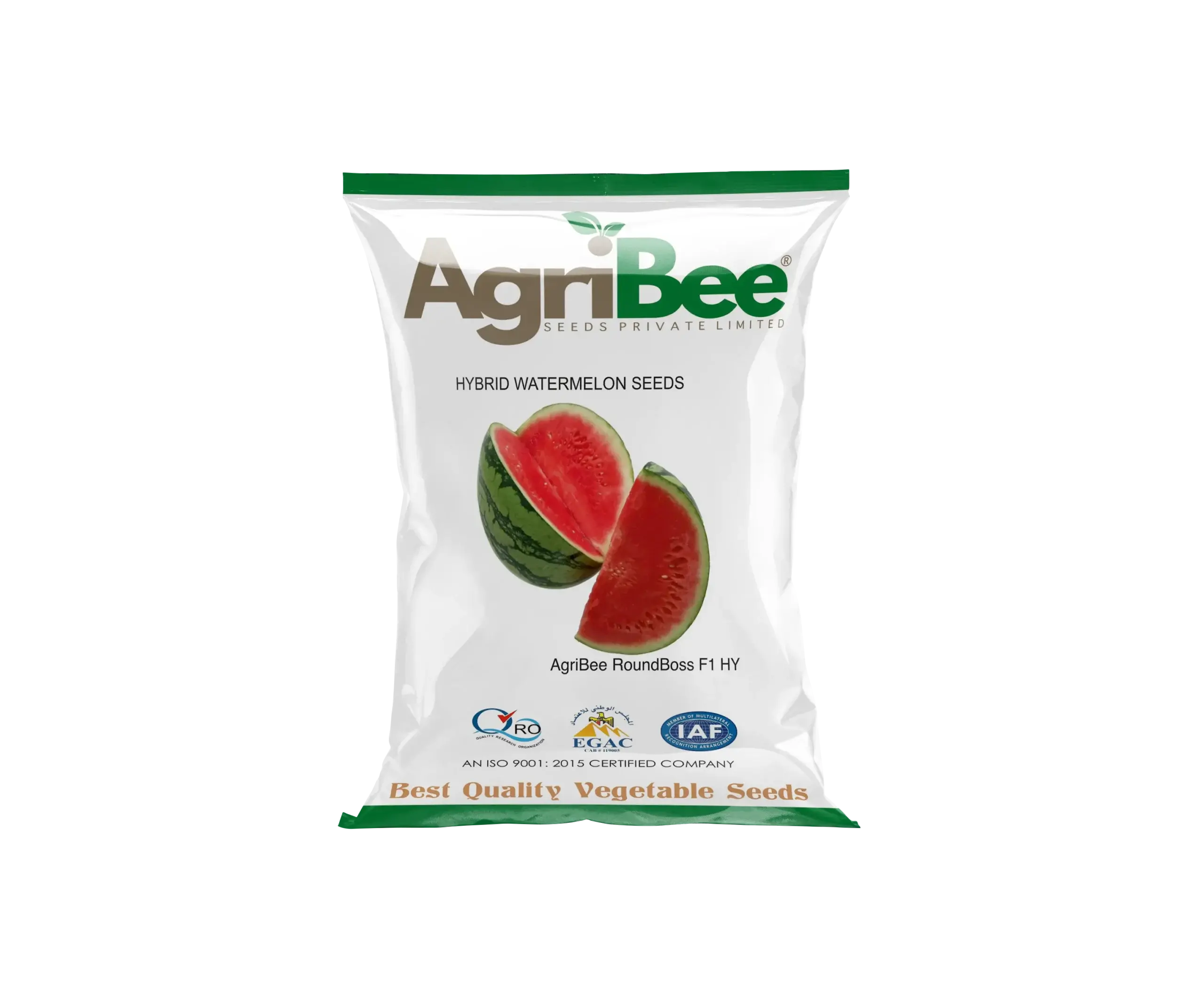
Farming & Cultivation Guide — Watermelon Seeds AgriBee RoundBoss F1 HY
Complete step-by-step agronomic guide for optimal crop management, disease resistance, and premium produce quality.
🌾 Soil Preparation & Field Prep
Proper land preparation ensures uniform seedling emergence and robust root anchorage.
🌱 Ideal Soil Type & pH
Well-drained sandy loam to loamy soils with pH 6.0–7.5. Watermelon thrives in light, warm soils that reach favorable germination temperatures early in the season. Heavy clay or waterlogged soils must be avoided due to susceptibility to root rot.
✨ Core Advantage
Loose, well-aerated seedbed promotes rapid radicle emergence, strong taproot development, and uniform vine growth without waterlogging stress.
- 1
Deep summer ploughing to a depth of 25–30 cm followed by 2–3 cross-harrowings to achieve a fine, clod-free tilth.
- 2
Field leveling using a laser leveler or board leveling to ensure uniform water distribution and prevent water stagnation in low spots.
- 3
Incorporate 8–10 tonnes per acre of well-decomposed FYM or compost during the last harrowing to improve soil structure, water retention, and microbial activity.
- 4
Apply gypsum at 250–300 kg/acre in alkaline soils or sulfur at 25 kg/acre in alkaline conditions to bring pH toward the ideal range before final seedbed preparation.
🌱 Sowing Time & Method
Precise seed rate and spacing maximize light interception and canopy development.
| Parameter | Recommendation | Agronomic Importance |
|---|---|---|
| Sowing Window | March–April (North/Central India) / October–November (South & West India) | Watermelon is a heat-loving crop; sowing should align with soil temperatures above 18°C for reliable germination and vigorous early growth. |
| Seed Rate | 800–1000 g per Acre (Direct Sowing) | Optimal seed rate ensures adequate plant population (~800–1000 plants/acre) accounting for field emergence variability and fruit-bearing vine requirement. |
| Spacing | 1.5–2.0 m (Row-to-Row) × 0.6–0.8 m (Plant-to-Plant) | Wide row spacing accommodates the trailing vine habit, maximizes sunlight interception, improves airflow to reduce foliar disease incidence, and facilitates field operations. |
| Sowing / Transplanting Depth | 2–3 cm (1–1.5 inch) below soil surface | Proper shallow depth ensures rapid and uniform germination; seeds sown too deeply face energy depletion before emergence, reducing stand uniformity. |
💧 Irrigation & Water Management
Adequate moisture regulation supports strong vegetative and reproductive growth.
☀️ Water Requirement Profile
Watermelon requires consistent soil moisture throughout the growing cycle but is moderately sensitive to both drought and waterlogging. Under drip irrigation, apply 3–5 mm per irrigation event every 2–3 days during peak summer. Total seasonal water requirement approximates 450–550 mm. Drip with mulch is highly recommended as it conserves moisture, suppresses weeds, and reduces foliar disease by keeping vines dry.
🌦️ Soil Moisture Management
In rainfed or semi-arid regions, adopt wide spacing and mulching with straw or polythene to conserve soil moisture. Avoid water stress during the flowering and fruit development stages (30–60 DAS), as moisture deficit at these stages causes blossom end drop, fruit cracking, and poor sugar accumulation.
- ✓
First Irrigation: Apply immediately after sowing to ensure seed coat softening and uniform germination. Follow with light irrigation at 48 hours if rainfall is inadequate.
- ✓
Vegetative Phase (15–30 DAS): Light and frequent irrigations every 5–7 days to support rapid vine growth and leaf area expansion without encouraging excessive lushness.
- ✓
Critical Growth Stage (Flowering & Fruit Set, 30–50 DAS): Maintain consistent soil moisture with irrigation every 3–4 days. Stress during this period directly impacts fruit set and initial fruit development. Increase frequency during peak summer (May–June).
- ✓
Pre-Harvest Water Withholding: Reduce irrigation frequency 7–10 days before expected harvest to concentrate sugars, improve Brix levels, and enhance firmness. Avoid overhead irrigation close to harvest to prevent fruit splitting and decay.
🧪 Fertilizer & Nutrition Management
Balanced crop nutrition supports robust plant structure and premium produce quality.
| Nutrient | Recommended Dose (per Acre) | Application Method & Timing |
|---|---|---|
| Nitrogen (N) | 80–100 kg/acre | 50% basal at sowing; remaining 50% split into two top-dressings at 20 DAS and 40 DAS for sustained vine growth and fruit development. |
| Phosphorus (P2O5) | 50–60 kg/acre | 100% basal application incorporated during final land preparation as DAP (18:46:0) or SSP to promote root initiation and flower development. |
| Potash (K2O) | 60–80 kg/acre | 50% basal + 50% at 40 DAS as MOP (60:0:0) to support fruit sizing, sugar translocation, and disease tolerance. |
🌿 Interculture & Weed Management
Timely weed control ensures optimal nutrient and moisture availability for crop seedlings.
-
1
First Weeding & Hoeing: Perform first weeding at 15–20 DAS using a rotating hoe or hand weeding, being careful not to damage shallow seminal roots. Early weed control is critical as watermelon has limited competitive ability during the first 3 weeks.
-
2
Second Weeding & Vine Training: Conduct second weeding at 30–35 DAS. Begin vine training by guiding main runners outward to ensure even canopy spread. Remove lateral branches near the base to improve airflow around the fruit zone.
-
3
Mulching and Inter-row Management: Apply plastic mulch (black or silver-gray) at transplanting or after first weeding to conserve moisture, suppress weeds, reflect UV light to deter aphids, and keep fruits clean. Alternatively, use straw mulch at 5–7 cm thickness. For organic systems, inter-row hoeing at 25 and 40 DAS keeps the field weed-free without chemical input.
🛡️ Pest & Disease Management
Proactive crop monitoring and integrated management ensure healthy crop development.
🐛 Insect Pest Management
- Fruit Fly (Bactrocera cucurbitae): Larvae tunnel into developing fruit causing rotting and premature drop. Control: Install methyl eugenol-based traps at 10 traps/acre from 30 DAS. Spray thiamethoxam 25 WG at 0.1 g/liter or spinosad 45 SC at 0.3 ml/liter targeting adult flies. Destroy infected fruits immediately in sealed bags.
- Aphids (Aphis gossypii): Colonize underside of leaves and tender shoots, sucking sap and transmitting cucurbit yellow stagnosis virus (CYSV). Control: Spray imidacloprid 17.8 SL at 0.3 ml/liter or thiamethoxam 25 WG at 0.1 g/liter. Introduce ladybird beetles (Harmonia axyridis) at 50,000/acre as biological control. Yellow sticky traps at 10/acre monitor adult populations.
- Cucurbit Beetle / Fruit Caterpillar (Diabrotica spp./Helicoverpa armigera): Beetles skeletonize leaves; caterpillars bore into fruits causing direct performance loss. Control: Spray chlorantraniliprole 18.5 SC at 0.3 ml/liter or emamectin benzoate 5 SG at 0.3 g/liter at 7-day intervals during peak infestation. Use pheromone traps at 5/acre for monitoring Helicoverpa population dynamics.
🔬 Disease Control
- Powdery Mildew (Podosphaera xanthii): White powdery patches on upper and lower leaf surfaces, leading to leaf senescence and reduced photosynthetic capacity. Control: Spray sulfur dust at 15–20 kg/acre or propiconazole 25 EC at 0.5 ml/liter at 5-day intervals. Reserve kresoxim-methyl 50 WG at 0.1 g/liter for resistant strains. Ensure adequate spacing to minimize humidity.
- Downy Mildew (Pseudoperonospora cubensis): Angular yellow lesions on upper leaf surface bounded by veins; purple-gray sporulation on undersurface. Control: Apply dimethomorph 50 WP at 0.2 g/liter or mancozeb 75 WP at 2.0 g/liter at 7-day intervals. Remove and destroy heavily infected leaves. Avoid overhead irrigation to reduce leaf wetness duration.
- Fusarium Wilt (Fusarium oxysporum f.sp. nivele): Wilting of vines starting from older leaves, yellowing, vascular browning, and eventual plant collapse. Control: Use resistant/rootstock combinations where available. Soil solarization for 4–6 weeks before sowing reduces inoculum. Apply trichoderma viride at 5–10 kg/acre mixed with FYM as soil drench. Avoid consecutive cucurbit crops; rotate with non-host cereals for 2–3 seasons.
✂️ Harvesting & Produce Quality Guide
Harvesting at peak maturity ensures maximum commercial grade and long keeping quality.
⏱️ Harvesting Schedule & Timing
First harvest begins at 75–80 days after sowing. Primary fruit maturation occurs within a 7–10 day window. Secondary smaller fruits may mature 5–7 days later if vine conditions remain favorable. Avoid delaying harvest beyond physiological maturity to prevent fruit cracking and flesh degradation.
⭐ Produce Quality Characteristics
Deep red, crisp, dense flesh with high sugar content (Brix 10–13°). Thick rind with dark green striped surface provides excellent handling and transport durability. Oblong to round fruit shape ensures uniform grading and commercial appeal.
| Quality Parameter | Agronomic Standard | Farmer & Market Benefit |
|---|---|---|
| First Harvest Stage | 75–80 Days after Sowing | Ensures peak flavor development, optimal firmness, and earliest market arrival for premium pricing. |
| Harvest Maturity Signs | Drying of the tendril nearest the fruit, yellowing of the ground spot, dull rind appearance, and firm resistance to thumb pressure | Prevents over-maturity, flesh softening, and post-harvest decay. |
| Shelf Life & Keeping Quality | 7–10 days at ambient temperature (25–30°C); up to 14 days under cool storage (10–12°C) | Thick rind and firm flesh provide extended marketing window and long-distance transport viability. |
| Market Suitability | Fresh table market, wholesale mandis, retail chains, and processing units; suitable for both domestic and export markets | Uniform size (4–8 kg), attractive striping, and deep red flesh command higher market rates and consumer preference. |
⭐ Varietal Features — Watermelon Seeds AgriBee RoundBoss F1 HY
Distinguishing characteristics that make this variety a top choice for Indian growers.
🌿 Core Variety Highlight
AgriBee RoundBoss F1 is a vigorous hybrid developed for early-maturing, high-quality watermelon production under Indian agro-climatic conditions, combining adaptability with consistent field performance.
🌿 Produce Quality & Appearance
Deep red, crisp flesh with exceptional sweetness; thick dark green striped rind provides superior handling resistance and visual market appeal. Oblong to round fruit shape ensures uniform grading.
🌿 Stress & Disease Tolerance
Demonstrates strong field tolerance to common cucurbit pathogens including powdery mildew and Fusarium wilt, along with moderate resilience to heat stress during summer cultivation windows.
🌿 Growth Habit & Vigor
Determinate to semi-determinate vine architecture with balanced foliage and strong primary runner development. Open canopy habit promotes fruit exposure and reduces disease microclimate.
🌿 Crop Duration & Earliness
Early maturity at 75–80 days enables flexible crop scheduling, multi-cropping systems, and early market entry when watermelon prices typically command premium rates.
🌿 Market & Farmer Preference
Trusted AgriBee F1 hybrid with consistent fruit set, uniform mature size (4–8 kg), high Brix content, and improved shelf life—making it a preferred choice among progressive farmers, commission agents, and wholesale traders across India.