Description
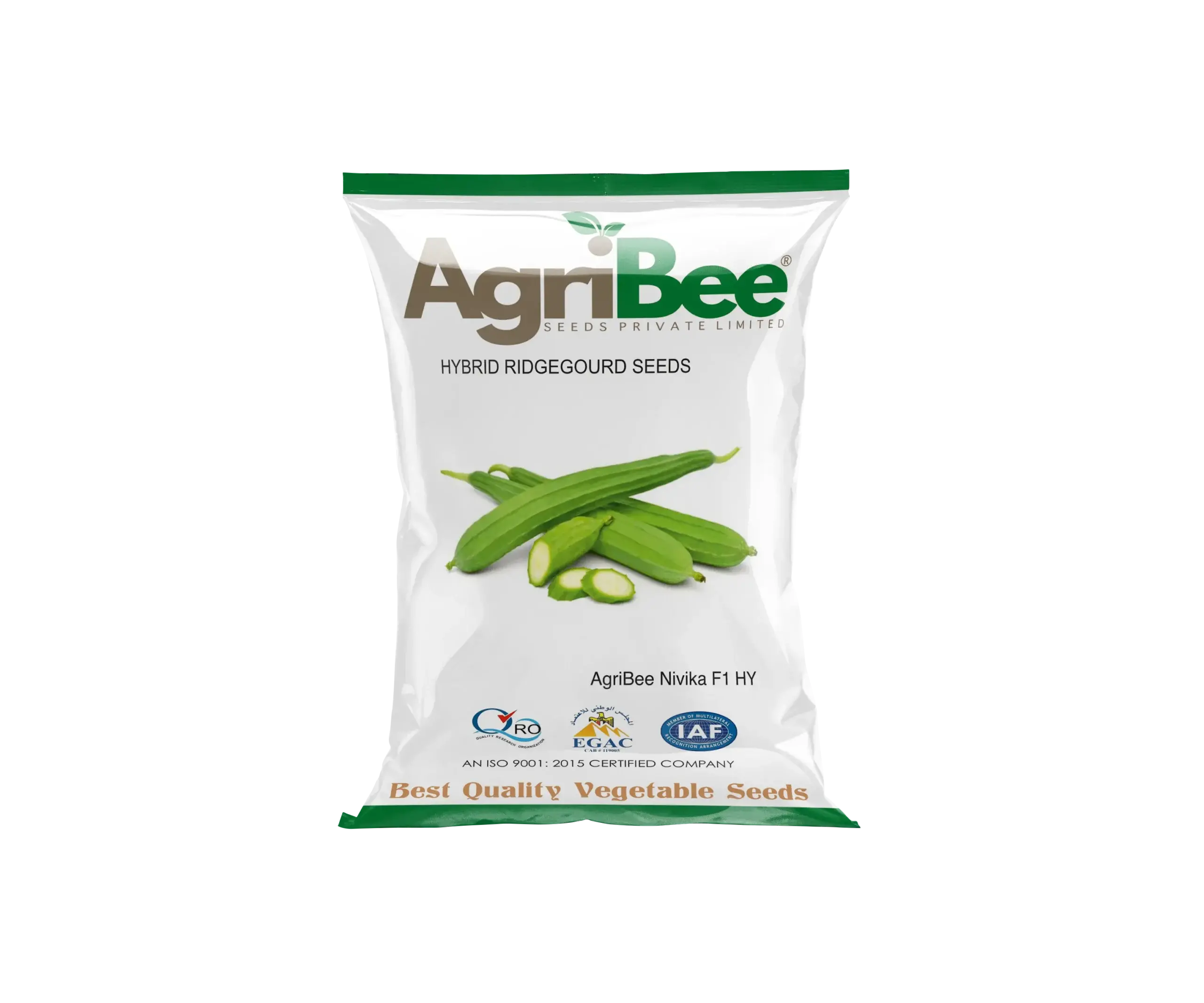
Farming & Cultivation Guide — Sponge Gourd Seeds AgriBee Nivika F1 HY
Complete step-by-step agronomic guide for optimal crop management, disease resistance, and premium produce quality.
🌾 Soil Preparation & Field Prep
Proper land preparation ensures uniform seedling emergence and robust root anchorage.
🌱 Ideal Soil Type & pH
Well-drained sandy loam to loamy soils with pH 6.0–7.5. Deep, fertile soils with good organic matter content support vigorous vine growth and uniform fruit development.
✨ Core Advantage
Loose, well-aerated seedbed ensures rapid seedling emergence and strong root penetration, establishing a robust foundation for high-quality fruit set.
- 1
Deep ploughing in early summer followed by 2–3 harrowing sessions to achieve a fine, clod-free tilth.
- 2
Formation of raised beds or broad beds with adequate drainage channels to prevent waterlogging during monsoon.
- 3
Incorporation of 8–10 tonnes/acre of well-decomposed FYM or vermicompost during the final harrowing.
- 4
Soil solarization or bio-fumigation in susceptible areas to reduce soil-borne pathogens and nematode loads.
🌱 Sowing Time & Method
Precise seed rate and spacing maximize light interception and canopy development.
| Parameter | Recommendation | Agronomic Importance |
|---|---|---|
| Sowing Window | Early June for Kharif; February–March for Summer cropping zones. | Aligns crop growth with favorable temperatures and humidity, minimizing stress during critical fruit development. |
| Seed Rate | 50–60 g per acre for direct sowing. | Optimized seed rate maintains ideal plant population without overcrowding, ensuring maximum air circulation and light interception. |
| Spacing | 90 cm × 60 cm (Row-to-row × Plant-to-plant). | Provides sufficient canopy spread for foliage health, ease of interculture, and harvesting operations. |
| Sowing Depth | 2–3 cm depth in rows or bumps. | Ensures consistent soil moisture contact for uniform germination and avoids deep-sowing delays. |
💧 Irrigation & Water Management
Adequate moisture regulation supports strong vegetative and reproductive growth.
☀️ Water Requirement Profile
Moderately drought-sensitive during early vine expansion. Drip irrigation is highly recommended to maintain consistent soil moisture without waterlogging, enhancing nutrient uptake efficiency.
🌦️ Soil Moisture Management
Avoid standing water around the crown. In rainfed conditions, ensure field drainage is cleared immediately after heavy showers to prevent root rot and maintain foliage turgor.
- ✓
First irrigation should be applied 3–4 days after sowing to ensure germination.
- ✓
Light irrigations at 3–4 day intervals during vegetative phase promote rapid ground cover.
- ✓
Critical moisture demand occurs from flowering through fruit elongation; deficit here reduces fruit smoothness and quality.
- ✓
Reduce irrigation frequency 5–7 days prior to harvest to improve shelf life and concentrate fruit flavor.
🧪 Fertilizer & Nutrition Management
Balanced crop nutrition supports robust plant structure and premium produce quality.
| Nutrient | Recommended Dose (per Acre) | Application Method & Timing |
|---|---|---|
| Nitrogen (N) | 20–25 kg/acre | 50% basal; 50% top-dressed at 25 DAS and again at first picking. |
| Phosphorus (P2O5) | 40–50 kg/acre | 100% basal application as DAP or SSP during seedbed preparation. |
| Potash (K2O) | 25–30 kg/acre | 100% basal; supports fruit firmness, dark green coloration, and disease resilience. |
🌿 Interculture & Weed Management
Timely weed control ensures optimal nutrient and moisture availability for crop seedlings.
-
1
First Weeding & Hoeing: Perform shallow hoeing at 10–12 DAS to control early weeds and loosen soil crust without damaging surface roots.
-
2
Second Weeding & Mulching: Weed at 25 DAS and apply straw mulch around hills to conserve soil moisture, suppress weeds, and keep developing fruits clean.
-
3
Trellising / Stake Support: Provide string trellis or stake support at 30–35 DAS to elevate vines, improve sunlight penetration, and reduce fruit contact with soil, minimizing rot risk.
🛡️ Pest & Disease Management
Proactive crop monitoring and integrated management ensure healthy crop development.
🐛 Insect Pest Management
- Fruit and shoot borer (Helicoverpa/Zaleuba): Curling shoots and bore holes in young fruits. Spray Emamectin benzoate 5% SG at 0.5 g/liter or Cartap hydrochloride 4G at 1 kg/acre at 7-day intervals.
- Aphids (Aphis gossypii): Clustering on tender shoots causing curling and honeydew. Spray Imidacloprid 17.8% SL at 0.3 ml/liter or Thiamethoxam 25% WG at 0.2 g/liter.
- Whitefly (Bemisia tabaci): Sticky leaves, yellowing, and viral vectoring. Spray Actara 25% WG at 0.3 g/liter or Clothianidin 50% WS at 0.2 g/liter.
🔬 Disease Control
- Powdery mildew (Erysiphe cichoracearum): White powdery patches on leaves reducing photosynthesis. Spray Sulphur 80% WP at 2 g/liter or Myclobutanil 8% WP at 0.5 ml/liter.
- Downy mildew (Pseudoperonospora cubensis): Angular yellow lesions on upper leaf surface with purple sporulation below. Spray Metalaxyl 35% FS at 1 ml/liter or Mancozeb 75% WP at 2 g/liter.
- Bacterial wilt (Ralstonia solanacearum): Rapid wilting of vines with brown vascular discoloration. Remove and destroy infected plants; drench soil with Streptocycline 50% WP at 0.5 g/liter or Copper oxychloride at 3 g/liter.
✂️ Harvesting & Produce Quality Guide
Harvesting at peak maturity ensures maximum commercial grade and long keeping quality.
⏱️ Harvesting Schedule & Timing
Begin first picking at 40–45 DAS. Subsequent pickings can be done every 2–3 days depending on vine vigour and weather conditions.
⭐ Produce Quality Characteristics
Premium market quality characterized by smooth, cylindrical fruits with dark green integument, firm texture, and low fiber content before maturity.
| Quality Parameter | Agronomic Standard | Farmer & Market Benefit |
|---|---|---|
| First Harvest Stage | 40–45 Days after Sowing | Enables early market entry when prices are typically higher and demand is strong. |
| Harvest Maturity Signs | Fruits reach 35–40 cm length with uniform dark green color and smooth skin. | Prevents over-maturity that leads to fiber development and texture. |
| Shelf Life & Keeping Quality | 5–7 days under cool, humid conditions with minimal mechanical damage. | Supports longer transport windows and maintains visual appeal for wholesale and retail markets. |
| Market Suitability | Ideal for fresh market, high-end supermarkets, and processing units requiring uniform size. | Consistent shape and color attract premium buyer preference and reduce sorting losses. |
⭐ Varietal Features — Sponge Gourd Seeds AgriBee Nivika F1 HY
Distinguishing characteristics that make this variety a top choice for Indian growers.
🌿 Core Variety Highlight
AgriBee Nivika F1 HY exhibits exceptional vine vigor and uniform fruit setting ability under diverse Indian growing conditions.
🌿 Produce Quality & Appearance
Produces cylindrical, smooth-skinned fruits with attractive dark green coloration and consistent 75–125 gm weight range.
🌿 Stress & Disease Tolerance
Strong field resilience against common cucurbit foliar diseases and moderate tolerance to heat fluctuations during fruiting.
🌿 Growth Habit & Vigor
Indeterminate growth habit with vigorous lateral branching, ensuring sustained fruit production over an extended harvest window.
🌿 Crop Duration & Earliness
Early maturing nature with first harvest at 40–45 DAS allows flexible crop sequencing and faster turnover.
🌿 Market & Farmer Preference
Farmers and traders prefer this variety for its visual uniformity, delayed fiber formation, and reliable performance in both Kharif and Summer seasons.