Description
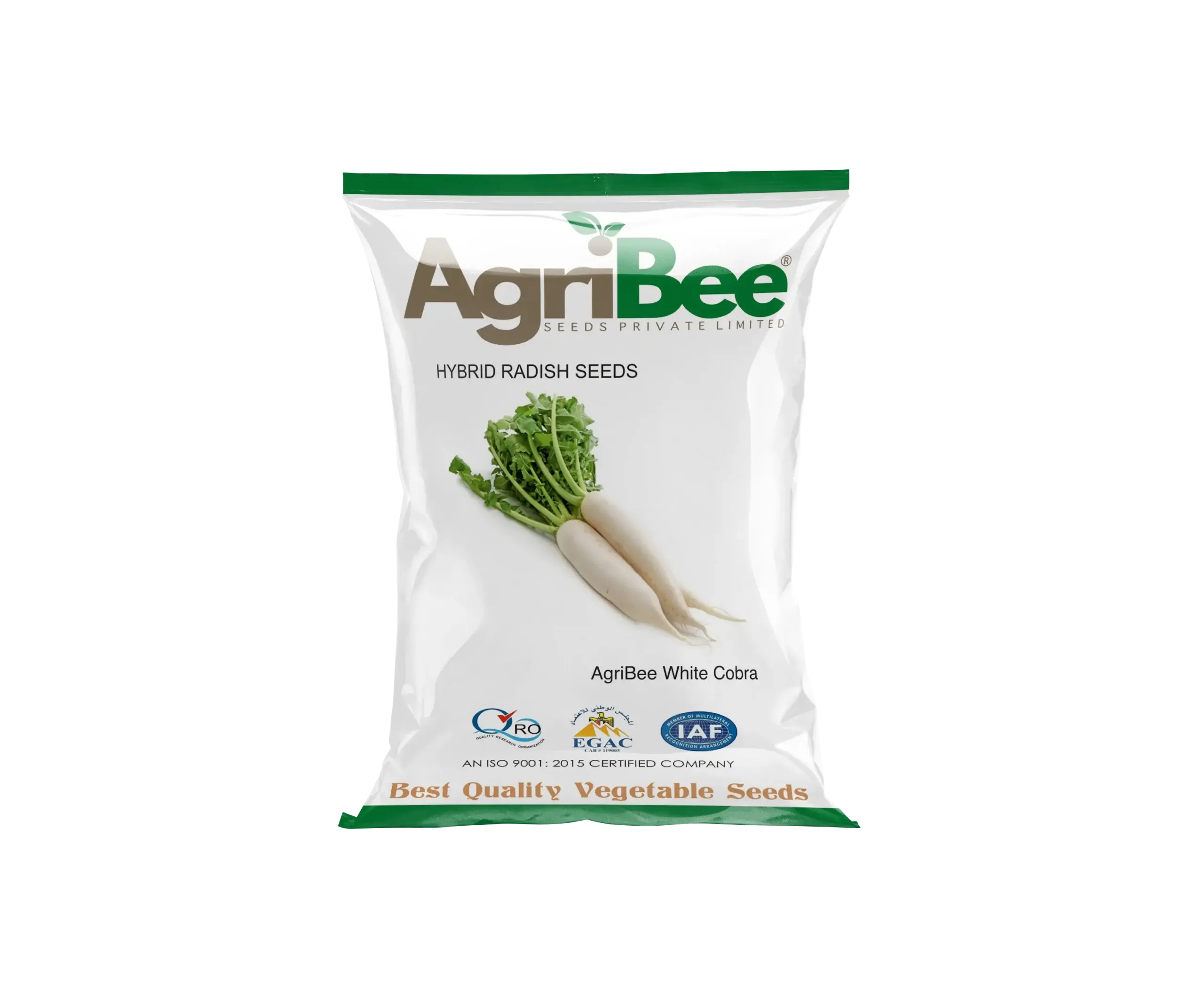
Farming & Cultivation Guide — Radish Seeds AgriBee White Cobra
Complete step-by-step agronomic guide for optimal crop management, disease resistance, and premium produce quality.
🌾 Soil Preparation & Field Prep
Proper land preparation ensures uniform seedling emergence and robust root anchorage.
🌱 Ideal Soil Type & pH
Well-drained loamy to sandy-loam soils with pH 6.0–7.5. Deep, fertile soils free from waterlogging promote uniform root development and smooth skin finish.
✨ Core Advantage
Fine, loose seedbed texture ensures unobstructed radial expansion of the long cylindrical root, preventing forked or malformed produce.
- 1
Deep ploughing to 25–30 cm depth during early summer followed by 2–3 harrowings to achieve fine tilth free from clods.
- 2
Field leveling with laser leveling or board leveling to ensure uniform moisture distribution and prevent water stagnation.
- 3
Incorporation of 15–20 tonnes/ha well-decomposed Farm Yard Manure (FYM) or vermicompost during final harrowing for improved soil structure and organic status.
- 4
Soil health conditioning: adjust pH with agricultural lime (if acidic, below 6.0) or gypsum (if alkaline, above 7.5); ensure good drainage channels around field boundaries.
🌱 Sowing Time & Method
Precise seed rate and spacing maximize light interception and canopy development.
| Parameter | Recommendation | Agronomic Importance |
|---|---|---|
| Sowing Window | Oct – Nov (Rabi predominant) / Jun – Jul (Kharif for early-maturing cultivars) | Cool season sowing ensures crisp texture, mild pungency, and optimal root elongation without bolting stress. |
| Seed Rate | 8–10 kg/ha for line sowing; 10–12 kg/ha for broadcast sowing | Optimal seed rate maintains uniform plant population for consistent root sizing and marketable grade produce. |
| Spacing | 20–25 cm row-to-row × 8–10 cm plant-to-plant | Adequate spacing allows full expression of 25–30 cm root length without root compression or mutual shading. |
| Sowing Depth | 1.0–1.5 cm (do not exceed 2 cm) | Shallow sowing ensures rapid and uniform germination; deeper sowing delays emergence and causes thick-necked or malformed roots. |
💧 Irrigation & Water Management
Adequate moisture regulation supports strong vegetative and reproductive growth.
☀️ Water Requirement Profile
Radish is moderately drought-sensitive; consistent soil moisture is critical during the 25–40 day vegetative-to-root bulking phase. Drip irrigation with 2–3 mm alternate-day application is highly compatible and improves root uniformity. Avoid both waterlogging and severe moisture deficits, which cause root cracking and pungency exaggeration.
🌦️ Soil Moisture Management
In rainfed conditions, ensure pre-sowing irrigation (2–3 irrigations before sowing) to build soil moisture reserve. Mulching with straw (2–3 cm layer) conserves moisture and keeps root collar clean. Install temporary drainage furrows to evacuate excess monsoon water within 6 hours of heavy rain.
- ✓
First irrigation at 3–4 days after sowing ( DAS ) to ensure prompt germination and seedling establishment.
- ✓
Light and frequent irrigation (every 5–7 days in Rabi; every 3–4 days in summer/Kharif) throughout the vegetative phase (10–25 DAS ).
- ✓
Critical moisture stage: 20–35 DAS coincides with rapid root elongation and bulking; maintain 60–70% field capacity without waterlogging.
- ✓
Withhold irrigation 3–4 days before harvest to reduce root moisture content, improve firmness, and extend post-harvest shelf life.
🧪 Fertilizer & Nutrition Management
Balanced crop nutrition supports robust plant structure and premium produce quality.
| Nutrient | Recommended Dose (per Acre) | Application Method & Timing |
|---|---|---|
| Nitrogen (N) | 40–50 kg N / ha (16–20 kg N/acre) | Basal: 25 kg N/ha at sowing; Top-dress: 15 kg N/ha at 20 DAS ; Remaining 10 kg N/ha at 30 DAS |
| Phosphorus (P2O5) | 30–40 kg P2O5 / ha (12–16 kg P2O5/acre) | 100% basal application as Single Super Phosphate (SSP) or Di-ammonium Phosphate (DAP) at sowing mixed into seedbed. |
| Potash (K2O) | 20–30 kg K2O / ha (8–12 kg K2O/acre) | 50% basal at sowing + 50% top-dressed at 25 DAS for improved root firmness and crisp texture. |
🌿 Interculture & Weed Management
Timely weed control ensures optimal nutrient and moisture availability for crop seedlings.
-
1
First Weeding & Hoeing: Perform at 10–12 DAS to eliminate early weed competition during the most vulnerable seedling stage. Shallow hand hoeing avoids root damage.
-
2
Second Weeding & Thin-ing: Carry out at 20–25 DAS . Thin seedlings to maintain 8–10 cm plant spacing. Remove alternate weeds and loose soil around root crown for better aeration.
-
3
Mulching and Final Cultivation: Apply straw or organic mulch after second weeding to conserve moisture and suppress late-season weeds. Avoid earthing-up as radish is a root crop; instead perform careful inter-row hoeing to prevent soil crust formation.
🛡️ Pest & Disease Management
Proactive crop monitoring and integrated management ensure healthy crop development.
🐛 Insect Pest Management
- Aphids (Myzus persicae): Sucking pests causing leaf curling, yellowing, and viral transmission. Spray Imidacloprid 17.8% SL at 0.3 ml/L or Neem-based bio-pesticide (Neemprime 1ml/L) at 10–15 DAS if incidence exceeds 10%. Repeat after 7 days if needed.
- Diamondback Moth (Plutella xylostella): Larvae cause characteristic window-panning and shot-hole lesions on leaves. Apply Bacillus thuringiensis (Bt) formulation at 1–1.5 g/L or Spinosad 45% SC at 0.5 ml/L. Deploy yellow sticky traps at 10 traps/acre for monitoring.
- Radish Flea Beetle (Phyllotreta raphani): Adults create numerous small puncture holes on cotyledons and true leaves; larvae feed on root surface. Spray Chlorantraniliprole 18.4% WG at 0.3 ml/L or Cartap hydrochloride 4G at 1 kg/acre. Install net house covering for early seedling protection.
🔬 Disease Control
- Damping Off (Pythium spp.): Seedlings collapse at soil line with water-soaked stem lesions. Pre-sow seed treatment with Thiram or Carbendazim at 2.5 g/kg seed; soil drench with Metalaxyl 35% WS at 2.5 g/L at 7 DAS as preventive measure.
- White Rust (Albugo candida): White, powdery oospore masses on undersurface of leaves; stunted and distorted growth. Spray Copper oxychloride 50% WP at 2.5 g/L or Mancozeb 75% WP at 2 g/L at first sign; repeat at 10-day intervals. Ensure field drainage to minimize humidity.
- Black Rot (Xanthomonas campestris pv. rapae): V-shaped yellow lesions on leaf margins progressing to blackened vascular strands in root. Remove and destroy infected plants immediately. Spray Copper hydroxide 77% WP at 3 g/L as preventive; practice 3-year crop rotation and use pathogen-free certified seed.
✂️ Harvesting & Produce Quality Guide
Harvesting at peak maturity ensures maximum commercial grade and long keeping quality.
⏱️ Harvesting Schedule & Timing
First harvest at 40–45 days after sowing. Roots are ready for pull when they reach 25–30 cm length with uniform girth. One complete field harvest is typical for this variety; no multiple pickings.
⭐ Produce Quality Characteristics
Pure white, long cylindrical roots with smooth skin, mild pungent flavor, and crisp succulent texture. Uniform size distribution enhances commercial appeal. High water content and vitamin C levels make it a nutritious fresh-market staple.
| Quality Parameter | Agronomic Standard | Farmer & Market Benefit |
|---|---|---|
| First Harvest Stage | 40–45 Days after Sowing (DAS) | Ensures peak tenderness, mild pungency, and early market arrival for superior price realization. |
| Harvest Maturity Signs | Root shoulder visible above soil; pure white skin; 25–30 cm length; firm to gentle squeeze | Prevents over-maturity which leads to woody texture, splitting, and pungency overload. |
| Shelf Life & Keeping Quality | 5–7 days under ambient conditions; 10–12 days at 0–4°C with high humidity (90–95% RH) | Clean white skin and firm flesh provide excellent transport durability and extended sales window. |
| Market Suitability | Fresh vegetable market, wholesale mandi, retail packaging, hotel & restaurant supply, processed salad industry | Uniform white appearance and long cylindrical shape command premium rates in organized and unorganized market channels. |
⭐ Varietal Features — Radish Seeds AgriBee White Cobra
Distinguishing characteristics that make this variety a top choice for Indian growers.
🌿 Core Variety Highlight
AgriBee White Cobra delivers reliable field performance with exceptional root uniformity and high germination rates under diverse Indian growing conditions.
🌿 Produce Quality & Appearance
Pure white, long cylindrical roots (25–30 cm) with smooth, unblemished skin, mild pungent taste, and crisp succulent flesh ideal for fresh consumption.
🌿 Stress & Disease Tolerance
Good field tolerance to common radish pathogens including white rust and black rot; vigorous root system tolerates moderate moisture fluctuations.
🌿 Growth Habit & Vigor
Erect growth habit with compact rosette foliage; minimal leafy canopy override ensures energy diversion toward robust root bulking.
🌿 Crop Duration & Earliness
Early-maturing at 40–45 days to first harvest, enabling flexible cropping sequences and multiple cycles per season in favorable zones.
🌿 Market & Farmer Preference
Consistent white color, uniform length, and mild pungency make White Cobra highly sought after by traders, processors, and export-oriented buyers across India.