Description
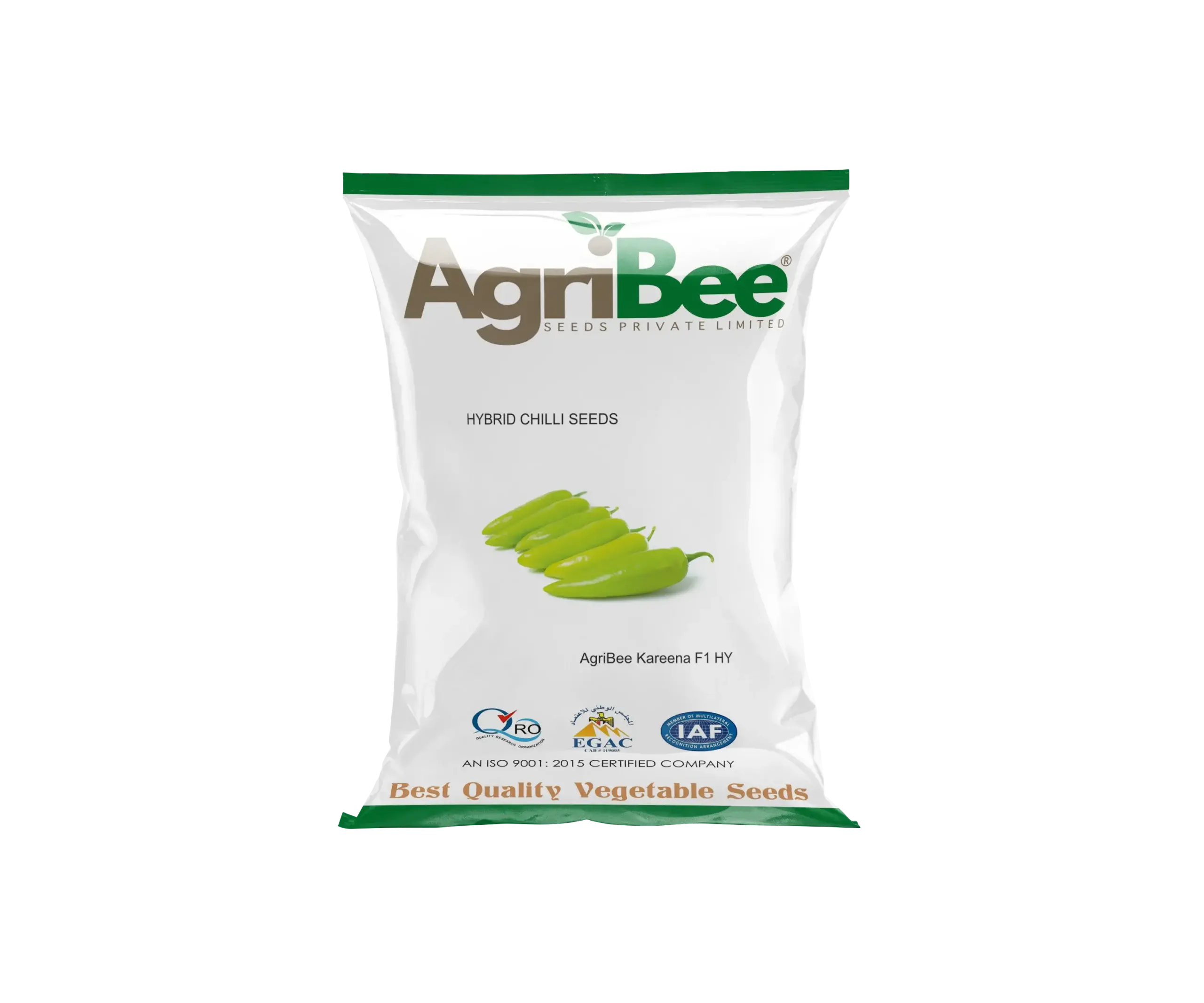
Farming & Cultivation Guide — Chilli Seeds AgriBee Kareena 99 F1 HY
Complete step-by-step agronomic guide for optimal crop management, disease resistance, and premium produce quality.
🌾 Soil Preparation & Field Prep
Proper land preparation ensures uniform seedling emergence and robust root anchorage.
🌱 Ideal Soil Type & pH
Well-drained loamy or sandy-loam soils with pH 6.0–7.5 and good organic matter content.
✨ Core Advantage
Deep, loose seedbed ensures rapid seed germination, strong taproot development, and excellent root anchorage for vigorous plant growth.
- 1Deep summer ploughing followed by 2–3 cross-harrowings to achieve fine tilth and break soil crusts.
- 2Field leveling and drainage channel preparation to prevent water stagnation during heavy rains.
- 3Incorporation of 8–10 tonnes per acre of well-decomposed FYM or compost during final harrowing.
- 4Soil health conditioning with gypsum (10 kg/acre in saline-affected areas) and lime application where pH is below 5.5.
🌱 Sowing Time & Method
Precise seed rate and spacing maximize light interception and canopy development.
| Parameter | Recommendation | Agronomic Importance |
|---|---|---|
| Sowing Window | June–July for Kharif; October–November for Rabi; February–March for Summer in southern zones | Aligns crop cycle with favourable temperature and rainfall patterns, ensuring optimal vegetative growth and fruit set |
| Seed Rate | 200–250 g per Acre (Transplanted method) | Maintains optimum plant population with healthy transplantable seedlings and uniform crop stand |
| Spacing | 45 cm (row-to-row) × 30 cm (plant-to-plant) | Promotes adequate canopy spread, airflow, sunlight penetration, and reduces humidity-related disease pressure |
| Sowing / Transplanting Depth | Sow seeds at 0.5–1.0 cm depth; transplant at 25–30 days after sowing when seedlings have 4–5 true leaves | Ensures uniform emergence from seedbed and vigorous establishment after transplanting without root damage |
💧 Irrigation & Water Management
Adequate moisture regulation supports strong vegetative and reproductive growth.
☀️ Water Requirement Profile
Chilli is moderately drought-tolerant but responds significantly to assured irrigation during critical stages. Drip irrigation is highly recommended for Kareena 99 F1 HY, delivering 2.5–3.0 litres per plant per session every 2–3 days during active growth.
🌦️ Soil Moisture Management
In rainfed environments, conserve soil moisture through mulching with paddy straw at 3–4 kg per metre row. Avoid waterlogging at any stage, as root rot and wilt pathogens thrive in saturated soils.
- ✓First irrigation immediately after transplanting (day 0) to ensure quick root establishment and reduce wilting.
- ✓During vegetative phase, irrigate at 8–10 day intervals depending on soil texture and temperature conditions.
- ✓Critical stages: flowering and fruit set demand consistent moisture; water stress during these phases causes flower drop, poor fruit set, and uneven fruit development.
- ✓Withhold heavy irrigation 7–10 days before final picking to improve fruit firmness and extend shelf life.
🧪 Fertilizer & Nutrition Management
Balanced crop nutrition supports robust plant structure and premium produce quality.
| Nutrient | Recommended Dose (per Acre) | Application Method & Timing |
|---|---|---|
| Nitrogen (N) | 80–100 kg/acre | 50% basal at transplanting; remaining 50% split into two equal top-dressings at 30 and 60 DAT |
| Phosphorus (P2O5) | 50–60 kg/acre | 100% basal application mixed with FYM and incorporated during final land preparation |
| Potash (K2O) | 40–50 kg/acre | 50% basal at transplanting; rest applied at first and second interculture for improved fruit quality and pungency |
🌿 Interculture & Weed Management
Timely weed control ensures optimal nutrient and moisture availability for crop seedlings.
-
1
First Weeding & Hoeing: Carry out at 15–20 DAT using a hand hoe or inter-cultivator to uproot competing weeds and loosen the soil surface, ensuring the crop remains weed-free during its most vulnerable early growth phase.
-
2
Second Weeding & Earthing-Up: Perform at 30–35 DAT to build a small mound around the plant base, which strengthens stem support, improves root aeration, and prevents lodging during fruit load development.
-
3
Mulching and Staking: Apply organic mulch (paddy straw or maize stover) at 3–4 kg per metre row immediately after second weeding to conserve soil moisture, moderate soil temperature, and suppress weed resurgence. Install bamboo stakes where plants show tendency to bend under fruit weight.
🛡️ Pest & Disease Management
Proactive crop monitoring and integrated management ensure healthy crop development.
🐛 Insect Pest Management
- Thrips (Thrips tabaci): Symptoms include silvery streaks, leaf curling, and distorted new growth. Control: Spray Methyl Demeton 30 EC at 1 ml/litre or Imidacloprid 17.8 SL at 0.3 ml/litre. Apply at 7-day intervals during peak infestation. Use yellow sticky traps at 10 traps per acre for monitoring.
- Bollworm / Fruit Borer (Helicoverpa armigera): Symptoms are bore holes on fruits with frass accumulation and internal seed damage. Control: Spray Spinosad 45 SC at 0.5 ml/litre or Chlorantraniliprole 18.5 SC at 0.3 ml/litre. Deploy pheromone traps at 5 per acre for population monitoring and mating disruption.
- Whitefly (Bemisia tabaci): Symptoms include yellowing, curling, and sticky sooty mould on leaves with stunted growth. Control: Spray Thiamethoxam 25 WG at 0.2 g/litre or Acetamiprid 20 SP at 0.5 g/litre. Blue sticky traps are effective for monitoring and reducing adult populations.
🔬 Disease Control
- Anthracnose (Colletotrichum capsici): Symptoms are sunken, circular, water-soaked lesions on ripe fruits often with salmon-coloured sporulation. Prevention: Spray Mancozeb 75 WP at 2.5 g/litre or Copper Oxychloride 50 WP at 3.0 g/litre at 10-day intervals. Remove and destroy infected fruits to reduce inoculum build-up.
- Bacterial Leaf Spot (Xanthomonas campestris pv. vesicatoria): Symptoms include small, water-soaked spots turning brown with yellow halos on leaves and cracks on fruits. Prevention: Spray Streptocycline 50 WP at 0.5 g/litre or Copper Hydroxide 77 WP at 2.0 g/litre. Use certified disease-free seeds and practice 3-year crop rotation.
- Fusarium Wilt (Fusarium oxysporum f.sp. capsici): Symptoms include sudden wilting of one side of the plant, yellowing, and vascular browning upon stem cut. Prevention: drench soil with Trichoderma viride at 10 g/litre at 7 DAT and repeat at 30 DAT. Avoid waterlogged conditions and use raised beds for effective drainage.
✂️ Harvesting & Produce Quality Guide
Harvesting at peak maturity ensures maximum commercial grade and long keeping quality.
⏱️ Harvesting Schedule & Timing
First harvesting begins 65–70 days after transplanting. Subsequent pickings are taken at 7–10 day intervals, allowing for continuous fruit maturation across the plant canopy.
⭐ Produce Quality Characteristics
Fruits exhibit a rich dark green colour, long slender shape measuring 8–10 cm, firm texture, and high pungency — characteristics highly valued in fresh markets, processors, and spice producers.
| Quality Parameter | Agronomic Standard | Farmer & Market Benefit |
|---|---|---|
| First Harvest Stage | 65–70 Days after Transplanting | Enables early market entry, securing better price realization and faster crop turnaround |
| Harvest Maturity Signs | Dark green, glossy skin; firm and crisp texture; full-length slender fruit development | Ensures fruits are harvested at peak quality, preventing over-maturity and tissue softening |
| Shelf Life & Keeping Quality | 7–10 days under ambient conditions; up to 14–16 days under cool storage at 10–12°C | Supports transportation to distant markets and extends sales window for farmers and traders |
| Market Suitability | Fresh market, wholesale mandis, export-grade packing, and dry chilli processing units | High pungency and attractive dark green colour attract premium rates from buyers and processors |
⭐ Varietal Features — Chilli Seeds AgriBee Kareena 99 F1 HY
Distinguishing characteristics that make this variety a top choice for Indian growers.
🌿 Core Variety Highlight
Kareena 99 F1 HY is a high-pungency hybrid tailor-made for Indian growers, combining early picking with sustained fruit production across multiple harvest cycles.
🌿 Produce Quality & Appearance
Long, slender fruits measuring 8–10 cm with a deep dark green hue, firm flesh, and high capsaicin concentration — ideal for both fresh consumption and value-added processing.
🌿 Stress & Disease Tolerance
Demonstrates strong field tolerance to Fusarium wilt and Anthracnose under variable climatic conditions, maintaining foliage integrity and fruit set throughout the growing season.
🌿 Growth Habit & Vigor
Vigorous plant architecture with well-branched canopy, sturdy stems supporting heavy fruit load, and balanced vegetative-to-reproductive growth.
🌿 Crop Duration & Earliness
Early picking at 65–70 days after transplanting enables timely harvest, flexible crop rotation planning, and reduced exposure to late-season pest pressures.
🌿 Market & Farmer Preference
Preferred by progressive farmers and traders for its uniform fruit length, high pungency, excellent dark green colour retention, and reliable shelf life — traits that command consistent market demand across India.