Description
Farming & Cultivation Guide — F1 Hybrid RidgeGourd
Complete step-by-step agronomic guide for optimal crop management, disease resistance, and premium produce quality.
🌾 Soil Preparation & Field Prep
Proper land preparation ensures uniform seedling emergence and robust root anchorage.
🌱 Ideal Soil Type & pH
Well-drained sandy loam to loamy soils with pH range of 6.0 – 7.5. Deep, fertile soils with good organic matter content support vigorous vine growth and healthy fruit development. Waterlogged or heavy clay soils must be avoided as they cause root rot and poor germination.
✨ Core Advantage
Loose, well-aerated seedbed ensures rapid and uniform germination, strong early root establishment, and adequate anchorage for the climbing vine habit reaching 6 to 8 feet.
- 1
Deep summer ploughing followed by 2–3 cross-harrowings to achieve fine tilth and break compacted layers.
- 2
Field leveling and creation of drainage channels to prevent water stagnation around the root zone.
- 3
Incorporation of well-decomposed FYM or compost at 8–10 tonnes per acre during final harrowing for improved soil structure and nutrient availability.
- 4
Soil health conditioning: If pH is below 6.0, apply agricultural lime at 200–300 kg/acre two weeks before sowing; if alkaline, apply gypsum at 250 kg/acre.
🌱 Sowing Time & Method
Precise seed rate and spacing maximize light interception and canopy development.
| Parameter | Recommendation | Agronomic Importance |
|---|---|---|
| Sowing Window | February – March for winter/spring crop; June – July for Kharif season crop | Aligns with favorable temperature (25–35°C) for rapid germination and avoids extreme cold or waterlogging stress |
| Seed Rate | 2 – 3 Kg per Acre | Ensures optimal plant population density without overcrowding, promoting balanced vine growth and fruit set |
| Spacing | 60 cm x 30 cm (Row-to-Row x Plant-to-Plant) | Provides adequate canopy spread, improves air circulation, reduces humidity-related disease pressure, and facilitates field operations |
| Sowing Depth | 2 – 3 cm | Optimal depth ensures consistent moisture contact for germination while preventing seed rot or weak emergence |
💧 Irrigation & Water Management
Adequate moisture regulation supports strong vegetative and reproductive growth.
☀️ Water Requirement Profile
Ridge gourd requires moderate and well-distributed moisture throughout its growth cycle. The crop is moderately drought-tolerant once established but responds significantly better with regular irrigation. Drip irrigation is highly recommended as it conserves water, delivers nutrients through fertigation, and keeps foliage drier, reducing disease incidence. Avoid furrow irrigation in heavy soils to prevent waterlogging around the crown.
🌦️ Soil Moisture Management
Under rainfed conditions, monitor soil moisture at 15 cm depth. Apply light irrigation immediately if soil dries out during flowering and fruit development stages, as moisture stress at these phases causes flower drop and deformed fruits. Mulching with straw or organic matter helps retain soil moisture and suppress weeds.
- ✓
First irrigation should be given 3–4 days after sowing to ensure uniform germination, especially in warm spring conditions.
- ✓
Vegetative phase (15–30 DAS): Light irrigation every 5–7 days to support rapid vine growth and leaf expansion.
- ✓
Critical stage — Flowering and Fruit Setting (30–50 DAS): Maintain consistent soil moisture with irrigation every 3–4 days. Stress during this phase causes significant flower abscission and poor fruit set.
- ✓
Pre-harvest: Reduce irrigation frequency slightly 5–7 days before harvest to improve fruit firmness and extend shelf life. Avoid overhead watering during fruit maturation.
🧪 Fertilizer & Nutrition Management
Balanced crop nutrition supports robust plant structure and premium produce quality.
| Nutrient | Recommended Dose (per Acre) | Application Method & Timing |
|---|---|---|
| Nitrogen (N) | 60 – 80 kg/acre | 50% basal at sowing through DAP; remaining 50% split top-dressed at 25 DAS and 40 DAS |
| Phosphorus (P2O5) | 40 – 50 kg/acre | 100% applied basal at sowing along with FYM and soil application of superphosphate or DAP |
| Potash (K2O) | 30 – 40 kg/acre | 50% basal at sowing; remaining 50% top-dressed at 40 DAS to support fruit development and disease resistance |
🌿 Interculture & Weed Management
Timely weed control ensures optimal nutrient and moisture availability for crop seedlings.
-
1
First Weeding & Hoeing: Carry out shallow hoeing and weeding at 10–12 DAS to eliminate early weed competition. This is critical as ridge gourd seedlings are slow to establish initially and weeds can quickly overshadow young plants.
-
2
Second Weeding & Earthing-Up: Perform second weeding and light earthing-up at 25–30 DAS. Raising soil around the base of the plant provides better root aeration and support as vines begin to trail or climb. Remove any weak or diseased seedlings during this operation.
-
3
Vine Training and Mulching: Install bamboo stakes (1.5–2 m height) or trellis nets at 30–35 DAS when vines begin twining. Guide main shoots upward for vertical growth. Apply organic mulch (straw or dried leaves) at 3–4 cm thickness between rows to conserve moisture, suppress weeds, and prevent soil-borne pathogen splash.
🛡️ Pest & Disease Management
Proactive crop monitoring and integrated management ensure healthy crop development.
🐛 Insect Pest Management
- Aphids (Macrosiphum eupbiae): Small green/black insects cluster on undersides of leaves and tender shoots, causing curling and honeydew secretion. Control: Spray Imidacloprid 17.8% SL at 0.3 ml/Litre or Acephate 75% SP at 1.0 g/Litre. Alternate with Neem-based bio-pesticide (Neemaron 0.3%) for resistant management.
- Fruit and Shoot Borer (Devosagella noxana): Larvae bore into tender shoots and fruits causing wilting and entry points for diseases. Control: Apply Carbendazim 50% WP at 1.0 g/Litre combined with Phosphamidron 80% SP at 0.5 ml/Litre. Remove and destroy affected shoots promptly. Pheromone traps at 10/acre help monitor adult population.
- Cucurbit Shoot and Fruit Borer (Helicoverpa armigera): Caterpillars feed on flowers and young fruits causing direct damage and secondary infections. Control: Spray Bacillus thuringiensis (Bt) @ 2.5 g/Litre at early larval stage. For severe infestation, use Chlorantraniliprole 18.5% SC at 0.3 ml/Litre. Destroy crop residues after harvest to reduce inoculum.
🔬 Disease Control
- Downy Mildew (Pseudoperonospora cubensis): Yellow angular lesions on upper leaf surface with purple-grey sporulation on underside, leading to rapid leaf drying. Control: Spray Metalaxyl 35% WS at 2.0 g/Litre or Mancozeb 75% WP at 2.5 g/Litre as preventive measure every 10–12 days during high humidity periods.
- Powdery Mildew (Erysiphe cichoracearum): White powdery growth on both leaf surfaces, causing chlorosis and premature leaf senescence. Control: Spray Sulphur 80% WP at 2.5 g/Litre or Myclobutanil 5% WP at 0.5 g/Litre. Ensure proper spacing for air circulation to reduce humidity around foliage.
- Foot Rot / wilt (Phytophthora capricola & Fusarium oxysporum): Water-soaked lesions at stem base, wilting of vines, and internal discoloration of vascular tissue. Control: drench soil with Copper Oxychloride 50% WP at 4.0 g/Litre at first sign. Remove and burn severely affected plants. Practice crop rotation with non-cucurbit crops for 2–3 seasons.
✂️ Harvesting & Produce Quality Guide
Harvesting at peak maturity ensures maximum commercial grade and long keeping quality.
⏱️ Harvesting Schedule & Timing
First picking begins at 50–55 days after sowing. Subsequent pickings are taken at 2–3 day intervals, totaling 6–8 harvests over the cropping period. Each picking should be done in the early morning hours for best quality retention.
⭐ Produce Quality Characteristics
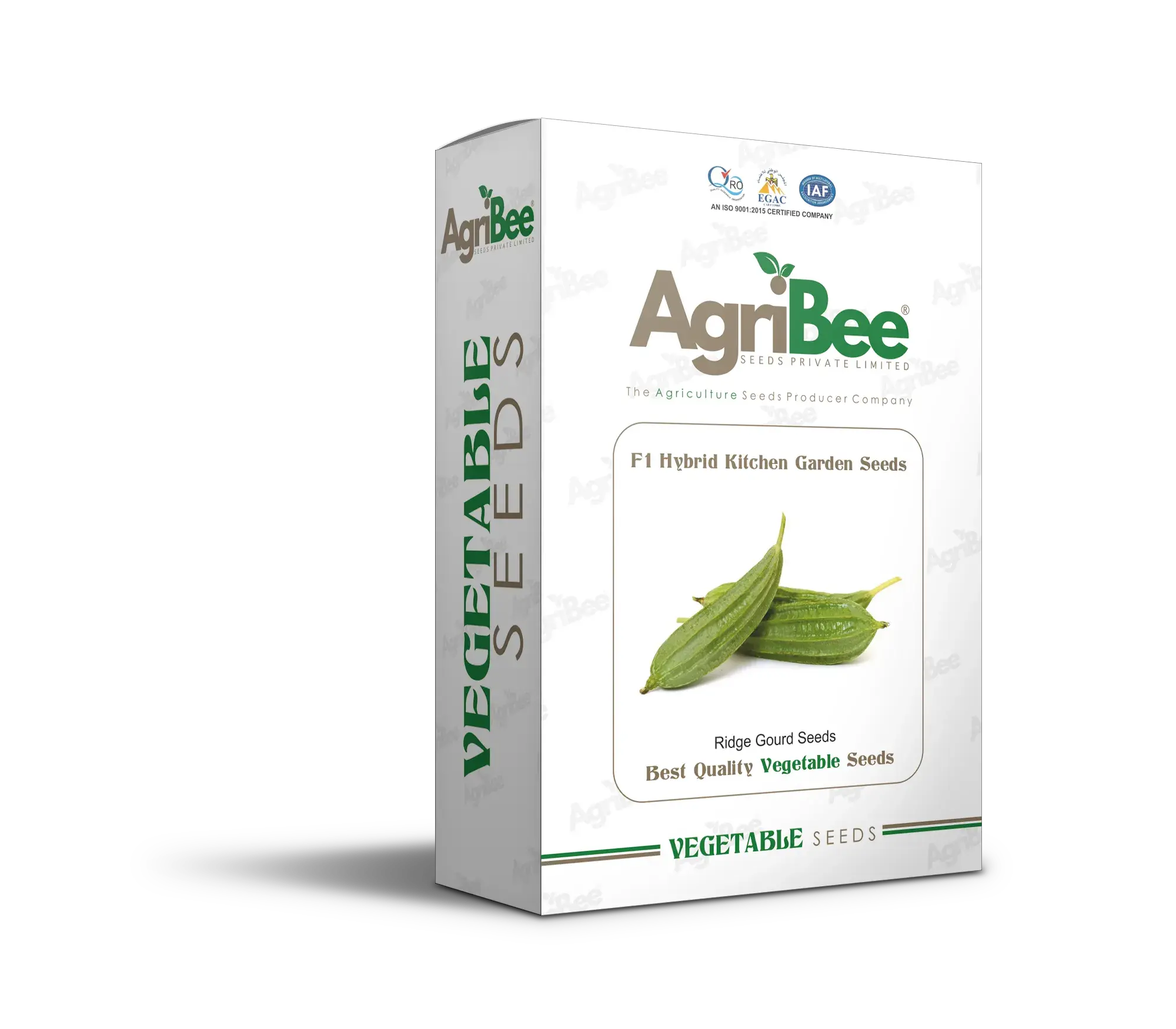
Premium ridge gourds exhibit dark green, firm skin with prominent sharp ridges running lengthwise. Fruits should be tender, crisp, and free from blemishes, cuts, or pest damage. Dark green coloration indicates optimal chlorophyll content and nutritional quality including vitamins A, C, and dietary fibre.
| Quality Parameter | Agronomic Standard | Farmer & Market Benefit |
|---|---|---|
| First Harvest Stage | 50 – 55 Days after Sowing | Early harvesting allows farmers to reach the market ahead of seasonal glut, fetching better prices and ensuring premium grade classification |
| Harvest Maturity Signs | Fruits 25–35 cm long, firm to touch, dark green with well-defined ridges; skin tender enough to puncture easily with thumbnail | Harvesting at this stage ensures maximum tenderness, sweetness, and consumer acceptance while preventing over-maturity which toughens the rind |
| Shelf Life & Keeping Quality | 3–5 days under ambient conditions; up to 7–10 days at 10–12°C with 90–95% relative humidity | Good post-harvest longevity enables transportation to distant markets and reduces rejection rates at mandis and retail outlets |
| Market Suitability | Fresh table market, wholesale mandis, retail chains, and hotel/restaurant supply chain | Uniform size, attractive dark green color, and prominent ridges make this variety highly preferred by traders and consumers across Indian markets |
⭐ Varietal Features — F1 Hybrid RidgeGourd
Distinguishing characteristics that make this variety a top choice for Indian growers.
🌿 Core Variety Highlight
F1 hybrid vigour delivers exceptional uniformity in fruit size (25–35 cm) and shape, making it a standout choice for farmers targeting consistent market-grade produce.
🌿 Produce Quality & Appearance
Dark green fruits with prominently sharp ridges offer superior visual appeal. Tender flesh, mild flavour, and crisp texture meet the highest consumer expectations.
🌿 Stress & Disease Tolerance
Engineered for strong field tolerance against major cucurbit pathogens including downy mildew and powdery mildew, ensuring reliable crop performance under variable Indian growing conditions.
🌿 Growth Habit & Vigor
Vigorous climbing vine reaching 6–8 feet with strong branching ability. Healthy dark green foliage supports sustained photosynthesis and overall plant robustness throughout the cropping cycle.
🌿 Crop Duration & Earliness
Early maturity at 50–55 days enables flexible crop planning, multiple cropping opportunities, and early market entry—critical for maximizing returns in kitchen garden and commercial systems.
🌿 Market & Farmer Preference
AgriBee’s F1 Hybrid RidgeGourd is preferred by progressive farmers and traders alike due to its uniform produce, attractive appearance, early readiness, and dependable field performance across diverse agro-climatic zones of India.