Description
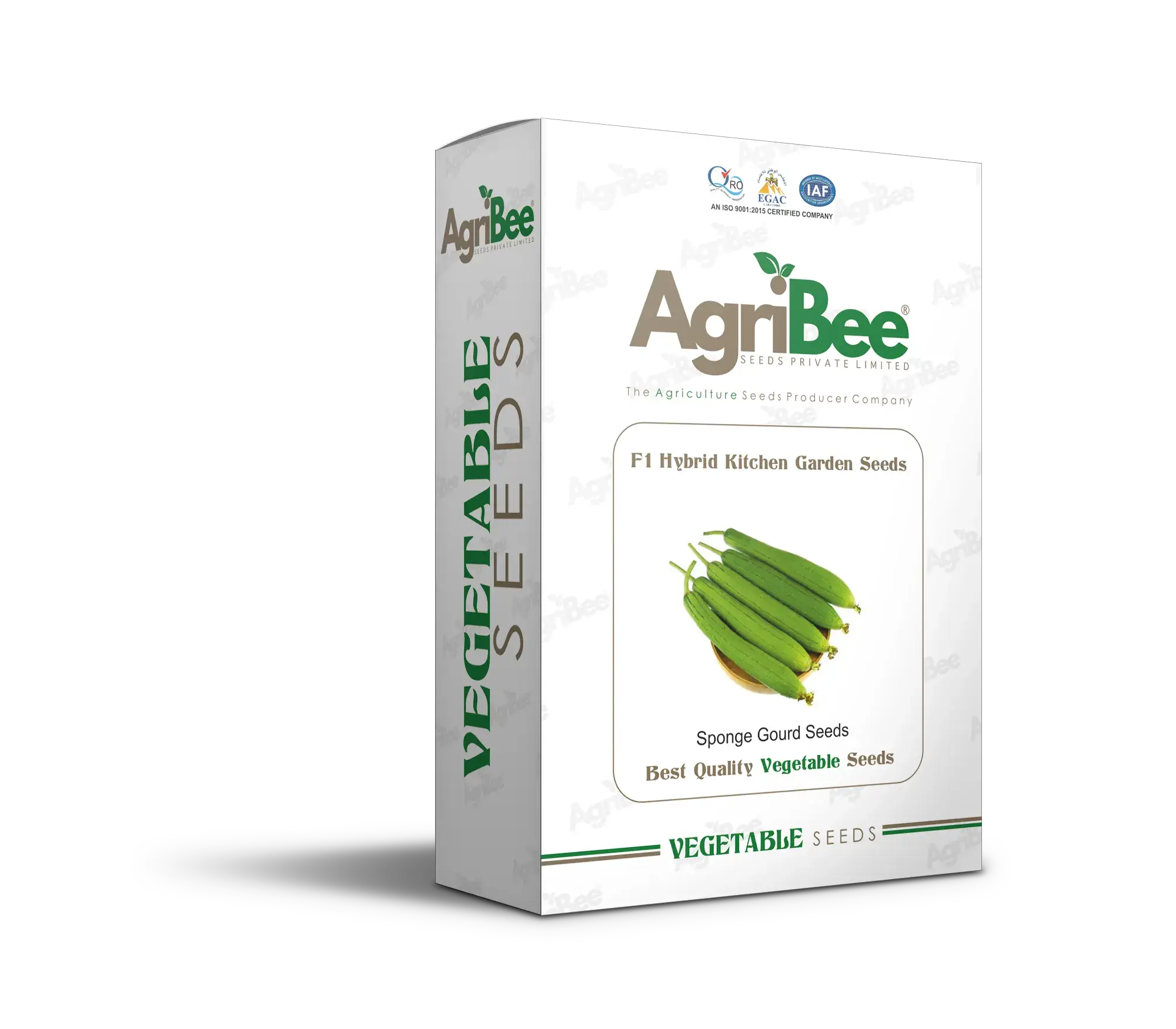
Farming & Cultivation Guide — F1 Hybrid SpongeGourd
Complete step-by-step agronomic guide for optimal crop management, disease resistance, and premium produce quality.
🌾 Soil Preparation & Field Prep
Proper land preparation ensures uniform seedling emergence and robust root anchorage.
🌱 Ideal Soil Type & pH
Well-drained loamy to sandy-loam soils with pH 6.0 – 7.5 are ideal. Heavy black soils are acceptable only if drainage is adequate. Sponge gourd does not tolerate waterlogging even briefly.
✨ Core Advantage
Loose, warm, fertile seedbed ensures rapid germination within 5 – 7 days and strong early root establishment critical for a fast-maturing vine crop.
- 1
Deep summer ploughing to 25–30 cm followed by 2–3 cross-harrowings for fine tilth and moisture conservation.
- 2
Formation of raised beds or broad furrows (15 cm height) to ensure excellent drainage and prevent root rot.
- 3
Incorporation of 8 – 10 tonnes per acre of well-decomposed FYM or compost during the last harrowing for soil conditioning.
- 4
Assessment of soil pH; if acidic (below 6.0), apply agricultural lime at 200 – 300 kg/acre two weeks before sowing.
🌱 Sowing Time & Method
Precise seed rate and spacing maximize light interception and canopy development.
| Parameter | Recommendation | Agronomic Importance |
|---|---|---|
| Sowing Window | Feb – Mar (Spring cropping in North/Central India); Jun – Jul (Kharif in most regions) | Warm soil temperatures (25–30°C) accelerate germination and vegetative growth; avoids chilling injury in early season. |
| Seed Rate | 2 – 3 kg per acre | Ensures optimal plant population of approximately 25,000 – 30,000 plants/acre for vigorous canopy development. |
| Spacing | 90 – 100 cm row-to-row × 30 – 40 cm plant-to-plant | Provides adequate spacing for climbing vine spread, air circulation, and efficient interculture operations. |
| Sowing Depth | 2 – 3 cm depth in hills of 2 – 3 seeds per stand, later thinned to 1 healthy seedling | Optimal depth balances emergence speed with seedling strength; covers seed adequately without causing burial stress. |
💧 Irrigation & Water Management
Adequate moisture regulation supports strong vegetative and reproductive growth.
☀️ Water Requirement Profile
Sponge gourd requires moderate and consistent moisture throughout its short crop cycle. The crop is moderately drought-sensitive during flowering and fruit development stages. Drip irrigation is highly compatible and recommended—it delivers uniform moisture, reduces leaf wetness, and minimizes fungal disease incidence. Avoid both waterlogging and prolonged dry spells.
🌦️ Soil Moisture Management
In rainfed Kharif conditions, ensure field drainage channels are clear before the first monsoon shower. Mulching with straw or wheat chaff (3 – 4 cm layer) conserves soil moisture and suppresses weeds. If intermittent dry spells occur between rains, provide one supplementary irrigatiton to prevent flower drop and fruit malformation.
- ✓
First irrigation at 3 – 4 DAS (Days After Sowing) to ensure uniform germination and seedling establishment.
- ✓
Vegetative phase (10 – 25 DAS): light irrigation every 3 – 4 days depending on soil type and weather conditions to support rapid vine growth.
- ✓
Critical stage (flowering to fruit set, 25 – 40 DAS): maintain consistent soil moisture; water stress during this period causes flower abortion, fruit deformation, and reduced fruit quality.
- ✓
Pre-harvest: reduce irrigation frequency during the last week before first picking to improve fruit firmness and shelf life, but do not allow wilting.
🧪 Fertilizer & Nutrition Management
Balanced crop nutrition supports robust plant structure and premium produce quality.
| Nutrient | Recommended Dose (per Acre) | Application Method & Timing |
|---|---|---|
| Nitrogen (N) | 40 – 50 kg/acre | 50% basal at sowing + 50% top-dressing at 20 – 25 DAS |
| Phosphorus (P2O5) | 25 – 30 kg/acre | 100% basal application mixed with FYM and incorporated during final harrowing |
| Potash (K2O) | 20 – 25 kg/acre | 100% basal except in sandy soils where 50% basal + 50% top-dressing at 25 DAS improves fruit quality |
🌿 Interculture & Weed Management
Timely weed control ensures optimal nutrient and moisture availability for crop seedlings.
-
1
First Weeding & Hoeing: Perform shallow hand weeding at 10 – 12 DAS to maintain a weed-free critical period. Cultivation must be shallow (3 – 5 cm) to avoid damaging the shallow root system of the young seedling.
-
2
Second Weeding & Earthing-Up: Conduct second weeding and light earthing-up at 20 – 25 DAS to promote adventitious root formation along the vine base and improve soil aeration around the root zone.
-
3
Trellis / Stake Training and Vine Guidance: Train primary vines vertically on trellis or bamboo stakes by 15 – 20 DAS. Remove side shoots (suckers) below the first node to direct energy toward main vine growth and fruit production. Mulching with organic material between rows conserves moisture and prevents weed resurgence.
🛡️ Pest & Disease Management
Proactive crop monitoring and integrated management ensure healthy crop development.
🐛 Insect Pest Management
- Aphids (Aphis gossypii): Sucking sap from leaves and tender shoots causing curling and honeydew sooty mould. Control: Spray Imidacloprid 17.8% SL at 0.3 ml/litre or Thiopron 20% SP at 0.5 g/litre. Use yellow sticky traps at 10 traps/acre for monitoring and mass trapping.
- Fruit Borer (Spodoptera frugiperda / Helicoverpa armigera): Larvae bore into fruits causing holes, frass exudation, and fruit rot. Control: Spray Chlorantraniliprole 18.5% SC at 0.4 ml/litre or Spinetoram 45% SC at 0.3 ml/litre. Practice early harvesting to remove infested fruits. Pheromone traps at 5/acre for monitoring.
- Cucurbit Whitefly (Bemisia tabaci): Causes yellowing, curling, and transmits begomoviruses. Control: Spray Thiamethoxam 25% WG at 0.3 g/litre or Acetamiprid 20% SP at 0.5 g/litre. Blue sticky traps at 10 traps/acre. Remove and destroy infected plant debris.
🔬 Disease Control
- Powdery Mildew (Erysiphe cichoracearum / Leveillula taurica): White powdery growth on leaves causing premature drying and reduced photosynthetic capacity. Control: Spray Sulphur 80% WP at 2 g/litre or Micronised Sulphur at 3 g/litre. Alternate with Myclobutanil 12.5% WS at 0.5 g/litre. Ensure proper spacing for canopy ventilation.
- Fusarium Wilt (Fusarium oxysporum f.sp. luffae): Yellowing and wilting of one side of the plant, vascular browning, and total collapse. Control: Seed treatment with Trichoderma viride at 4 g/kg seed or soil drench with same at 5 kg/acre in 500 litres water. Rotate with non-cucurbit crops. Remove and burn infected plants immediately.
- Downy Mildew (Pseudoperonospora cubensis): Irregular yellow angular lesions on upper leaf surface with purplish-grey sporulation on underside in humid conditions. Control: Spray Mancozeb 75% WP at 2.5 g/litre or Metalaxyl + Mancozeb 8% + 64% WP at 2.5 g/litre. Avoid overhead irrigation and reduce humidity around canopy.
✂️ Harvesting & Produce Quality Guide
Harvesting at peak maturity ensures maximum commercial grade and long keeping quality.
⏱️ Harvesting Schedule & Timing
First picking begins at 48 – 52 DAS. Subsequent pickings are made at 2 – 3 day intervals over a 3 – 4 week harvesting window using a sharp knife or cutting blade, avoiding tearing of the vine.
⭐ Produce Quality Characteristics
Fruits should be light green, smooth-skinned, firm yet tender, and 20 – 30 cm in length. Flesh should be spongy, white to pale green, with minimal seed development. Over-mature fruits become fibrous, hard, and lose market value.
| Quality Parameter | Agronomic Standard | Farmer & Market Benefit |
|---|---|---|
| First Harvest Stage | 48 – 52 Days after Sowing | Ensures early market arrival when prices are typically favourable and produce is at peak tenderness. |
| Harvest Maturity Signs | Light green colour, smooth and glossy skin, firm texture, size 20 – 30 cm; seeds just beginning to form but not hardened | Prevents over-maturity which leads to fibrous, woody fruit unsuitable for fresh market. |
| Shelf Life & Keeping Quality | 3 – 5 days under ambient conditions; up to 7 – 10 days under cool storage (10 – 12°C with 90 – 95% relative humidity) | Good post-harvest retention enables transportation to distant mandis and reduces spoilage losses. |
| Market Suitability | Fresh table vegetable; high demand in urban mandis, retail markets, and hotel/restaurant supply chains across India | Uniform size, attractive light green colour, and smooth skin command premium rates in wholesale and retail markets. |
⭐ Varietal Features — F1 Hybrid SpongeGourd
Distinguishing characteristics that make this variety a top choice for Indian growers.
🌿 Core Variety Highlight
AgriBee F1 Hybrid Sponge Gourd delivers exceptional vine vigor and uniform fruiting habit, making it a reliable choice for both Kharif and Spring seasons across diverse Indian agro-climatic zones.
🌿 Produce Quality & Appearance
Produces 20 – 30 cm light green fruits with smooth, glossy skin and tender spongy flesh. Fruits are uniformly shaped with minimal deformity, meeting stringent market grade standards.
🌿 Stress & Disease Tolerance
Demonstrates good field tolerance to common cucurbit diseases including powdery mildew and downy mildew under moderate pressure, along with resilience to typical heat and moisture fluctuations during the short crop cycle.
🌿 Growth Habit & Vigor
Vigorous climbing vine reaching 6 – 8 feet with strong lateral branching. Healthy green foliage provides optimal photosynthetic capacity supporting sustained fruit production over multiple pickings.
🌿 Crop Duration & Earliness
Early maturing at 48 – 52 days to first harvest, enabling farmers to fit this crop efficiently within rotation systems and capitalize on early market windows before supply glut.
🌿 Market & Farmer Preference
High demand in vegetable markets across India due to consistent fruit quality, attractive appearance, and tender texture. Farmers appreciate the uniformity, disease resilience, and dependable vine performance that translate into reliable income from repeated pickings.