
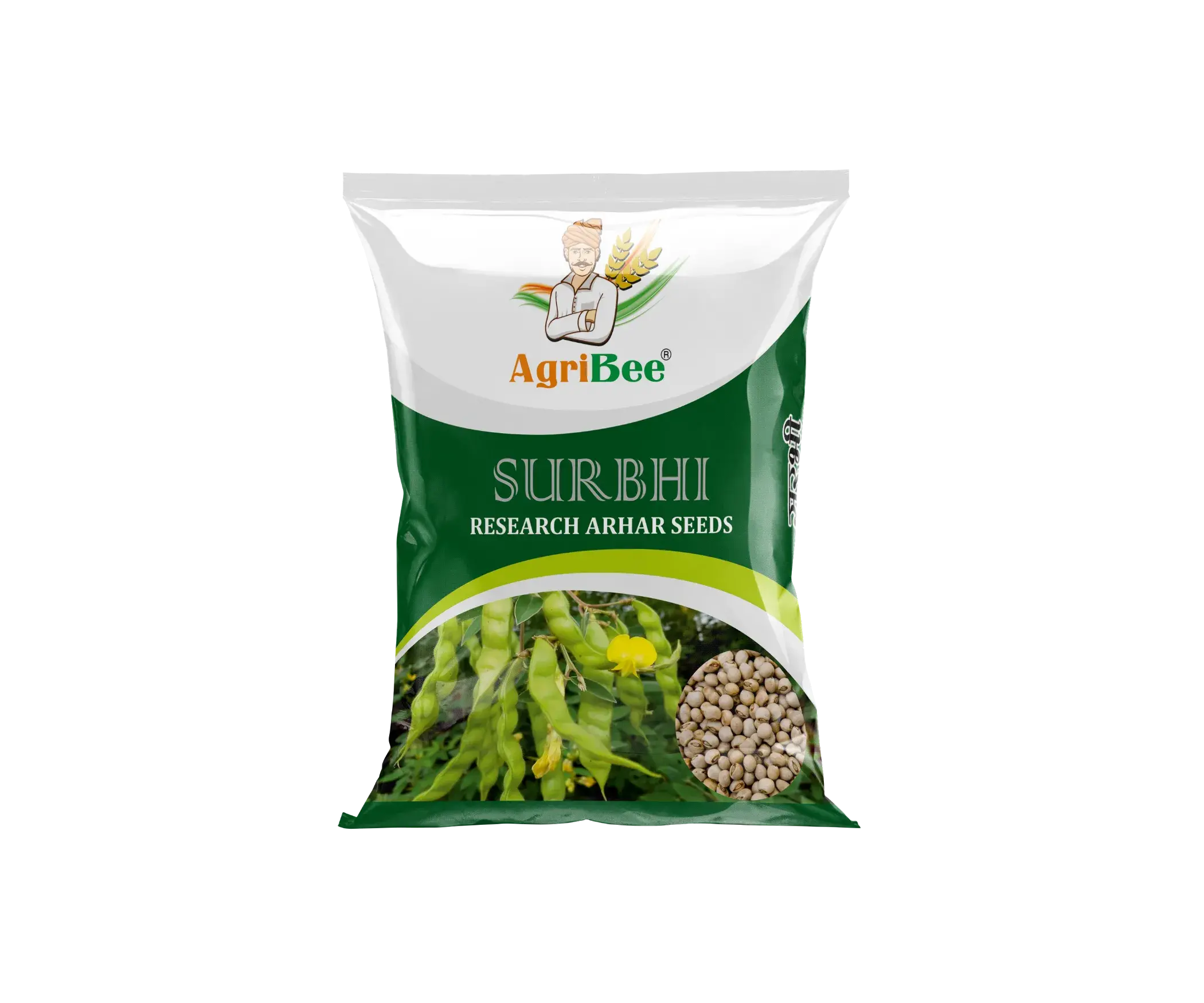
Description
शेती व लागवड संपूर्ण मार्गदर्शक — Arhar Seeds Surbhi
Complete step-by-step agronomic guide for optimal crop management, disease resistance, and premium produce quality.
🌾 जमिनीची पूर्वमशागत
Proper land preparation ensures uniform seedling emergence and robust root anchorage.
🌱 योग्य जमिनीचा प्रकार व सामू (pH)
Well-drained loamy to black cotton soils (Vertisols) with a pH range of 6.0 to 8.0. Pigeon pea thrives in soils with moderate fertility and good permeability.
✨ प्रमुख कृषी फायदे
Deep taproot system establishes rapidly in well-structured soil, providing excellent anchorage for tall plants and enabling access to subsoil moisture and nutrients.
- 1
Deep summer ploughing followed by 2–3 cross-harrowings to break hardpan and prepare fine tilth.
- 2
Field leveling and drainage preparation to prevent waterlogging during monsoon rains.
- 3
Incorporation of well-decomposed FYM or compost (10–15 tonnes per acre) at last ploughing for soil organic matter enrichment.
- 4
Soil health conditioning: liming recommended for acidic soils below pH 5.5; gypsum application advised for sodic soils above pH 8.5.
🌱 पेरणीची वेळ व पद्धत
Precise seed rate and spacing maximize light interception and canopy development.
| निकष / मापदंड | शिफारस / पद्धत | कृषी महत्त्व |
|---|---|---|
| पेरणीची वेळ | May to August (early Kharif to late Kharif windows) | Aligns germination and early growth with pre-monsoon soil moisture and subsequent rainfall distribution |
| बियाणे प्रमाण (प्रति एकर) | 1.5 to 2.0 kg per acre | Optimized seed rate ensures adequate plant population while preventing overcrowding and disease pressure |
| लागवडीतील अंतर | 90 cm (row-to-row) x 30 cm (plant-to-plant) | Provides optimal canopy spread, air circulation, and sunlight penetration for healthy pod development |
| पेरणीची खोली | 3 to 5 cm below soil surface | Ensures proper seed-soil contact for uniform germination while allowing radicle emergence without strain |
💧 पाणी व्यवस्थापन
Adequate moisture regulation supports strong vegetative and reproductive growth.
☀️ Water Requirement Profile
Arhar Surbhi exhibits moderate drought tolerance due to its deep root system. Under irrigated conditions, irrigation at critical stages significantly enhances flower retention and pod setting. The crop requires approximately 450–550 mm of water during the growing period. Drip irrigation is compatible and water-efficient when integrated with fertigation.
🌦️ Soil Moisture Management
In rainfed conditions, ensure good soil moisture conservation through mulching or intercropping. Avoid moisture stress during flowering and pod development stages, as these are most sensitive to water deficit. Early sowing in residual soil moisture can help establish roots before peak monsoon.
- ✓
First irrigation at 10–15 DAS if soil moisture is inadequate; establishes strong initial root growth.
- ✓
During vegetative phase, light irrigation at 15–20 day intervals during dry spells promotes bushy growth.
- ✓
Critical stage irrigation at flowering and pod filling (50–80 DAS) is essential for maximizing grain quality and weight.
- ✓
Withhold irrigation 10–15 days before harvest to facilitate uniform pod drying and reduce pod shattering losses.
🧪 खत व्यवस्थापन
Balanced crop nutrition supports robust plant structure and premium produce quality.
| पोषक घटक | शिफारस केलेले प्रमाण (प्रति एकर) | वापरण्याची वेळ व पद्धत |
|---|---|---|
| नायट्रोजन (N) | 20–25 kg/acre | Basal 10 kg + top-dressing 10–15 kg at 30 DAS |
| फॉस्फरस (P2O5) | 40–50 kg/acre | 100% basal application with DAP or SSP at sowing |
| पोटॅश (K2O) | 20–25 kg/acre | 100% basal with MOP or SOP for improved pod filling and stalk strength |
🌿 तण नियंत्रण व आंतरमशागत
Timely weed control ensures optimal nutrient and moisture availability for crop seedlings.
-
1
First Weeding & Hoeing: Carried out at 20–25 DAS to eliminate early weed competition. Shallow hoeing avoids root damage while ensuring a weed-free critical period for seedling establishment.
-
2
Second Weeding & Earthing-Up: Performed at 40–45 DAS to control later-emerging weeds and provide root zone aeration. Earthing-up around the base supports tall plants and prevents lodging during heavy rains.
-
3
Mulching and Staking: Organic mulching with crop residues at 30 DAS conserves soil moisture and suppresses weeds. For taller stands, staking or tying with natural fibers may be needed in high-nitrogen zones to prevent lodging.
🛡️ कीड व रोग व्यवस्थापन
Proactive crop monitoring and integrated management ensure healthy crop development.
🐛 Insect Pest Management
- Pod Borer (Helicoverpa armigera): Larvae bore into pods and feed on developing grains. Monitor using pheromone traps at 10/acre. Spray Cartap hydrochloride 4G at 20 kg/acre or Spinetoram 12% SC at 100 ml/acre at first sign of infestation. Repeat at 10-day intervals if needed.
- Pigeon Pea Husk Bug (Riptortus linearis): Sucks sap from pods causing shriveling and whitish patches. Spray Neem-based formulation (NSKE 5%) at 5% solution or Imidacloprid 17.8% SL at 60 ml/acre. Deploy yellow sticky traps at 5/acre for monitoring.
- Pod Beetle (Bruchus cobanensis): Adults lay eggs on pods; larvae develop inside grains. Apply Carbaryl 50 WP at 1 kg/acre or Chlorpyriphos 20 EC at 1.5 L/acre at pod initiation stage. Destroy infested pods manually to break life cycle.
🔬 Disease Control
- Bacterial Wilt (Ralstonia solanacearum): Plants show sudden wilting with green leaves; brown discoloration in vascular tissue on stem cross-section. Use pathogen-free seeds; drench soil with Streptocycline 0.1 g/L or Copper oxychloride 0.3% at planting. Remove and destroy infected plants immediately.
- Fusarium Wilt (Fusarium udum): Yellowing and wilting of lower leaves starting from one side; brown streaks on stem. Apply Trichoderma viride at 10 kg/acre mixed with FYM as basal; seed treatment with Carbendazim 50 WP at 2 g/kg seed. Avoid continuous pigeon pea cropping.
- Anthracnose (Colletotrichum truncatum): Dark circular spots on pods and leaves; black acervuli visible under humid conditions. Spray Mancozeb 75 WP at 2 kg/acre or Propiconazole 25% EC at 500 ml/acre at first appearance. Ensure proper spacing for canopy ventilation.
✂️ काढणी व प्रत नियंत्रण
Harvesting at peak maturity ensures maximum commercial grade and long keeping quality.
⏱️ Harvesting Schedule & Timing
harvest commences at 130–140 days after sowing when 70–80% of pods turn brown and begin drying on the plant. Pods mature asynchronously, so 2–3 selective picking rounds may be needed at 7–10 day intervals.
⭐ Produce Quality Characteristics
Grains are light gray in color with 5–7 grains per pod, exhibiting uniform size, good test weight, and pleasant flavor. The green foliage during growth indicates healthy photosynthetic activity contributing to premium grain filling.
| Quality निकष / मापदंड | Agronomic Standard | Farmer & Market Benefit |
|---|---|---|
| काढणीची अवस्था | 130 – 140 Days after Sowing | Ensures full grain maturation and optimal light-gray color development for market acceptance |
| परिपक्वतेची लक्षणे | Pods turn brown and dry; grains rattle inside pods; plant foliage begins yellowing | Prevents over-maturity that leads to excessive pod shattering and grain loss in field |
| Shelf Life & Keeping Quality | 3–4 months under dry, cool storage with moisture content below 12% | Light gray grains maintain visual appeal and cooking quality during storage and transit |
| बाजार उपयुक्तता | Suitable for direct grain market, dal processing, and institutional buyers | Uniform grain color and size attract premium rates from traders and processing units |
⭐ विविध वैशिष्ट्ये — Arhar Seeds Surbhi
Distinguishing characteristics that make this variety a top choice for Indian growers.
🌿 Core Variety उच्चlight
Arhar Seeds Surbhi delivers robust field performance with consistent pod set and strong grain filling under Indian Kharif conditions, backed by reliable germination and stand establishment.
🌿 Produce Quality & Appearance
Light gray grains with 5–7 well-filled kernels per pod offer excellent visual appeal, uniform size, and superior cooking quality preferred by consumers and processors alike.
🌿 Stress & Disease Tolerance
Demonstrates good field tolerance to common pigeon pea diseases including bacterial and Fusarium wilts, along with moderate resilience to drought conditions typical of rainfed ecosystems.
🌿 Growth Habit & Vigor
Vigorous upward growth habit reaching 5–6 feet with dense green foliage, strong main stem, and well-branched architecture that supports heavy pod load without lodging.
🌿 Crop Duration & Earliness
Medium duration variety maturing in 130–140 days, enabling flexible integration into crop rotation systems and timely land preparation for subsequent crops.
🌿 Market & Farmer Preference
Trusted by farmers across central and western India for its dependable performance, attractive light-gray grain color, and consistent pod productivity, making it a preferred choice among traders and dal mill buyers.