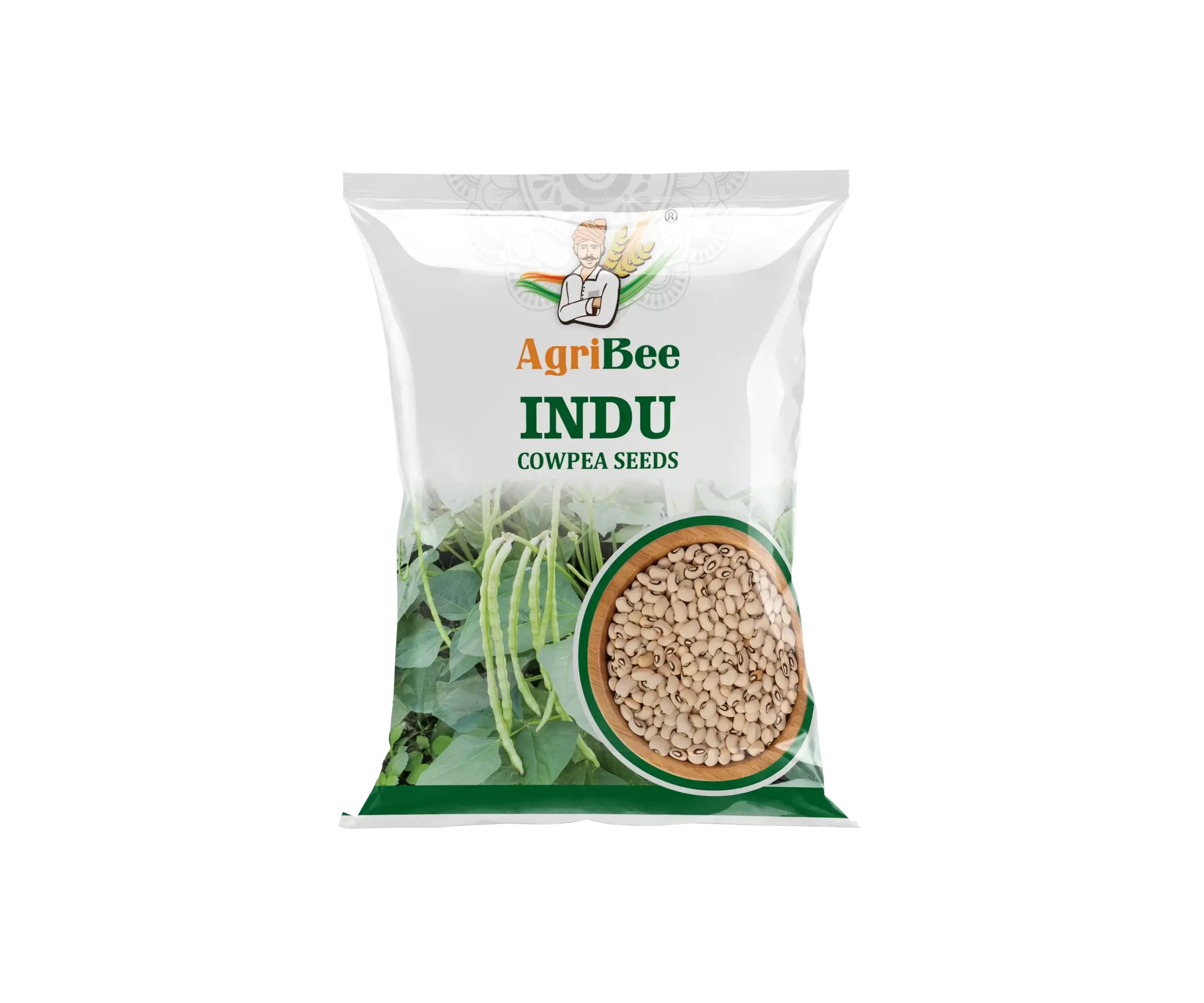
Description
शेती व लागवड संपूर्ण मार्गदर्शक — Cowpea Seeds – Indu
Complete step-by-step agronomic guide for optimal crop management, disease resistance, and premium produce quality.
🌾 जमिनीची पूर्वमशागत
Proper land preparation ensures uniform seedling emergence and robust root anchorage.
🌱 योग्य जमिनीचा प्रकार व सामू (pH)
Well-drained sandy loam to loamy soils with pH 6.0–7.5. The variety performs best in deep, fertile soils with good organic matter content and excellent drainage to prevent waterlogging.
✨ प्रमुख कृषी फायदे
Loose, well-aerated seedbed ensures rapid and uniform germination of milky-white cowpea seeds, promoting strong primary root establishment and early canopy development.
- 1
Deep summer ploughing followed by 2–3 cross-harrowings to achieve fine tilth and break soil crusts.
- 2
Field leveling with contour bunding where necessary and preparation of proper drainage channels to avoid water stagnation.
- 3
Incorporation of 8–10 tonnes per hectare of well-decomposed FYM or vermicompost during last harrowing to improve soil structure and microbial activity.
- 4
Soil testing for pH and nutrient status; liming recommended where pH falls below 5.5 to optimize nutrient availability.
🌱 पेरणीची वेळ व पद्धत
Precise seed rate and spacing maximize light interception and canopy development.
| निकष / मापदंड | शिफारस / पद्धत | कृषी महत्त्व |
|---|---|---|
| पेरणीची वेळ | Mid-January to mid-July depending on region; Rabi (Jan–Feb) and Kharif/Summer (June–July) windows are optimal | Aligns sowing with favorable temperature and moisture regimes, minimizing frost risk and maximizing vegetative growth before peak summer heat |
| बियाणे प्रमाण (प्रति एकर) | 30–35 kg per hectare for line sowing; 40–45 kg per hectare for broadcasting | Ensures optimal plant population density for balanced canopy development and efficient branch production |
| लागवडीतील अंतर | 60 cm x 15 cm (row-to-row x plant-to-plant) | Provides adequate spacing for 10–20 branches per plant, improves air circulation, and reduces humidity-related disease pressure |
| पेरणीची खोली | 3–4 cm for normal soils; 4–5 cm for lighter sandy soils | Ensures adequate soil contact for consistent moisture uptake without burial too deep, which delays germination |
💧 पाणी व्यवस्थापन
Adequate moisture regulation supports strong vegetative and reproductive growth.
☀️ Water Requirement Profile
Cowpea (Vigna sinensis) exhibits moderate drought tolerance but responds significantly to adequate soil moisture during flowering and pod development. The crop requires approximately 400–500 mm of water throughout its lifecycle. Drip irrigation is highly compatible and delivers 25–30% water savings while improving pod uniformity and reducing soil-borne disease incidence.
🌦️ Soil Moisture Management
Under rainfed conditions, ensure thorough pre-sowing irrigation (godhuli irrigation) to activate seed germination. Mulching with straw at 2–3 tonnes per hectare conserves soil moisture and moderates soil temperature during the critical 48–50 day harvest window. Avoid moisture stress immediately after germination and during pod set.
- ✓
First irrigation: Apply 4–5 days after sowing if soil moisture is inadequate; this promotes uniform emergence across the field.
- ✓
Vegetative phase (15–30 DAS): Light irrigation at 7–10 day intervals to support vigorous branching and leaf expansion.
- ✓
Critical stage (30–50 DAS — flowering to pod fill): Maintain consistent soil moisture with irrigation every 5–7 days; water stress at this stage causes flower drop and reduces legume quality and diameter.
- ✓
Pre-harvest: Reduce irrigation frequency during final picks to avoid excessive moisture that can cause pod rotting and reduce shelf life.
🧪 खत व्यवस्थापन
Balanced crop nutrition supports robust plant structure and premium produce quality.
| पोषक घटक | शिफारस केलेले प्रमाण (प्रति एकर) | वापरण्याची वेळ व पद्धत |
|---|---|---|
| नायट्रोजन (N) | 20–25 kg/acre as basal; top-dress 10 kg/acre at 30 DAS | Basal application with DAP; urea split applied at first weeding for sustained vegetative growth supporting 10–20 branches per plant |
| फॉस्फरस (P2O5) | 40–50 kg/acre | 100% basal applied through DAP or Single Super Phosphate at sowing for root development and nodulation support |
| पोटॅश (K2O) | 20–25 kg/acre | 50% at basal through MOP; remaining 50% at 35 DAS to enhance pod filling, legume firmness, and dark green fruit coloration |
🌿 तण नियंत्रण व आंतरमशागत
Timely weed control ensures optimal nutrient and moisture availability for crop seedlings.
-
1
First Weeding & Hoeing: Carry out at 10–12 DAS using a hand hoe or cultivator. Keep weeding shallow (2–3 cm depth) to avoid damaging the shallow root system. Early weed control is critical as cowpea is a slow initial grower and competes poorly with weeds during the first two weeks.
-
2
Second Weeding & Earthing-Up: Conduct at 25–30 DAS with mild earthing-up around the base of plants. This supports the branching habit (10–20 branches) of the Indu variety and improves root aeration during the critical flowering period.
-
3
Special Interculture Operation — Mulching: Apply straw or green mulch at 2–3 tonnes per acre immediately after second weeding. Mulching conserves soil moisture, suppresses late-stage weeds, keeps pods clean from soil contact (reducing sooty mold), and maintains pod color vibrancy.
🛡️ कीड व रोग व्यवस्थापन
Proactive crop monitoring and integrated management ensure healthy crop development.
🐛 Insect Pest Management
- Leafhopper (Amrasca biguttula biguttula): Small yellowish-green insects cause silvering and drying of leaf edges. Control: Spray Azadirachtin 0.03% (Neem-based) at 5 ml/liter or Imidacloprid 17.8% SL at 0.3 ml/liter. Repeat spray at 7-day intervals if infestation persists. Monitor with yellow sticky traps at field edges.
- Pod Borer (Helicoverpa armigera): Larvae bore into developing pods causing direct damage and secondary infections. Control: Apply Bacillus thuringiensis (Bt) formulation at 25 g/acre in 500 L water at first sign of egg laying. For severe infestations, use Spinosad 45% SC at 0.4 ml/liter. Install pheromone traps at 10 traps/acre for monitoring.
- Aphids (Aphis craccivora): Clusters of black aphids on undersides of leaves and tender shoots cause curling and stunting. Control: Spray Imidacloprid 70% WS at 0.3 g/liter or Thiamethoxam 25% WG at 0.2 g/liter. Conservation of ladybird beetles and parasitoid wasps is encouraged as natural enemies.
🔬 Disease Control
- Powdery Mildew (Erysiphe polygoni): पांढरा powdery fungal growth on leaves and pod surfaces reduces photosynthetic capacity and pod appearance. Prevention: Spray Sulphur fungicide (Wettable Sulphur 80% WP) at 2.5 g/liter at first appearance. Ensure adequate plant spacing (60×15 cm) to minimize leaf wetness duration and improve canopy airflow.
- Mosaic Disease (Cowpea Mosaic Virus transmitted by aphids): Mottled yellow-green patterns on leaves with leaf distortion. Prevention: Use hybrid & research disease-free seeds (AgriBee hybrid & research), control aphid vectors promptly with systemic insecticides, and remove and destroy infected plants immediately to prevent spread.
- Fusarium Wilt (Fusarium oxysporum f. sp. vignae): Yellowing and wilting of lower leaves with brown discoloration of vascular tissue. Prevention: Practice 3-year crop rotation with non-leguminous crops. Seed treatment with Trichoderma viride (4 g/kg seed) and soil drench with Trichoderma @ 5 kg/acre at 15 DAS in susceptible fields.
✂️ काढणी व प्रत नियंत्रण
Harvesting at peak maturity ensures maximum commercial grade and long keeping quality.
⏱️ Harvesting Schedule & Timing
harvest begins at 48–50 DAS. Subsequent pickings are carried out at 3–4 day intervals. A total of 6–8 pickings are typical, with each picking conducted in the early morning hours when pods are firm and turgid.
⭐ Produce Quality Characteristics
Pods exhibit uniform dark green coloration, smooth texture, and crisp snap when bent. Legume dimensions of 12–15 cm length and 5 mm diameter meet premium market standards. Milky white seed coat variety produces grains with excellent cooking quality, soft texture, and rich flavor upon maturity.
| Quality निकष / मापदंड | Agronomic Standard | Farmer & Market Benefit |
|---|---|---|
| काढणीची अवस्था | 48–50 Days after Sowing — early morning manual picking | Ensures early market arrival, premium pricing, and optimal pod tenderness |
| परिपक्वतेची लक्षणे | Dark green, glossy pod surface; firm to touch; legume length 12–15 cm; seeds just beginning to develop inside | Prevents over-maturity that causes fiber development and pod toughening |
| Shelf Life & Keeping Quality | 3–4 days under ambient conditions; 7–10 days under refrigerated storage (8–10°C with 90–95% RH) | Facilitates long-distance transport to urban mandis and retail chains with minimal quality loss |
| बाजार उपयुक्तता | Fresh table vegetable — premium supermarkets, hotel/restaurant trade, urban wholesale mandis, and processed food industry | Dark green color and uniform pod size command premium rates; high branching habit ensures continuous supply over multiple pickings |
⭐ विविध वैशिष्ट्ये — Cowpea Seeds – Indu
Distinguishing characteristics that make this variety a top choice for Indian growers.
🌿 Core Variety उच्चlight
Indu is a high-performing cowpea variety developed by AgriBee Seeds with exceptional early maturity at 48–50 DAS, enabling farmers to enter the market ahead of conventional varieties and capture premium off-season prices.
🌿 Produce Quality & Appearance
Produces uniformly dark green, glossy pods measuring 12–15 cm in length with 5 mm diameter. The milky white seed variety delivers grains with superior cooking quality, soft texture, and appetizing appearance favored by consumers.
🌿 Stress & Disease Tolerance
Demonstrates good field tolerance to common cowpea pests including aphids and pod borers, and moderate resistance to Fusarium wilt and powdery mildew under integrated pest management practices.
🌿 Growth Habit & Vigor
Semi-branched plant architecture reaching 90–94 cm in height with 10–20 productive branches per plant. The vigorous branching habit ensures high pod-bearing nodes and continuous harvest potential.
🌿 Crop Duration & Earliness
Early maturity at 48–50 days to harvest allows flexible crop scheduling within the January–July window and enables integration into short-duration cropping systems such as rice-wheat and cotton-cowpea rotations.
🌿 Market & Farmer Preference
Farmers favor Indu for its reliable branching pattern, dark green pod color that appeals to traders, and early harvest capability. Dealers and processors prefer the uniform pod size and excellent shelf life that minimize post-harvest losses across the supply chain.