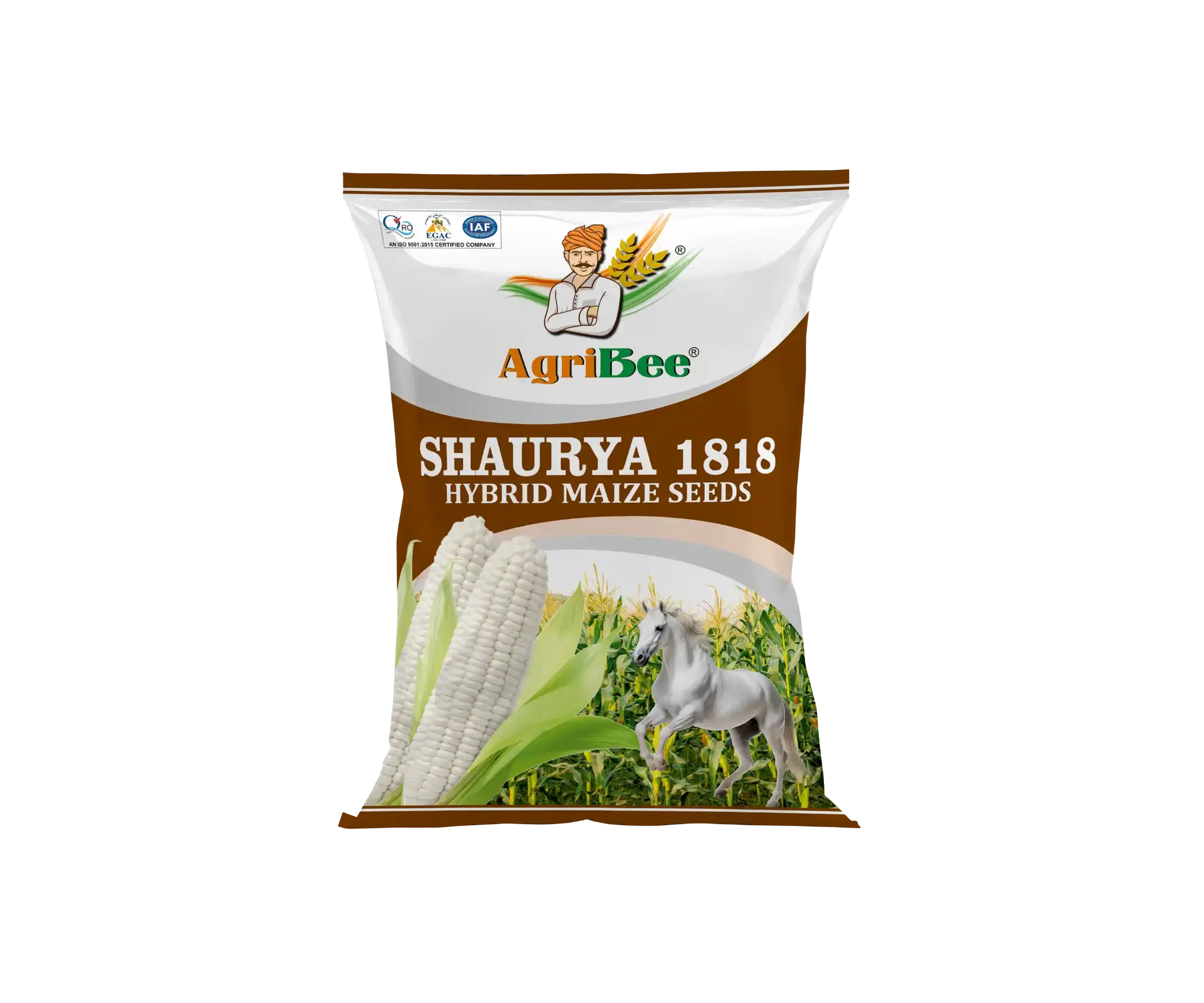

Description
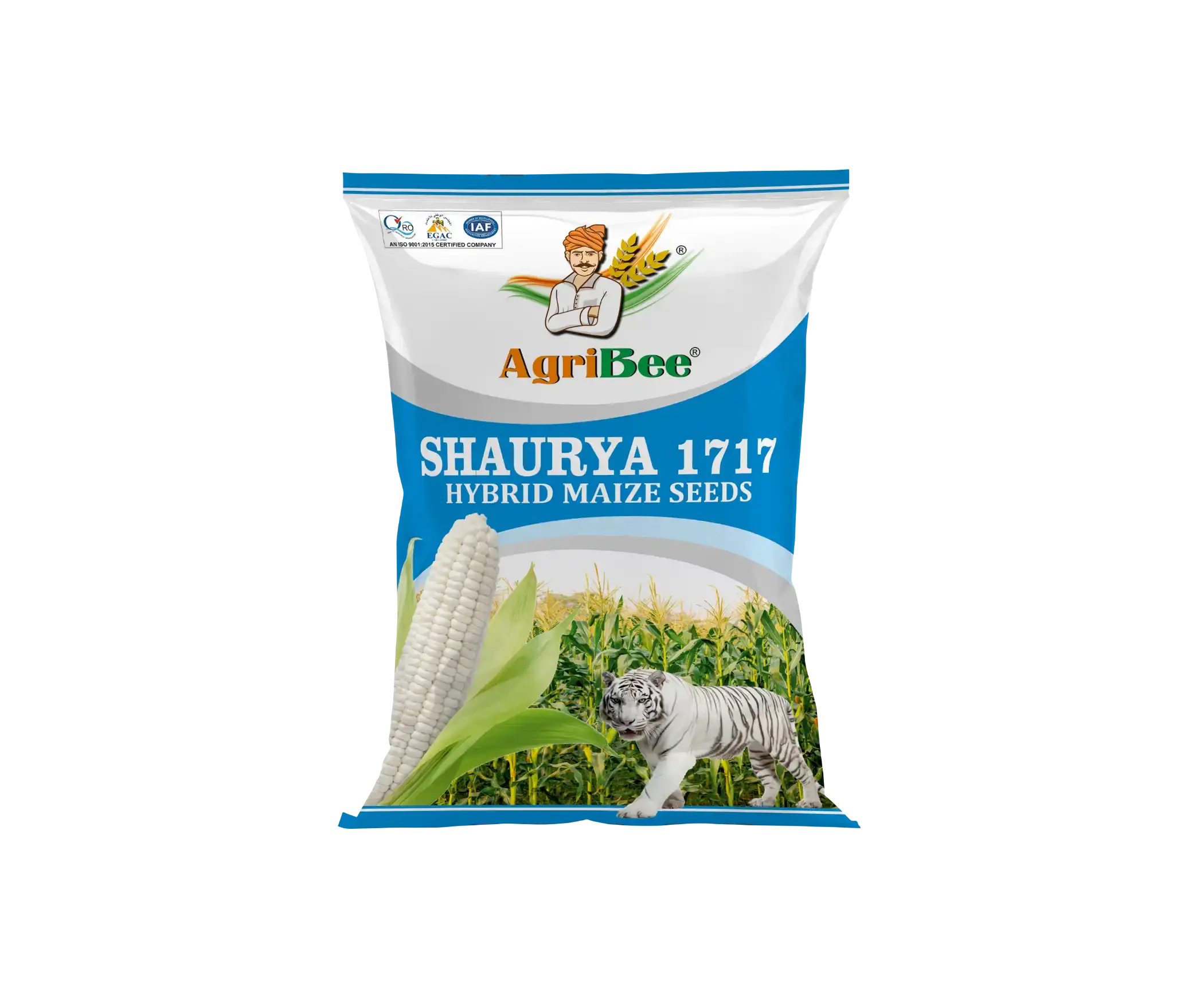
शेती व लागवड संपूर्ण मार्गदर्शक — पांढरा Maize Shaurya 1717
Complete step-by-step agronomic guide for optimal crop management, disease resistance, and premium produce quality.
🌾 जमिनीची पूर्वमशागत
Proper land preparation ensures uniform seedling emergence and robust root anchorage.
🌱 योग्य जमिनीचा प्रकार व सामू (pH)
Well‑drained loamy to clay‑loam soils with pH 5.5–7.5 and high organic carbon content.
✨ प्रमुख कृषी फायदे
The open, friable seedbed promotes rapid imbibition, uniform germination, and strong root anchorage for vigorous plant stand.
- 1
Deep summer ploughing (25–30 cm) followed by 2–3 cross‑harrowings to achieve a fine, clod‑free tilth.
- 2
Field leveling and formation of drainage channels to avoid water stagnation during heavy rains.
- 3
Incorporation of 8–10 t/acre of well‑decomposed FYM or compost at final ploughing to improve soil structure and moisture retention.
- 4
Soil health conditioning with agricultural lime (if pH <5.5) or gypsum (if sodic), based on soil test recommendations.
🌱 पेरणीची वेळ व पद्धत
Precise seed rate and spacing maximize light interception and canopy development.
| निकष / मापदंड | शिफारस / पद्धत | कृषी महत्त्व |
|---|---|---|
| पेरणीची वेळ | May–July (Summer/Kharif) and October–December (Rabi) | Sowing in these windows avoids extreme temperature stress and aligns with favorable rainfall patterns for uniform germination. |
| बियाणे प्रमाण (प्रति एकर) | 8–10 kg / Acre | Maintains optimal plant population (≈40,000–45,000 plants/ha) without overcrowding, ensuring balanced canopy development. |
| लागवडीतील अंतर | 60 cm (row‑to‑row) × 20 cm (plant‑to‑plant) | Optimal spacing improves light interception, air circulation, and simplifies field operations and harvest. |
| पेरणीची खोली | 3–5 cm | Ensures adequate soil‑seed contact for consistent moisture uptake while allowing unhindered seedling emergence. |
💧 पाणी व्यवस्थापन
Adequate moisture regulation supports strong vegetative and reproductive growth.
☀️ Water Requirement Profile
Maize has moderate drought tolerance but is highly sensitive to moisture stress during tasseling to grain filling. Under drip irrigation, maintain soil moisture at 70–80% of field capacity; furrow or basin irrigation should be applied at 8–10 day intervals during peak vegetative and reproductive stages.
🌦️ Soil Moisture Management
In rainfed conditions, synchronize sowing with monsoon onset, use conservation mulches to reduce evaporation, and plan emergency irrigation at silking if rain gaps exceed 10 days to safeguard pollination and grain set.
- ✓
First irrigation 7–10 days after sowing to ensure uniform germination, especially in summer soils.
- ✓
During active vegetative growth (tillering to knee‑high stage), irrigate every 10–12 days depending on soil type and weather.
- ✓
Critical irrigation at 50–60 days after sowing coincides with tasseling and silking; water stress at this stage drastically reduces grain filling and vigor.
- ✓
Withhold irrigation 7–10 days before harvest to facilitate uniform drying and prevent lodging.
🧪 खत व्यवस्थापन
Balanced crop nutrition supports robust plant structure and premium produce quality.
| पोषक घटक | शिफारस केलेले प्रमाण (प्रति एकर) | वापरण्याची वेळ व पद्धत |
|---|---|---|
| नायट्रोजन (N) | 120 kg / acre | Apply 1/3 as basal at sowing, remaining 2/3 in two equal splits at 30 DAS and 45 DAS. |
| Phosphorus (P₂O₅) | 60 kg / acre | 100% as basal through DAP (or SSP) at final land preparation. |
| Potash (K₂O) | 40 kg / acre | Apply 50% with basal P and the remainder as top‑dress at first irrigation after 30 DAS. |
🌿 तण नियंत्रण व आंतरमशागत
Timely weed control ensures optimal nutrient and moisture availability for crop seedlings.
-
1
First Weeding & Hoeing: Carry out at 15 DAS using a conical hoe or rotavator to eradicate early weed flush and loosen soil crust, improving root aeration.
-
2
Second Weeding & Earthing‑Up: At 30 DAS, perform another weeding and ridge the soil around the base of plants to provide mechanical support and protect developing roots from wind lodging.
-
3
विशेष आंतरमशागत: Apply a thin straw mulch (2–3 cm) between rows to conserve soil moisture, suppress weeds, and moderate soil temperature during high‑summer sowing.
🛡️ कीड व रोग व्यवस्थापन
Proactive crop monitoring and integrated management ensure healthy crop development.
🐛 Insect Pest Management
- Shoot Fly (Atherigona exigua): Symptoms include dead hearts and central leaf pull‑out in seedlings. Control: Apply fipronil 75 WDG at 0.3 kg/acre as soil drench around the stem at 10–15 DAS, or release Trichogramma japonicum (1 lakh/acre) at weekly intervals.
- Stem Borer (Chilo partellus): Larvae bore into stems causing premature drying and easy breakage. Control: Spray chlorantraniliprole 18.5 SC at 0.4 ml/liter water at first sign of active feeding; alternatively, use Bacillus thuringiensis (Bt) formulation at 250 g/acre.
- Aphids (Rhopalosiphum maidis): Colonies on leaf sheaths and tassels cause curling and sooty mold. Control: Imidacloprid 17.8 SL at 0.3 ml/liter water or release Aphidius colemani; apply periodic sprinkler irrigation to dislodge colonies.
🔬 Disease Control
- Downy Mildew (Peronosclerospora philippinensis): Yellowing and stunting of leaves with dense fungal sporulation on the underside. Control: Treat seeds with metalaxyl 35% WS at 4 g/kg seed; spray propineb 70 WP at 2.5 g/liter water at onset of disease.
- Leaf Blight (Bipolaris maydis): Oval brown lesions with yellow halos on leaves. Control: Apply mancozeb 75 WP at 2 g/liter water as preventive spray at 40 DAS and repeat after 15 days under humid conditions.
- Smut (Ustilago maydis): Galls replacing kernels and leaves; spread via soil‑borne spores. Control: Use hybrid & research disease‑free seeds; treat with thiram 2.5 g/kg seed; remove and destroy any visible galls before they rupture.
✂️ काढणी व प्रत नियंत्रण
Harvesting at peak maturity ensures maximum commercial grade and long keeping quality.
⏱️ Harvesting Schedule & Timing
harvest is completed at 90–100 days after sowing when grains reach physiological maturity (milky‑white, firm texture). Allow the crop to dry naturally in the field for an additional 5–7 days to improve grain hardness and shelf life.
⭐ Produce Quality Characteristics
The variety produces milky‑white, compact ears with a sweet, delicate flavor. Grain texture is firm yet tender, retaining high sugar content at harvest and appealing to fresh‑market consumers and processing units.
| Quality निकष / मापदंड | Agronomic Standard | Farmer & Market Benefit |
|---|---|---|
| काढणीची अवस्था | 90–100 Days after Sowing (full physiological maturity) | Ensures maximum grain fill, optimal kernel weight, and best sensory attributes for fresh consumption. |
| परिपक्वतेची लक्षणे | Ear shank dries, husk turns pale and papery, grain loses moisture and attains hard dent stage | Visual cues prevent premature picking and guarantee uniform quality across the lot. |
| Shelf Life & Keeping Quality | 7–10 days under ambient conditions (25–30°C); extends to 15–20 days if kept in cool, ventilated storage | Robust grain coat and low moisture content at harvest support longer marketing windows and reduced post‑harvest losses. |
| बाजार उपयुक्तता | Fresh market, wholesale mandis, institutional buyers, and processing for popcorn, flour, or canned products | Uniform milky‑white color and consistent ear size attract premium prices and broaden buyer acceptance. |
⭐ विविध वैशिष्ट्ये — पांढरा Maize Shaurya 1717
Distinguishing characteristics that make this variety a top choice for Indian growers.
🌿 Core Variety उच्चlight
पांढरा Maize Shaurya 1717 exhibits exceptional field vigor, uniform stand establishment, and high genetic purity, delivering reliable performance across diverse Indian agro‑climatic zones.
🌿 Produce Quality & Appearance
Ears are compact with milky‑white kernels that are sweet, tender, and visually appealing; grain color remains consistent even after harvest, meeting stringent fresh‑market standards.
🌿 Stress & Disease Tolerance
Shows moderate tolerance to downy mildew, leaf blight, and shoot fly pressure; maintains foliage health under moisture‑stress conditions, reducing the need for intensive chemical intervention.
🌿 Growth Habit & Vigor
Upright plant architecture with broad green leaves ensures efficient light capture and robust photosynthetic activity, supporting steady dry‑matter accumulation throughout the growing cycle.
🌿 Crop Duration & Earliness
A mid‑early hybrid reaching maturity in 90–100 days, enabling farmers to fit it into tight rotation schedules (e.g., wheat–maize, rice–maize) and capitalize on off‑season price advantages.
🌿 Market & Farmer Preference
Trusted by progressive growers for its uniform ear size, striking white kernel color, and strong field performance, making it a preferred choice for contract farming, export‑oriented supply chains, and direct retail markets.