
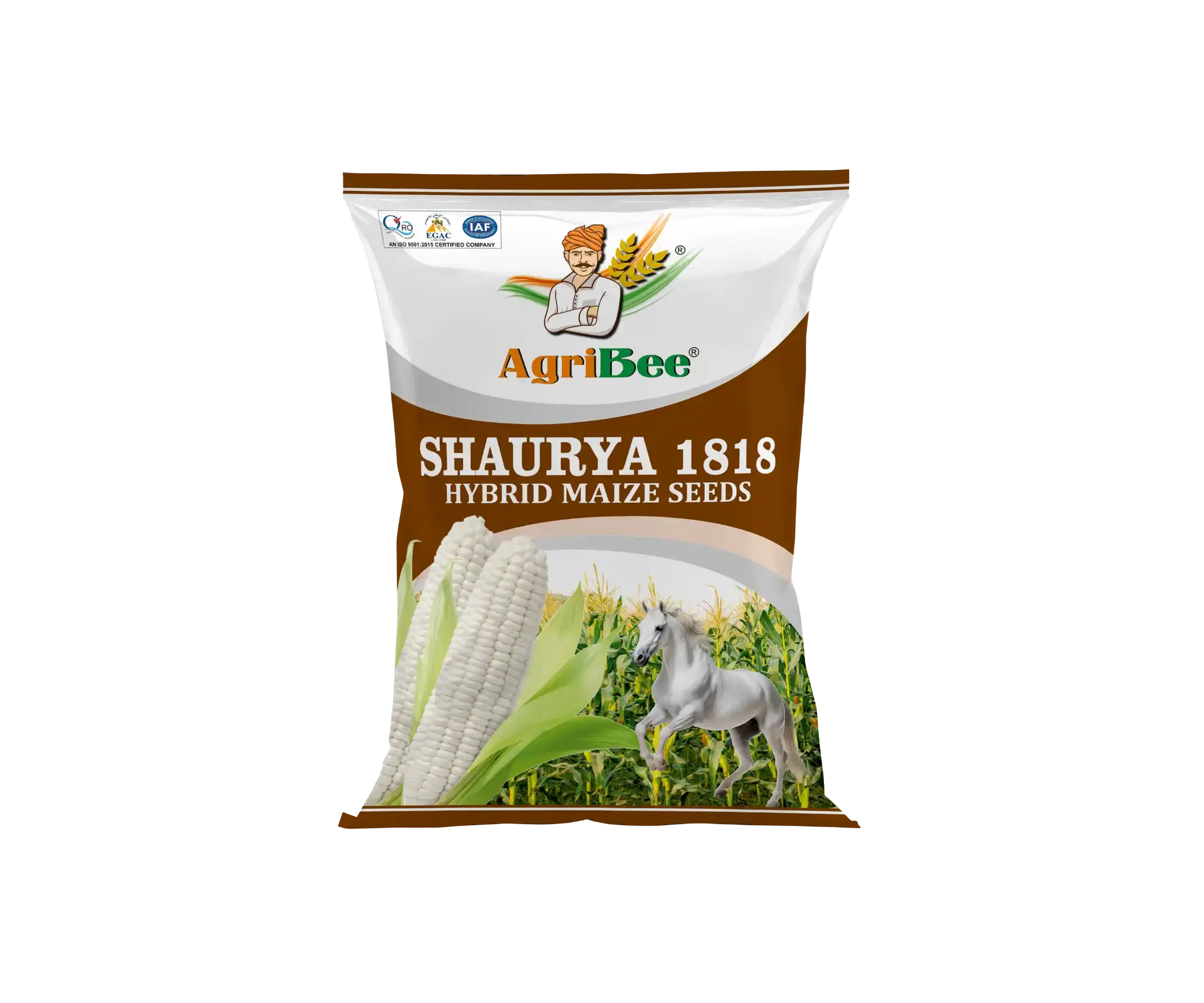
Description
शेती व लागवड संपूर्ण मार्गदर्शक — पांढरा Maize Shaurya 1818
Complete step-by-step agronomic guide for optimal crop management, disease resistance, and premium produce quality.
🌾 जमिनीची पूर्वमशागत
Proper land preparation ensures uniform seedling emergence and robust root anchorage.
🌱 योग्य जमिनीचा प्रकार व सामू (pH)
Well-drained loamy to clay-loam soils with pH 6.0–7.5. The variety performs optimally in deep, fertile soils with good organic matter content and moderate moisture retention capacity.
✨ प्रमुख कृषी फायदे
Loamy soil structure promotes rapid germination, strong root anchorage for tall non-lodging plants, and efficient nutrient uptake for excellent tip filling.
- 1
Deep summer ploughing to 25–30 cm followed by 2–3 cross-harrowings for fine tilth and weed seed burial.
- 2
Field leveling using laser or pipe level for uniform water distribution and consistent germination across the field.
- 3
Incorporation of 10–12 tonnes per hectare of well-decomposed FYM or compost during the final harrowing to build soil organic carbon.
- 4
Soil health conditioning: apply gypsum at 250 Kg/Ha in alkaline/sodic soils and sulfur at 40 Kg/Ha in deficient soils to maintain near-neutral pH.
🌱 पेरणीची वेळ व पद्धत
Precise seed rate and spacing maximize light interception and canopy development.
| निकष / मापदंड | शिफारस / पद्धत | कृषी महत्त्व |
|---|---|---|
| पेरणीची वेळ | ऑक्टोबर ते नोव्हेंबर for Rabi; June to early July for Kharif monsoon sowing | Sowing within this window ensures optimal temperature (25–32°C) and moisture conditions for uniform germination and avoids pre-monsoon drought stress. |
| बियाणे प्रमाण (प्रति एकर) | 40–42 Kg per Hectare (16–17 Kg per Acre) | Maintains optimal plant population of approximately 55,000–60,000 plants/Ha for balanced canopy development and non-lodging stand. |
| लागवडीतील अंतर | 60 cm Row-to-Row x 20 cm Plant-to-Plant (or 75 x 20 cm for Rabi) | Ensures adequate canopy spread, inter-row aeration, light penetration, and reduces disease humidity buildup while supporting tall plant architecture. |
| पेरणीची खोली | 5–7 cm under normal conditions; 7–8 cm in lighter sandy soils | Promotes uniform germination, proper seed-soil contact, and deeper root establishment for lodging resistance. |
💧 पाणी व्यवस्थापन
Adequate moisture regulation supports strong vegetative and reproductive growth.
☀️ Water Requirement Profile
पांढरा Maize Shaurya 1818 is highly responsive to irrigated conditions. Maintain soil moisture at 60–70% of field capacity throughout the growing cycle. Under drip irrigation, apply 3–4 cm water per irrigation every 3–4 days during peak vegetative and grain-filling stages. The crop is moderately drought-sensitive during flowering and early grain-filling; even brief moisture stress at silking can reduce tip fill quality.
🌦️ Soil Moisture Management
In rainfed or low-rainfall zones, sow immediately after a soaking rain to ensure adequate germination moisture. Use mulching (straw or polyethylene) to conserve soil moisture. Avoid waterlogging at any stage—install quick-drainage channels as white maize is sensitive to standing water beyond 24 hours.
- ✓
First irrigation at 20–25 DAS (tillering stage) to establish robust root system and promote uniform seedling growth.
- ✓
Vegetative phase: irrigate every 10–12 days during active leaf and stem growth to sustain vigorous foliage development.
- ✓
Critical stage — silking to dough stage (45–70 DAS): maintain consistent moisture; any deficit here directly compromises tip filling and kernel solidity. Apply irrigation at 7–8 day intervals during this window.
- ✓
Withhold irrigation 10–12 days before expected harvest to allow natural drying of grain moisture and improve keeping quality.
🧪 खत व्यवस्थापन
Balanced crop nutrition supports robust plant structure and premium produce quality.
| पोषक घटक | शिफारस केलेले प्रमाण (प्रति एकर) | वापरण्याची वेळ व पद्धत |
|---|---|---|
| नायट्रोजन (N) | 120–150 Kg per Hectare | 50% basal at sowing (along with P and K); remaining 50% split as top-dressing at 30 DAS and 50 DAS. Under high-response irrigated conditions, consider a third split at boot stage for sustained green foliage. |
| Phosphorus (P₂O₅) | 60 Kg per Hectare | 100% basal application incorporated at final seedbed preparation. Use DAP (18-46-0) or SSP to deliver both P and supplementary S/Zn. |
| Potash (K₂O) | 50–60 Kg per Hectare | Apply 50% basally with P and remaining 50% at 40–45 DAS to support stalk strength, lodging resistance, and kernel firmness for excellent tip filling. |
🌿 तण नियंत्रण व आंतरमशागत
Timely weed control ensures optimal nutrient and moisture availability for crop seedlings.
-
1
First Weeding & Hoeing: Carry out shallow hoeing and weeding at 15–20 DAS before weed seeds germinate and compete for nutrients. Use a rotary weeder or hand hoe carefully to avoid root damage. Early weed control during this window is critical for establishing vigorous crop stand.
-
2
Second Weeding & Earthing-Up: Perform second weeding and earthing-up at 35–40 DAS. Mounding soil around the base strengthens brace roots, improves lodging resistance for tall plants, and enhances root zone aeration during heavy irrigation or monsoon rains.
-
3
विशेष आंतरमशागत: Apply organic or black plastic mulch between rows at 20 DAS to conserve moisture, suppress weeds, and moderate soil temperature. In high-population sowing, remove excess suckers (secondary tillers) at 30–35 DAS to direct assimilates toward primary ear development and improve tip filling uniformity.
🛡️ कीड व रोग व्यवस्थापन
Proactive crop monitoring and integrated management ensure healthy crop development.
🐛 Insect Pest Management
- Shoot Fly (Atherigona soccata): Sucks sap from young seedlings causing 'dead heart' symptom and central leaf death. Control: Spray Phosalone 35 EC at 1.5 ml/L or Chlorpyriphos 20 EC at 2 ml/L at 10 and 15 DAS as seedling protection. Apply carbosulfan granules at the base at 10 DAS as preventive measure.
- Pink Stem Borer (Sesamia inferens): Larvae bore into stem causing wilting, drying of upper leaves, and tunneling visible frass. Control: Install pheromone traps at 10/acre for monitoring. Spray Cartap hydrochloride 4 GP at 1 kg/acre in leaf axils at 35 and 50 DAS, or use Chlorantraniliprole 18.5 SC at 0.3 ml/L at first sign of infestation.
- Corn Stalk Borer / Stem Borer (Chilo partellus): Adults lay eggs near leaf margins; larvae enter stems causing irregular holes and entry points for secondary rot. Control: Practice deep ploughing to expose overwintering larvae. Spray Spinosad 45 SC at 0.3 ml/L or Emamecin benzoate 5 SG at 0.4 g/L at peak flowering when moth activity is highest.
🔬 Disease Control
- Northern Corn Leaf Blight (Exserohilum turcicum): Characteristic cigar-shaped grey-green lesions on upper leaves reducing photosynthetic area. Preventive: Remove crop residue post-harvest to reduce inoculum. Spray Mancozeb 75 WP at 2.5 g/L or Propineb at 2 g/L at early symptom appearance and repeat after 10 days if needed.
- Downy Mildew (Peronosclerospora sorghi): Downy white fungal growth on leaf underside, yellowing and stunting of infected plants. Control: Use seed treatment with Metalaxyl 35 WS at 4 g/Kg seed before sowing. Foliar spray of Mancozeb 75 WP at 2 g/L at first sign of disease spread in humid conditions.
- Stem Rust (Puccinia sorghi): Raised reddish-brown pustules on lower leaf surfaces causing premature leaf senescence. Management: Ensure adequate potassium nutrition to strengthen cell walls. Apply Sulphur dust (80%) at 15 Kg/acre or spray Triforine at 0.1% if disease pressure is high during cool, humid periods.
✂️ काढणी व प्रत नियंत्रण
Harvesting at peak maturity ensures maximum commercial grade and long keeping quality.
⏱️ Harvesting Schedule & Timing
Harvest when 80–85% of silks turn brown and kernels reach physiological maturity at full dent stage. harvest is typically at 95–100 DAS in Kharif and 110–115 DAS in Rabi. Harvest the entire crop at once as it is a single-harvest hybrid.
⭐ Produce Quality Characteristics
पांढरा semi-flint kernels exhibit excellent tip filling with uniform plumpness, bright white color, firm texture, and minimal shriveling. The grain shows good test weight, low broken-kernel percentage, and attractive market appearance suitable for fresh market, processing, and value-added white maize products.
| Quality निकष / मापदंड | Agronomic Standard | Farmer & Market Benefit |
|---|---|---|
| काढणीची अवस्था | 95–100 DAS (Kharif) / 110–115 DAS (Rabi) | Ensures peak kernel solidity, optimal moisture content (~14–15%), and early market arrival for better price realization. |
| परिपक्वतेची लक्षणे | Brown and desiccated silks, hard dough to full dent kernel stage, black layer formation at kernel base, husk turning pale yellow and dry | Prevents over-maturity, kernel shattering, and pest infestation in storage; maintains grain hardness for transport. |
| Shelf Life & Keeping Quality | Grain remains stable for 4–6 months at ambient temperature when moisture is below 13%; semi-flint type resists mold and insect attack better than soft flint types | Facilitates long-distance transport, extended sales window, and reduced post-harvest losses for farmers and traders. |
| बाजार उपयुक्तता | पांढरा semi-flint kernels are preferred for fresh market, food processing (flour, popped corn, industrial starch), and specialty mandi channels | Attracts premium market rates as white maize commands higher prices in both domestic and export-oriented supply chains. |
⭐ विविध वैशिष्ट्ये — पांढरा Maize Shaurya 1818
Distinguishing characteristics that make this variety a top choice for Indian growers.
🌿 Core Variety उच्चlight
पांढरा Maize Shaurya 1818 is a medium-maturity hybrid specifically bred for outstanding tip filling and non-lodging architecture, making it one of the most reliable white semi-flint maize choices under Indian irrigated conditions.
🌿 Produce Quality & Appearance
The white semi-flint kernels display brilliant whiteness, excellent tip fill with minimal bare patches, firm grain texture, and high test weight — traits highly valued by processors and fresh-market traders across India.
🌿 Stress & Disease Tolerance
Demonstrates good tolerance to major leaf blights and acceptable field resistance under average disease pressure, enabling stable performance across diverse agro-climatic zones in India.
🌿 Growth Habit & Vigor
Tall, upright plant architecture with strong stalks and well-developed brace roots ensures non-lodging even under high input regimes and wind conditions, supporting dense planting populations.
🌿 Crop Duration & Earliness
Medium maturity with 95–100 days in Kharif and 110–115 days in Rabi provides flexibility for crop rotation planning and enables farmers to fit the crop between successive commercial cycles.
🌿 Market & Farmer Preference
Farmers favor this AgriBee variety for its excellent response to inputs, high vigor, superior grain appearance, and consistent tip-filling performance that translates into strong dealer and trader demand in white maize markets.