Description
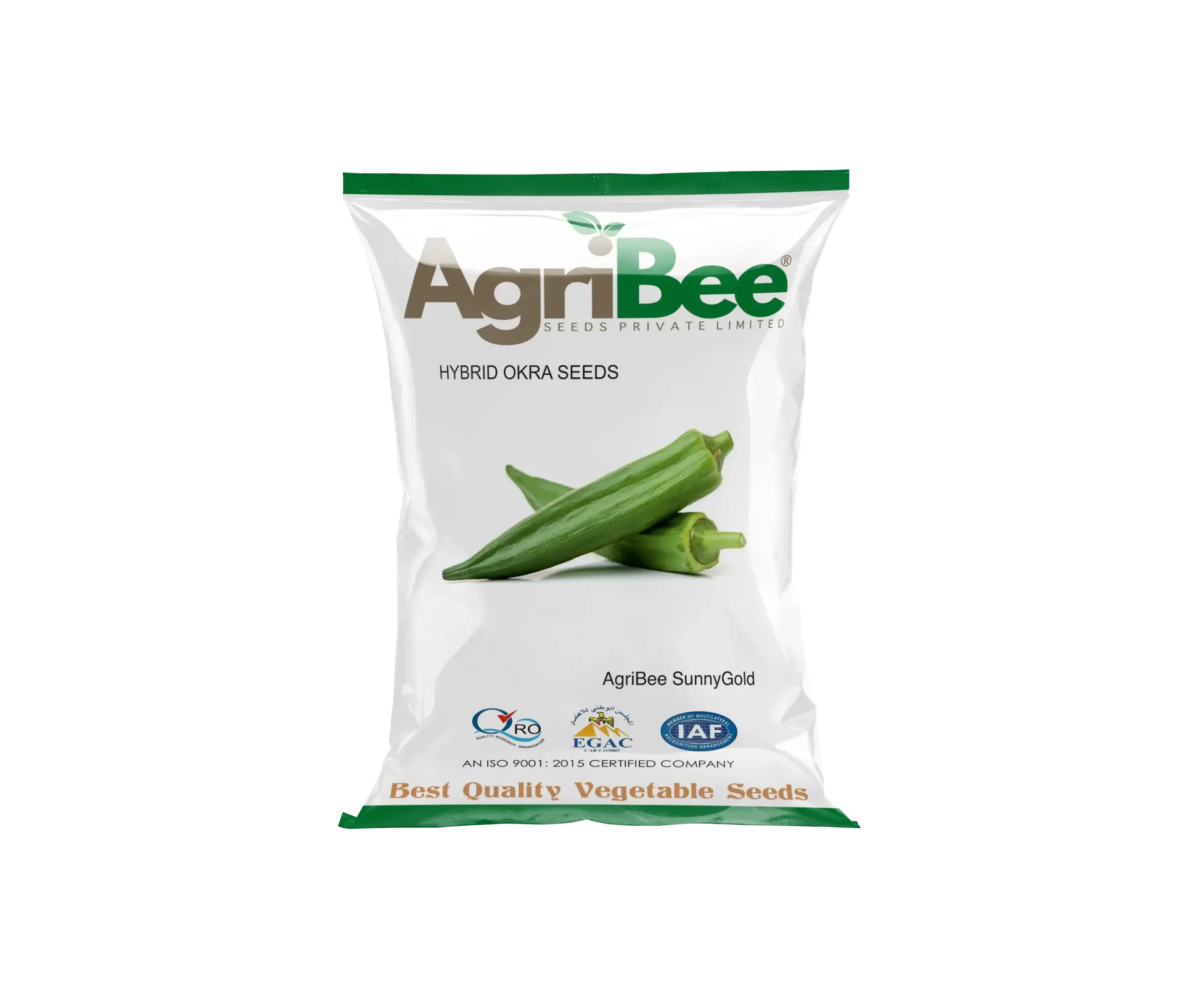
Farming & Cultivation Guide — Okra Seeds AgriBee SunnyGold
Complete step-by-step agronomic guide for optimal crop management, disease resistance, and premium produce quality.
🌾 Soil Preparation & Field Prep
Proper land preparation ensures uniform seedling emergence and robust root anchorage.
🌱 Ideal Soil Type & pH
Well-drained loamy to sandy-loam soils with pH 6.0–7.5. Deep, fertile soils with good organic matter content promote vigorous root development and sustained pod production. Avoid heavy clay and waterlogged soils.
✨ Core Advantage
Fine, well-aerated seedbed ensures rapid and uniform germination of Okra Seeds AgriBee SunnyGold, establishing strong primary root systems for improved nutrient and water uptake throughout the crop cycle.
- 1
Deep summer ploughing followed by 2–3 cross-harrowings for fine tilth and complete weed destruction.
- 2
Field leveling and drainage preparation to prevent water stagnation, especially in Kharif conditions.
- 3
Incorporation of 10–12 t/ha well-decomposed FYM or compost during last harrowing for soil structure improvement.
- 4
Soil health conditioning — test pH and apply gypsum or lime if required to maintain pH between 6.0 and 7.5 for optimal nutrient availability.
🌱 Sowing Time & Method
Precise seed rate and spacing maximize light interception and canopy development.
| Parameter | Recommendation | Agronomic Importance |
|---|---|---|
| Sowing Window | June – mid-July (Kharif) | March – April (Summer) | October – November (Rabi, South India) | Okra is a warm-season crop; sowing during rising soil temperatures (20–30°C) ensures rapid germination and establishes the crop before peak pest pressure. |
| Seed Rate | 8–10 kg/ha for direct sowing | 5–6 kg/ha for transplanting | Maintains optimal plant population without overcrowding, ensuring adequate canopy ventilation and fruiting space. |
| Spacing | Row-to-row: 60 cm × Plant-to-plant: 30 cm (conventional) | 45 cm × 15 cm (intensive system) | Optimal spacing supports balanced canopy development, improves air circulation, and reduces disease humidity buildup. |
| Sowing / Transplanting Depth | 2–3 cm depth for direct sowing | Transplant at 2–3 leaf stage (15–20 DAS) | Shallow sowing ensures quick seed emergence; okra seeds are large and require warm, moist soil conditions for uniform germination. |
💧 Irrigation & Water Management
Adequate moisture regulation supports strong vegetative and reproductive growth.
☀️ Water Requirement Profile
Okra exhibits moderate drought tolerance once established but demands consistent soil moisture for sustained vegetative growth and continuous fruit set. Drip irrigation is highly compatible and improves water use efficiency by 30–40%. Irrigate at 4–6 day intervals during summer and 7–10 day intervals during Kharif, supplying approximately 4–6 cm water per irrigation event.
🌦️ Soil Moisture Management
In rainfed conditions, sow on contour bunds or raised beds to capture and conserve monsoon moisture. Mulching with straw at 5–7 cm thickness significantly reduces evaporation and maintains root-zone moisture. Apply a light irrigation at sowing if pre-monsoon showers are erratic.
- ✓
First irrigation: Apply 2–3 days after sowing to ensure uniform germination and early seedling vigor.
- ✓
Vegetative phase (15–40 DAS): Maintain light but frequent irrigation every 5–7 days to support rapid stem and leaf growth.
- ✓
Critical stage — flowering and fruit set (40 DAS onward): Consistent moisture is essential; water stress during this period causes flower drop and poor pod setting.
- ✓
Pre-harvest: Reduce irrigation frequency in the final 10 days before first picking to improve fruit firmness and extend shelf life.
🧪 Fertilizer & Nutrition Management
Balanced crop nutrition supports robust plant structure and premium produce quality.
| Nutrient | Recommended Dose (per Acre) | Application Method & Timing |
|---|---|---|
| Nitrogen (N) | 60–80 kg/ha | 50% basal at sowing + 25% at 30 DAS + 25% at 50 DAS (first fruiting stage) |
| Phosphorus (P₂O₅) | 40–50 kg/ha | 100% basal application as DAP (18:46:00) or SSP during final land preparation |
| Potash (K₂O) | 30–40 kg/ha | 50% basal + 50% at 45 DAS to support fruit development and overall plant vigor |
🌿 Interculture & Weed Management
Timely weed control ensures optimal nutrient and moisture availability for crop seedlings.
-
1
First Weeding & Hoeing: Carry out at 15–20 DAS using a hand hoe or rotavator. Early weed control is critical as okra is a slow-establishing crop in the first 3 weeks. Keep the inter-row clean to reduce competition for moisture and nutrients.
-
2
Second Weeding & Earthing-Up: Perform at 30–35 DAS. Light earthing-up around the plant base improves root aeration and provides mechanical support as the plant begins branching and fruiting.
-
3
Mulching and Staking (Optional): Organic mulch (straw/paddy husk) at 5–7 cm thickness conserves soil moisture and suppresses weed flush. In high-density planting (45 × 15 cm), light staking with bamboo strings may be required to prevent lodging under heavy fruit load.
🛡️ Pest & Disease Management
Proactive crop monitoring and integrated management ensure healthy crop development.
🐛 Insect Pest Management
- Aphids (Macrosiphum euphorbiae): Cluster on tender shoots and undersides of leaves, causing curling and honeydew sooting. Spray Imidacloprid 17.8% SL at 0.3 ml/L or Neem-based formulation (Azadirachtin 1%) at 2 ml/L. Repeat at 7-day intervals if infestation persists. Release Aphidius colemani in protected cultivation.
- Okra Shoot & Fruit Borer (Holotrichia consanguinea / Helicoverpa armigera): Larvae bore into squares, shoots, and young fruits causing wilting and fruit drop. Apply Chlorantraniliprole 18.5% SC at 0.3 ml/L or Spinosad 45% SC at 0.4 ml/L at first sign of damage. Destroy infested pods manually. Install pheromone traps at 10/acre for monitoring.
- Jassids / Leafhoppers (Amrasca biguttula): Sucking pests causing yellowing and browning of leaf margins ('hopper burn'). Spray Dimethoate 30% EC at 1.5 ml/L or Imidacloprid 17.8% SL at 0.3 ml/L. Use yellow sticky traps at 15 traps/acre for adult monitoring and suppression.
🔬 Disease Control
- Yellow Vein Mosaic Virus (YVMV) — Causal agent: Okra yellow vein mosaic virus (OYVMV), transmitted by whitefly (Bemisia tabaci). Symptoms: Bright yellow vein clearing on leaves, severe stunting, and reduced fruiting. AgriBee SunnyGold carries tolerance to YVMV. Control whitefly vector with Yellow Sticky Traps (20/acre) and spray Thiometon 25% WG at 0.5 g/L or Imidacloprid 17.8% SL at 0.3 ml/L. Remove and destroy infected plants immediately.
- Powdery Mildew (Erysiphe cichoracearum): White powdery fungal growth on upper leaf surface, progressing to necrosis. Preventive spray of Sulphur wettable powder 80% WP at 2 g/L or Micronised Sulphur at 2.5 g/L at 30 and 45 DAS. Ensure proper spacing for canopy ventilation to reduce humidity.
- Bacterial Wilt (Ralstonia solanacearum): Sudden wilting of entire plant with vascular browning. Seed treatment with Streptocycline 0.1% or Copper oxychloride 0.3% for 30 minutes before sowing. Soil drench with Carbendazim 50% WP at 1 g/L at first symptom appearance. Practice 3-year crop rotation with non-host cereals.
✂️ Harvesting & Produce Quality Guide
Harvesting at peak maturity ensures maximum commercial grade and long keeping quality.
⏱️ Harvesting Schedule & Timing
First harvest begins 45–50 days after sowing. Subsequent pickings are taken at 2–3 day intervals throughout the productive phase, ensuring fruits are harvested at the tender stage before seeds harden.
⭐ Produce Quality Characteristics
Premium dark green color, slender 5-ridged pods measuring 10–12 cm with tender, non-fibrous flesh. Crisp texture, mild sweet flavor, and excellent cooking quality. Uniform pod size and minimal fiber string make this variety highly desirable for fresh market and food processing.
| Quality Parameter | Agronomic Standard | Farmer & Market Benefit |
|---|---|---|
| First Harvest Stage | 45–50 Days after Sowing | Early and uniform maturity enables early market arrival, fetching better price realization. |
| Harvest Maturity Signs | Pods 10–12 cm long, dark green, firm to touch; seeds just beginning to form but not visible externally | Ensures tender, fiber-free produce; over-mature pods become tough and fibrous. |
| Shelf Life & Keeping Quality | 3–4 days under ambient conditions; up to 7–10 days at 10–13°C with high humidity | Excellent post-harvest durability supports longer transport chains and reduces market wastage. |
| Market Suitability | Fresh table market, wholesale mandis, modern retail chains, and food processing units | Uniform appearance and dark green color attract premium rates from traders and exporters alike. |
⭐ Varietal Features — Okra Seeds AgriBee SunnyGold
Distinguishing characteristics that make this variety a top choice for Indian growers.
🌿 Core Variety Highlight
AgriBee SunnyGold is a high-performing okra hybrid specifically bred for Yellow Vein Mosaic Virus (YVMV) tolerance, making it a reliable choice for regions where this devastating disease is endemic.
🌿 Produce Quality & Appearance
Slender, 5-ridged pods with a striking dark green color and consistent 10–12 cm length. Tender flesh with minimal fiber, offering superior eating and cooking quality that commands preference in fresh markets.
🌿 Stress & Disease Tolerance
Engineered tolerance to YVMV provides a critical edge in disease-prone zones. The variety also exhibits good field resilience against moderate moisture stress and common foliar diseases when managed with standard cultural practices.
🌿 Growth Habit & Vigor
Compact to semi-compact plant architecture with strong central leader and balanced lateral branching. Robust foliage with deep green leaves supports sustained photosynthetic activity and continuous fruiting.
🌿 Crop Duration & Earliness
First picking at 45–50 days after sowing delivers early market entry. Continued cropping over 4–6 weeks of regular harvesting maximizes total crop productivity and farmer income opportunity.
🌿 Market & Farmer Preference
Uniform pod morphology, disease resilience, and exceptional shelf life make AgriBee SunnyGold a trusted choice among progressive farmers, commission agents, and agri-input dealers across India's okra-growing belts.