Description
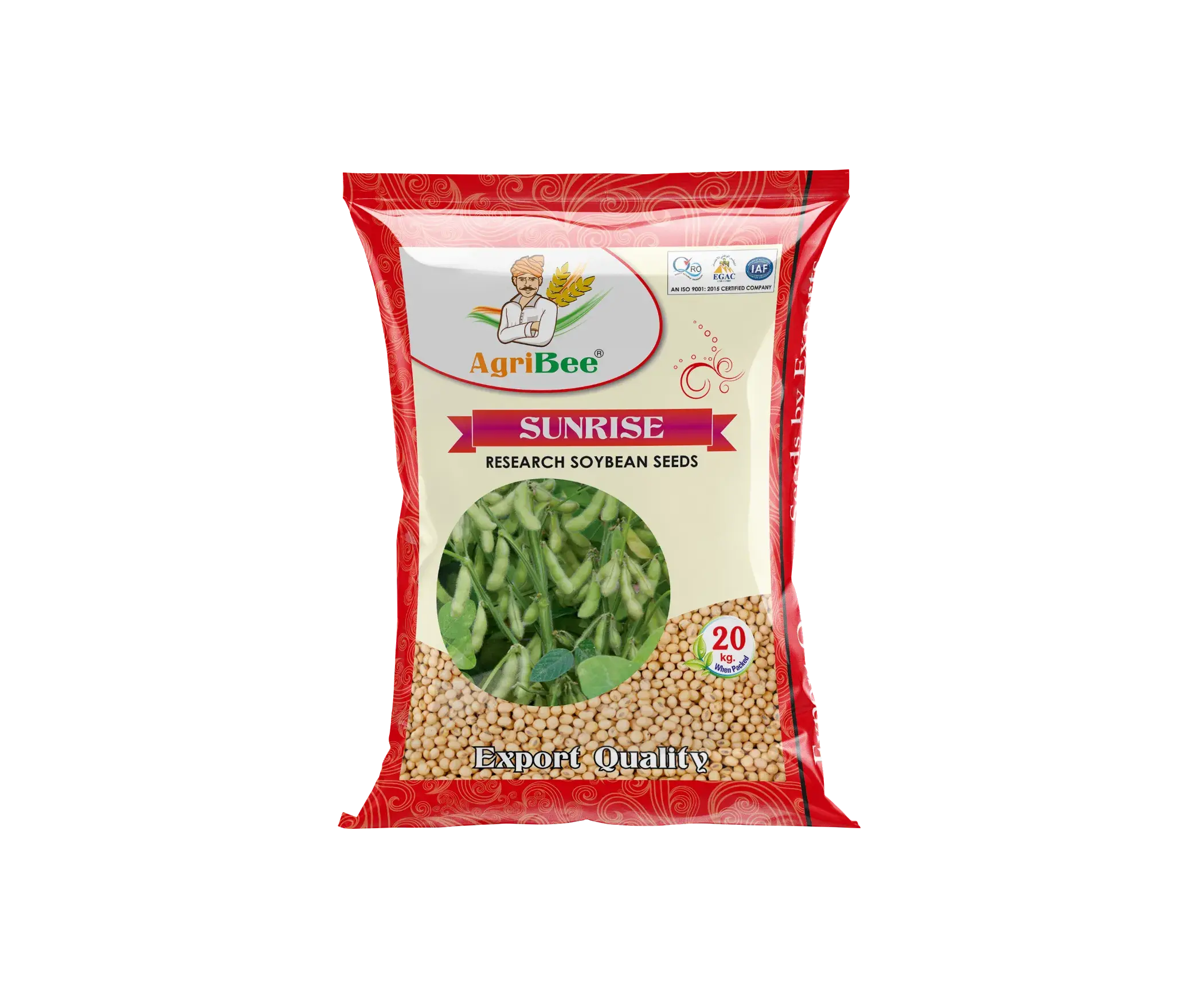
Farming & Cultivation Guide — Soybean Seeds Sunrise
Complete step-by-step agronomic guide for optimal crop management, disease resistance, and premium produce quality.
🌾 Soil Preparation & Field Prep
Proper land preparation ensures uniform seedling emergence and robust root anchorage.
🌱 Ideal Soil Type & pH
Well-drained loamy to sandy-loam soils with pH 6.0–7.5. Soybean thrives in deep, fertile soils with good permeability; waterlogged or heavy clay soils must be avoided to prevent root rot and poor nodulation.
✨ Core Advantage
Light, friable seedbed ensures rapid imbibition, uniform germination, and unhindered radicle emergence, resulting in strong taproot development and better soil nutrient uptake.
- 1
Deep summer ploughing followed by 2–3 cross-harrowings to achieve a fine, clod-free tilth for even seed placement.
- 2
Field leveling and creation of drainage channels to prevent water stagnation, especially in clayey patches.
- 3
Incorporation of 5–8 tonnes per acre of well-decomposed FYM or compost during the last harrowing to improve soil structure and organic carbon.
- 4
Soil pH testing and lime application (200–300 kg/acre) if pH is below 5.5; gypsum may be applied in alkaline sodic soils above pH 8.5.
🌱 Sowing Time & Method
Precise seed rate and spacing maximize light interception and canopy development.
| Parameter | Recommendation | Agronomic Importance |
|---|---|---|
| Sowing Window | May to early July depending on regional rainfall pattern and irrigation availability | Sowing coincides with the onset of pre-monsoon warmth, ensuring rapid germination and establishing seedlings before heavy monsoon rains |
| Seed Rate | 30–32 kg per acre | Ensures optimum plant population of approximately 2.2–2.5 lakh plants per hectare for balanced canopy and uniform pod set |
| Spacing | 45 cm row-to-row × 10 cm plant-to-plant | Provides adequate inter-row spacing for mechanical weeding, improved air circulation, and reduces microclimate humidity that favors fungal diseases |
| Sowing Depth | 3–5 cm in normal soils; up to 7 cm in light sandy soils | Optimal depth ensures consistent soil moisture contact for imbibition while preventing depth-related germination delays or seedling exhaustion |
💧 Irrigation & Water Management
Adequate moisture regulation supports strong vegetative and reproductive growth.
☀️ Water Requirement Profile
Soybean requires approximately 500–650 mm of water during its 115–120 day life cycle. The crop is moderately drought-tolerant due to its deep taproot system but is highly sensitive to moisture stress during flowering and pod development. Drip irrigation with fertigation is compatible and can improve water use efficiency by 30–40% when alternate furrow irrigation is practiced.
🌦️ Moisture Management
In rainfed conditions, ensure timely sowing to capture residual soil moisture. Apply 1–2 protective irrigations at flowering (R1–R2 stage) and pod filling (R5–R6 stage) to prevent flower abscission and pod drop. Mulching with farmyard waste or straw helps conserve soil moisture and suppress weeds during dry spells.
- ✓
First irrigation at 10–12 days after sowing in irrigated conditions; in rainfed areas, rely on pre-sowing irrigation (ghanijal) if soil profile is dry.
- ✓
Vegetative phase: light irrigations at 10–12 day intervals to maintain soil moisture at field capacity without waterlogging.
- ✓
Critical stage — flowering to pod fill (45–80 DAS): maintain consistent soil moisture; any stress during this period causes significant flower and pod shedding, affecting flower quality and seed development.
- ✓
Withhold irrigation 10–12 days before harvest to facilitate uniform pod desiccation, reduce seed moisture content, and minimize shattering losses during harvesting.
🧪 Fertilizer & Nutrition Management
Balanced crop nutrition supports robust plant structure and premium produce quality.
| Nutrient | Recommended Dose (per Acre) | Application Method & Timing |
|---|---|---|
| Nitrogen (N) | 20–25 kg/acre (10 kg N as basal + 15 kg N as split at 30 DAS) | 50% basal at sowing through DAP; remaining 50% top-dressed at first weeding or 30 days after sowing for sustained vegetative growth and green foliage retention. |
| Phosphorus (P₂O₅) | 40–50 kg/acre | 100% basal application as Di-ammonium phosphate (DAP) or Single super phosphate (SSP) at sowing to promote root development and nodulation. |
| Potash (K₂O) | 20–30 kg/acre | 100% basal along with P; split application at late vegetative stage supports pod integrity, seed filling, and stalk strength. |
🌿 Interculture & Weed Management
Timely weed control ensures optimal nutrient and moisture availability for crop seedlings.
-
1
First Weeding & Hoeing: Carry out at 15–20 days after sowing (DAS) using a hand hoe or cultivator. Early weeding is critical because soybean's slow initial growth makes it highly competitive against weeds during the first 30 days. Maintain a weed-free perimeter around the field to prevent pest migration.
-
2
Second Weeding & Earthing-Up: Conduct at 30–35 DAS with shallow inter-row hoeing and marginal earthing-up around plant bases. This improves root aeration, prevents lodging as the plant reaches 2.5–3.5 feet, and buries young weed flushes before they compete for nutrients.
-
3
Special Interculture Operation: Apply organic mulch (paddy straw @ 2–3 tonnes/acre) immediately after second weeding to conserve soil moisture, moderate soil temperature, and suppress subsequent weed germination. In areas prone to wind damage, inter-cultivation at 45 DAS helps reinforce root anchorage.
🛡️ Pest & Disease Management
Proactive crop monitoring and integrated management ensure healthy crop development.
🐛 Insect Pest Management
- Pod Borer (Helicoverpa armigera): Caterpillars bore into pods and consume developing seeds. Control: Spray chlorantraniliprole 18.5% SC at 60 ml/acre or spinosad 45% SC at 40 ml/acre at peak flowering and early pod formation stage. Apply during late afternoon for better coverage.
- Soybean Aphid (Aphis glycines): Colonizes undersides of leaves causing yellowing, curling, and stunted growth; also vectors viral diseases. Control: Spray imidacloprid 17.8% SL at 100 ml/acre or thiamethoxam 25% WG at 40 g/acre at first sign of infestation. Release aphidius colemani parasitoids in infested fields for biological control.
- Stem Borer / Pod Fly (Leguminivora glycinivorella): Larvae feed on young pods causing shot-hole appearance and seed damage. Control: Install pheromone traps at 10 traps/acre for monitoring; spray cartap hydrochloride 4G at 10 kg/acre or flubendiamide 39.35% SC at 150 ml/acre during pod initiation stage. Practice crop rotation to break pest cycles.
🔬 Disease Control
- Soybean Cyst Nematode (Heterodera glycines): Yellowing, stunting, and poor root nodulation; white lemon-shaped cysts visible on roots. Management: Use certified nematode-resistant seed stock; rotate with non-host crops like maize or wheat; apply soil drench of carbendazim 50% WP at 1 kg/acre at 30 DAS as preventive measure.
- Downy Mildew (Peronospora manshurica): Downy fuzzy growth on leaf undersides with yellow chlorotic patches on upper surface; defoliation occurs in severe cases. Control: Spray metalaxyl + mancozeb 64% WP at 2 kg/acre or mancozeb 75% WP at 2.5 kg/acre at first appearance. Ensure proper plant spacing for canopy airflow to reduce humidity.
- Root Rot & Wilts (Fusarium spp., Sclerotium rolfsii): Wilting, browning of taproot, web-like mycelial growth at soil line, and plant collapse. Prevention: Seed treatment with carbendazim 50% WP at 2.5 g/kg seed; soil application of Trichoderma viride @ 5 kg/acre mixed with 100 kg sand at sowing; avoid waterlogging and practice 3-year rotation away from legumes.
✂️ Harvesting & Produce Quality Guide
Harvesting at peak maturity ensures maximum commercial grade and long keeping quality.
⏱️ Harvesting Schedule & Timing
Harvest is carried out as a single straight-cut operation at 115–120 days after sowing when 95% of pods have turned brown and plants are fully desiccated. Manual cutting with a sickle or machine combining may be used depending on field size and accessibility.
⭐ Produce Quality Characteristics
Seeds exhibit a consistent light yellow color with uniform size, smooth seed coat texture, and high oil content. Pods contain 8–10 well-filled seeds each. Foliage remains vibrant green throughout the vegetative phase, indicating efficient photosynthetic activity and nutrient mobility. The variety shows good resistance to shattering, ensuring minimal post-maturity grain loss.
| Quality Parameter | Agronomic Standard | Farmer & Market Benefit |
|---|---|---|
| Harvest Stage | 115–120 days after sowing at physiological maturity | Ensures optimal seed filling, maximum oil accumulation, and uniform grain color for market acceptance |
| Harvest Maturity Signs | Pods turn brown to tan, seeds rattle when shaken, leaflets have dropped, plant stems are dry and brittle | Prevents over-maturity that leads to pod shattering and under-maturity that reduces oil content and seed weight |
| Shelf Life & Keeping Quality | 6–8 months under dry, cool storage conditions with seed moisture content maintained below 10% | Light yellow seeded variety with hard seed coat exhibits excellent storability and resistance to insect attack during storage |
| Market Suitability | Preferred for oil extraction (soya oil) and animal feed meal; suitable for domestic mandis and processing units across India | Uniform light yellow seed color and consistent pod filling attract premium procurement rates from oil mills and feed processors |
⭐ Varietal Features — Soybean Seeds Sunrise
Distinguishing characteristics that make this variety a top choice for Indian growers.
🌿 Core Variety Highlight
Sunrise is a reliably productive soybean variety developed for Indian Kharif conditions, offering a balanced combination of medium duration (115–120 days), compact plant architecture, and consistent light yellow seed quality preferred by oil processors.
🌿 Produce Quality & Appearance
Seeds display a uniform light yellow color with high oil content. Each pod typically bears 8–10 well-filled seeds, reflecting excellent pollination efficiency and nutrient remobilization during the grain filling phase.
🌿 Stress & Disease Tolerance
The variety demonstrates moderate tolerance to common soybean diseases including downy mildew and root rot under typical Kharif field conditions. Its relatively short stature and open canopy reduce susceptibility to foliar diseases by improving airflow and reducing leaf zone humidity.
🌿 Growth Habit & Vigor
Compact plant height of 2.5–3.5 feet with strong stem architecture provides natural lodging resistance. Vigorous early growth and bright green foliage indicate efficient nitrogen fixation and photosynthetic capacity throughout the growing cycle.
🌿 Crop Duration & Earliness
Reaching maturity in 115–120 days, Sunrise enables farmers to complete the Kharif soybean cycle comfortably within the monsoon window, allowing timely preparation for subsequent Rabi crops such as wheat, chickpea, or mustard in rotational systems.
🌿 Market & Farmer Preference
Farmers favor Sunrise for its predictable performance, ease of mechanized harvest, and light yellow seed grade that commands steady demand from soya oil mills. The variety's manageable height and low shattering tendency simplify both manual and machine harvesting operations.