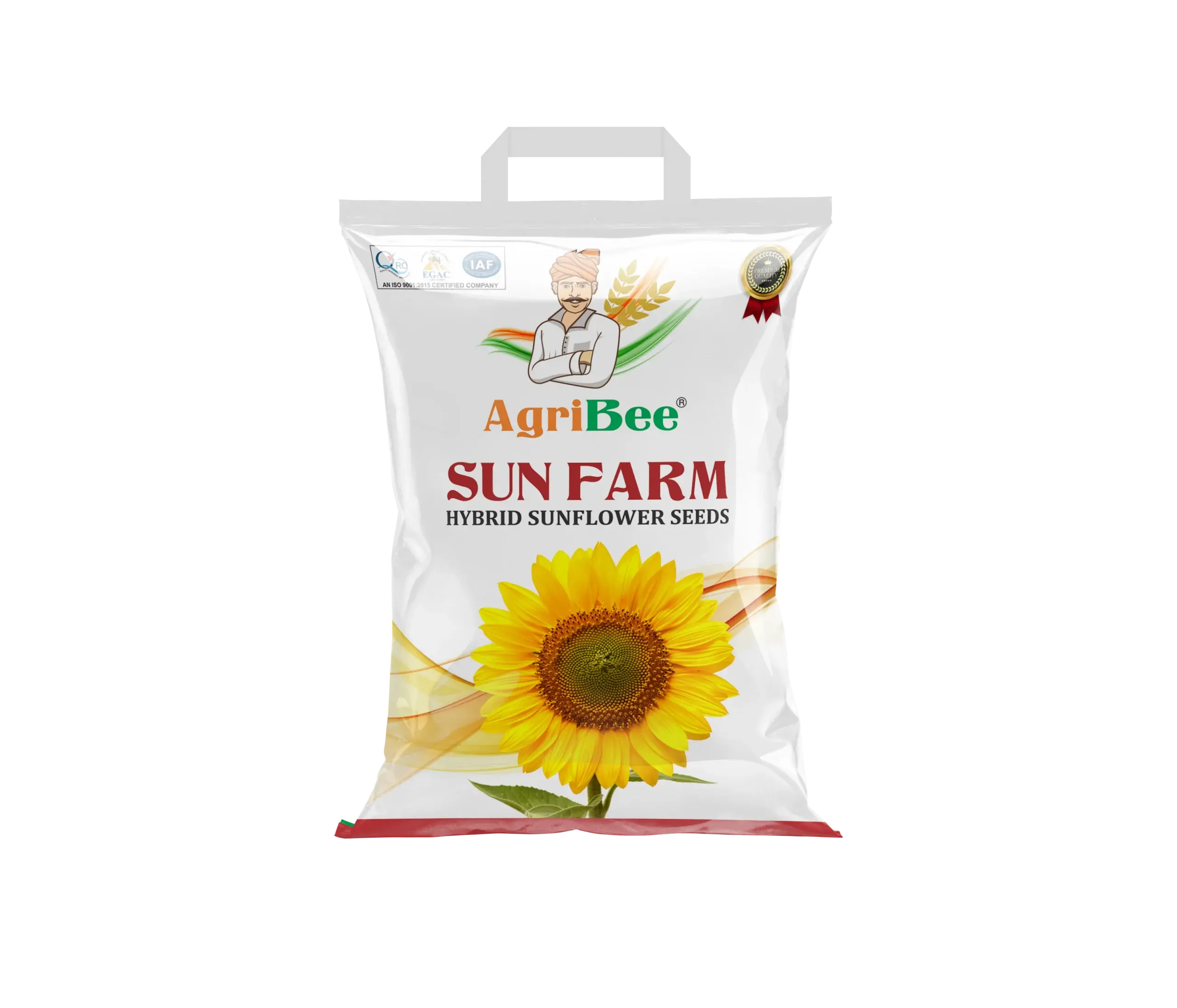
Description
Farming & Cultivation Guide — Sunflower Sunfarm
Complete step-by-step agronomic guide for optimal crop management, disease resistance, and premium produce quality.
🌾 Soil Preparation & Field Prep
Proper land preparation ensures uniform seedling emergence and robust root anchorage.
🌱 Ideal Soil Type & pH
Well-drained loamy to clay-loam soils with good moisture retention. Optimal pH range: 6.0–7.5.
✨ Core Advantage
Deep taproot establishment for strong anchorage and efficient nutrient uptake.
- 1
Deep summer ploughing followed by 2–3 cross-harrowings for fine tilth.
- 2
Field leveling and drainage preparation to avoid water stagnation.
- 3
Incorporate well-decomposed FYM or compost @ 5–8 t/acre as basal manure.
- 4
Apply gypsum or sulfur where needed to balance alkaline/salty soils.
🌱 Sowing Time & Method
Precise seed rate and spacing maximize light interception and canopy development.
| Parameter | Recommendation | Agronomic Importance |
|---|---|---|
| Sowing Window | June–July for Kharif; Oct–Nov for Rabi; Feb–Mar for Zaid | Aligns temperature within 20–30°C range for optimal germination and growth |
| Seed Rate | 2 kg per acre | Ensures uniform plant population and canopy coverage |
| Spacing | 60 cm x 10 cm (row-to-row x plant-to-plant) | Promotes adequate light penetration and airflow for healthy flower development |
| Sowing Depth | 2–3 cm | Ensures consistent emergence without excessive seedling energy expenditure |
💧 Irrigation & Water Management
Adequate moisture regulation supports strong vegetative and reproductive growth.
☀️ Water Requirement Profile
Sunflower Sunfarm exhibits moderate drought tolerance due to its deep taproot system. However, adequate soil moisture during flowering and grain filling significantly enhances seed filling and oil quality.
🌦️ Soil Moisture Management
In rainfed areas, sow at the onset of reliable monsoon rainfall. Use mulching to conserve soil moisture and reduce evaporation during hot, dry spells.
- ✓
First irrigation at 20–25 days after sowing (DAS) to support initial root and vegetative growth.
- ✓
Maintain light irrigation every 10–15 days during the vegetative phase depending on soil texture and rainfall.
- ✓
Critical irrigation at 50–60 DAS during budding and flowering; ensure consistent moisture to prevent pollination failure.
- ✓
Reduce irrigation frequency from 80 DAS onward; cease watering completely 10–12 days before harvest to facilitate drying and prevent seed rot.
🧪 Fertilizer & Nutrition Management
Balanced crop nutrition supports robust plant structure and premium produce quality.
| Nutrient | Recommended Dose (per Acre) | Application Method & Timing |
|---|---|---|
| Nitrogen (N) | 40–50 kg/acre | 50% basal at sowing, 50% top-dressed at 30 DAS |
| Phosphorus (P2O5) | 40–50 kg/acre | 100% basal with DAP or single-superphosphate at sowing |
| Potash (K2O) | 20–30 kg/acre | 100% basal with MOP to strengthen stalk and improve seed oil content |
🌿 Interculture & Weed Management
Timely weed control ensures optimal nutrient and moisture availability for crop seedlings.
-
1
First Weeding & Hoeing: Carry out at 15–20 DAS to remove early weed competition and loosen soil surface for aeration.
-
2
Second Weeding & Earthing-Up: Perform at 30–35 DAS to control later weeds and mound soil around stems for improved root anchorage.
-
3
Inter-row Hoeing & Mulching: Mulch with straw or green leaves between rows to conserve moisture, suppress weeds, and moderate soil temperature.
🛡️ Pest & Disease Management
Proactive crop monitoring and integrated management ensure healthy crop development.
🐛 Insect Pest Management
- Sunflower Head Caterpillar: Symptoms include bore holes in flower heads and frass accumulation. Control: Spray Endosulfan 4% dust @ 15 kg/acre or recommend Trichogramma releases at 50,000/acre weekly from branching stage.
- Shoot Borer: Larvae bore into young shoots causing wilting and dieback. Control: Apply cartap hydrochloride @ 0.1% or spinosad @ 0.05% spray at first sighting of shot-hole damage.
- Aphids: Clusters of small insects on underside of leaves causing curling and honeydew secretion. Control: Spray imidacloprid 17.8% SL @ 0.3 ml/L or release ladybird beetles as biological control.
🔬 Disease Control
- Downy Mildew: Yellow patches on upper leaf surface with white fluffy growth underneath. Causal agent: Plasmopara halstedii. Control: Seed treatment with metalaxyl @ 3 g/kg seed; foliar spray of mancozeb @ 0.25% at first symptoms.
- Powdery Mildew: White powdery coating on leaves and stems reducing photosynthesis. Causal agent: Erysiphe cichoracearum. Control: Apply wettable sulfur @ 2–3 kg/acre in 500 L water or propiconazole @ 0.1% spray.
- Rust: Orange-brown pustules on lower leaf surface leading to premature leaf drop. Causal vector: Puccinia helianthi. Control: Remove and destroy infected plant debris; apply hexaconazole @ 0.1% as preventive spray.
✂️ Harvesting & Produce Quality Guide
Harvesting at peak maturity ensures maximum commercial grade and long keeping quality.
⏱️ Harvesting Schedule & Timing
Single harvest at full physiological maturity, generally 90–105 days after sowing. Cut flower heads when the back turns pale brown/yellow and seeds harden.
⭐ Produce Quality Characteristics
Seeds exhibit high oil content, uniform size, strong testa color, and low moisture (@9%). Heads are sturdy with good shattering resistance, ensuring minimal field loss during combined harvesting.
| Quality Parameter | Agronomic Standard | Farmer & Market Benefit |
|---|---|---|
| Harvest Stage | 90–105 Days after Sowing | Captures peak oil accumulation and optimal seed dry matter |
| Harvest Maturity Signs | Back of head turns yellow-brown, seeds feel hard, florets dry and fall off easily | Prevents over-maturity that causes shattering and bird damage |
| Shelf Life & Keeping Quality | 2–3 months under dry, ventilated storage conditions | Maintains oil stability and prevents mold or rancidity development |
| Market Suitability | Oil extraction, seed sales to processors, direct mandi dispatch | High demand in oilseed markets due to consistent seed filling and clean appearance |
⭐ Varietal Features — Sunflower Sunfarm
Distinguishing characteristics that make this variety a top choice for Indian growers.
🌿 Core Variety Highlight
Sunflower Sunfarm delivers robust stand establishment and vigorous early growth under diverse Indian agro-climatic zones.
🌿 Produce Quality & Appearance
Produces uniformly filled, dark-striped seeds with excellent oil richness and minimal blank or shriveled kernels.
🌿 Stress & Disease Tolerance
Demonstrates solid field tolerance to common downy mildew and moderate resilience under moisture stress conditions.
🌿 Growth Habit & Vigor
Upright plant architecture with strong stem strength supports both single and multiple head formations without lodging.
🌿 Crop Duration & Earliness
Matures within 90–105 days, enabling timely land preparation for subsequent crops in intensive rotation systems.
🌿 Market & Farmer Preference
Farmers favor Sunfarm for its predictable performance, clean harvest readiness, and reliable demand from oil processors and seed traders.