
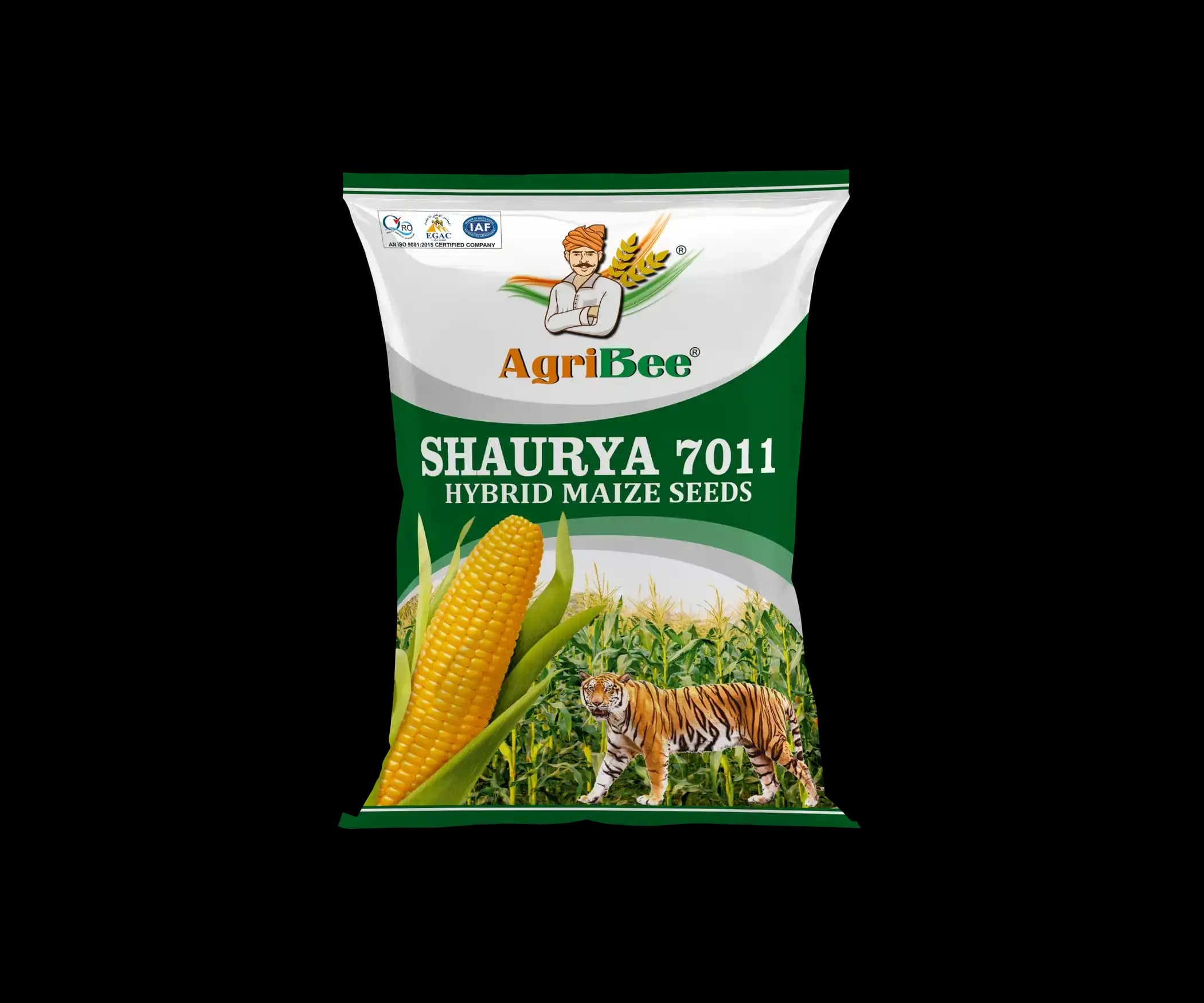
Description
Farming & Cultivation Guide — Yellow Maize Shaurya 7011
Complete step-by-step agronomic guide for optimal crop management, disease resistance, and premium produce quality.
🌾 Soil Preparation & Field Prep
Proper land preparation ensures uniform seedling emergence and robust root anchorage.
🌱 Ideal Soil Type & pH
Well-drained loamy to sandy-loam soils with pH 6.0–7.5. Deep, fertile soils with good organic matter content support vigorous stalk growth and cob development. Avoid waterlogged or heavy clay soils.
✨ Core Advantage
Light, well-aerated loamy soil ensures rapid seed germination, strong root anchorage for tall 6.5–7 ft plants, and efficient nutrient uptake throughout the crop cycle.
- 1
Deep summer ploughing to 25–30 cm depth followed by 2–3 cross-harrowings to achieve fine, clod-free tilth.
- 2
Field leveling using laser leveling or board leveling to ensure uniform irrigation distribution and prevent water stagnation.
- 3
Incorporate 8–10 tonnes of well-decomposed FYM or compost during the last harrowing to improve soil structure and moisture retention.
- 4
Conduct a soil health test and apply gypsum or sulphur where needed to maintain pH within the optimal 6.0–7.5 range for nutrient availability.
🌱 Sowing Time & Method
Precise seed rate and spacing maximize light interception and canopy development.
| Parameter | Recommendation | Agronomic Importance |
|---|---|---|
| Sowing Window | May–June (early summer), July–August (Kharif peak), September–October (late Kharif), November–December (Rabi/spring intercrop) | Aligns sowing with favorable temperature and moisture regimes for uniform germination and stress-free vegetative growth |
| Seed Rate | 8–10 kg per acre (single seed per hole at 20 cm stand) | Optimizes plant population density to balance competition and canopy coverage for healthy cob development |
| Spacing | 60 cm (row-to-row) x 20 cm (plant-to-plant) | Ensures adequate air circulation, sunlight penetration to lower leaves, and sufficient ear formation space between plants |
| Sowing Depth | 3–5 cm (light soils: 5 cm; heavy soils: 3 cm) | Proper depth ensures good soil contact for consistent moisture absorption and prevents seed rot or emergence failure |
💧 Irrigation & Water Management
Adequate moisture regulation supports strong vegetative and reproductive growth.
☀️ Water Requirement Profile
Yellow Maize Shaurya 7011 requires moderate and well-distributed moisture. The crop is moderately drought-tolerant but performs best with 5–7 irrigations during the growing season. Drip irrigation is highly compatible and improves water use efficiency by 30–40%. Each irrigation event should apply 40–50 mm of water depending on soil type and weather conditions.
🌦️ Moisture Management
In rainfed areas, sow at the onset of monsoon and rely on residual soil moisture supplemented by 1–2 protective irrigations. Critical moisture stress during flowering and cob filling must be avoided to prevent kernel blanking and poor grain fill. Mulching with straw helps conserve soil moisture between rains.
- ✓
First irrigation sowing within 24–48 hours (called 'peek' or baby irrigation) to ensure uniform seed germination and stand establishment.
- ✓
Vegetative phase (25–60 DAS): irrigate at 10–12 day intervals depending on soil texture and weather; maintain consistent soil moisture for rapid leaf and stalk growth.
- ✓
Critical stage (silking to grain filling, 60–90 DAS): this is the most water-sensitive phase. Maintain adequate soil moisture without waterlogging; drought stress during silking causes poor pollination, kernel set, and deformed cobs.
- ✓
Pre-harvest: reduce irrigation frequency from 90–100 DAS. Withhold irrigation 7–10 days before expected harvest to allow cob drying on stalk, improving grain color intensity, shelf life, and harvestability.
🧪 Fertilizer & Nutrition Management
Balanced crop nutrition supports robust plant structure and premium produce quality.
| Nutrient | Recommended Dose (per Acre) | Application Method & Timing |
|---|---|---|
| Nitrogen (N) | 80–100 kg/acre (as Urea 46% N) | 50% basal at sowing; 25% at 25–30 DAS (cattle manure or first weeding); 25% at 50–55 DAS (tasseling stage) for maximum vegetative and cob growth |
| Phosphorus (P2O5) | 50–60 kg/acre (as DAP 18:46:0 or SSP) | 100% basal application at sowing, placed 5 cm below and 5 cm beside the seed to avoid direct seed contact and prevent fertilizer burn |
| Potash (K2O) | 40–50 kg/acre (as MOP 60% K2O) | 50% basal at sowing; 50% split at 50–55 DAS to strengthen stalks, improve grain fill, and enhance drought tolerance and disease resistance |
🌿 Interculture & Weed Management
Timely weed control ensures optimal nutrient and moisture availability for crop seedlings.
-
1
First Weeding & Hoeing: Carry out at 10–15 DAS using a hand hoe or rotary weeder. This critical early weed-free period prevents competition for moisture and nutrients during active root and leaf establishment. Shallow cultivation (5–7 cm depth) avoids root damage.
-
2
Second Weeding & Earthing-Up: Perform at 25–30 DAS. Earthing up (mounding soil around the base of the plant) provides mechanical support for the 6.5–7 ft tall stalk, prevents lodging during windy conditions or heavy rains, and promotes additional adventitious root formation for better nutrient uptake.
-
3
Desuckering & Residual Weed Management: Remove suckers (lateral shoots) from the axils of lower leaves after 45 DAS to direct photosynthates toward main stalk and cob development. Apply pre-emergence herbicide (atrazine 0.5 kg/acre) at sowing in larger fields for effective weed control and reduced manual labor. Inter-row hoeing at 35 DAS maintains a clean field through the reproductive phase.
🛡️ Pest & Disease Management
Proactive crop monitoring and integrated management ensure healthy crop development.
🐛 Insect Pest Management
- Shoot Borer (Chilo partellus): Larvae bore into the growing shoot causing 'dead heart' and window-pane feeding on young leaves. Control: Apply neem-based biopesticide (Neemprime 0.3%) at 15 and 30 DAS as preventive spray. For infested fields, spot apply granules of Carbendazim 10 g/plant in whorl. Install pheromone traps at 10/acre for monitoring and mass trapping.
- Stem Borer / Corn Borer (Ostrinia furnacalis & Sesamia inferens): Larvae tunnel into the stem causing wilting, breakage, and secondary fruit borer entry. Control: Spray Chlorantraniliprole 18.5% SC at 0.3 ml/liter or Emamectin Benzoate 5% SG at 0.5 g/liter at 40 and 60 DAS. Destroy crop residues post-harvest to break the pest cycle.
- Fruit/Bud Worm (Helicoverpa armigera): Larvae feed on developing ears and tassels, causing direct cob damage and reduced grain quality. Control: Apply Bacillus thuringiensis (Bt) based formulation at 1 kg/acre as dust or spray at 2.5 g/liter at early flower stage. Follow with Spinetoram 11.7% WG at 0.3 ml/liter if population exceeds economic threshold level.
🔬 Disease Control
- Southern Corn Leaf Blight (Cochliobolus heterostrophus): Long elliptical gray-green lesions on leaves that coalesce under humid conditions, reducing photosynthetic area. Preventive spray: Mancozeb 75% WP at 2.5 g/liter or Propineb 70% WP at 2 g/liter at 45 DAS and again at 65 DAS. Remove and destroy infected plant debris after harvest.
- Maize Downy Mildew (Peronosporella destructor): Yellow chlorotic streaks on leaves with cottony fungal growth underneath during high humidity. Control: Seed treatment with metalaxyl 35% FS at 4 ml/kg seed plus carbendazim 50% WP at 2.5 g/kg. Foliar spray of Propamocarb 72% WP at 2 ml/liter at first sign of infection.
- Ear Rot / Fusarium Kernel Rot (Fusarium verticillioides): Pinkish-white fungal growth on kernels with internal rotting, reducing grain quality and shelf life. Preventive measures include proper drainage, avoiding waterlogging, and timely harvest. Spraying of Trichoderma viride suspension (10 g/liter) drench at base during vegetative stage reduces soil inoculum load.
✂️ Harvesting & Produce Quality Guide
Harvesting at peak maturity ensures maximum commercial grade and long keeping quality.
⏱️ Harvesting Schedule & Timing
harvest commences at 100–110 days after sowing when cobs reach full size (8–10 inches) and physiological maturity. All cobs are harvested in a single picking operation by twisting or cutting the cob at the shank. For continuous production in staggered sowing fields, harvest can be done in two stages at 7-day intervals.
⭐ Produce Quality Characteristics
Premium yellow maize with vibrant dark orange grain color, firm and densely filled kernels, green healthy leaves, and smooth silk appearance. The cob measures 8–10 inches with excellent grain set, sweetness, and tender texture—ideal for fresh market, processing, and value-added products.
| Quality Parameter | Agronomic Standard | Farmer & Market Benefit |
|---|---|---|
| Harvest Stage | 100–110 Days after Sowing (DAS) | Ensures the crop reaches full physiological maturity with maximum grain fill, dark orange color development, and optimal sugar-to-starch conversion for superior taste and texture |
| Harvest Maturity Signs | Silk turns brown and dry; kernel dent appears; husk turns pale green to yellow; grain hardness test (nail cannot easily penetrate kernel); cob size reaches 8–10 inches | Prevents harvesting at immature stage which leads to shriveling, poor flavor, and rapid post-harvest deterioration |
| Shelf Life & Keeping Quality | 5–7 days under ambient conditions (25–32°C); up to 10–12 days under cool storage (8–12°C) with 85–90% relative humidity | Dark orange pigmented grains with thick husk cover provide natural protection against microbial spoilage and physical damage during transit and market display |
| Market Suitability | Fresh table corn, canned processing, frozen corn, grain meal production, poultry feed, and direct farmer markets (mandi/haat) | Versatile end-use profile combined with appealing dark orange grain color attracts premium rates from both wholesale traders and direct consumers across regional and export markets |
⭐ Varietal Features — Yellow Maize Shaurya 7011
Distinguishing characteristics that make this variety a top choice for Indian growers.
🌿 Core Variety Highlight
Yellow Maize Shaurya 7011 is a robust hybrid developed by AgriBee Seeds with balanced genetics for high plant vigor, strong stalk integrity, and wide adaptability across summer, Kharif, and Rabi seasons in diverse Indian agro-climatic zones.
🌿 Produce Quality & Appearance
Produces uniformly sized cobs (8–10 inches) with striking dark orange grain color, dense kernel packing, sweet flavor, and tender texture. Green foliage and strong husk cover ensure visual appeal and extended post-harvest holding quality.
🌿 Stress & Disease Tolerance
Demonstrates strong field tolerance to common maize leaf blights, downy mildew, and stem borers under Indian growing conditions. Moderate drought resilience allows adaptation to variable monsoon patterns and supplemental irrigation schedules.
🌿 Growth Habit & Vigor
Upright plant architecture reaching 6.5–7 feet with strong central stalk and lush green foliage. Excellent canopy coverage promotes efficient photosynthesis while maintaining air flow to reduce fungal pressure. Sturdy stem resists lodging even under moderate wind.
🌿 Crop Duration & Earliness
Reaches maturity in 100–110 days, enabling flexible rotation with subsequent crops such as pulses, vegetables, or cover crops. Early-to-mid maturity window supports multiple cropping cycles per year in southern and western India.
🌿 Market & Farmer Preference
Preferred by progressive farmers for its reliable stand establishment, consistent cob size, attractive dark orange grain, and strong disease resilience. The variety commands trader preference due to uniform appearance, good shelf life, and versatility across fresh and processing market channels.