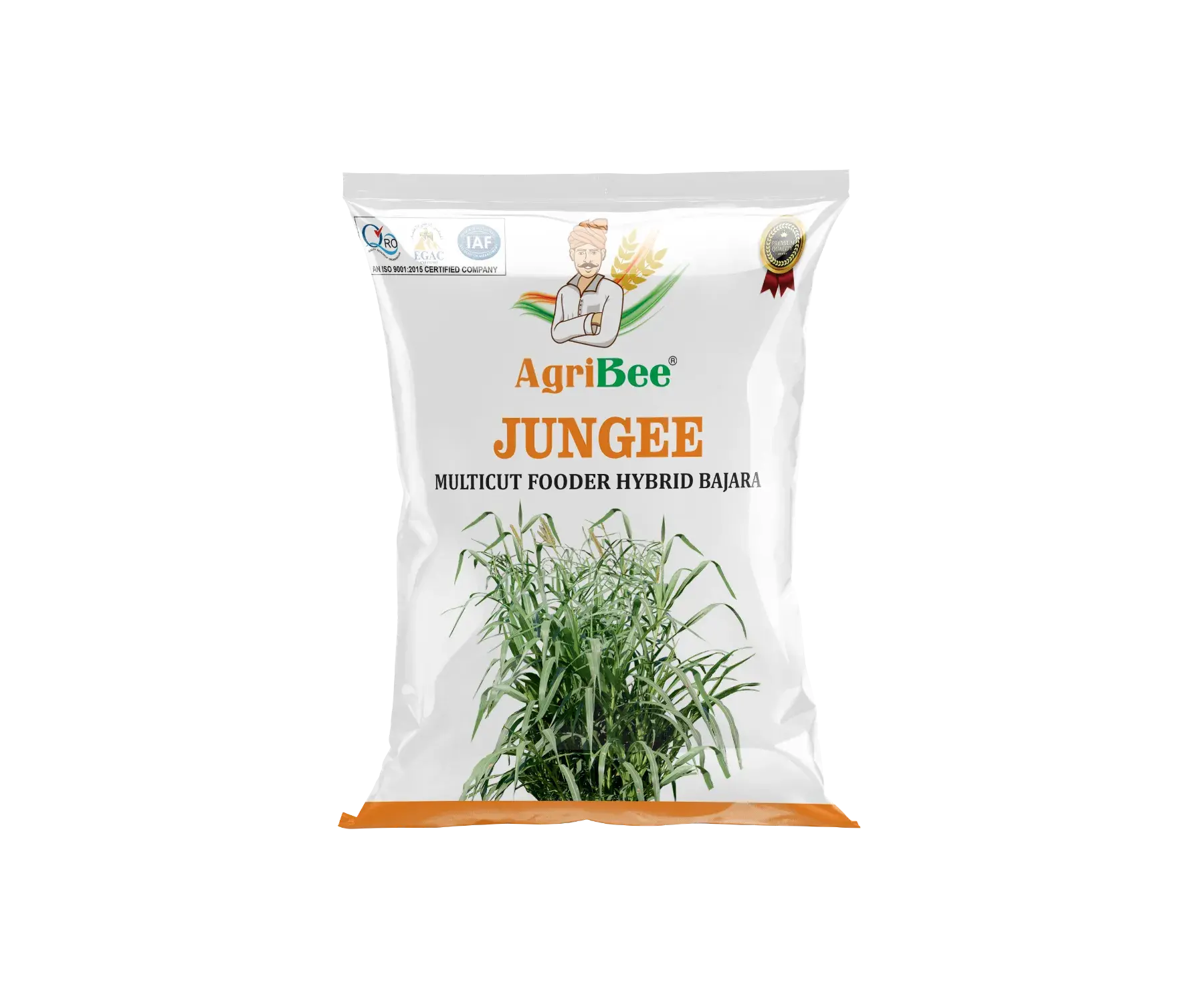
Description
Farming & Cultivation Guide — Fodder Bajra – Jungee
Complete step-by-step agronomic guide for optimal crop management, disease resistance, and premium produce quality.
🌾 Soil Preparation & Field Prep
Proper land preparation ensures uniform seedling emergence and robust root anchorage.
🌱 Ideal Soil Type & pH
Well-drained sandy loam to loamy soils; pH 6.0–8.5. Bajra tolerates marginal, dryland soils better than most cereals but performs optimally with good internal drainage and moderate organic carbon.
✨ Core Advantage
Fine, crumbly tilth ensures rapid seedling emergence, strong early root anchorage, and uniform canopy development — critical for multi-cut fodder regeneration.
- 1
Deep summer ploughing (25–30 cm) followed by 2–3 cross-harrowings to achieve fine tilth and break hardpans.
- 2
Field leveling with board leveling for uniform water distribution; prepare peripheral drainage channels to prevent waterlogging.
- 3
Incorporate 8–10 t/ha of well-decomposed FYM or compost during the last harrowing to boost soil organic carbon and moisture retention.
- 4
Conduct soil health testing; if pH is below 6.0, apply 200–300 kg/ha of agricultural lime; if above 8.5, incorporate gypsum at 250 kg/ha along with organic amendments.
🌱 Sowing Time & Method
Precise seed rate and spacing maximize light interception and canopy development.
| Parameter | Recommendation | Agronomic Importance |
|---|---|---|
| Sowing Window | June – mid-July (Kharif) | Oct – Nov (Rabi in Maharashtra, Karnataka, Tamil Nadu) | Aligns sowing with monsoon onset for rainfed crops; ensures adequate soil moisture for germination and early establishment. |
| Seed Rate | 8–10 kg/acre (rainfed row sowing) | 6–7 kg/acre (irrigated close spacing) | Optimizes plant population for maximum leafy biomass and profuse tillering without excessive competition. |
| Spacing | 45 cm (row-to-row) × 10–12 cm (plant-to-plant) | Aids canopy spread, improves inter-row aeration, and facilitates mechanical or manual multi-cut harvesting. |
| Sowing Depth | 3–5 cm (light soils: 5 cm; heavy soils: 3 cm) | Ensures consistent soil moisture contact for uniform germination; deeper sowing in light sands prevents desiccation. |
💧 Irrigation & Water Management
Adequate moisture regulation supports strong vegetative and reproductive growth.
☀️ Water Requirement Profile
Bajra is inherently drought-resilient and can complete its lifecycle with 300–400 mm rainfall. Under irrigated fodder production, light and frequent irrigation (every 10–12 days during active growth) sustains rapid leafy regrowth between cuts. Drip irrigation with 2–3 low-frequency cycles per week is highly compatible and conserves water while maintaining consistent soil moisture for tiller initiation.
🌦️ Soil Moisture Management
In rainfed conditions, ensure residual soil moisture is conserved through early sowing immediately after monsoon onset. Use mulching (straw or plastic) to reduce evaporation. Avoid moisture stress during the boot stage (35–45 DAS) as this is the peak nutritional quality window (9–10% protein) and the first fodder cut.
- ✓
First irrigation (or reliance on pre-sow soaking rain) should be applied within 5–7 days after sowing to ensure uniform germination.
- ✓
During the vegetative phase (15–40 DAS), maintain light moisture at 8–10 day intervals to support vigorous tillering and leaf expansion.
- ✓
Critical stage — boot to early heading (40–55 DAS): do not allow moisture stress; this period determines foliage succulence, protein content, and multi-cut regeneration vigor.
- ✓
Withhold irrigation 5–7 days before each fodder cutting to reduce field stickiness, ease harvesting, and improve hay/silage curing quality.
🧪 Fertilizer & Nutrition Management
Balanced crop nutrition supports robust plant structure and premium produce quality.
| Nutrient | Recommended Dose (per Acre) | Application Method & Timing |
|---|---|---|
| Nitrogen (N) | 40–50 kg/acre (Rainfed) | 60–80 kg/acre (Irrigated) | 50% basal at sowing + 50% top-dressed at first weeding (15–20 DAS). For multi-cut systems, apply 10–15 kg N/acre as top-dressing after each cut to promote rapid regrowth. |
| Phosphorus (P2O5) | 30–40 kg/acre (as DAP or SSP) | 100% basal application at sowing, placed 5 cm below and beside the seed to prevent direct seed contact and ensure root-zone availability. |
| Potash (K2O) | 20–30 kg/acre (as MOP) | 100% basal at sowing for rainfed; split 50% basal + 50% after first cut for irrigated multi-cut fodder systems to support stalk strength and disease tolerance. |
🌿 Interculture & Weed Management
Timely weed control ensures optimal nutrient and moisture availability for crop seedlings.
-
1
First Weeding & Hoeing: Carry out at 10–15 days after sowing (DAS) using a hand hoe or rotavator. Early weed control is critical as bajra's early growth is slow; weeds compete aggressively for moisture and nutrients during this window.
-
2
Second Weeding & Thinout: Perform at 25–30 DAS. Remove excess seedlings to maintain recommended spacing. Light earthing-up around the base of plants improves root aeration and supports the developing tiller mass.
-
3
Inter-row Cultivation & Mulching: After the first fodder cut, lightly hoe inter-rows to break crust and control flush weeds. Apply 2–3 cm straw mulch between rows to conserve soil moisture, suppress weed resurgence, and protect the crown zone for rapid second-cut regeneration.
🛡️ Pest & Disease Management
Proactive crop monitoring and integrated management ensure healthy crop development.
🐛 Insect Pest Management
- Shoot and Root Borer (Tryporhiza insignita): Larvae bore into young shoots and roots, causing wilting and dead hearts. Control: Apply Carbofuran 3G at 12–15 kg/acre at 15 DAS as granular soil application; alternatively, use Bacillus thuringiensis (Bt) @ 250 g/acre in 500 L water as a foliar spray at early infestation stage.
- Leafhopper (Balclutha furcata): Sucks sap from leaves causing yellowing and drying of leaf tips. Control: Spray Imidacloprid 17.8% SL at 150 ml/acre in 400 L water; repeat at 12-day interval if populations rebound. Encourage natural predators by preserving field boundary hedgerows.
- Stem Borer (Chilo partellus): Larvae tunnel into stems, causing drying of central leaves and reduced tillering. Control: Apply Chlorpyriphos 20 EC at 1.5 L/acre in 500 L water at first sign of adult moth activity (use pheromone traps for monitoring). Install hexaconazole-based systemic drench at 10 DAS in high-pressure zones.
🔬 Disease Control
- Downy Mildew (Sclerospora graminicola): Yellowing and stunting of seedlings with white cottony growth on leaf undersides; this variety shows moderate resistance. Prevention: Seed treatment with Metalaxyl 35% WS @ 4 g/kg seed; follow with foliar spray of Mancozeb 75 WP @ 2.5 g/L water at 25 DAS as a protective measure in humid conditions.
- Ergot (Claviceps persica): Honeydew exudation on female florets replacing grains with dark sclerotia; toxic to livestock. Prevention: This variety exhibits moderate ergot resistance. Avoid late sowing in humid zones where flowering coincides with heavy dew. Remove and destroy infected plants immediately; apply Propineb 70 WP @ 2 g/L at early heading as a preventive fungicide spray.
- Leaf Spot / Cercospora Blight (Cercospora sorghi): Small reddish-brown spots with yellow halos on lower leaves, spreading upward under humid weather. Control: Apply Copper oxychloride 50 WP @ 3 g/L at first appearance; ensure adequate plant spacing for canopy airflow to reduce leaf wetness duration.
✂️ Harvesting & Produce Quality Guide
Harvesting at peak maturity ensures maximum commercial grade and long keeping quality.
⏱️ Harvesting Schedule & Timing
First cut at 50–55 DAS at the boot stage for maximum protein (9–10%) and foliage palatability. Subsequent cuts at 25–30 day intervals; total 3–4 productive cuts per season with excellent regeneration vigor.
⭐ Produce Quality Characteristics
Leafy, succulent green foliage with profuse tillering ensures high palatability for ruminants. At boot stage, crude protein content peaks at 9–10%, making it an excellent base for green fodder, hay, and silage. Tiller density provides consistent biomass quality across cuts.
| Quality Parameter | Agronomic Standard | Farmer & Market Benefit |
|---|---|---|
| First Harvest Stage | Boot stage (50–55 DAS) — just before head emergence | Ensures peak protein content, maximum leafy biomass, and tender foliage preferred by livestock. |
| Harvest Maturity Signs | Leaves fully expanded, lush green color, tiller density at peak, panicle just visible inside sheath | Prevents lignification and fiber buildup; maintains digestibility and feeding acceptability. |
| Shelf Life & Keeping Quality | Fresh fodder: 12–18 hours under ambient conditions; Hay: 3–4 months when properly cured and stacked; Silage: 6–8 months in sealed trenches/bags | Multi-cut regeneration allows extended fodder supply; hay and silage preservation enables year-round utilization. |
| Market Suitability | On-farm dairy feeding, local cattle feed markets, hay/silage supply to dairy cooperatives, and integration with mixed cropping systems | High protein fodder commands steady demand from dairy farmers; dual-purpose utility (green fodder + preserved fodder) reduces market risk. |
⭐ Varietal Features — Fodder Bajra – Jungee
Distinguishing characteristics that make this variety a top choice for Indian growers.
🌿 Core Variety Highlight
Jungee delivers exceptional leafy biomass with profuse tillering, making it a top-choice fodder bajra for multi-cut dairy farming systems across India.
🌿 Produce Quality & Appearance
Vibrant green, succulent foliage with high tiller density; boot-stage protein content of 9–10% ensures superior nutritive value for cattle and buffalo.
🌿 Stress & Disease Tolerance
Moderately resistant to Downy Mildew and Ergot — two of the most damaging bajra diseases — providing reliable field performance in humid and semi-arid regions.
🌿 Growth Habit & Vigor
Compact yet highly tillering plant architecture with dense leaf canopy; strong regenerative capacity ensures vigorous regrowth after each cut.
🌿 Crop Duration & Earliness
First fodder harvest in 50–55 days enables early market entry, flexible crop rotation planning, and multiple cutting cycles within a single season.
🌿 Market & Farmer Preference
Trusted by dairy farmers and cooperative societies for its consistent multi-cut performance, high palatability, and suitability for both fresh fodder and preserved feed (hay/silage) production.