Description
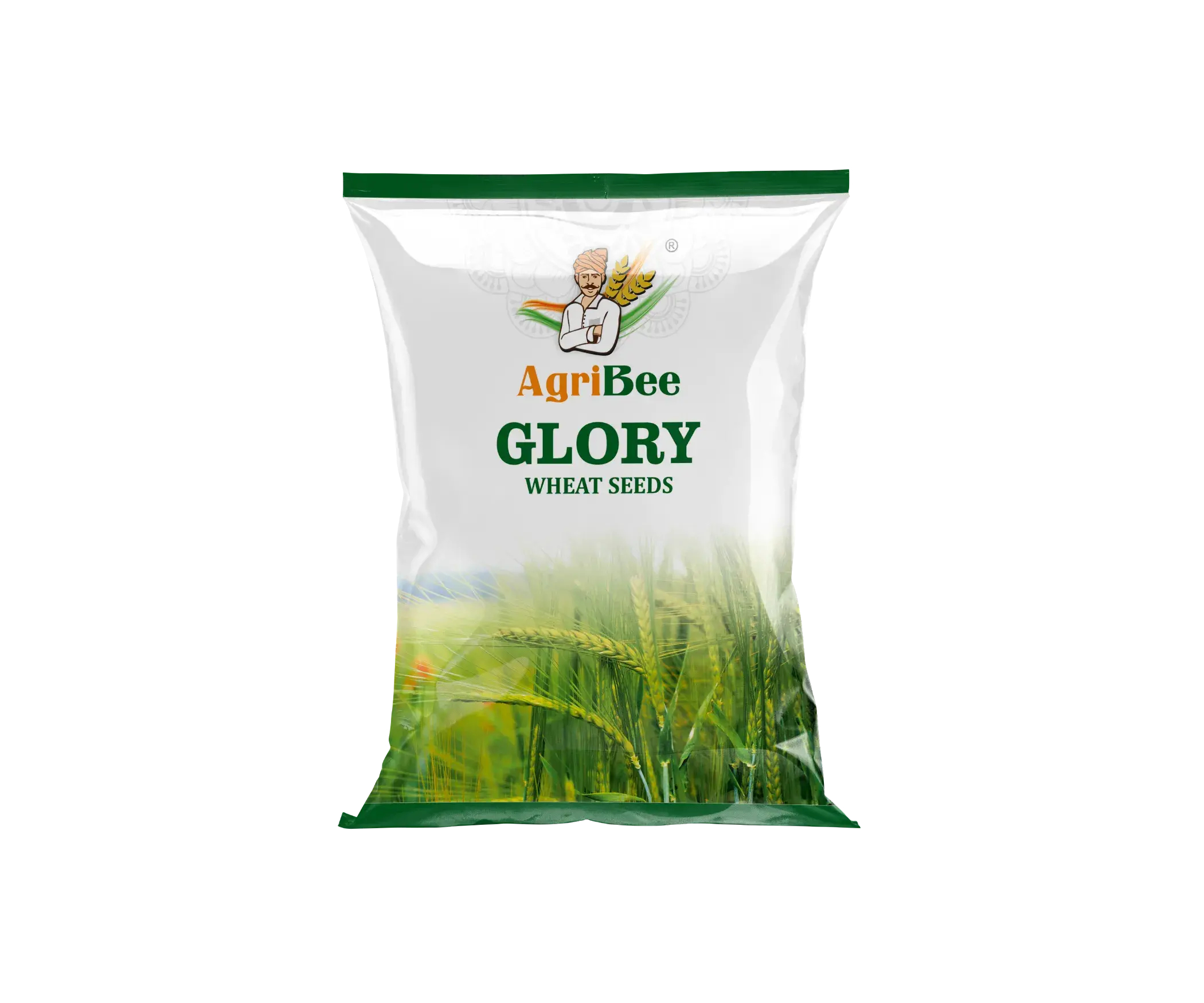
Farming & Cultivation Guide — Wheat Seeds Glory
Complete step-by-step agronomic guide for optimal crop management, disease resistance, and premium produce quality.
🌾 Soil Preparation & Field Prep
Proper land preparation ensures uniform seedling emergence and robust root anchorage.
🌱 Ideal Soil Type & pH
Well-drained loamy to clay-loam soils with pH 6.0–8.0 and good water-holding capacity.
✨ Core Advantage
Fine tilth ensures rapid and uniform germination of light-amber seeds with strong early root anchorage.
- 1
Deep summer ploughing followed by 2–3 cross-harrowings for fine tilth and weed seed burial.
- 2
Field leveling (leveling board) and preparation of drainage channels to prevent water logging.
- 3
Incorporation of well-decomposed FYM or compost (5–10 t/ha) at final land preparation.
- 4
Soil health conditioning: apply gypsum (10–15 kg/acre) in sodic soils; lime in acidic soils below pH 6.0.
🌱 Sowing Time & Method
Precise seed rate and spacing maximize light interception and canopy development.
| Parameter | Recommendation | Agronomic Importance |
|---|---|---|
| Sowing Window | 15 October – 30 November (Rabi) | Sowing within this window avoids late-winter frost damage and ensures optimal grain filling before heat stress. |
| Seed Rate | 22–25 kg per acre (100 kg/ha) | Maintains ideal plant population for maximum tillering and canopy coverage. |
| Spacing | 22.5 cm row-to-row (drilling method) | Promotes uniform light interception, air circulation, and reduces intra-canopy disease pressure. |
| Sowing Depth | 3–5 cm (1.2–2.0 inches) | Ensures adequate seed-soil contact for uniform germination of 7.6 g 100-seed-weight kernels. |
💧 Irrigation & Water Management
Adequate moisture regulation supports strong vegetative and reproductive growth.
☀️ Water Requirement Profile
Wheat is a moderate-water-demand crop. Under drip or furrow irrigation, apply approximately 400–450 mm of water throughout the crop cycle. The variety exhibits moderate drought resilience during early vegetative stages but requires consistent moisture during reproductive phases.
🌦️ Soil Moisture Management
In rainfed areas, apply a pre-sowing irrigan or protective irrigation at sowing to ensure germination. If moisture stress occurs during crown root initiation or milk stage, supplemental irrigation can mitigate significant quality losses.
- ✓
First irrigation (basal water) at 20–25 DAS to support crown root development and nutrient uptake.
- ✓
Vegetative phase: light irrigation at 40–45 DAS depending on soil moisture and weather conditions.
- ✓
Critical stages: irrigation at flag leaf stage (~70 DAS) and milk/dough stage (~80–85 DAS) for optimal grain filling and test weight.
- ✓
Withhold irrigation 10–12 days before harvest to facilitate uniform ripening, reduce shattering losses, and improve seed storage quality.
🧪 Fertilizer & Nutrition Management
Balanced crop nutrition supports robust plant structure and premium produce quality.
| Nutrient | Recommended Dose (per Acre) | Application Method & Timing |
|---|---|---|
| Nitrogen (N) | 80–100 kg/acre (198–246 kg urea) | 50% basal at sowing, 25% at first irrigation (20–25 DAS), 25% at flag leaf stage (~70 DAS). |
| Phosphorus (P2O5) | 40–50 kg/acre (250–310 kg DAP) | 100% basal application at sowing along with seed-drill or band placement near the seed zone. |
| Potash (K2O) | 30–40 kg/acre (50–67 kg MOP) | 100% basal application at sowing; split to second half at first irrigation for improved grain quality and stalk strength. |
🌿 Interculture & Weed Management
Timely weed control ensures optimal nutrient and moisture availability for crop seedlings.
-
1
First Weeding & Hoeing: Perform at 15–20 DAS using a rotary weeder or hand hoe to maintain a weed-free period during early crop establishment.
-
2
Second Weeding & Inter-row Cultivation: Carry out at 35–40 DAS to control mid-season weeds and improve soil aeration around the developing root system.
-
3
Mulching / Residue Management: In dry zones, light inter-row mulching with crop residue conserves soil moisture and suppresses late-season weed germination between rows.
🛡️ Pest & Disease Management
Proactive crop monitoring and integrated management ensure healthy crop development.
🐛 Insect Pest Management
- Aphids (Sitobion avenae): Small green/black insects cluster on leaves and stems, causing yellowing and honeydew sooty mold. Spray imidacloprid 17.8% SL at 0.3 ml/liter water or thiamethoxam 25% WG at 0.2 g/liter water. Scout fields weekly during tillering and stem elongation.
- Termites (Odontotermes spp.): Adults tunnel into young stems and roots causing patchy drying. Apply chlorpyriphos 20% EC at 2 ml/liter water as a soil drench around affected patches, or use bait stations of neem-coated bran at 5 kg/acre.
- Brown Planthopper (Nilaparvata lugens): Sucking insects cause white-heel damage and plant wilting. Maintain field sanitation; spray dinotefuran 20% SP at 0.5 g/liter water or buprofezin 25% SC at 1 ml/liter water at first sighting.
🔬 Disease Control
- Powdery Mildew (Blumeria graminis f. sp. tritici): White powdery growth on leaves and leaf sheaths, reducing photosynthetic area. Preventive spray of propiconazole 25% EC at 0.1 ml/liter water or myclobutanil at first sign of infection during late tillering to stem elongation.
- Rust Diseases — Leaf & Stem Rust (Puccinia triticina & P. graminis): Orange-brown pustules on leaves and stems causing premature drying. Apply hexaconazole 5% EC at 1 ml/liter water or tricyclazole at early infection stage; repeat at 15-day intervals if epidemic conditions persist.
- Fusarium Head Blight / Scab (Fusarium spp.): Pinkish discoloration of spikelets, shriveled kernels, and mycotoxin contamination. Preventive application of propiconazole 25% EC at anthesis (flowering stage); ensure good field drainage and avoid excessive nitrogen top-dressing during grain fill.
✂️ Harvesting & Produce Quality Guide
Harvesting at peak maturity ensures maximum commercial grade and long keeping quality.
⏱️ Harvesting Schedule & Timing
Whole-field harvest at 92–96 DAS when plant moisture content drops to 12–14%, indicated by uniformly golden straw and hard grain that cannot be indented with a thumbnail.
⭐ Produce Quality Characteristics
Attractive light-amber colored kernels with a 100-seed weight of 7.6 g, moderate tillering (3.6 tillers/plant), and compact plant height of 89–94 cm producing clean, well-filled grains with excellent milling and baking qualities.
| Quality Parameter | Agronomic Standard | Farmer & Market Benefit |
|---|---|---|
| First Harvest Stage | 92–96 Days after Sowing | Ensures peak kernel filling, optimal test weight, and market-ready grain quality. |
| Harvest Maturity Signs | Golden-yellow straw, firm hard kernels, light amber seed coat, moisture below 14% | Prevents pre-harvest sprouting, grain shedding, and quality deterioration in the field. |
| Shelf Life & Keeping Quality | 6–8 months under cool, dry, well-ventilated storage at moisture <12% | Light-amber kernels with low moisture resistance support long-duration storage and inter-state transport. |
| Market Suitability | Milling, flour production, wholesale mandi, and export-grade cereals | Uniform kernel size, attractive color, and strong test weight attract premium trader rates. |
⭐ Varietal Features — Wheat Seeds Glory
Distinguishing characteristics that make this variety a top choice for Indian growers.
🌿 Core Variety Highlight
AgriBee Wheat Seeds Glory delivers reliable Rabi-season performance with a balanced tillering capacity of 3.6 tillers per plant and adaptive growth under diverse Indian agro-climatic conditions.
🌿 Produce Quality & Appearance
Attractive light-amber seeds with a consistent 100-seed weight of 7.6 g, delivering clean grain with excellent color uniformity preferred by millers and traders.
🌿 Stress & Disease Tolerance
Moderate tolerance to common rusts and powdery mildew under standard management; compact stature reduces lodging risk under moderate fertilizer regimes.
🌿 Growth Habit & Vigor
Compact plant height of 89–94 cm with strong crowns and uniform canopy architecture supporting efficient light capture and sturdy stem integrity.
🌿 Crop Duration & Earliness
Days to 50% flowering in 45–49 days and maturity in 92–96 days, enabling timely harvest and flexible crop rotation scheduling in the Rabi system.
🌿 Market & Farmer Preference
Trusted by farmers across Northwest and Central India for its attractive seed appearance, dependable germination, uniform maturity, and strong field vigor under standard Rabi wheat management.