Description
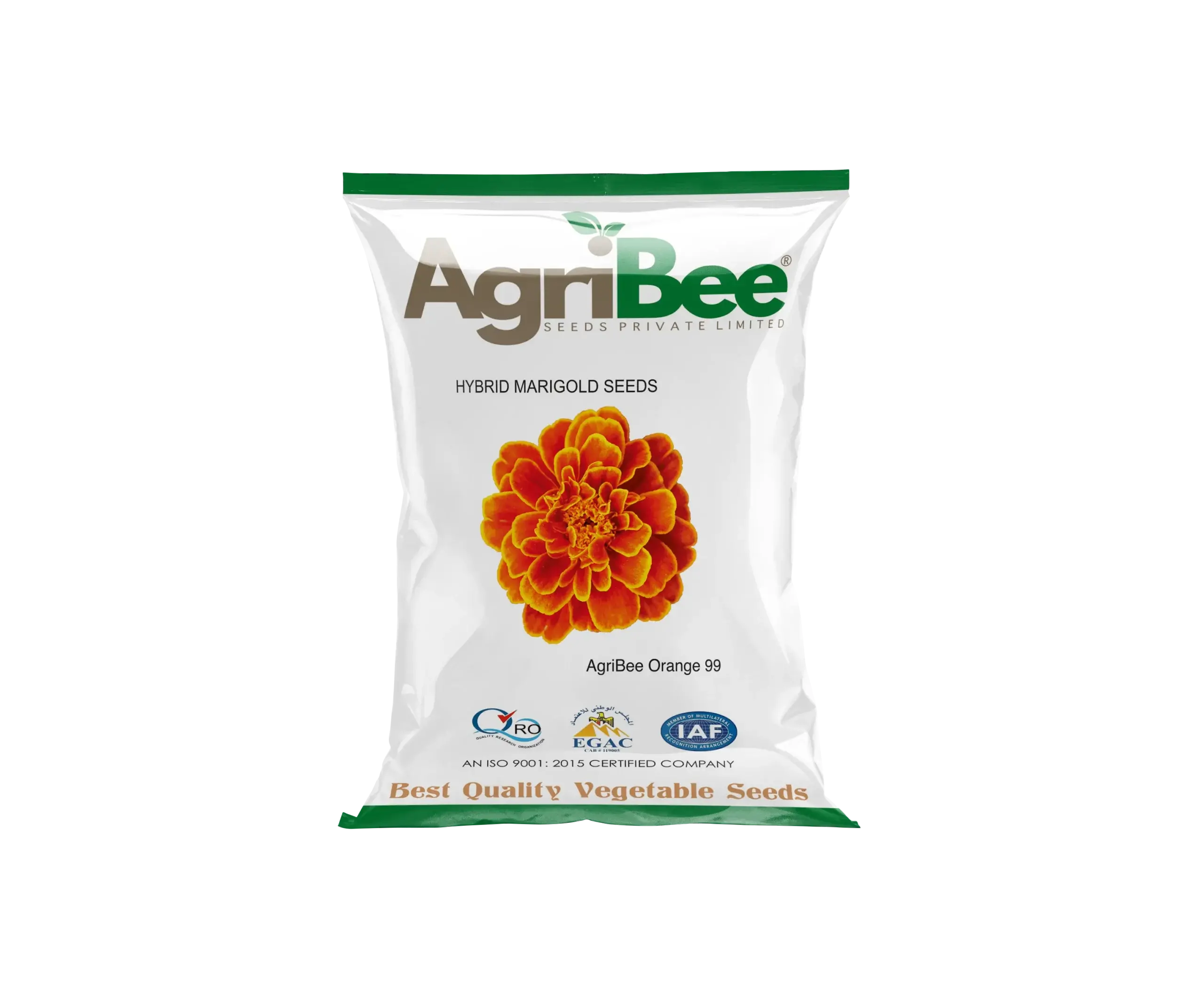
Farming & Cultivation Guide — Marigold Seeds AgriBee Orange 99
Complete step-by-step agronomic guide for optimal crop management, disease resistance, and premium produce quality.
🌾 Soil Preparation & Field Prep
Proper land preparation ensures uniform seedling emergence and robust root anchorage.
🌱 Ideal Soil Type & pH
Well-drained loamy to sandy-loam soils with pH 6.0 – 7.5. Heavy soils must be avoided to prevent waterlogging and root rot.
✨ Core Advantage
Loose, friable seedbed ensures rapid and uniform germination with strong taproot anchorage for bushy 30–40 cm plant architecture.
- 1
Deep summer ploughing followed by 2–3 cross-harrowings to achieve fine tilth and destroy weed seed banks.
- 2
Field leveling and drainage furrow preparation to ensure free water percolation and prevent stagnant moisture.
- 3
Incorporate 8–10 tonnes per acre of well-decomposed FYM or compost during final harrowing for soil structure improvement.
- 4
Conduct soil test and apply lime at 200–250 kg/acre if pH is below 6.0; raise beds of 15 cm height in low-lying water-prone areas.
🌱 Sowing Time & Method
Precise seed rate and spacing maximize light interception and canopy development.
| Parameter | Recommendation | Agronomic Importance |
|---|---|---|
| Sowing Window | January – March & August – September | Sowing in these windows avoids extreme heat stress and heavy monsoon rains, ensuring high germination and robust flower development. |
| Seed Rate | 1 – 1.5 Kg per Acre | Maintains optimal plant population of approximately 40,000–50,000 plants per acre for maximum flower coverage. |
| Spacing | 30 cm x 25 cm (Row-to-Row x Plant-to-Plant) | Provides adequate canopy spread for bushy 30–40 cm growth, promotes airflow, and reduces humidity-related disease pressure. |
| Sowing Depth | 1 – 1.5 cm (0.4 – 0.6 inch) | Shallow sowing ensures quick emergence since marigold seeds are small and require light for uniform germination. |
💧 Irrigation & Water Management
Adequate moisture regulation supports strong vegetative and reproductive growth.
☀️ Water Requirement Profile
Marigold requires moderate irrigation; the variety is moderately drought tolerant once established but performs best with regular moisture. Drip irrigation is highly compatible and improves water use efficiency by 30–40% while keeping foliage dry to reduce disease incidence.
🌦️ Soil Moisture Management
In rainfed conditions, adopt contour bunding and mulching to conserve soil moisture. Ensure timely pre-sowing irrigation to create favourable seedbed moisture for germination, especially in August–September kharif sowing.
- ✓
First irrigation immediately after sowing (white irrigation) is critical for uniform germination; subsequent irrigation at 3–4 day intervals in summer and 7–10 day intervals in winter.
- ✓
Vegetative phase (20–35 DAS): Maintain light but frequent irrigation to support dark green foliage development and bushy branching.
- ✓
Flowering stage (40–50 DAS onwards): Ensure consistent soil moisture; water stress during bud initiation reduces flower size and petal density.
- ✓
Withhold irrigation 2–3 days before each picking to reduce flower moisture content and improve shelf life during transport.
🧪 Fertilizer & Nutrition Management
Balanced crop nutrition supports robust plant structure and premium produce quality.
| Nutrient | Recommended Dose (per Acre) | Application Method & Timing |
|---|---|---|
| Nitrogen (N) | 40 kg/acre | 50% basal at sowing + 50% top-dressing at 25 DAS |
| Phosphorus (P2O5) | 30 kg/acre | 100% basal along with FYM and soil application before sowing |
| Potash (K2O) | 20 kg/acre | 100% basal application; supports petal colour intensity and stalk strength |
🌿 Interculture & Weed Management
Timely weed control ensures optimal nutrient and moisture availability for crop seedlings.
-
1
First Weeding & Hoeing: Carry out at 10–12 DAS using a hand hoe or cultivate. Keep the zone within 5 cm of plant base weed-free to reduce competition for nutrients during early root establishment.
-
2
Second Weeding & Earthing-Up: Perform at 25–30 DAS along with shallow inter-row hoeing. Light earthing-up around the plant base provides additional root anchorage for bushy 30–40 cm growing plants and improves soil aeration.
-
3
Mulching & Top Dressing: Apply straw mulch at 2–3 tonnes/acre after second weeding to conserve moisture, suppress weeds, and maintain consistent soil temperature. Remove any lateral shoots that compete with primary flower bud development.
🛡️ Pest & Disease Management
Proactive crop monitoring and integrated management ensure healthy crop development.
🐛 Insect Pest Management
- Thrips (Heliothrips haemorrhoidalis): Suck sap from buds causing distortion and brownish discoloration. Spray Thiamethoxam 25% WG at 0.1 g/L or Imidacloprid 17.8% SL at 0.3 ml/L. Repeat after 10–12 days if infestation persists.
- Caterpillars (Spodoptera litura): Defoliate leaves and bore into flower buds. Spray Chlorantraniliprole 18.5% SC at 0.3 ml/L or Bacillus thuringiensis at 2–3 g/L as bio-control. Focus spray on growing points and undersides of leaves.
- Red Spider Mite (Tetranychus urticae): Cause stippling and bronzing of dark green leaves, reducing photosynthetic capacity. Spray Hexythiazox 5% EC at 0.5 ml/L or Abamectin 1.9% EC at 0.3 ml/L. Maintain adequate soil moisture as mite outbreaks worsen under dry conditions.
🔬 Disease Control
- Powdery Mildew (Erysiphe cichoracearum): White powdery growth on leaves and petals; most prevalent in humid weather with poor air circulation. Spray Sulphur dust (80% WP) at 2 kg/acre or Myclobutanil 10.7% WS at 0.5 g/L. Ensure proper spacing for canopy ventilation.
- Root Rot / Damping Off (Phytophthora nicotianae / Rhizoctonia solani): Waterlogged soils cause wilting, yellowing, and stem collapse at soil level. drench with Metalaxyl + Mancozeb 6.9% + 64% WP at 2.5 g/L or Copper Oxychloride at 3 g/L. Avoid overhead irrigation and ensure raised beds in heavy soils.
- Leaf Spot (Cercospora maricola): Small brown spots with yellow halos on foliage reducing overall plant vigor. Spray Mancozeb 75% WP at 2 g/L or Carbendazim 50% WP at 1 g/L at 10-day intervals. Remove and destroy severely infected plant debris.
✂️ Harvesting & Produce Quality Guide
Harvesting at peak maturity ensures maximum commercial grade and long keeping quality.
⏱️ Harvesting Schedule & Timing
First picking begins at 45–50 days after sowing when flowers reach full bloom with 8–10 cm diameter. Subsequent pickings are made every 3–4 days throughout the flowering cycle, typically yielding 4–6 pickings over a 3–4 week period.
⭐ Produce Quality Characteristics
Bright orange, densely petaled flowers with strong 30–45 cm stalks. Dark green foliage indicates good nutrition. Flowers are ideal for garlands, religious offerings, and decorative markets with high visual appeal and uniform colour.
| Quality Parameter | Agronomic Standard | Farmer & Market Benefit |
|---|---|---|
| First Harvest Stage | 45 – 50 Days after Sowing | Ensures early market entry when flower prices are often premium; flowers have reached commercial size. |
| Harvest Maturity Signs | Full bloom with 8–10 cm flower diameter; petals fully expanded with bright orange colour; buds slightly loosened but not open. | Prevents over-maturity, petal drop, and pollen shedding which reduce market value and shelf life. |
| Shelf Life & Keeping Quality | 5–7 days under ambient conditions; 7–10 days under cool storage (10–12°C). Flowers hold colour and form well post-harvest. | Facilitates transport to distant mandis and urban markets with minimal quality deterioration. |
| Market Suitability | Fresh flower market, garland making, religious ceremonies, export-grade cut flowers, and processing units. | Uniform brightness and large flower size attract premium rates from traders and florists across Indian markets. |
⭐ Varietal Features — Marigold Seeds AgriBee Orange 99
Distinguishing characteristics that make this variety a top choice for Indian growers.
🌿 Core Variety Highlight
AgriBee Orange 99 delivers consistent bright orange colour with large 8–10 cm flowers and dense petal arrangement, making it a top choice for commercial and ceremonial markets.
🌿 Produce Quality & Appearance
Vibrant bright orange hue with tightly packed petals ensures superior visual appeal. Dark green foliage provides attractive contrast and indicates strong photosynthetic health throughout the crop cycle.
🌿 Stress & Disease Tolerance
Good field tolerance to common marigold diseases including powdery mildew and root rot under well-managed conditions. Moderate drought resilience supports cultivation in varied Indian agro-climatic zones.
🌿 Growth Habit & Vigor
Bushy compact plant architecture at 30–40 cm height ensures excellent ground coverage with multiple branching points, producing abundant flowers per plant without excessive staking.
🌿 Crop Duration & Earliness
Early maturity in 45–50 days enables farmers to fit multiple cropping cycles per year, improving land productivity and enabling flexible scheduling between Kharif and Rabi seasons.
🌿 Market & Farmer Preference
Farmers and traders prefer this AgriBee variety for its uniform flower size, intense colour, long stalks, and reliable performance across seasons — ensuring consistent demand in temple markets, wedding seasons, and festive periods throughout India.