Description
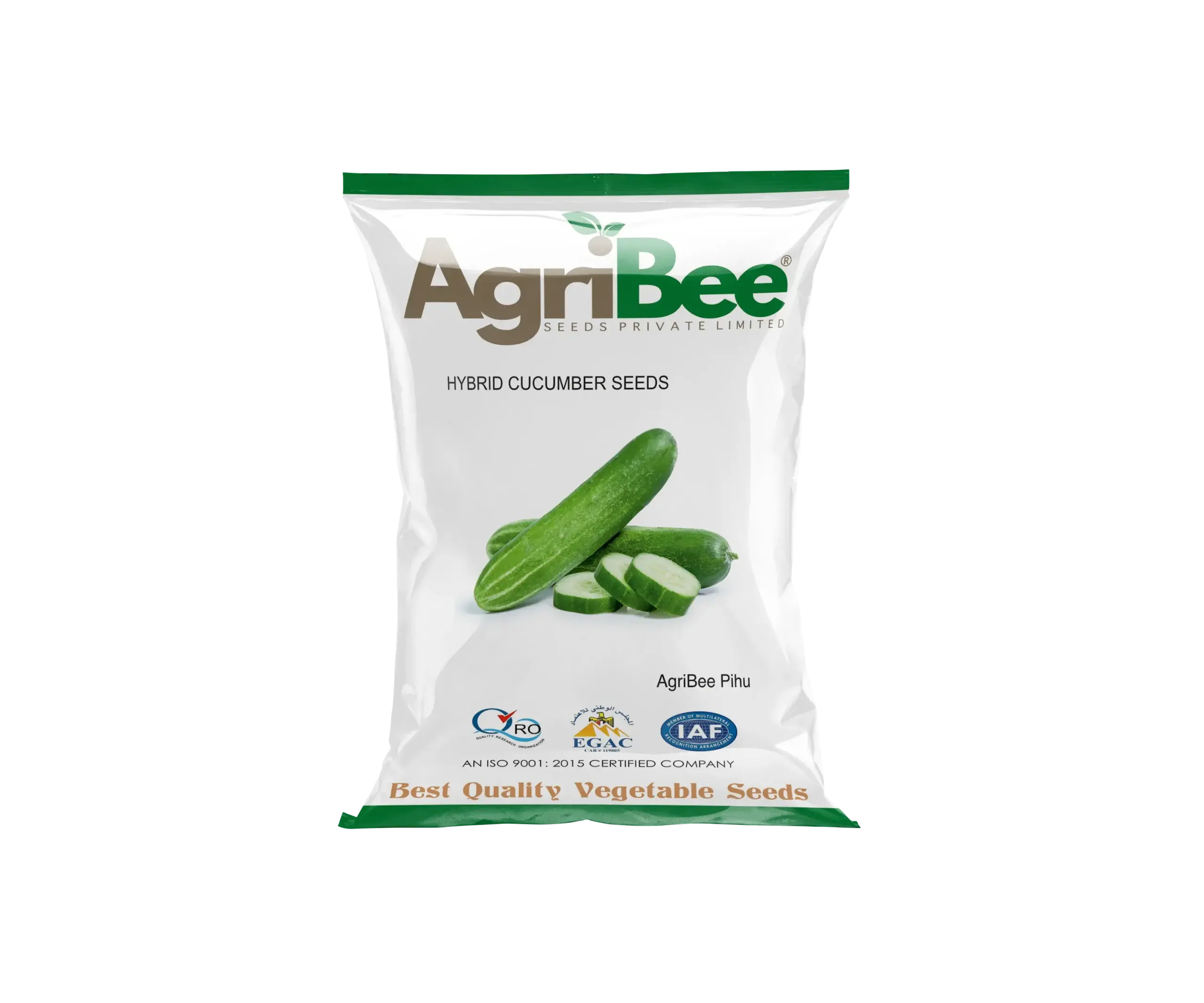
Farming & Cultivation Guide — Cucumber Seeds AgriBee Pihu
Complete step-by-step agronomic guide for optimal crop management, disease resistance, and premium produce quality.
🌾 Soil Preparation & Field Prep
Proper land preparation ensures uniform seedling emergence and robust root anchorage.
🌱 Ideal Soil Type & pH
Well-drained sandy loam to loamy soils with pH 6.0–7.5. Deep, fertile soils with good organic matter content are ideal for sustained vine growth and fruit development.
✨ Core Advantage
Loose, well-aerated seedbed ensures rapid imbibition, uniform germination, and strong primary root establishment — critical for cucumber's shallow fibrous root system.
- 1
Deep summer ploughing to 25–30 cm followed by 2–3 cross-harrowings for fine tilth and weed reduction.
- 2
Field leveling with burr crushing to ensure uniform water distribution and prevent waterlogging in low patches.
- 3
Incorporation of 8–10 tonnes/acre well-decomposed FYM or compost during last harrowing for improved soil structure and moisture retention.
- 4
Soil health conditioning: Apply gypsum at 250 kg/acre in saline-affected soils; use lime at 200–300 kg/acre where pH is below 5.8.
🌱 Sowing Time & Method
Precise seed rate and spacing maximize light interception and canopy development.
| Parameter | Recommendation | Agronomic Importance |
|---|---|---|
| Sowing Window | June–July (Kharif) in Central & South India; October–November (Rabi) in North India; February–March (Summer) in protected cultivation areas | Aligns with favorable temperature (25–30°C) for rapid germination and vigorous vegetative growth while avoiding frost damage in Rabi. |
| Seed Rate | 1.0–1.2 kg/acre (direct), 500–600 g/acre (transplant) | Optimizes plant population at 35,000–45,000 plants/acre for balanced canopy and uninterrupted fruit production. |
| Spacing | 60–75 cm row-to-row × 20–25 cm plant-to-plant (supported cultivation); 90 × 60 cm (spread cultivation) | Ensures adequate inter-row aeration, light penetration, and easy intercultural operations while supporting uniform fruit sizing. |
| Sowing / Transplanting Depth | 2–2.5 cm depth for direct sowing; 0.5–1.0 cm for nursery seedlings | Shallow sowing promotes quick radicle emergence; excessive depth reduces germination due to poor oxygen availability in seed coat. |
💧 Irrigation & Water Management
Adequate moisture regulation supports strong vegetative and reproductive growth.
☀️ Water Requirement Profile
Cucumber has a shallow root system and moderate drought sensitivity. Under drip irrigation, apply 3–4 mm water per session every 2–3 days during active growth. Total water requirement is approximately 400–500 mm over the crop cycle. Drip fertigation is highly compatible and improves nutrient-use efficiency by 30–40%.
🌦️ Soil Moisture Management
In rainfed conditions, ensure timely pre-sowing irrigation and maintain soil moisture at field capacity during germination and fruit initiation stages. Use black mulch film or straw mulch to reduce evaporation and conserve soil moisture. Avoid water stagnation as it rapidly causes root rot.
- ✓
First irrigation immediately after sowing (injection irrigation) to ensure uniform seed coat imbibition and germination.
- ✓
Vegetative phase: Light and frequent irrigations every 3–4 days to support rapid vine expansion without waterlogging.
- ✓
Critical stage — flowering and early fruit set: Maintain consistent soil moisture; stress at this stage causes flower drop, fruit, and poor set.
- ✓
Pre-harvest: Reduce irrigation frequency 5–7 days before final harvest to improve fruit firmness and shelf life; avoid wetting foliage to minimize fungal spread.
🧪 Fertilizer & Nutrition Management
Balanced crop nutrition supports robust plant structure and premium produce quality.
| Nutrient | Recommended Dose (per Acre) | Application Method & Timing |
|---|---|---|
| Nitrogen (N) | 60–80 kg/acre | 50% basal at last harrowing; 50% top-dressed at 25 DAS and again at first picking stage. |
| Phosphorus (P2O5) | 40–50 kg/acre | 100% basal application as DAP or SSP incorporated during final land preparation. |
| Potash (K2O) | 30–40 kg/acre | 60% basal + 40% split at flowering and first fruit development for improved fruit firmness and color. |
🌿 Interculture & Weed Management
Timely weed control ensures optimal nutrient and moisture availability for crop seedlings.
-
1
First Weeding & Hoeing: Carry out at 10–12 DAS using a conical weeder. Shallow cultivation (5 cm depth) avoids root damage. Early weed control is critical as cucumber is a poor competitor during seedling stage.
-
2
Second Weeding & Earthing-Up: Perform at 20–25 DAS with deeper hoeing (8–10 cm). Build slight earthing around the base to support advancing vines and encourage adventitious root formation along the stem.
-
3
Special Interculture Operation: Install trellis net or bamboo stakes at 15–20 DAS for vertical training. Remove lateral shoots (suckers) below the first 5 nodes to direct energy toward main vine and fruit production. Mulch with black polyethylene film or paddy straw (4–5 cm layer) to suppress weeds, conserve moisture, and keep fruits clean.
🛡️ Pest & Disease Management
Proactive crop monitoring and integrated management ensure healthy crop development.
🐛 Insect Pest Management
- Aphids (Myzus persicae, Aphis gossypii): Sucking sap from leaves causing curling, yellowing, and honeydew sooty mold. Vector of cucumber mosaic virus. Control: Spray Imidacloprid 17.8% SL at 0.3 ml/L or Thiamethoxam 25% WG at 0.2 g/L. Release ladybird beetles (10,000/acre) as biological control.
- Fruit Fly (Bactrocera cucurbitae): Females lay eggs in developing fruits causing larval infestation and fruit rot. Control: Apply Spinosad 45% SC at 0.3 ml/L or Chlorantraniliprole 18.5% SC at 0.2 ml/L. Install methyl eugenol traps (20/acre) for mass trapping.
- Whitefly (Bemisia tabaci): Cluster feeding on leaf undersides causes leaf yellowing, wilting, and transmission of begomoviruses. Control: Spray Diafenthiuron 50% WP at 1.0 g/L or Acetamiprid 20% SP at 0.5 g/L. Use yellow sticky traps (40/acre) for monitoring and reduction.
🔬 Disease Control
- Downy Mildew (Pseudoperonospora cubensis): Olive-brown angular lesions on leaves bounded by veins, white sporulation on leaf underside under humid conditions. Preventive: Spray Mancozeb 75% WP at 2.5 g/L or Metalaxyl 35% SS at 1.0 g/L at 7-day intervals. Remove and destroy infected plant debris.
- Powdery Mildew (Erysiphe cucurbitae): White powdery fungal growth on both leaf surfaces causing premature leaf senescence. Control: Spray Sulphur 80% WP at 3.0 g/L or Myclobutanil 10.9% SE at 0.5 ml/L. Ensure proper spacing for canopy air circulation.
- Fusarium Wilt (Fusarium oxysporum f. sp. cucumerinum): Wilting of vines starting from lower leaves, vascular browning, and plant collapse. Preventive: Seed treatment with Trichoderma viride at 4 g/kg seed or carbendazim at 2.5 g/kg. Soil drench with Pseudomonas fluorescens at 10 g/L at 20 DAS.
✂️ Harvesting & Produce Quality Guide
Harvesting at peak maturity ensures maximum commercial grade and long keeping quality.
⏱️ Harvesting Schedule & Timing
First picking begins 45–50 days after sowing. Subsequent pickings are taken at 2–3 day intervals throughout the harvesting period, with 7–9 picks possible over a 3–4 week productive window.
⭐ Produce Quality Characteristics
Premium cylindrical fruits with uniform light to medium green exocarp, smooth texture, crisp flesh, and sweet mild flavor. Firm fruit wall with minimal seed cavity ensures excellent table quality and reduced waste during processing.
| Quality Parameter | Agronomic Standard | Farmer & Market Benefit |
|---|---|---|
| First Harvest Stage | 45–50 Days after Sowing | Enables early market arrival when cucumber prices are typically higher due to limited supply. |
| Harvest Maturity Signs | Fruits 18–22 cm length, light to medium green color, firm to touch, skin smooth without yellowing | Prevents over-maturity that leads to seed hardening, fruit hollowing, and off-flavors. |
| Shelf Life & Keeping Quality | 5–7 days under ambient conditions (25–30°C); up to 10–12 days at 8–10°C with 90–95% relative humidity | Extended post-harvest life supports longer transport chains and access to distant mandis and export markets. |
| Market Suitability | Fresh table market, premium retail chains, export-grade packing, and food processing units | Uniform fruit shape, attractive green color, and consistent size attract premium rates from traders and modern trade outlets. |
⭐ Varietal Features — Cucumber Seeds AgriBee Pihu
Distinguishing characteristics that make this variety a top choice for Indian growers.
🌿 Core Variety Highlight
AgriBee Pihu delivers exceptional field vigor and uniform fruit set under diverse Indian growing conditions, making it a reliable choice across Kharif, Rabi, and summer seasons.
🌿 Produce Quality & Appearance
Cylindrical, uniformly shaped fruits in light to medium green color with smooth skin and compact seed cavity. Individual fruit weight of 150–200 gm meets modern market specifications for fresh consumption and branded packaging.
🌿 Stress & Disease Tolerance
Demonstrates strong tolerance to downy mildew and fusarium wilt — two most devastating diseases of cucumber in India. Moderate resistance to powdery mildew and good adaptability under heat stress during summer cultivation.
🌿 Growth Habit & Vigor
Indeterminate bush-type vine with vigorous lateral branching. Strong main runner supports prolific fruiting along the stem. Excellent trellis compatibility ensures upright fruit growth and uniform exposure.
🌿 Crop Duration & Earliness
Early-maturing genotype with first harvest in just 45–50 days, enabling quick crop turnover, flexible rotation planning, and multiple cropping cycles per year in suitable zones.
🌿 Market & Farmer Preference
Farmers favor AgriBee Pihu for its consistent fruit grading, high market appeal, reduced pesticide dependency, and reliable performance across soil types — from the alluvial plains of Punjab to the black soils of Maharashtra and the coastal tracts of South India.