Description
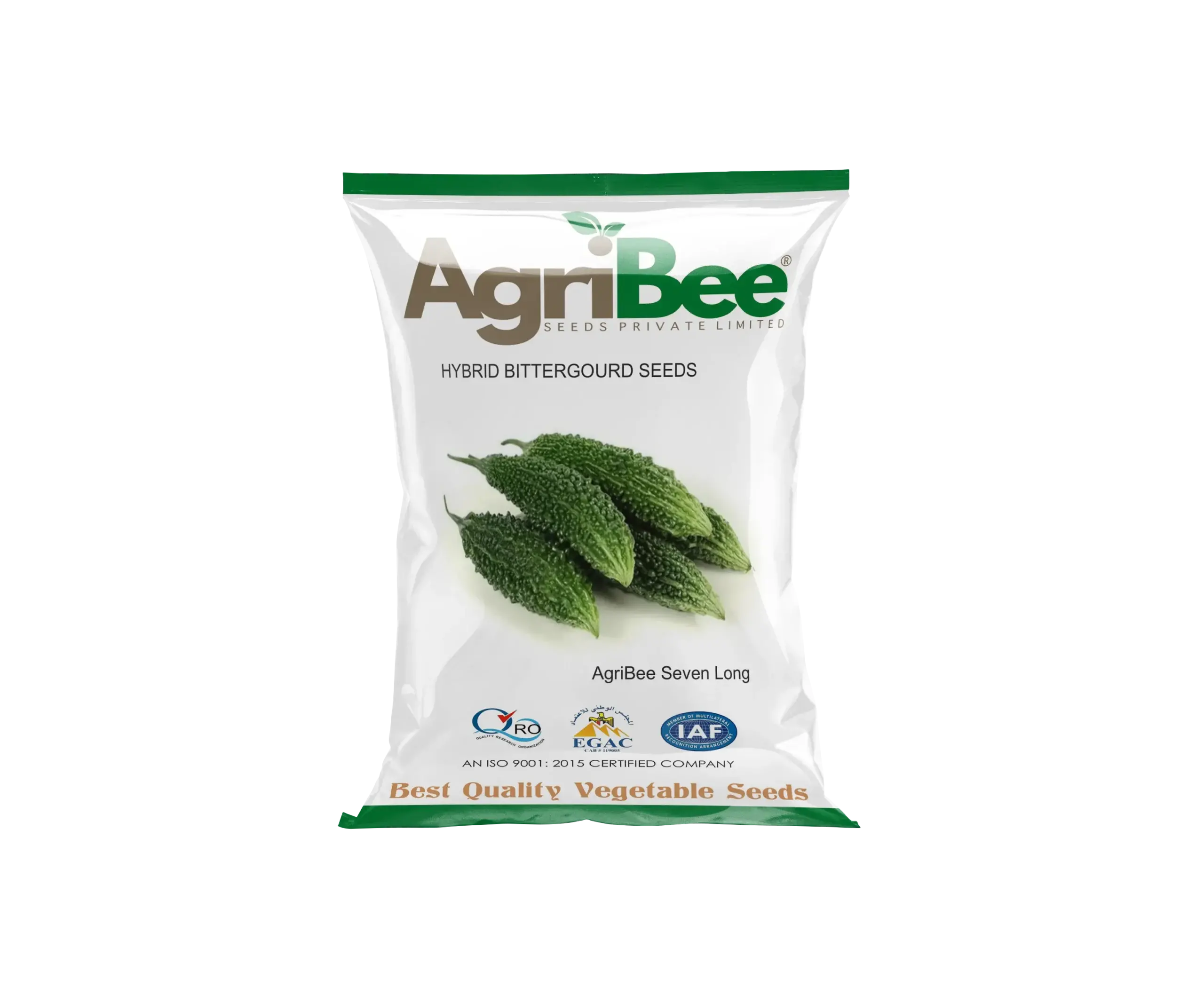
Farming & Cultivation Guide — Bitter Gourd Seeds AgriBee Seven Long
Complete step-by-step agronomic guide for optimal crop management, disease resistance, and premium produce quality.
🌾 Soil Preparation & Field Prep
Proper land preparation ensures uniform seedling emergence and robust root anchorage.
🌱 Ideal Soil Type & pH
Well-drained sandy loam to loamy soils with pH 6.0–7.5. Deep, fertile soils with good organic matter content support vigorous vine growth and healthy fruit development.
✨ Core Advantage
Loose, well-aerated seedbed ensures rapid germination and strong root penetration, establishing robust vine architecture early in the crop cycle.
- 1
Deep summer ploughing followed by 2–3 cross-harrowings to produce a fine, clod-free tilth suitable for shallow-rooted cucurbits.
- 2
Field leveling and creation of proper drainage channels to prevent water stagnation, which is highly detrimental to bitter gourd roots.
- 3
Incorporation of 15–20 tonnes per hectare of well-decomposed FYM or compost during the final harrowing to enhance soil structure and moisture retention.
- 4
Soil health conditioning with lime application (200–250 kg/ha) in acidic soils to maintain an optimal pH range for nutrient availability.
🌱 Sowing Time & Method
Precise seed rate and spacing maximize light interception and canopy development.
| Parameter | Recommendation | Agronomic Importance |
|---|---|---|
| Sowing Window | Kharif: June–July | Rabi: October–November | Summer: February–March | Aligns sowing with favorable temperature (25–35°C) and moisture regimes, ensuring uniform germination and avoiding frost or waterlogging damage. |
| Seed Rate | 2.0–2.5 kg per hectare for direct sowing; 500–600 g per hectare for nursery raising | Optimal seed rate maintains ideal plant population without excessive competition for light, water, and nutrients. |
| Spacing | Row-to-row: 100–120 cm × Plant-to-plant: 40–50 cm | Wide spacing accommodates the spreading vine habit, improves canopy aeration, reduces humidity-related disease pressure, and facilitates easy harvesting. |
| Sowing / Transplanting Depth | 2.5–3.0 cm depth for direct sowing; seed placed with cotyledon side down | Proper depth ensures adequate soil contact for imbibition while allowing the emerging seedling to reach the surface without exhausting reserves. |
💧 Irrigation & Water Management
Adequate moisture regulation supports strong vegetative and reproductive growth.
☀️ Water Requirement Profile
Bitter gourd is moderately drought-sensitive despite its warm-season adaptation. Consistent soil moisture is critical, especially from flowering through fruit development. Drip irrigation is highly recommended as it delivers 30–40% water savings compared to flood irrigation while maintaining uniform soil moisture and reducing foliar disease incidence. The crop requires approximately 400–500 mm of total water during the growth cycle.
🌦️ Soil Moisture Management
In rainfed ecosystems, sow on broad raised beds (10–12 cm height) to ensure quick drainage of excess monsoon water. Apply organic mulch (paddy straw at 4–5 t/ha) immediately after sowing to conserve soil moisture, suppress weeds, and moderate soil temperature. Supplemental irrigation at flowering and young fruit stages is essential to prevent flower drop and fruit deformation under erratic rainfall.
- ✓
First irrigation (infusion water) within 24–48 hours of sowing to initiate seed germination. Subsequent light irrigations every 3–4 days until emergence.
- ✓
Vegetative phase: irrigate every 5–7 days depending on soil type and weather. Maintain moderate moisture to promote vigorous vine extension without encouraging excessive foliage at the expense of flowering.
- ✓
Critical stage — flowering and fruit set (25–50 DAS): ensure regular irrigation every 4–5 days. Water stress during this window causes flower abscission, poor fruit set, and malformation of fruits.
- ✓
Withhold heavy irrigation 3–4 days before each harvest to improve fruit firmness, reduce spoilage during handling, and enhance shelf life.
🧪 Fertilizer & Nutrition Management
Balanced crop nutrition supports robust plant structure and premium produce quality.
| Nutrient | Recommended Dose (per Acre) | Application Method & Timing |
|---|---|---|
| Nitrogen (N) | 60–80 kg/ha (24–32 kg/acre) | 50% basal at sowing along with phosphorus and potash; remaining 50% top-dressed at 25–30 DAS as a side-application around the hill margin. |
| Phosphorus (P₂O₅) | 40–50 kg/ha (16–20 kg/acre) | 100% basal application incorporated into the seedbed during final harrowing. Phosphorus promotes early root development and enhances flowering. |
| Potash (K₂O) | 30–40 kg/ha (12–16 kg/acre) | 100% basal application. Potash supports fruit thickening, dark green coloration, and improves overall fruit firmness and post-harvest durability. |
🌿 Interculture & Weed Management
Timely weed control ensures optimal nutrient and moisture availability for crop seedlings.
-
1
First Weeding & Hoeing: Carry out at 10–12 DAS using a hand hoe or cultivator. Shallow weeding (3–4 cm depth) avoids root damage. A weed-free environment during the first 3 weeks is critical as bitter gourd is a poor competitor against weeds.
-
2
Second Weeding & Earthing-Up: Perform at 20–25 DAS with slightly deeper hoeing (5–6 cm). Mound soil lightly around the base of each hill to support adventitious root formation and improve aeration around the crown.
-
3
Special Interculture Operation — Trellising & Pruning: Install trellis netting or strings 7–10 days after sowing so vines can climb as they grow. Remove lateral branches up to the first 3–4 nodes to direct energy toward main vine growth and early fruiting. De-suckering after fruit set improves air circulation and reduces disease pocket formation within the canopy. Mulching with straw between rows conserves moisture and suppresses late-season weeds.
🛡️ Pest & Disease Management
Proactive crop monitoring and integrated management ensure healthy crop development.
🐛 Insect Pest Management
- Aphids (Aphis gossypii): Small green/black colonies on underside of leaves and tender shoots causing curling and honeydew deposition. Spray Imidacloprid 17.8% SL at 0.3 ml/L or Thiamethoxam 25% WG at 0.2 g/L. As a biological control, introduce ladybird beetles or release Trichogramma at 50,000/ha weekly for two applications.
- Fruit & Shoot Borer (Diaphania perspectalis): Larvae bore into tender shoots causing wilting (shoot borer) and tunnel into young fruits causing rot and exit holes. Collect and destroy infested shoots and fruits manually. Spray Chlorantraniliprole 18.5% SC at 0.3 ml/L or Emamectin benzoate 5% SG at 0.5 g/L. Apply pheromone traps at 10/acre for monitoring and mass trapping.
- Cucurbit Whitefly (Bemisia tabaci): Sucking pests causing yellowing, leaf curling, and sooty mold on honeydew. Spray Acetamiprid 20% SP at 0.3 g/L or Spirotetramat 22.9% OD at 0.4 ml/L. Install yellow sticky traps at 15/acre. Crop hygiene and weed eradication around field margins reduce whitefly reservoirs.
🔬 Disease Control
- Powdery Mildew (Erysiphe cichoracearum): White powdery fungal growth on both leaf surfaces leading to premature drying and reduced photosynthetic area. Spray Sulphur wettable powder at 2.0 g/L or Myclobutanil 6.9% WP at 0.2 g/L. Preventive spraying at 25 DAS and repeated at 10-day intervals under high humidity is effective. Avoid overhead irrigation to reduce leaf wetness.
- Downy Mildew (Pseudoperonospora cubensis): Angular yellow lesions on upper leaf surface with grey-purple sporulation on the underside in humid conditions. Spray Mancozeb 75% WP at 2.5 g/L or Cycloheximide 18.7% SL at 1.0 ml/L. Rotate with non-cucurbit crops for 2–3 seasons. Remove and destroy heavily infected plant debris.
- Fruit Rot / Anthracnose (Colletotrichum orbiculare): Water-soaked circular spots on fruits that enlarge, become sunken, and develop salmon-colored spore masses in moist weather. Spray Copper oxychloride 50% WP at 3.0 g/L or Propineb 70% WP at 2.0 g/L. Ensure proper spacing for air circulation and avoid water splashing onto fruits during irrigation.
✂️ Harvesting & Produce Quality Guide
Harvesting at peak maturity ensures maximum commercial grade and long keeping quality.
⏱️ Harvesting Schedule & Timing
First picking begins at 50–55 days after sowing. Subsequent pickings are taken at 2–3 day intervals over a harvesting period of 25–35 days, with 7–10 harvests per plant cycle.
⭐ Produce Quality Characteristics
Fruits of AgriBee Seven Long exhibit a spindle shape with characteristic toothed/warty surface, rich dark green skin, and a firm, crisp flesh. Fruit weight ranges 80–120 g with a length of 15–20 cm. The skin is glossy and unblemished at maturity, reflecting strong varietal vigor. Taste is characteristically bitter with a firm texture that holds well during cooking.
| Quality Parameter | Agronomic Standard | Farmer & Market Benefit |
|---|---|---|
| First Harvest Stage | 50–55 Days after Sowing | Enables early market arrival when supply is limited, commanding better price realization for farmers. |
| Harvest Maturity Signs | Skin deep dark green, firm to touch, fruit length 15–20 cm; seeds not yet hardened | Prevents over-maturity which causes yellowing, seed hardening, and bitter flavor deterioration. |
| Shelf Life & Keeping Quality | 5–7 days under ambient conditions; up to 10–12 days at 10–12°C with high relative humidity | Dark green, firm fruits withstand transport better, reducing post-harvest losses and expanding market reach. |
| Market Suitability | Fresh table market, mandis, modern retail chains, and processing units for dried bitter gourd products | Spindle shape and uniform dark green color meet trader and consumer preference, fetching premium rates. |
⭐ Varietal Features — Bitter Gourd Seeds AgriBee Seven Long
Distinguishing characteristics that make this variety a top choice for Indian growers.
🌿 Core Variety Highlight
AgriBee Seven Long is bred for early and uniform fruiting, delivering the first harvest within 50–55 days, enabling farmers to capture early-market premiums and fit into tight rotation schedules.
🌿 Produce Quality & Appearance
Fruits are spindle-shaped with prominent toothed/warty texture, dark glossy green skin, and uniform dimensions (15–20 cm length, 80–120 g weight), meeting stringent market grading standards.
🌿 Stress & Disease Tolerance
The variety exhibits good field tolerance to common cucurbit pathogens including powdery mildew and downy mildew under moderate pressure, and maintains foliage health throughout the growing season.
🌿 Growth Habit & Vigor
Vigorous vine growth with well-branched architecture that responds effectively to trellising. Strong primary and secondary vine development ensures continuous fruiting over an extended harvest window.
🌿 Crop Duration & Earliness
With first harvest at 50–55 days and a total crop cycle of approximately 75–85 days, this variety supports multiple cropping systems and flexible sequencing with succeeding crops.
🌿 Market & Farmer Preference
Farmers value the uniform fruit size, dark green attractive color, good shelf life, and consistent bearing habit. Traders prefer the spindle shape and firm texture that survives transport with minimal damage, making AgriBee Seven Long a reliable choice across Indian markets.