Description
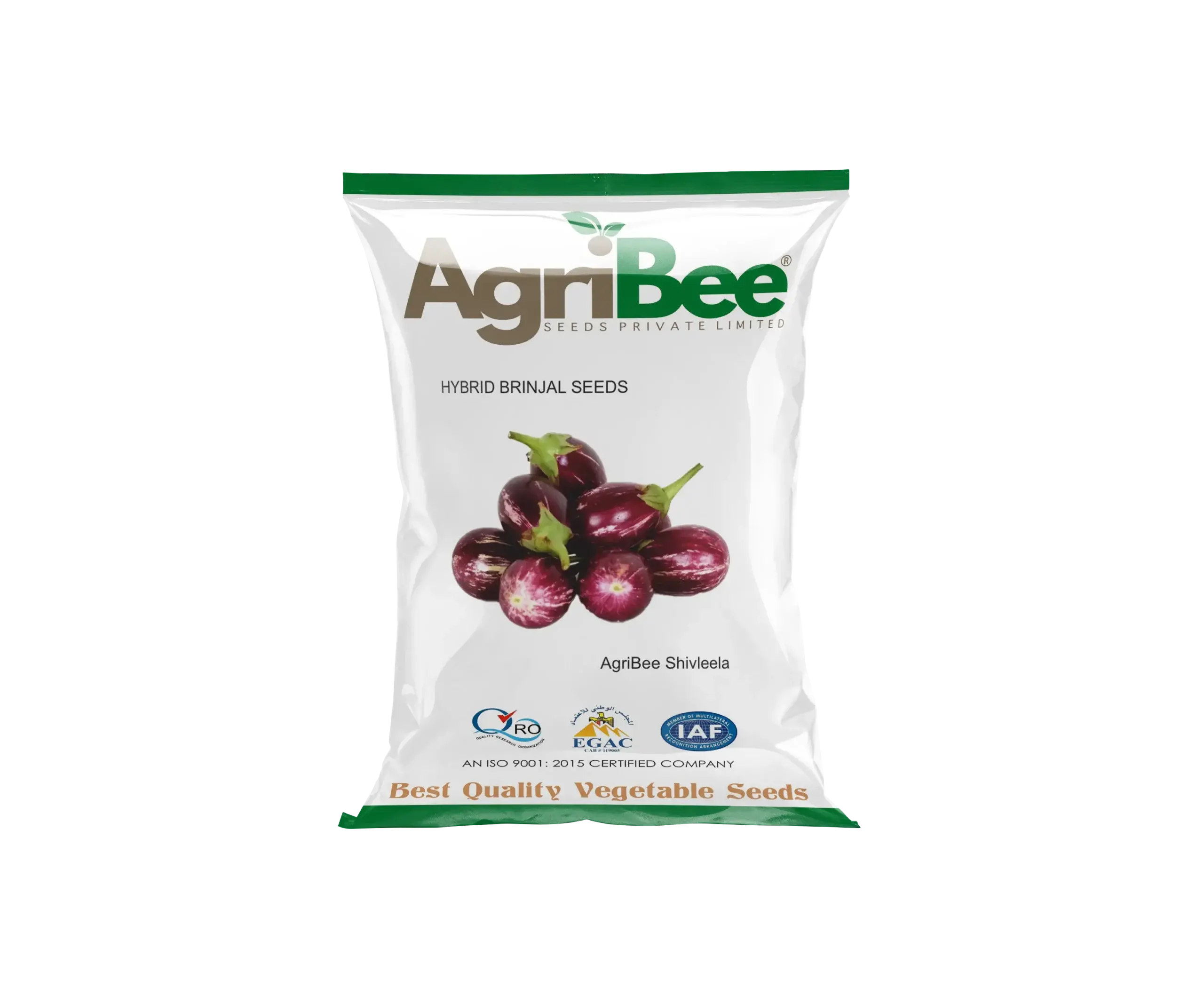
Farming & Cultivation Guide — Brinjal Seeds AgriBee Shivleela
Complete step-by-step agronomic guide for optimal crop management, disease resistance, and premium produce quality.
🌾 Soil Preparation & Field Prep
Proper land preparation ensures uniform seedling emergence and robust root anchorage.
🌱 Ideal Soil Type & pH
Well‑drained loamy to clay‑loamy soils with pH 6.0–7.5. Heavy soils must have good internal drainage to prevent waterlogging.
✨ Core Advantage
Fine tilth and moist (but not wet) seedbed ensure rapid germination, uniform seedling emergence, and strong early root anchorage.
- 1
Deep summer ploughing followed by 2–3 cross‑harrowings to obtain a fine, clod‑free tilth.
- 2
Field leveling and creation of peripheral drains to avoid standing water.
- 3
Incorporation of 8–10 t/ha well‑decomposed FYM or compost during last ploughing.
- 4
Soil‑test‑based amendment: apply agricultural lime at 200–300 kg/acre if pH <6.0; record gypsum for sodic soils.
🌱 Sowing Time & Method
Precise seed rate and spacing maximize light interception and canopy development.
| Parameter | Recommendation | Agronomic Importance |
|---|---|---|
| Sowing Window | June–July (Kharif); Oct–Nov (Rabi); Feb–March (Summer) | Aligns transplanting with favorable temperature and avoids peak pest pressure and extreme heat. |
| Seed Rate | 300–350 g / Acre (transplanted nursery) | Maintains optimum plant population (~25,000–30,000 plants/acre) without excessive seedling crowding. |
| Spacing | 60–75 cm (row‑to‑row) × 45–60 cm (plant‑to‑plant) | Promotes canopy spread, improves air circulation, and eases interculture and harvest operations. |
| Sowing / Transplanting Depth | 1.0–1.5 cm for seed sowing; transplant at 15–20 DAS when 4–5 true leaves appear | Shallow cover ensures quick radicle emergence; older seedlings establish faster after transplanting. |
💧 Irrigation & Water Management
Adequate moisture regulation supports strong vegetative and reproductive growth.
☀️ Water Requirement Profile
Brinjal requires moderate, consistent moisture; it is moderately drought‑tolerant but sustained moisture stress during flowering and fruit set reduces fruit set and causes malformation. Drip irrigation with mulch is highly compatible and conserves water.
🌦️ Soil Moisture Management
In rainfed zones, synchronize transplanting with expected rains. Use organic mulch (paddy straw, 3–4 cm thick) immediately after transplanting to conserve soil moisture and suppress weeds. Provide supplemental irrigation during dry spells in the critical fruit‑development phase.
- ✓
First irrigation within 3–5 days after transplanting to settle roots and reduce transplant shock.
- ✓
Vegetative phase: irrigate at 7–10 day intervals depending on soil texture and rainfall.
- ✓
Critical stage – flowering through young fruit development: maintain consistent soil moisture; deficit here directly lowers fruit quality and symmetry.
- ✓
Pre‑harvest: reduce irrigation frequency 10–12 days before first picking to improve fruit firmness and shelf life.
🧪 Fertilizer & Nutrition Management
Balanced crop nutrition supports robust plant structure and premium produce quality.
| Nutrient | Recommended Dose (per Acre) | Application Method & Timing |
|---|---|---|
| Nitrogen (N) | 60–75 kg/acre | 50% basal at last ploughing; remaining 50% split at 30 and 60 days after transplanting. |
| Phosphorus (P₂O₅) | 20 kg/acre | 100% basal as DAP or SSP incorporated during field preparation. |
| Potash (K₂O) | 16–20 kg/acre | 100% basal; an additional 10 kg K₂O/acre at first fruit set improves fruit firmness and color development. |
🌿 Interculture & Weed Management
Timely weed control ensures optimal nutrient and moisture availability for crop seedlings.
-
1
First Weeding & Hoeing: Perform at 15–20 days after transplanting (DAT) using a hand hoe or rotavator. Early weed competition is critical; a weed‑free period up to 30 DAT ensures vigorous root and canopy development.
-
2
Second Weeding & Earthing‑Up: Carry out at 30–35 DAT. Light earthing‑up around the stem supports root zone aeration, prevents lodging, and covers any exposed lateral roots.
-
3
Special Interculture Operation: Apply black plastic mulch (40 μm) at transplanting to conserve moisture, suppress weeds, and reflect UV light, reducing aphid incidence. De‑sucker early side shoots in the first 45 DAT to direct photosynthates toward main‑stem fruiting. Staking is recommended in high‑rainfall zones to keep fruits clean and reduce disease contact.
🛡️ Pest & Disease Management
Proactive crop monitoring and integrated management ensure healthy crop development.
🐛 Insect Pest Management
- Fruit and Shoot Borer (FSB) – Leucinodes orbonalis: larvae bore into fruits and tender shoots, causing wilting and fruit rot. Control: install pheromone traps at 10/acre; spray chlorantraniliprole 0.3 ml/L or spinosad 0.5 ml/L at 7‑day intervals from flowering; destroy infested shoots periodically.
- Brinjal Shot‑Hole Borer – Conophilus coquilletti: small circular holes on fruits and stems with gum exudation. Control: apply neem‑based pesticide (0.3%) at 15‑day intervals; remove and burn severely infested branches; maintain field sanitation.
- Aphids (Aphis gossypii) & Whiteflies (Bemisia tabaci): suck sap, cause leaf curling, and transmit viruses. Control: yellow sticky traps at 10/acre; spray imidacloprid 0.3 ml/L or thiamethoxam 0.1 g/L; introduce predatory insects (ladybird beetles) where feasible.
🔬 Disease Control
- Bacterial Wilt – Ralstonia solanacearum: sudden wilting of one side of the plant, vascular browning, and bacterial ooze from cut stems. Preventive spray: carbendazim 0.1% or streptocycline 0.1 g/L at 15‑day intervals; use raised beds, crop rotation with non‑solanaceous crops, and solarize soil before planting.
- Early Blight – Alternaria solani: concentric ring spots on lower leaves, leading to defoliation and sun‑scalded fruits. Control: spray mancozeb 0.2% or chlorothalonil 0.1% at 10‑day intervals; remove infected leaves and avoid overhead irrigation.
- Tomato Spotted Wilt Virus (TSWV) – transmitted by thrips: bronzing/necrotic ringspots on leaves, wilting, and fruit deformation. Management: control thrips populations aggressively; use silver mulch to repel thrips; rogue and destroy infected plants immediately.
✂️ Harvesting & Produce Quality Guide
Harvesting at peak maturity ensures maximum commercial grade and long keeping quality.
⏱️ Harvesting Schedule & Timing
First picking begins 60–65 days after transplanting. Subsequent pickings are taken at 5–7 day intervals, typically 6–8 rounds over a 4–5 week harvesting period.
⭐ Produce Quality Characteristics
Fruits exhibit a glossy, smooth skin with intense purple/black/green pigmentation (depending on the selected line), firm flesh, minimal seedy texture, and a sweet‑mild flavor. Calyx is green, broad, and non‑spiny, enhancing market appeal.
| Quality Parameter | Agronomic Standard | Farmer & Market Benefit |
|---|---|---|
| First Harvest Stage | 60–65 days after transplanting, when fruits reach 100–250 g and skin is taut and shiny | Ensures peak tenderness, early market arrival, and higher recoverable grade‑A fruits. |
| Harvest Maturity Signs | Skin glossy, color uniform, fruit firm to gentle pressure; ovary seeds beginning to develop but not hard | Prevents over‑maturity, which leads to bitterness, seed toughening, and reduced shelf life. |
| Shelf Life & Keeping Quality | 5–7 days at ambient temperature (25–30°C); up to 10–12 days under cool storage (10–12°C) with 90–95% RH | Facilitates long‑distance transport, reduces post‑harvest losses, and extends sales window for farmers. |
| Market Suitability | Premium table fruit for fresh market, mandis, and processing units; attractive appearance commands higher price realization | Uniform size, vibrant color, and spiny‑free calyx meet trader and consumer preferences across regions. |
⭐ Varietal Features — Brinjal Seeds AgriBee Shivleela
Distinguishing characteristics that make this variety a top choice for Indian growers.
🌿 Core Variety Highlight
AgriBee Shivleela combines early maturity (60–65 DAT) with robust field vigor, ensuring reliable crop establishment even under variable soil and moisture conditions.
🌿 Produce Quality & Appearance
Oval to round fruits with a rich purple/black/green glossy peel, firm flesh, and a green, non‑spiny calyx deliver premium visual and culinary qualities valued in urban and rural markets.
🌿 Stress & Disease Tolerance
Demonstrates good tolerance to common brinjal stresses such as bacterial wilt and early blight, while maintaining foliage health under moderate insect pressure when integrated pest management is practiced.
🌿 Growth Habit & Vigor
Compact to semi‑spreading plant architecture with strong primary branching; healthy dark‑green foliage provides effective canopy cover and supports sustained fruit set.
🌿 Crop Duration & Earliness
Early flowering and fruiting enable first harvest in 60–65 days, allowing flexible cropping sequences and timely land preparation for subsequent crops.
🌿 Market & Farmer Preference
Uniform fruit weight (100–250 g), excellent shelf life, and disease resilience make AgriBee Shivleela a preferred choice among progressive farmers, traders, and seed dealers seeking consistent field performance and market acceptance.